
Missed renewals, fragmented records, and inconsistent approvals create avoidable financial, legal, and operational exposure. Enterprise contract management software gives organizations a controlled, centralized system to manage agreements from intake through renewal, helping every department work from reliable data, accelerate decisions, and protect business value.
TL;DR
Because contracts affect every department, shared systems improve control, speed, and accountability.
Once records are centralized, teams can find terms, owners, dates, risks, and obligations without manual searches.
Automating intake, review, approval, and signing shortens cycle times while reducing avoidable errors.
After signature, contract data gives finance, procurement, sales, and legal the information they need to protect value.
To govern contracts consistently across business units, organizations need robust access rules, audit trails, and playbooks.
Modern CLM tools provide a common process while allowing each function to control its own work.
Why Every Team Shares Contract Management Needs
Departments approach contracts from their own business perspective. Additionally, legal focuses on risk exposure and the language of the agreement. Procurement, by contrast, monitors supplier terms, price changes, and service levels. Finance is concerned with payment duties, revenue terms, and broader financial exposure. Sales tends to prioritize rapid approvals and fully executed signatures.
Although the objectives vary, the operational requirements do not. Regardless of function, every team needs reliable records, clear ownership, fast access, and timely alerts. Just as important is knowing that the latest approved version governs the relationship.
A software company, for example, might rely on separate systems for sales, procurement, and finance. Moreover, customer agreements may live in the sales team's CRM. Supplier contracts, meanwhile, may be stored by procurement in shared folders. Payment dates are often recorded by finance in spreadsheets. Negotiated versions can remain buried in legal's email threads.
This structure creates several problems:
Staff cannot confirm which document represents the final agreement.
Teams miss renewal dates and notice periods.
Business users repeatedly return to legal with the same contract questions.
Furthermore, finance, in turn, may have no complete view of payment duties and price changes.
That gap in visibility prevents leaders from measuring contract volume, risk, or turnaround time.
The International Association for Contract and Commercial Management, now World Commerce and Contracting, identifies trust, clarity, and balanced terms as key parts of effective commercial relationships. Careful drafting alone does not produce effective outcomes. Agreement management continues after signature.
A contract's operational demands continue beyond execution. After signature, the contract generates tasks, deadlines, approvals, reports, payments, and performance measures. Also, each promise requires monitoring and action before its deadline passes.
Enterprise software for contract management provides teams with a shared operating model. It does not erase each department's role. Instead, it gives every group the same source of contract truth and the same basic controls.
Also, that shared model also improves internal service. Business users can submit structured requests. Legal can allocate work according to risk and workload. Procurement can track supplier obligations. Finance can view commercial terms without asking another team for a document.
Therefore, the value grows as contract volume increases. A small business may manage agreements through folders for a time. A large enterprise may handle thousands of contracts across entities, regions, products, and suppliers. Therefore, manual methods become harder to control with every new business unit.
A strong enterprise program should answer five simple questions:
Where does the current contract live?
Who owns each obligation and decision?
Which terms create financial, legal, or operational risk?
What action must happen next?
Can the company prove who changed or approved the document?
If teams cannot answer those questions quickly, contract work deserves a stronger system.
Related articles: Best Practices For Contract Obligation Tracking
How Contract Visibility Improves Business Control
Contract visibility means more than storing PDF files in one folder. Additionally, it means locating the right agreement, understanding its key terms, and determining its current status. It also means connecting each contract to owners, dates, obligations, approvals, and business relationships.
The foundation is a shared contract repository. Teams can keep executed agreements, amendments, exhibits, order forms, and related records in one place. Search tools can locate terms by keyword, metadata, or document content. Permissions can restrict sensitive records by role, department, entity, or region.
Once the information is organized, practical questions become easier to investigate:
Which suppliers have data security duties?
Which customers receive price protection?
Which agreements are scheduled for renewal in the next 90 days?
Moreover, do any agreements impose unusual liability terms?
Which business units are still relying on outdated templates?
Is a recorded owner missing from any contract?
When the data is unstructured, staff must review documents manually. Manual review is time-consuming and can produce inconsistent results. It also complicates portfolio analysis.
Extracting metadata turns unstructured agreements into usable records. A system can identify parties, effective dates, governing law, payment terms, renewal language, and obligations. Teams can then filter those fields across the entire portfolio.
Furthermore, this matters during audits, acquisitions, disputes, and business reviews. A legal team might begin by locating every contract that contains a particular indemnity clause. Finance, by contrast, may isolate the payment terms applicable in a particular region. Procurement, meanwhile, may be focused on supplier agreements expiring this year. With searchable contract data, each request can be addressed more quickly.
The National Institute of Standards and Technology provides guidance on access control, audit records, and data protection through its Cybersecurity Framework. Those principles should govern how contract systems protect confidential agreements. Access to that repository should remain governed by appropriate permissions.
Visibility extends to the document history. Also, teams should be able to review prior versions, comments, redlines, and approvals. Version control helps users avoid signing an outdated draft. It provides an evidentiary record when someone questions a decision.
An effective visibility program typically includes:
A repository for current and historic agreements.
Defined fields that capture dates, parties, value, risk, and ownership.
Search across scanned and digital documents.
OCR for paper records and image based files.
Document comparison integrated with version history.
Audit trails that tie activity to access permissions.
Therefore, dashboards showing contract status and upcoming events.
Visibility does more than accelerate searches; it also supports better decisions. Leaders can compare supplier terms, identify common negotiation issues, and see where contract work slows down. Legal can focus attention on higher risk agreements. Operations can act on service commitments before performance suffers.
One example shows the difference. A regional healthcare provider discovers that several vendor contracts include different breach notice periods. Its legal team searches the repository, filters agreements by notice period, and gives security leaders a clear action list. Without structured search, the team might learn about the differences only after an incident.
Related articles: The Contract Visibility Crisis in Legal Teams
How Automated Workflows Speed Up Contract Approval
Contract speed affects revenue, supplier continuity, and employee productivity. Additionally, slow work often stems from unclear intake, repeated reviews, manual routing, and missing information. Enterprise software can place each request into a defined process.
The process starts before drafting. A request portal can ask the business user for the deal type, counterparty, value, region, template, and required date. Those answers determine which team receives the request.
By capturing this information up front, the intake step prevents avoidable back and forth. Legal can begin work immediately once those facts are captured. The requester can see what happens next. Moreover, managers can track incoming demand without searching through email.
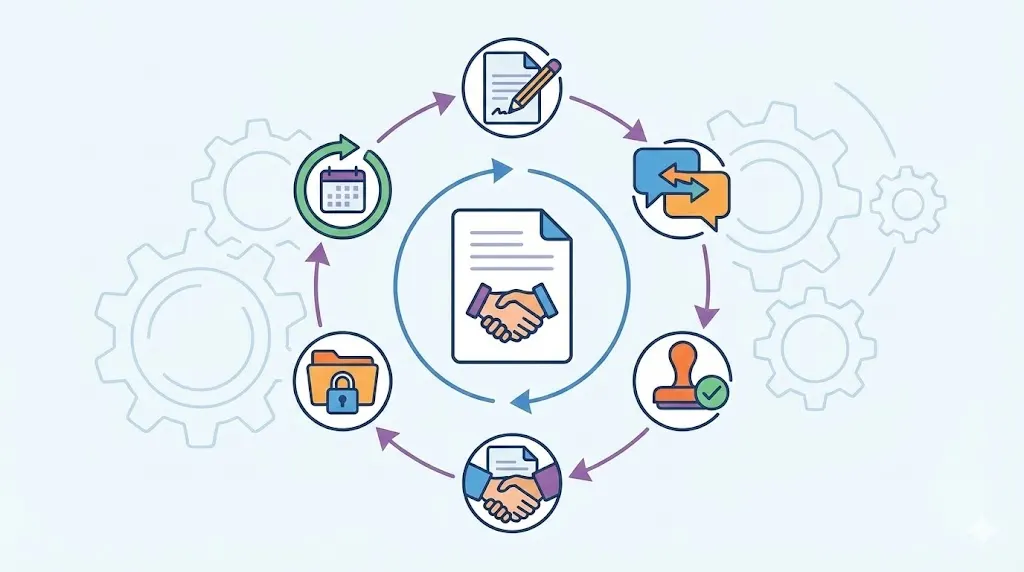
A controlled workflow usually follows this path:
A business user submits a complete contract request.
The system selects an approved template and clause set for the request.
The assigned reviewer examines both the draft and the business terms.
Exceptions go to the appropriate approver.
Negotiators work from tracked redlines and comments.
Once authorization is complete, the system sends the final document to the designated signer.
Once executed, the agreement is stored in the central repository.
Furthermore, obligations are assigned and future alerts scheduled automatically.
This structure does not eliminate the need for human judgment. It is directed to the person best positioned to make each decision, at the appropriate stage. A low-risk order form may follow a short path. A high-value agreement may require approval from legal, finance, security, and executive leadership.
Approval automation reduces idle time. Reviewers receive reminders as deadlines approach. Open work generates notifications for managers. Also, status dashboards can show whether a request waits with legal, finance, or the counterparty.
The Association of Corporate Counsel regularly highlights workflow design, self service, and process measurement in legal operations. These practices help legal teams focus on complex matters while business users handle routine requests within approved limits.
Also, templates and clause libraries add another layer of control. Teams can maintain approved language, fallback positions, and required provisions in one place. Users can insert dynamic fields without copying old contracts. Legal can update standard language when policy changes.
Negotiation tools also improve collaboration. Participants can compare versions, track comments, and record decisions. Therefore, this reduces the risk of conflicting edits across email attachments. It also gives legal a clear record of how the parties reached the final text.
Electronic signatures remove another delay. Once final approval is complete, the approved document is sent to authorized signers. After signature, the agreement returns to the repository without manual downloading and filing.
Teams should assess workflow performance using metrics such as:
Request volume by department and contract type.
Time from intake to first draft.
Duration of legal review.
Consequently, approval time, broken down by role or business unit.
Length of the negotiation and number of redlines.
Time elapsed between approval and signature.
Percentage of requests that use approved templates.
Number of requests returned because information is missing.
Together, these measures expose weaknesses in the process. When finance accounts for most delays, the team may need clearer approval limits. A high return rate from legal often signals missing details in the intake form. Long signature times suggest that signer rules need review.
Speed should never replace control. A fast workflow that allows wrong templates, weak approvals, or missing records creates future cost. The right system balances faster movement with clear rules.
Related articles: Enterprise Legal Operations Software Explained
How Contract Software Reduces Risk and Exposure
Contracts create risk through their words and through the duties they assign. Additionally, a liability cap may not match the deal value. A supplier may lack required insurance. Sales may overlook a customer's termination right. If no one sends notice by the deadline, the renewal may take effect.
Before those issues cause harm, teams need a way to identify them. Playbooks let CLM software assess agreements against policy. A playbook is a set of rules that tells reviewers what acceptable language should include.
For example, a security playbook can evaluate:
Breach notification timing.
Rules governing data location and transfer.
Moreover, whether the agreement grants adequate audit rights.
Subcontractor controls, including oversight requirements.
Business continuity responsibilities, including required measures.
Required insurance coverage.
Post-termination data deletion.
A finance playbook may review payment timing, tax duties, price increases, credits, and late fees. A sales playbook can assess liability, warranties, service levels, and termination rights. Each team can focus on risks tied to its work.
Furthermore, aI review can identify unusual language, missing provisions, and deviations from approved positions. It can also summarize key risks for a human reviewer. The reviewer still makes the final decision, but the system reduces the time spent finding issues.
AI clause recommendations can suggest approved alternatives or fallback language. This helps negotiators respond with more consistency. It also keeps exceptions visible instead of burying them in email.
The Securities and Exchange Commission provides public company guidance on material contracts and disclosure obligations. While each company must assess its own duties, organized contract records help teams locate relevant agreements and commercial terms. Also, better records support legal review and reporting work.
Risk management must continue after signature. Teams should assign obligations to named owners with due dates and escalation rules. Those obligations may include insurance certificates, reports, service credits, data reviews, payments, audits, or notice periods.
A contract obligation record should show:
The exact duty or milestone.
The responsible owner, whether an individual or team.
The governing contract and clause that establish the obligation.
The deadline or recurrence interval that governs it.
Evidence demonstrating completion of the obligation.
Therefore, applicable escalation steps.
Related financial or operational consequences.
The alert schedule should reflect the level of risk. A notice deadline may need reminders 120, 60, and 30 days ahead. A monthly report may need a recurring task. A critical security duty may need escalation to a manager after one missed deadline.
Portfolio analytics can show exposure across contracts. Leaders might use them to track agreements without owners, high risk clauses by region, or obligations that remain overdue. Consequently, they can use that data to set priorities rather than rely on anecdotes.
A practical risk review process looks like this:
Define the policies that matter for each contract type.
Maintain current approved clauses and fallback positions.
Apply those rules to new agreements and legacy contracts alike.
Assign each material obligation to a named owner.
Configure alerts for notice deadlines and performance dates.
Document every exception, its rationale, and the relevant approvals.
Escalate unresolved risks to the appropriate business leaders.
This framework promotes consistent decisions while preserving room for informed exceptions. A business may accept a higher liability cap for a strategic deal. The system should record that choice, its approver, and any controls that reduce the exposure.
Related articles: Contract Management Software for Sales Teams
How Departments Use One Contract System
Enterprise contract management delivers the most value when every department can point to a clear benefit. Rather than routing every user through an identical screen or process, the platform should accommodate how each department works. Additionally, each group should have the tools it needs, while core records and controls remain consistent.
Legal teams
Legal teams need control over language, exceptions, and risk. Approved templates, clause libraries, playbooks, and review queues give them structured support. They can also see workload, turnaround time, and open requests.
That leaves legal staff to concentrate manual review on matters that call for legal judgment. Routine agreements, meanwhile, can follow guided paths governed by preset rules. Lawyers can then devote more time to strategic matters, disputes, and complex negotiations.
Procurement teams
Procurement teams manage supplier relationships and commercial terms. They need visibility into pricing, performance standards, renewal rights, rebates, and the duties tied to supplier performance. A shared repository gives procurement a basis for comparing agreements across suppliers and business units.
From sourcing through execution, events can move through a common process. That process can verify that the executed agreement reflects the terms the parties negotiated. It can notify owners when supplier reviews, certificates, or renewal decisions require attention.
Finance teams
To support payments, forecasts, revenue checks, and exposure reviews, finance needs accurate contract data. Payment dates, price changes, credits, tax terms, and financial limits can appear as structured fields. Finance can search those terms directly rather than asking legal to retrieve each document.
Upcoming renewals and variable charges can also surface in dashboards. This view improves planning and limits unexpected costs. Finance can assess contract value against actual performance and approved budgets.
Sales teams
Sales teams need speed and visibility. A request portal can guide sellers toward approved templates and required information. Status views can show where a deal waits and what action remains.
Sales also benefits after signing. It can therefore expose customer commitments, service obligations, renewal dates, and special terms. That helps account teams meet promises and prepare for expansion or renewal discussions.
Operations and IT teams
Operations teams own many contract duties. Its remit may extend from service delivery and implementation dates to support levels, security reviews, and supplier performance. The system can assign responsibility for these duties and preserve evidence of completion.
IT often oversees integrations, access rules, and broader system governance. Reliable connections with CRM, ERP, procurement, identity, and electronic signature tools are therefore essential. Those connections reduce duplicate entry while keeping business data aligned.
Used across these functions, the arrangement supports handoffs that are both clear and useful. Sales, for instance, can flag unusual billing terms for finance. When a new data duty arises, legal can alert security. A supplier milestone can move from procurement to operations without losing context. The result is a handoff that remains visible and traceable at every stage.
Approval rules should remain specific to each contract type. Revenue approval may be required for a sales agreement, for example. Security review may instead be required for a supplier agreement. A non disclosure agreement, meanwhile, may take a much narrower route. Workflows can accommodate these distinctions while keeping the records in one system.
Simple user design makes adoption more likely. Users should know where to start, what information to provide, and how to check status. Leaders should define ownership before launch. They should also explain why the process protects speed and business value.
Related articles: How to Manage Risk Effectively with Contract Management
How to Build an Enterprise Contract Management Program
Software cannot fix unclear policies by itself. Additionally, a strong program must align people, process, data, and technology. Leaders should define the business problem before selecting features.
Start with a contract inventory. Identify where teams store agreements, who owns each repository, and which records matter most. Include customer contracts, supplier agreements, employment documents, licenses, amendments, and non monetary agreements.
Then classify contracts by risk and business value. A low value standard agreement may need limited review. A global outsourcing contract may need legal, security, finance, and executive review. This classification should guide workflows, access, and reporting.
Set clear ownership for each stage:
Business users own accurate request information.
Legal owns the approved language and handles exceptions requiring legal judgment.
Finance sets the criteria for financial review.
Procurement defines the standards applied to supplier processes.
Operations remains accountable for performance obligations.
IT oversees integrations and security and provides technical support.
Executives set policy and determine the organization's risk tolerance.
Moreover, with those responsibilities established, design a minimum viable process. Leave less common exceptions for later rather than automating them at the outset. The initial scope should cover common agreement types and high volume requests. Use the resulting usage data to guide subsequent expansion.
Choose data fields that are practical to maintain. Insufficient fields weaken reporting. Too many fields frustrate users and reduce adoption. Start with parties, agreement type, business owner, effective date, expiration date, renewal terms, value, risk level, and key obligations.
Define access rules before migration. Contracts may contain personal data, pricing, trade secrets, or regulated information. Role based access can limit records by department, entity, geography, or contract type. Audit trails should record views, edits, approvals, and downloads.
Legacy migration requires care. Bulk import and OCR can digitize old agreements, but those extracted fields still need review. Prioritize active contracts, high value agreements, and records with important dates approaching.
A practical rollout can proceed in the following sequence:
Begin by mapping current contract processes and pain points.
Rank contract types and business units according to business need.
For those priorities, prepare the necessary templates, clauses, approval rules, and playbooks.
Set up intake, review, signature, storage, and alerting within the process.
Migrate the priority agreements and validate their metadata afterward.
Give each role targeted training and publish straightforward process guidance.
Use quarterly reviews to identify improvements to the process.
Use measures that leaders can readily interpret to evaluate outcomes. Track cycle time, missed renewals, self service use, review workload, approval delays, and obligation completion. Also track user satisfaction and the percentage of agreements in the central repository.
The World Economic Forum has described data quality and governance as central to effective digital operations. Contract programs need the same discipline. Poor metadata can produce poor alerts and unreliable reports, even when the software works correctly.
Do not treat the launch as a one time technology project. New regulations, products, entities, and business models will change contract needs. Assign a program owner and create a regular review cycle for templates, clauses, workflows, permissions, and reports.
Related articles: Types of Contracts Every Business Needs
How CLM Software Solves This
Contract lifecycle management software connects intake, drafting, review, approval, signing, storage, and post signature tracking. Additionally, it gives teams a single controlled process that accommodates different rules for legal, procurement, finance, sales, and operations.
Volody supports this work with AI drafting, contract review, summaries, metadata extraction, playbooks, workflow automation, obligation alerts, search, version control, dashboards, and enterprise integrations. These tools help teams create consistent agreements, find key terms, review risk, and act on important dates.
Make contract management more controlled, efficient, and measurable. Explore Volody's CLM Software and equip every department to manage agreements with confidence.
FAQ
What capabilities does enterprise agreement software provide?
Additionally, from request through renewal or termination, the platform manages agreements. It supports drafting, review, approval, signing, storage, search, reporting, and obligation tracking.
Why do all departments need access to contract data?
Each department owns different contract tasks. Shared access helps teams find accurate terms, meet deadlines, and make decisions without repeated requests to legal or operations.
What support does contract software provide to legal teams?
It gives legal teams approved templates, clause libraries, review playbooks, workflows, and workload reports. Moreover, legal can focus manual review on higher risk or unusual agreements.
Can procurement use software for managing contracts?
Yes. Procurement can manage supplier agreements, compare commercial terms, track performance duties, and receive renewal alerts. It can also confirm that signed contracts match negotiated terms.
How does CLM software support finance?
Finance can search payment terms, price changes, credits, renewal dates, and financial limits. This data supports forecasting, payment control, revenue review, and exposure analysis.
Furthermore, does the software replace lawyers?
No. The software handles repeatable tasks and highlights potential issues. Lawyers still assess legal meaning, business context, negotiation strategy, and acceptable exceptions.
What should companies include in a contract repository?
Companies should include active customer, supplier, employment, licensing, partnership, and non monetary agreements. They should also store amendments, exhibits, order forms, and related execution records.
What is the deployment timeline for enterprise contract software?
Also, the timeline depends on contract volume, integrations, data quality, workflows, and user groups. Also, a focused rollout for priority contract types can begin before the company migrates every legacy record.
What contract metrics should leaders track?
Useful measures include cycle time, approval delays, request volume, template use, missed renewals, open obligations, and agreements with missing owners. Leaders should connect these measures to business outcomes.
How does AI help with contract management?
AI can draft from approved content, extract metadata, summarize agreements, identify unusual clauses, and suggest approved alternatives. Human reviewers should validate important findings before making decisions.
About the Company

Volody AI CLM is an Agentic AI-powered Contract Lifecycle Management platform designed to eliminate manual contracting tasks, automate complex workflows, and deliver actionable insights. As a one-stop shop for all contract activities, it covers drafting, collaboration, negotiation, approvals, e-signature, compliance tracking, and renewals. Built with enterprise-grade security and no-code configuration, it meets the needs of the most complex global organizations. Volody AI CLM also includes AI-driven contract review and risk analysis, helping teams detect issues early and optimize terms. Trusted by Fortune 500 companies, high-growth startups, and government entities, it transforms contracts into strategic, data-driven business assets.




" height="216.72211px" id="FYO0bO80Y" transform="translate(3 6.105)" width="206.073px"/><path d="M 108.174 222 C 88.432 222 70.303 217.239 53.785 207.717 C 37.267 198.196 24.173 185.052 14.504 168.285 C 4.835 151.312 0 132.165 0 110.845 C 0 89.731 4.835 70.792 14.504 54.025 C 24.173 37.052 37.267 23.804 53.785 14.282 C 70.303 4.761 88.432 0 108.174 0 C 128.116 0 146.246 4.761 162.562 14.282 C 179.08 23.804 192.073 37.052 201.541 54.025 C 211.21 70.792 216.044 89.731 216.044 110.845 C 216.044 132.165 211.21 151.312 201.541 168.285 C 192.073 185.052 179.08 198.196 162.562 207.717 C 146.044 217.239 127.915 222 108.174 222 Z M 108.174 183.189 C 120.864 183.189 132.044 180.291 141.713 174.495 C 151.382 168.492 158.936 160.006 164.375 149.035 C 169.814 138.064 172.533 125.334 172.533 110.845 C 172.533 96.355 169.814 83.729 164.375 72.965 C 158.936 61.994 151.382 53.611 141.713 47.815 C 132.044 42.02 120.864 39.122 108.174 39.122 C 95.483 39.122 84.202 42.02 74.332 47.815 C 64.663 53.611 57.109 61.994 51.67 72.965 C 46.231 83.729 43.511 96.355 43.511 110.845 C 43.511 125.334 46.231 138.064 51.67 149.035 C 57.109 160.006 64.663 168.492 74.332 174.495 C 84.202 180.291 95.483 183.189 108.174 183.189 Z" fill="rgba(255, 255, 255, 0.12)" height="222px" id="aa1McFcE9" transform="translate(227.183 3)" width="216.04399999999998px"/><path d="M 42.302 182.257 L 111.799 182.257 L 111.799 216.722 L 0 216.722 L 0 0 L 42.302 0 Z" fill="rgba(255, 255, 255, 0.12)" height="216.72211px" id="yRq4AnrsX" transform="translate(477.721 6.105)" width="111.79899999999998px"/><path d="M 108.174 222 C 88.432 222 70.303 217.239 53.785 207.717 C 37.267 198.196 24.173 185.052 14.504 168.285 C 4.835 151.312 0 132.165 0 110.845 C 0 89.731 4.835 70.792 14.504 54.025 C 24.173 37.052 37.267 23.804 53.785 14.282 C 70.303 4.761 88.432 0 108.174 0 C 128.116 0 146.246 4.761 162.562 14.282 C 179.08 23.804 192.073 37.052 201.541 54.025 C 211.21 70.792 216.045 89.731 216.045 110.845 C 216.045 132.165 211.21 151.312 201.541 168.285 C 192.073 185.052 179.08 198.196 162.562 207.717 C 146.044 217.239 127.915 222 108.174 222 Z M 108.174 183.189 C 120.864 183.189 132.044 180.291 141.713 174.495 C 151.382 168.492 158.936 160.006 164.375 149.035 C 169.814 138.064 172.534 125.334 172.534 110.845 C 172.534 96.355 169.814 83.729 164.375 72.965 C 158.936 61.994 151.382 53.611 141.713 47.815 C 132.044 42.02 120.864 39.122 108.174 39.122 C 95.483 39.122 84.202 42.02 74.332 47.815 C 64.663 53.611 57.108 61.994 51.67 72.965 C 46.231 83.729 43.511 96.355 43.511 110.845 C 43.511 125.334 46.231 138.064 51.67 149.035 C 57.108 160.006 64.663 168.492 74.332 174.495 C 84.202 180.291 95.483 183.189 108.174 183.189 Z" fill="rgba(255, 255, 255, 0.12)" height="222px" id="mo8HQspQ0" transform="translate(609.155 3)" width="216.04500000000007px"/><path d="M 73.727 0 C 95.885 0 115.324 4.45 132.044 13.351 C 148.967 22.252 161.957 34.982 171.027 51.541 C 180.287 67.894 184.917 86.937 184.917 108.671 C 184.917 130.405 180.287 149.449 171.027 165.801 C 161.957 181.947 148.967 194.47 132.044 203.371 C 115.324 212.271 95.885 216.722 73.727 216.722 L 0 216.722 L 0 0 Z M 72.216 179.773 C 94.374 179.773 111.497 173.564 123.583 161.144 C 135.669 148.724 141.713 131.233 141.713 108.671 C 141.713 86.109 135.669 68.515 123.583 55.888 C 111.497 43.055 94.374 36.638 72.216 36.638 L 42.302 36.638 L 42.302 179.773 Z" fill="rgba(255, 255, 255, 0.12)" height="216.72211px" id="I3iXX5Hi_" transform="translate(859.693 6.105)" width="184.91699999999992px"/><path d="M 185.22 0 L 113.91 141.273 L 113.91 216.722 L 71.61 216.722 L 71.61 141.273 L 0 0 L 47.74 0 L 93.06 99.046 L 138.08 0 Z" fill="rgba(255, 255, 255, 0.12)" height="216.72211px" id="nzHyWC0_d" transform="translate(1061.78 6.105)" width="185.22000000000003px"/></svg>)