

Legal teams often juggle countless tasks that slow down progress. Managing contracts, tracking legal matters, and handling invoices can feel like a maze with no clear exit. A Guide to the Best Legal Operations Software helps legal, operations, and technology leaders find tools that cut through this complexity. Imagine your team spending less time on repetitive tasks and more time on strategic priorities. This article breaks down what legal operations software does, highlights top tools, and explains how to pick the right one for your team’s needs.
TL;DR
Legal operations software automates contract management, billing, and matter tracking to reduce manual work.
Additionally, core features include managing legal matters, automating document generation, processing electronic invoices, performing in-depth data analysis, and integrating smoothly with existing enterprise systems.
The most effective solutions demonstrate strength in contract lifecycle management, spend control, and comprehensive legal operations at the enterprise scale.
Selecting appropriate software hinges on a thorough assessment of your team’s specific challenges, compliance requirements, and strategic growth objectives.
It is critical to look beyond superficial features like visually appealing dashboards and focus on robust core capabilities that ensure both usability and scalability.
By streamlining workflows, enhancing cross-functional collaboration, and mitigating legal exposure, contract management software delivers substantial operational benefits.
What Does Legal Operations Software Actually Do?
Legal teams benefit from tools that centralize and automate routine tasks, enabling more efficient workload management. Instead of relying on spreadsheets, emails, and manual tracking, teams get a system that organizes contracts, legal matters, invoices, and compliance tasks in one place. Additionally, this approach also frees up time for legal professionals to concentrate on higher-value work.
At its core, the platform handles:
Contract management: Create, review, approve, and store contracts in a structured way.
Matter tracking: Keep all case details, deadlines, and documents organized.
Invoice processing: Automate billing review and approval to avoid surprises.
Compliance monitoring: Track regulatory requirements and deadlines.
Reporting and analytics: Turn raw data into insights about spend, risk, and performance.
For example, a legal team at a mid-sized company might spend hours each week chasing contract approvals and manually entering invoice data. Automating these steps reduces errors and accelerates workflows. This means contracts close faster and legal budgets stay on track.
According to Gartner, organizations that adopt legal operations tools report a 30% reduction in contract cycle times and a 25% drop in legal spend overruns. These improvements come from eliminating bottlenecks and making data-driven decisions.
Related articles: What to Track in Legal Operations Dashboards
Key Features to Look for in Legal Operations Software
Selecting appropriate legal operations software requires understanding which features address your unique challenges. Here are the essential capabilities that every good platform should offer:
Matter Management
Matter management organizes all your legal cases and projects in one place. It tracks deadlines, case status, involved parties, and related documents. This feature prevents missed deadlines and lost files.
For example, a legal team handling multiple litigation cases can see each matter’s progress and upcoming court dates at a glance. This reduces the risk of missing critical steps.
Document Automation
Document automation speeds up contract and document creation by using templates and pre-approved clauses. It reduces human error and ensures consistency.
Imagine generating an NDA in minutes instead of hours by filling in a few fields. This feature also helps non-legal staff create documents correctly without legal team intervention.
E-Billing and Invoice Processing
E-billing automates invoice review and approval. Moreover, it enforces billing guidelines and flags discrepancies before payment. This functionality also helps control legal spend and avoid unexpected costs.
For instance, a finance team can automatically route invoices to the right approver and track payment status without manual follow-up.
Analytics and Reporting
Analytics turn legal data into actionable insights. Dashboards show contract turnaround times, spend trends, vendor performance, and risk exposure.
Legal leaders use these insights to optimize budgets, negotiate better vendor terms, and identify bottlenecks in workflows.
Integration Capabilities
Software for legal operations must integrate with other business tools such as CRM, accounting software, email platforms, and document storage. This integration prevents data silos and streamlines workflows.
For example, syncing contract data with a CRM system helps sales teams track contract status without leaving their platform.
User Experience and Scalability
A clean, intuitive interface ensures adoption across legal and business teams. The software should scale with your organization’s growth, supporting more users, entities, and complex workflows.
Avoid tools that look impressive but require extensive training or customization to work effectively.
Related articles: Contract Guidelines vs Playbooks: Selecting the Appropriate Legal Approach
How to Evaluate the Best Legal Operations Software for Your Team
Finding the right software means matching its capabilities to your team’s needs and future plans. Here’s a step-by-step approach to evaluation:
Identify Your Pain Points
Start by listing the biggest challenges your team faces. Are contract approvals slow? Is invoice processing error-prone? Do you lack visibility into legal spend?
Understanding these pain points helps you focus on features that address real problems instead of shiny extras.
Define Your Growth Plans
Project the evolution of your legal operations over the next 1 to 3 years. Will your team expand? Will new business units or geographies be incorporated? The software should support this growth without costly upgrades.
Prioritize Security and Compliance
Legal data is sensitive. In addition, ensure the software meets your organization’s security standards, including encryption, access controls, and audit logs. Moreover, compliance with regulations like GDPR or HIPAA may be required.
Calculate Total Cost of Ownership
Look beyond the sticker price. Consider setup fees, training, customization, user licenses, and ongoing support costs. A cheaper tool with hidden costs can become expensive over time.
Test Usability
Request demos and trial periods. Involve end users from legal and other departments to test workflows. A tool that fits naturally into daily work will have higher adoption and deliver faster ROI.
Check Vendor Support and Roadmap
Evaluate the vendor’s customer support responsiveness and product development plans. You want a partner that will evolve the software to meet changing legal needs.
Related articles: Level Up Legal Operations: 6 Tips to Legal Efficiency
Top Legal Operations Software Tools for 2025
After analyzing market trends, user reviews, and expert opinions, here is a list of leading legal operations software platforms that excel in different areas:
Software | Strengths | Ideal For |
|---|---|---|
Contract Lifecycle Management (CLM) Platform A | AI contract review, workflow automation, approval tracking | Legal teams focused on contract efficiency |
Spend Management Tool B | Invoice processing, budget tracking, vendor management | Finance and procurement-heavy legal ops |
Enterprise Legal Ops Suite C | Matter management, compliance, analytics | Large teams with complex workflows |
Hybrid CLM and Spend Solution D | Contract and invoice automation, reporting | Mid-sized companies scaling legal ops |
Cloud-Based Legal Workspace E | Collaboration, document automation, intake management | Teams needing flexible, remote-friendly tools |
Each tool offers unique features, but all share a focus on reducing manual work, improving visibility, and supporting collaboration.
Related articles: Maximize Legal Efficiency with Generative AI in CLM
What Makes Contract Lifecycle Management Software Essential?
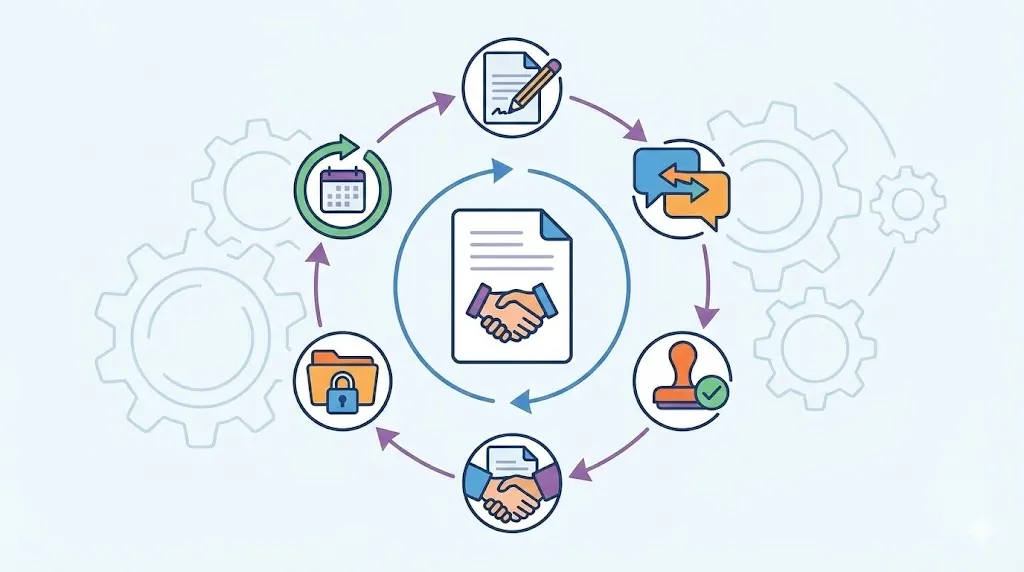
Contract Lifecycle Management (CLM) software optimizes every stage of a contract’s lifecycle. Additionally, from initial drafting and negotiation through execution and renewal, CLM platforms minimize errors and accelerate workflows.
AI-Powered Contract Review
Modern CLM tools leverage artificial intelligence to analyze contracts and identify potentially risky provisions or absent critical terms. This helps legal teams spot issues early and ensures compliance with company policies.
For example, AI can highlight unusual indemnity provisions or omitted termination rights, preventing costly mistakes.
Workflow Automation
Approval routing, reminders, and escalations become more efficient through CLM software. This eliminates bottlenecks caused by manual follow-ups and lost emails.
Imagine a contract automatically moving to the right approver based on contract value or department. This speeds up turnaround times.
Centralized Contract Repository
The platform provides a secure repository that aggregates all contracts, creating a definitive reference point. Teams can search contracts by keywords, metadata, or dates, reducing time spent hunting for documents.
Version control tracks every change, so teams always work on the latest contract draft.
Electronic Signatures
Integrating e-signature capabilities allows contracts to be signed quickly and legally. This removes delays caused by printing, scanning, or mailing documents.
Reporting and Analytics
CLM platforms provide dashboards showing contract volume, cycle times, renewal dates, and risk exposure. Legal leaders use this data to improve processes and reduce risks.
Related articles: AI in Law: Smart Contracts & Legal Automation Tools
How Legal Operations Software Helps Different Teams
Legal operations software supports more than just legal teams. It benefits sales, finance, HR, procurement, and other departments that interact with contracts and legal workflows.
Legal Teams
Legal teams use the software to automate routine tasks, track matters, and manage contracts. This frees lawyers to focus on strategic advice and risk management.
Related Article: Legal Team Structure: Understanding Roles and Titles
Sales Teams
Sales teams close deals faster by accessing contract templates and tracking approval status without delays. Integration with CRM systems keeps sales reps informed.
Finance Teams
Finance uses e-billing and spend analytics to control legal expenses and ensure compliance with budgets. Automated invoice approvals reduce errors.
Human Resources
HR teams manage employment contracts, policy acknowledgments, and compliance documents efficiently. Automation reduces administrative burdens.
Procurement
Procurement tracks vendor contracts, renewals, and performance metrics. Automated alerts prevent missed deadlines and renegotiation opportunities.
Related articles: How to Manage Legal Teams: 8 Proven Tactics for Success
Real-World Examples of Legal Operations Software Impact
Consider a technology company struggling with slow contract approvals that delayed sales deals. Additionally, after implementing a CLM platform featuring AI review and workflow automation, contract cycle times dropped by 40%. Sales teams accessed contract status in real time, improving communication.
A healthcare provider used matter management and e-billing software to track legal cases and invoices. This improved budget forecasting and reduced invoice errors by 30%.
An enterprise with multiple business units implemented a software solution incorporating role-based access controls. This ensured sensitive contracts stayed confidential while enabling collaboration across teams.
These examples demonstrate measurable improvements in efficiency, cost control, and risk management achieved through advanced legal technology platforms.
Related articles: How Sales and Legal Collaboration Achieves Business Success
Why Contract Management Software Matters
Contract management platforms serve as a critical infrastructure within legal operations. Additionally, it organizes contracts, automates workflows, and provides data insights that improve decision-making.
Without a centralized system, contracts get lost in emails, spreadsheets, or shared drives. Missing critical deadlines, encountering compliance risks, and wasting valuable time are common consequences.
Contract management solutions enhance collaboration between legal and business teams. By offering clear visibility into contract status and approvals, they alleviate frustration and minimize delays.
The right software adapts to your organization’s needs, scales with growth, and protects sensitive data. It empowers legal teams to move contracts forward confidently and efficiently.
Related Article: New AI Regulations Every Legal Team Should Know
How Contract Lifecycle Management Software Solves This
Contract lifecycle management software simplifies contract creation, review, approval, and storage. Additionally, it also streamlines repetitive processes and consolidates all contract-related functions into a single platform.
Features like AI contract review reduce risk by identifying problematic clauses early. Workflow automation speeds approvals and reduces bottlenecks. Centralized repositories ensure contracts are easy to find and manage.
Modern CLM tools also support electronic signatures, making contract execution faster and more secure. Reporting dashboards provide insights into contract performance and risks.
Volody offers a contract management platform with AI-powered drafting, review, and metadata extraction. Its approval workflows and clause libraries enable legal teams to produce contracts with greater efficiency and accuracy. The platform includes role-based access controls and audit trails to protect sensitive information.
See how Volody's CLM Software helps legal teams accelerate contract management while enhancing oversight.
FAQ
What functions does software for legal operations perform?
Additionally, legal operations platforms assist legal departments in managing contracts, legal matters, invoices, and compliance tasks more efficiently.
It centralizes routine workflows and aggregates data to reduce manual workload.
How does contract lifecycle management technology improve legal workflows?
Contract lifecycle management solutions handle automation of drafting, reviewing, approving, and archiving contracts.
It accelerates each stage with automated routing, AI-driven risk detection, and centralized contract repositories.
What features are most important in platforms designed for legal operations?
Moreover, essential capabilities encompass matter tracking, document automation, electronic billing, data analytics, integration with enterprise systems, and stringent security measures.
Can tools designed for legal operations assist non-legal departments?
Yes. Sales, finance, HR, and procurement teams benefit from contract templates, approval tracking, invoice processing, and compliance monitoring provided by legal technology.
How do I choose the right software for legal operations?
Assess operational challenges, forecast scalability requirements, emphasize data protection, evaluate comprehensive costs, verify user experience, and review vendor responsiveness prior to procurement.
Is AI really useful within legal operations platforms?
Furthermore, aI accelerates contract review by identifying risky clauses, proposing alternative wording, extracting critical data, and summarizing contract provisions.
This reduces errors and speeds up review.
How secure are platforms for managing legal operations?
Reputable software uses encryption, role-based access, audit trails, and compliance certifications to protect sensitive legal data.
What is the difference between CLM and software for legal operations?
CLM focuses specifically on managing contracts throughout their lifecycle.
Also, legal operations platforms frequently encompass CLM alongside matter management, e-billing, and analytics to support broader legal department functions.
Can legal technology integrate with other business systems?
Yes. Most platforms connect with CRM, accounting, email, and document management systems to streamline workflows and avoid data silos.
How long does it take to implement legal operations platforms?
Implementation varies by complexity but typically ranges from a few weeks to several months. Features like bulk import and no-code configuration can speed up the process.
This comprehensive guide highlights how these platforms can transform legal teams by automating tasks, improving visibility, and supporting collaboration. Choosing the right tool depends on understanding your team’s needs and future plans. Contract management software plays a central role in this transformation by streamlining contract workflows and reducing risk.
About the Company

Volody AI CLM is an Agentic AI-powered Contract Lifecycle Management platform designed to eliminate manual contracting tasks, automate complex workflows, and deliver actionable insights. As a one-stop shop for all contract activities, it covers drafting, collaboration, negotiation, approvals, e-signature, compliance tracking, and renewals. Built with enterprise-grade security and no-code configuration, it meets the needs of the most complex global organizations. Volody AI CLM also includes AI-driven contract review and risk analysis, helping teams detect issues early and optimize terms. Trusted by Fortune 500 companies, high-growth startups, and government entities, it transforms contracts into strategic, data-driven business assets.





" height="216.72211px" id="FYO0bO80Y" transform="translate(3 6.105)" width="206.073px"/><path d="M 108.174 222 C 88.432 222 70.303 217.239 53.785 207.717 C 37.267 198.196 24.173 185.052 14.504 168.285 C 4.835 151.312 0 132.165 0 110.845 C 0 89.731 4.835 70.792 14.504 54.025 C 24.173 37.052 37.267 23.804 53.785 14.282 C 70.303 4.761 88.432 0 108.174 0 C 128.116 0 146.246 4.761 162.562 14.282 C 179.08 23.804 192.073 37.052 201.541 54.025 C 211.21 70.792 216.044 89.731 216.044 110.845 C 216.044 132.165 211.21 151.312 201.541 168.285 C 192.073 185.052 179.08 198.196 162.562 207.717 C 146.044 217.239 127.915 222 108.174 222 Z M 108.174 183.189 C 120.864 183.189 132.044 180.291 141.713 174.495 C 151.382 168.492 158.936 160.006 164.375 149.035 C 169.814 138.064 172.533 125.334 172.533 110.845 C 172.533 96.355 169.814 83.729 164.375 72.965 C 158.936 61.994 151.382 53.611 141.713 47.815 C 132.044 42.02 120.864 39.122 108.174 39.122 C 95.483 39.122 84.202 42.02 74.332 47.815 C 64.663 53.611 57.109 61.994 51.67 72.965 C 46.231 83.729 43.511 96.355 43.511 110.845 C 43.511 125.334 46.231 138.064 51.67 149.035 C 57.109 160.006 64.663 168.492 74.332 174.495 C 84.202 180.291 95.483 183.189 108.174 183.189 Z" fill="rgba(255, 255, 255, 0.12)" height="222px" id="aa1McFcE9" transform="translate(227.183 3)" width="216.04399999999998px"/><path d="M 42.302 182.257 L 111.799 182.257 L 111.799 216.722 L 0 216.722 L 0 0 L 42.302 0 Z" fill="rgba(255, 255, 255, 0.12)" height="216.72211px" id="yRq4AnrsX" transform="translate(477.721 6.105)" width="111.79899999999998px"/><path d="M 108.174 222 C 88.432 222 70.303 217.239 53.785 207.717 C 37.267 198.196 24.173 185.052 14.504 168.285 C 4.835 151.312 0 132.165 0 110.845 C 0 89.731 4.835 70.792 14.504 54.025 C 24.173 37.052 37.267 23.804 53.785 14.282 C 70.303 4.761 88.432 0 108.174 0 C 128.116 0 146.246 4.761 162.562 14.282 C 179.08 23.804 192.073 37.052 201.541 54.025 C 211.21 70.792 216.045 89.731 216.045 110.845 C 216.045 132.165 211.21 151.312 201.541 168.285 C 192.073 185.052 179.08 198.196 162.562 207.717 C 146.044 217.239 127.915 222 108.174 222 Z M 108.174 183.189 C 120.864 183.189 132.044 180.291 141.713 174.495 C 151.382 168.492 158.936 160.006 164.375 149.035 C 169.814 138.064 172.534 125.334 172.534 110.845 C 172.534 96.355 169.814 83.729 164.375 72.965 C 158.936 61.994 151.382 53.611 141.713 47.815 C 132.044 42.02 120.864 39.122 108.174 39.122 C 95.483 39.122 84.202 42.02 74.332 47.815 C 64.663 53.611 57.108 61.994 51.67 72.965 C 46.231 83.729 43.511 96.355 43.511 110.845 C 43.511 125.334 46.231 138.064 51.67 149.035 C 57.108 160.006 64.663 168.492 74.332 174.495 C 84.202 180.291 95.483 183.189 108.174 183.189 Z" fill="rgba(255, 255, 255, 0.12)" height="222px" id="mo8HQspQ0" transform="translate(609.155 3)" width="216.04500000000007px"/><path d="M 73.727 0 C 95.885 0 115.324 4.45 132.044 13.351 C 148.967 22.252 161.957 34.982 171.027 51.541 C 180.287 67.894 184.917 86.937 184.917 108.671 C 184.917 130.405 180.287 149.449 171.027 165.801 C 161.957 181.947 148.967 194.47 132.044 203.371 C 115.324 212.271 95.885 216.722 73.727 216.722 L 0 216.722 L 0 0 Z M 72.216 179.773 C 94.374 179.773 111.497 173.564 123.583 161.144 C 135.669 148.724 141.713 131.233 141.713 108.671 C 141.713 86.109 135.669 68.515 123.583 55.888 C 111.497 43.055 94.374 36.638 72.216 36.638 L 42.302 36.638 L 42.302 179.773 Z" fill="rgba(255, 255, 255, 0.12)" height="216.72211px" id="I3iXX5Hi_" transform="translate(859.693 6.105)" width="184.91699999999992px"/><path d="M 185.22 0 L 113.91 141.273 L 113.91 216.722 L 71.61 216.722 L 71.61 141.273 L 0 0 L 47.74 0 L 93.06 99.046 L 138.08 0 Z" fill="rgba(255, 255, 255, 0.12)" height="216.72211px" id="nzHyWC0_d" transform="translate(1061.78 6.105)" width="185.22000000000003px"/></svg>)