

Contracts form the backbone of business relationships. Yet, many legal teams struggle to manage them well. Without clear rules, contracts get lost in email threads or scattered drives, leading to missed deadlines and costly mistakes. The 7 contract management principles for your legal teams can help you build a reliable, efficient process that reduces risk and saves time. This guide breaks down these principles with practical examples and actionable steps.
TL;DR
Consolidating contracts within a single platform minimizes the risk of agreements being misplaced or neglected.
Additionally, utilizing standardized templates alongside clause libraries enhances consistency and mitigates exposure to potential risks.
It is imperative to meticulously monitor all obligations and deadlines to avoid penalties and ensure compliance with regulatory requirements.
The adoption of proactive risk management through defined policies and streamlined workflows is essential.
Implementing automation for routine tasks accelerates the drafting, approval, and renewal phases of contract management.
Ensuring comprehensive visibility into contract statuses and performance indicators across all departments is indispensable.
Drive ongoing enhancements to the contract lifecycle by leveraging analytical data and stakeholder feedback.
What Are Contract Management Principles and Why Do They Matter?
Contract management principles establish essential guidelines that shape the processes of drafting, reviewing, storing, and renewing contracts. Additionally, they form a comprehensive framework designed to ensure the contract lifecycle is managed with optimal efficiency, complete transparency, and full adherence to regulatory requirements. These principles function as the strategic foundation that legal teams depend upon to sustain order and uniformity.
Without these principles, teams work in silos with inconsistent practices. Contracts get lost or forgotten. Risks multiply. Legal teams spend more time firefighting than adding value.
For mid-sized companies, the challenge is even greater. Managing complex contracts is routine, yet these organizations must do so with far fewer resources than their larger counterparts. Without clear principles, they face missed deadlines, compliance gaps, and inefficiencies that drain resources.
Strong adherence to these guidelines enables legal teams to: create consistent processes across departments and contract types. They reduce exposure to risk by implementing standardized terms and rigorous approval procedures. Time management improves significantly when automation and well-defined workflows are employed. Visibility into contract status and obligations becomes more transparent. The inherent value of contracts is maintained throughout every phase of the lifecycle.
Related Article: What Is Contract Lifecycle Management? A 2026 Guide
Why Do Organizations Need Formal Contract Management Principles?
Many companies have some contract rules on paper. However, adherence to these policies is often inconsistent. Additionally, contracts still get drafted in email chains or stored in multiple folders. Renewal reminders depend on memory, not systems.
This gap between policy and practice causes value leakage. According to World Commerce & Contracting, poor contract management can erode about 8.6% of contract value on average. For mid-market firms, the impact is often higher due to resource constraints.
The increase in contract volumes frequently surpasses the growth in legal staffing. In the absence of formal principles, teams often find it challenging to manage the workload effectively. Common issues include:
Renewal deadlines frequently pass unnoticed, triggering automatic contract extensions.
Moreover, inconsistent contract language introduces heightened legal risks.
Critical contracts become scattered across numerous drives and email accounts.
Reactive compliance measures lead to increased penalties or disputes.
Lengthy approval workflows delay the finalization of business agreements.
A well-defined set of principles serves to unify the approach across departments. This framework aligns legal, sales, procurement, and finance teams on how contracts are created, reviewed, approved, and tracked. This reduces errors and speeds up workflows.
Related articles: How Legal and Finance Can Collaborate Better on Contracts
Principle 1: Centralize Every Contract in One System
Many legal teams store contracts in multiple places: shared drives, email attachments, local folders. Additionally, this fragmentation creates blind spots. Teams lose track of contracts, deadlines, and obligations.
Imagine a company with contracts spread across Google Drive, email inboxes, and a legacy file server. The legal team missed a vendor contract auto-renewal with unfavorable terms. The company paid $180,000 for a service it no longer used. This happens more often than you think.
Industry research shows enterprises manage contracts across an average of 24 different systems. When contracts are dispersed, no individual or department has a comprehensive view. This leads to:
Missing the critical deadlines for renewals or terminations.
Moreover, overlaps in agreements or the presence of conflicting provisions.
Challenges in retrieving contracts or pinpointing essential clauses.
Elevated legal exposure coupled with potential financial repercussions.
Centralization involves consolidating all contracts into one unified, searchable repository. This encompasses customer agreements, vendor contracts, NDAs, employment contracts, and partnership deals.
A robust central system provides: version control to monitor amendments and revisions, metadata tagging to facilitate filtering by contract category, counterparty, or date, full-text search capabilities for immediate retrieval of contracts or clauses, role-based access restricting visibility to authorized personnel only, and secure storage with audit trails to ensure compliance.
Centralization transforms contract management from guesswork into a controlled process. Legal teams can find any contract in seconds, track deadlines, and avoid costly oversights.
Related articles: What are Contract Obligations and How to Manage Them
Principle 2: Use Standardized Templates and Clause Libraries
Starting contracts from scratch wastes time and invites errors. Additionally, when business units draft contracts independently, this often results in inconsistent clauses appearing across agreements. Sales teams copy language from old deals. Procurement uses outdated templates. The result is a patchwork of agreements with varying liability caps, termination rights, and indemnity terms.
This inconsistency creates compliance gaps and legal risk. Legal teams then invest significant time reviewing contracts that lack a common baseline, rather than leveraging pre-approved language.
Using pre-approved contract templates combined with curated clause repositories lays down a uniform structure for all agreements.
One major advantage is the acceleration of contract creation through access to ready-to-use standardized language.
Rigorous vetting of terms also plays a critical role in minimizing legal exposure.
The uniformity of contract format streamlines review workflows.
It also clarifies which provisions remain open to negotiation.
A clause repository consists of vetted language segments. Each segment comes with fallback options tailored for negotiation and jurisdiction-specific conditions. Legal teams maintain control over modifications by mandating approval for any exceptions.
For example, if a sales rep wants to modify an indemnification clause, the system triggers an approval workflow. This prevents unauthorized changes from slipping through email attachments.
Developing such a repository requires an upfront investment but ultimately enhances efficiency and mitigates risk. Begin by cataloging frequent contract categories and key clauses. Collaborate with stakeholders to finalize standard language. Finally, ensure compliance by integrating this framework within your contract management system.
Related articles: 7 Key Contract Clauses Found in Business Contracts
Principle 3: Track Every Obligation and Deadline Proactively
Contracts contain many obligations: payment terms, delivery dates, renewal windows, compliance requirements. Additionally, missing these can lead to penalties, fines, or disputes.
Reactive compliance means discovering a problem after damage occurs. For example, a missed GDPR data processing addendum or an expired insurance certificate on a vendor contract.
According to World Commerce & Contracting, weak post-signature management causes companies to lose an average of 8.6% of contract value. The landscape of regulatory mandates is rapidly evolving, with increasing complexity across frameworks such as GDPR, SOX, HIPAA, and various industry-specific standards.
Effective obligation management involves several critical components: systematically capturing all essential deadlines and contractual duties within a centralized platform.
It also requires deploying automated notification systems designed to alert relevant stakeholders well before obligations mature.
Moreover, establishing clear accountability means assigning specific individuals to oversee each contractual commitment.
Continuously monitoring adherence to regulatory requirements.
Promptly escalating issues to mitigate risk and prevent breaches.
Without this, legal teams rely on memory or manual tracking, which fails at scale. Automated tracking reduces risk and frees legal to focus on higher-value work.
Related articles: Top Contract Management Tips for Legal Professionals
Principle 4: Manage Contract Risk with Clear Policies and Workflows
Contracts introduce multiple layers of risk to organizations, including financial, legal, and reputational threats. Additionally, effective mitigation depends on establishing well-defined policies and workflows.
Legal teams should establish criteria covering:
The types of contracts that mandate review or approval.
Defined risk thresholds concerning financial exposure or liability.
Clear escalation procedures for terms identified as high risk.
Comprehensive negotiation playbooks.
Mechanisms to prevent unauthorized amendments.
Moreover, without such governance, problematic clauses frequently find their way into agreements. For instance, a sales representative might inadvertently consent to unlimited liability or waive critical protections absent legal oversight.
Workflows enforce risk management by routing contracts through the right approvers. Automated alerts flag unusual terms or missing approvals.
Risk management also means training business teams on contract policies. Clear communication reduces errors and speeds approvals.
Related articles: Contract Management Software for Sales Teams | CLM Guide
Principle 5: Automate Routine Contract Tasks to Save Time
Manual contract processes are slow and error-prone. Additionally, the reliance on email and spreadsheets for drafting, reviewing, approving, and renewing contracts consumes significant time and introduces inefficiencies.
Automation accelerates contract management by enabling the creation of initial drafts through the use of templates and clause libraries. Contract progression relies on structured approval workflows equipped with timely reminders to ensure continuous momentum.
Issuing alerts for upcoming renewals and critical obligations.
Utilizing data extraction tools to capture essential contract information without manual input.
Automation reduces turnaround times by up to 70% and cuts costs by over 90% for mid-market legal teams, according to industry reports.
It also improves accuracy by reducing manual data entry and missed steps. Legal teams can focus on higher-value tasks like negotiation and risk analysis.
Related articles: Contract Templates Standardization: Simplifying Legal Work
Principle 6: Maintain Full Visibility into Contract Status and Performance
Legal teams require up-to-the-minute visibility into the status of contracts throughout their entire portfolio. Additionally, without this transparency, they face significant challenges in managing risks and supporting strategic business decisions.
Visibility means:
Tracking contract stages: draft, review, approval, signature, renewal.
Monitoring turnaround times and bottlenecks.
Producing comprehensive reports that detail contract volumes segmented by type, counterparty, or business unit.
Detecting contracts approaching renewal deadlines or containing other critical obligations that require attention.
Conducting thorough assessments to measure the embedded risk exposure within contractual agreements.
Dashboards and analytics provide this insight. They help legal leaders allocate resources, improve processes, and demonstrate value to stakeholders.
Without visibility, teams operate reactively and struggle to prioritize work.
Related articles: How to Manage Legal Teams: 8 Proven Tactics for Success
Principle 7: Continuously Improve Your Contract Process
Contract management is a dynamic process that demands sustained focus beyond initial implementation. Additionally, teams must consistently review and fine-tune their operational workflows.
Continuous improvement means:
Soliciting feedback from both legal and business stakeholders.
Analyzing contract data to identify delays or errors.
Updating templates and clause libraries based on lessons learned.
Refining workflows to remove bottlenecks.
Training teams on new policies and tools.
Improvement keeps contract management aligned with changing business needs and regulations. It also builds trust between legal and other departments.
Related articles: What is Contract Review? Review Checklist: 7 Must-Have Tips
How CLM Software Solves These Contract Management Challenges
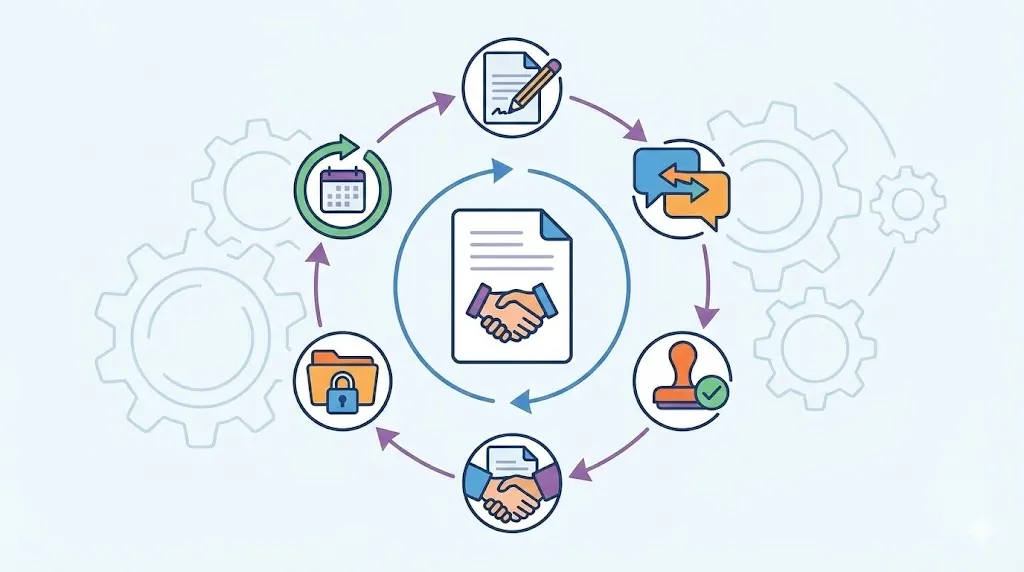
Contract Lifecycle Management (CLM) software provides the tools to apply these principles in daily practice. Additionally, it also centralizes all agreements within a single platform, enforces the use of standardized templates, monitors obligations, mitigates risk, automates workflows, and enhances transparency.
Modern CLM solutions incorporate artificial intelligence to accelerate the preparation and evaluation of contracts. They extract metadata automatically and highlight risky clauses. Automated alerts prevent missed deadlines. Access controls based on user roles safeguard sensitive information.
Volody’s platform delivers:
AI contract drafting and review capabilities to produce faster, more consistent contracts.
A centralized repository equipped with sophisticated search functions and version control.
Management of clause libraries and templates to maintain compliance with standards.
Automated approval workflows that seamlessly integrate with e-signature functions.
Moreover, obligation tracking supported by timely alerts and detailed dashboards.
Role-based access controls combined with audit trails to maintain regulatory compliance.
These features help reduce risk, improve operational efficiency, and enhance the overall quality of contracts.
> Looking for a better way to manage contracts? Explore Volody's CLM Software.
FAQ
What is the most important contract management principle for legal teams?
Centralizing all agreements within a single platform represents the essential first step. Without this consolidated repository, managing contracts and tracking deadlines becomes fragmented and prone to error. This foundation enables subsequent efforts like standardization and compliance oversight.
Also, how do standardized templates reduce legal risk?
Furthermore, standardized templates incorporate pre-approved language that has undergone rigorous legal review. This approach minimizes the introduction of unauthorized or high-risk provisions. Consistent treatment of terms like liability limits and termination clauses helps diminish disputes and regulatory breaches.
Why is tracking contract obligations so crucial?
Contracts often specify deadlines related to payments, renewals, or regulatory compliance. Failure to meet these deadlines may result in penalties, fines, or lost opportunities. Automated tracking with proactive alerts ensures timely fulfillment of contractual duties.
Can automation replace legal review?
Automation speeds up routine tasks like drafting and flagging risky clauses but does not replace legal judgment. Also, it helps legal teams focus on complex review and negotiation by handling repetitive work.
What risks arise from poor contract visibility?
Without adequate insight, legal departments struggle to identify which contracts are approaching renewal or contain high-risk terms. This lack of visibility can result in missed opportunities, unforeseen liabilities, and inefficient distribution of resources.
How does a clause library improve contract drafting?
A curated repository of approved contractual language segments, including fallback options, enables efficient assembly of contracts without relinquishing control over negotiable elements. This approach shortens drafting cycles and reduces errors.
As a result, how do workflows contribute to effective contract management?
Workflows enforce prescribed sequences for review and approval, ensuring compliance with organizational policies. They prevent unauthorized changes and accelerate the signing process. Therefore, automated notifications maintain momentum throughout.
How often should contract management processes be reviewed?
Teams should review and update their contract processes regularly, at least annually or when business needs change. Continuous improvement helps adapt to new regulations and operational challenges.
What features should I look for when selecting contract management software?
Seek a solution that centralizes contracts, supports templates and clause libraries, automates workflows, tracks obligations, provides visibility, and offers robust security and compliance capabilities.
How can legal teams measure contract management success?
Key metrics include contract turnaround time, renewal rates, compliance incidents, and risk exposure. Dashboards and analytics in CLM software help track these and identify improvement areas.
About the Company

Volody AI CLM is an Agentic AI-powered Contract Lifecycle Management platform designed to eliminate manual contracting tasks, automate complex workflows, and deliver actionable insights. As a one-stop shop for all contract activities, it covers drafting, collaboration, negotiation, approvals, e-signature, compliance tracking, and renewals. Built with enterprise-grade security and no-code configuration, it meets the needs of the most complex global organizations. Volody AI CLM also includes AI-driven contract review and risk analysis, helping teams detect issues early and optimize terms. Trusted by Fortune 500 companies, high-growth startups, and government entities, it transforms contracts into strategic, data-driven business assets.





" height="216.72211px" id="FYO0bO80Y" transform="translate(3 6.105)" width="206.073px"/><path d="M 108.174 222 C 88.432 222 70.303 217.239 53.785 207.717 C 37.267 198.196 24.173 185.052 14.504 168.285 C 4.835 151.312 0 132.165 0 110.845 C 0 89.731 4.835 70.792 14.504 54.025 C 24.173 37.052 37.267 23.804 53.785 14.282 C 70.303 4.761 88.432 0 108.174 0 C 128.116 0 146.246 4.761 162.562 14.282 C 179.08 23.804 192.073 37.052 201.541 54.025 C 211.21 70.792 216.044 89.731 216.044 110.845 C 216.044 132.165 211.21 151.312 201.541 168.285 C 192.073 185.052 179.08 198.196 162.562 207.717 C 146.044 217.239 127.915 222 108.174 222 Z M 108.174 183.189 C 120.864 183.189 132.044 180.291 141.713 174.495 C 151.382 168.492 158.936 160.006 164.375 149.035 C 169.814 138.064 172.533 125.334 172.533 110.845 C 172.533 96.355 169.814 83.729 164.375 72.965 C 158.936 61.994 151.382 53.611 141.713 47.815 C 132.044 42.02 120.864 39.122 108.174 39.122 C 95.483 39.122 84.202 42.02 74.332 47.815 C 64.663 53.611 57.109 61.994 51.67 72.965 C 46.231 83.729 43.511 96.355 43.511 110.845 C 43.511 125.334 46.231 138.064 51.67 149.035 C 57.109 160.006 64.663 168.492 74.332 174.495 C 84.202 180.291 95.483 183.189 108.174 183.189 Z" fill="rgba(255, 255, 255, 0.12)" height="222px" id="aa1McFcE9" transform="translate(227.183 3)" width="216.04399999999998px"/><path d="M 42.302 182.257 L 111.799 182.257 L 111.799 216.722 L 0 216.722 L 0 0 L 42.302 0 Z" fill="rgba(255, 255, 255, 0.12)" height="216.72211px" id="yRq4AnrsX" transform="translate(477.721 6.105)" width="111.79899999999998px"/><path d="M 108.174 222 C 88.432 222 70.303 217.239 53.785 207.717 C 37.267 198.196 24.173 185.052 14.504 168.285 C 4.835 151.312 0 132.165 0 110.845 C 0 89.731 4.835 70.792 14.504 54.025 C 24.173 37.052 37.267 23.804 53.785 14.282 C 70.303 4.761 88.432 0 108.174 0 C 128.116 0 146.246 4.761 162.562 14.282 C 179.08 23.804 192.073 37.052 201.541 54.025 C 211.21 70.792 216.045 89.731 216.045 110.845 C 216.045 132.165 211.21 151.312 201.541 168.285 C 192.073 185.052 179.08 198.196 162.562 207.717 C 146.044 217.239 127.915 222 108.174 222 Z M 108.174 183.189 C 120.864 183.189 132.044 180.291 141.713 174.495 C 151.382 168.492 158.936 160.006 164.375 149.035 C 169.814 138.064 172.534 125.334 172.534 110.845 C 172.534 96.355 169.814 83.729 164.375 72.965 C 158.936 61.994 151.382 53.611 141.713 47.815 C 132.044 42.02 120.864 39.122 108.174 39.122 C 95.483 39.122 84.202 42.02 74.332 47.815 C 64.663 53.611 57.108 61.994 51.67 72.965 C 46.231 83.729 43.511 96.355 43.511 110.845 C 43.511 125.334 46.231 138.064 51.67 149.035 C 57.108 160.006 64.663 168.492 74.332 174.495 C 84.202 180.291 95.483 183.189 108.174 183.189 Z" fill="rgba(255, 255, 255, 0.12)" height="222px" id="mo8HQspQ0" transform="translate(609.155 3)" width="216.04500000000007px"/><path d="M 73.727 0 C 95.885 0 115.324 4.45 132.044 13.351 C 148.967 22.252 161.957 34.982 171.027 51.541 C 180.287 67.894 184.917 86.937 184.917 108.671 C 184.917 130.405 180.287 149.449 171.027 165.801 C 161.957 181.947 148.967 194.47 132.044 203.371 C 115.324 212.271 95.885 216.722 73.727 216.722 L 0 216.722 L 0 0 Z M 72.216 179.773 C 94.374 179.773 111.497 173.564 123.583 161.144 C 135.669 148.724 141.713 131.233 141.713 108.671 C 141.713 86.109 135.669 68.515 123.583 55.888 C 111.497 43.055 94.374 36.638 72.216 36.638 L 42.302 36.638 L 42.302 179.773 Z" fill="rgba(255, 255, 255, 0.12)" height="216.72211px" id="I3iXX5Hi_" transform="translate(859.693 6.105)" width="184.91699999999992px"/><path d="M 185.22 0 L 113.91 141.273 L 113.91 216.722 L 71.61 216.722 L 71.61 141.273 L 0 0 L 47.74 0 L 93.06 99.046 L 138.08 0 Z" fill="rgba(255, 255, 255, 0.12)" height="216.72211px" id="nzHyWC0_d" transform="translate(1061.78 6.105)" width="185.22000000000003px"/></svg>)