

Risk is a constant in business. Yet many companies still struggle to spot and control risks tied to contracts. Imagine a global company juggling hundreds of vendor agreements, each with different rules and deadlines. Without clear oversight, risks slip through the cracks, leading to costly penalties or supply disruptions. Managing risk in a new age with contract management software offers a way to bring clarity and control to this complex challenge.
TL;DR
Contracts represent a primary channel through which risk infiltrates organizations, underscoring the imperative of rigorous contract management to mitigate exposure.
Additionally, manual contract workflows fragment information and foster reactive approaches to risk, thereby elevating the likelihood of compliance breaches.
Effective third-party risk management depends on seamless collaboration across departments combined with continuous assessment of evolving risk variables.
Platforms designed for contract management consolidate contractual data, providing organizations with the capability to proactively detect and mitigate emerging risks.
Contract analysis software enhanced with AI capabilities accelerates the review process by identifying problematic clauses and automating the tracking of contractual commitments.
Merging contract management with enterprise applications establishes a unified data repository that enhances comprehensive risk governance.
Why Is Managing Contract Risk More Critical Than Ever?
Contracts form the backbone of business relationships. Additionally, they also define expectations, assign responsibilities, and establish penalties. Yet many companies still rely on spreadsheets, emails, or disconnected systems to track contracts. This approach creates blind spots. When risks materialize, companies frequently respond in a reactive manner instead of adopting proactive risk mitigation strategies.
Recent disruptions have revealed critical vulnerabilities within supply chains and third-party relationships. Regulatory demands keep increasing, requiring firms to prove compliance with complex rules. Financial reporting standards grow stricter. Environmental and social governance factors add new layers of risk. Without a clear view into contracts, companies face fines, reputational damage, and lost opportunities.
Consider a procurement team onboarding a new supplier. Without a centralized contract system, the team might miss critical compliance clauses or renewal deadlines. If the supplier fails to meet quality standards, the company may have limited recourse. This example shows how unmanaged contract risk can ripple across operations.
According to a Deloitte survey, 79% of organizations say they struggle to monitor third-party risks effectively. The challenge is not lack of awareness but lack of tools and processes to manage risk continuously. Contract management software provides that missing link.
How Do Contract Risks Usually Arise?
Risk can creep in at many contract stages. Here are common sources:
Poorly drafted contracts: Ambiguous or missing clauses create loopholes or unclear obligations.
Siloed information: Different teams hold parts of contracts, making it hard to get a full picture.
Manual tracking: Relying on spreadsheets or emails leads to missed deadlines and obligations.
Lack of ongoing monitoring: Risk assessments done once at signing don’t catch changes in supplier performance or regulations.
Inconsistent processes: Without standard templates and workflows, contracts vary widely in quality and risk exposure.
For example, a sales team might negotiate a contract with favorable terms but overlook compliance clauses required by law. Without a centralized review, this risk goes unnoticed until a regulatory audit. Or a company might miss a renewal deadline on a key service contract, leading to automatic renewal at unfavorable rates.
These risks are not theoretical. The Ponemon Institute reports that data breaches caused by third-party vendors cost companies an average of $4.29 million per incident. Many breaches stem from contract gaps or weak oversight.
Related articles: What is Contract Risk & How to manage it?
What Does a Strong Third-Party Risk Program Look Like?
Managing risk effectively requires more than software. Additionally, achieving this demands a comprehensive program that combines expert knowledge, stringent processes, and sophisticated technological tools. Here’s what to build:
Cross-functional team: Include legal, procurement, finance, and compliance experts. Each brings a perspective on risk.
Clear risk assessment framework: Define how to evaluate risks across contracts, suppliers, and business units.
Standardized contract templates: Use approved language to reduce variation and risk exposure.
Ongoing monitoring: Track supplier performance, regulatory changes, and contract compliance continuously.
Training and communication: Equip teams with detailed guidance on risk policies and clarify their responsibilities in contract management.
Senior leadership support: Secure unequivocal backing from executives who allocate resources and uphold compliance standards.
This method transforms risk management from a compliance obligation into a strategic, forward-thinking discipline. For instance, suppliers may be rated by their risk profile to determine the sequencing of audits or contract reviews. Automated screening tools help legal teams focus their attention on contracts identified as high-risk.
Flexibility remains essential given the relentless evolution of markets and regulatory requirements. Without continual adaptation, risk programs quickly become obsolete and exposed to emerging vulnerabilities. To counter this, organizations must adopt agile processes that refresh risk assessments regularly and facilitate rapid, evidence-based decision-making.
Explore further: Procurement Contract Risks That Could Sink Your Business
Why Start Risk Management at Contracting?
Contracts are the first place risk appears. Additionally, identifying risks at this stage can significantly mitigate complications down the line. Manual contract management slows this down and hides risks.
Manual processes often mean:
Contracts stored in multiple locations with no central access.
Review cycles extend considerably because of ongoing, fragmented email communication.
Deadlines for renewals or obligations frequently slip through the cracks.
There is often insufficient clarity regarding contract terms and the associated risks.
This lack of oversight leads to delays and errors. For instance, a company may sign a contract without fully understanding penalty clauses or compliance requirements. These missteps can expose the organization to substantial financial and legal liabilities.
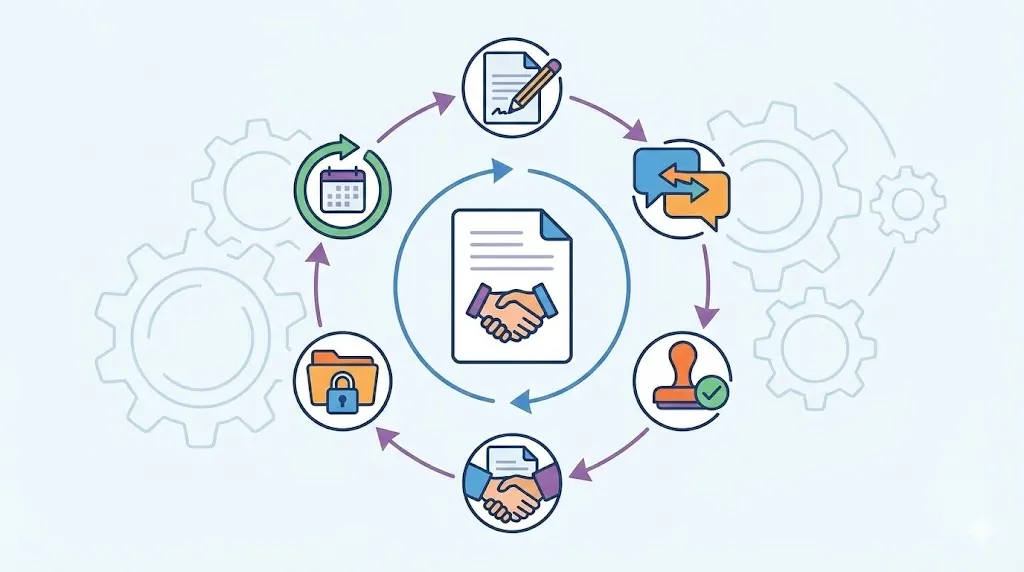
Contract management software fundamentally transforms contract handling within organizations. Centralization of all agreements results in a unified and accessible repository. The drafting, reviewing, and approval phases benefit from streamlined, automated workflows. AI-driven tools scan documents to flag risky language or identify absent clauses. These innovations enable teams to identify and address potential risks proactively before finalizing contracts.
For example, AI can highlight unusual indemnity terms or missing data privacy provisions. Legal reviewers receive targeted notifications to examine these critical areas. Procurement teams can track contract milestones automatically. These improvements reduce unforeseen complications and strengthen the risk management framework.
Related articles: Understanding Contract Risk Exposure in Business
How Does Contract Management Software Improve Risk Visibility?
Visibility is the foundation of risk management. Additionally, inadequate insight often leaves companies reacting to issues only after they have materialized, rather than anticipating and mitigating them in advance.
Contract management software enhances risk oversight through several key features:
Central repository: A secure, centralized location for all contracts, equipped with full-text search and metadata tagging to facilitate precise retrieval.
Real-time dashboards: Offering a consolidated view, these dashboards combine contract status, risk assessments, and upcoming deadlines into a single, actionable interface.
Automated alerts: Notifications are generated to prompt timely responses to renewals, contractual commitments, and compliance requirements.
AI-powered analysis: Contracts are examined by sophisticated algorithms that identify risky clauses, deviations from standard templates, and compliance gaps.
Integration with other systems: This capability allows contract data to flow seamlessly into procurement, finance, and ERP systems, supporting unified operational workflows.
These functionalities also dismantle organizational silos. Teams gain access to a unified source of truth for contract risk, facilitating rapid analysis of specific clauses or supplier relationships.
For example, if a supplier misses a delivery milestone, the system flags the contract clause and triggers a review. Legal and procurement teams can act before the issue escalates. This proactive approach reduces financial and operational risks.
Related articles: Contract Risk Analysis Strengthened By AI In Legal Ops
What Are the Key Features to Look for in Contract Management Software?
Not all contract management tools are equal. To effectively mitigate risk, prioritize the following capabilities:
AI Contract Review: Utilizes advanced algorithms to identify potentially hazardous language and detect absent clauses.
Obligation Management: Tracks deadlines, milestones, and deliverables to prevent missed commitments.
Approval Workflows: Streamlines the process by automating contract routing and approval steps, reducing cycle times while maintaining compliance.
Version Control: Maintains comprehensive audit trails that record every modification, ensuring stringent governance and accountability standards.
Template and Clause Libraries: Contains a repository of standardized contract language aimed at minimizing risk exposure across various agreements.
Search and Reporting: Equips users with robust functionalities to swiftly retrieve contracts and compile detailed risk assessment reports.
Integration Capabilities: Supports interoperability with ERP, CRM, and procurement systems to facilitate efficient data synchronization.
Security Controls: Enforces role-based permissions and uses encryption protocols to protect confidential contract information.
For example, advanced contract analysis identifies clauses that could expose the organization to unlimited liability. Obligation management can trigger alerts for upcoming insurance renewals. Approval workflows guarantee that contracts receive necessary legal endorsement prior to execution.
These functionalities significantly decrease manual workload and minimize the likelihood of errors. They enable teams to concentrate on strategic risk management decisions rather than routine administrative duties.
Related articles: Contract Management Security: Risks, Mistakes and Solutions
How Can Organizations Build a Culture That Supports Contract Risk Management?
Technology alone is not enough. Additionally, organizational culture and the engagement of personnel significantly influence outcomes. Here are steps to foster a risk-aware environment:
Educate teams: Deliver comprehensive training focused on identifying contract-related risks alongside effective utilization of software tools.
Define clear roles: Establish specific responsibilities for drafting, reviewing, and managing contracts to maintain accountability throughout the contract lifecycle.
Encourage collaboration: Foster open communication and coordinated efforts among legal, procurement, and finance departments to address risks proactively.
Set policies: Develop comprehensive guidelines that dictate contract approvals, define acceptable risk thresholds, and outline escalation processes.
Reward compliance: Incentivize adherence to established risk management standards within teams.
Measure performance: Track metrics like contract cycle time, risk incidents, and compliance rates.
For example, a company might hold monthly cross-department meetings to assess potential risks inherent in contracts while exchanging insights gained. This keeps risk top of mind and builds trust.
Strong culture ensures that contract risk management is not a checkbox but a daily habit. It helps companies respond faster to changes and reduces costly mistakes.
Related articles: 10 Best Contract Management Software in the USA
Why Contract Management Software Matters
Managing contract risk requires clear visibility, fast insights, and consistent processes. Contract management software centralizes contracts, automates workflows, and uses AI to spot risks early. This reduces manual errors and speeds decision-making.
With contract software, companies can:
See all contracts and obligations consolidated in a single platform.
Get alerts that identify potential risks well before they escalate.
Maintain standardized contract language to minimize variability across agreements.
Monitor compliance metrics in real time, integrating them with supplier performance data.
Ensure seamless integration of contract data with broader enterprise systems.
Volody’s solution delivers these benefits through AI-driven contract review, obligation tracking, and automated approvals. It helps legal and operations teams manage risk efficiently and confidently.
> Looking for a better way to manage contracts? Discover Volody's CLM Software.
FAQ
What does managing risks in contractual agreements entail?
Additionally, contract risk management involves identifying, evaluating, and mitigating risks associated with contractual agreements.
How does utilizing contract lifecycle solutions reduce risk?
This technology consolidates contracts into a single repository, streamlines processes through automation, and employs AI algorithms to detect clauses that may pose risks or identify missing obligations. This enables teams to identify potential issues promptly and maintain adherence to compliance standards.
Who should be involved in managing contract risk?
Effective risk management requires collaboration among legal professionals, procurement specialists, finance experts, and compliance officers.
Legal, procurement, finance, and compliance teams should collaborate.
Moreover, each group contributes distinct perspectives on contract risks and controls.
Can these contract tools integrate with other systems?
Yes. It often connects with ERP, CRM, procurement, and finance systems to provide a unified view of contract data and related business processes.
What risks are most common in contracts?
Common risks include unclear terms, missed deadlines, non-compliance with regulations, and supplier performance failures.
How often should contract risk be reviewed?
Risk requires continuous monitoring beyond the signing phase. Furthermore, ongoing reviews are critical to detect changes in regulations or supplier status.
Is AI reliable for contract risk analysis?
AI can quickly scan large volumes of contracts to identify common risks. However, human review remains essential for complex or high-stakes contracts.
What are the benefits of obligation management?
It prevents missed deadlines, penalties, and service failures by tracking contract milestones and deliverables with automated alerts.
How can companies build a risk-aware culture?
Organizations cultivate a risk-conscious environment through targeted training, defined responsibilities, cross-functional collaboration, robust policies, and performance metrics centered on managing contractual risks.
What should I look for when selecting a contract management platform?
Choose a solution featuring AI-powered review, obligation tracking, workflow automation, robust security measures, and integration capabilities tailored to your organization's operational needs.
About the Company

Volody AI CLM is an Agentic AI-powered Contract Lifecycle Management platform designed to eliminate manual contracting tasks, automate complex workflows, and deliver actionable insights. As a one-stop shop for all contract activities, it covers drafting, collaboration, negotiation, approvals, e-signature, compliance tracking, and renewals. Built with enterprise-grade security and no-code configuration, it meets the needs of the most complex global organizations. Volody AI CLM also includes AI-driven contract review and risk analysis, helping teams detect issues early and optimize terms. Trusted by Fortune 500 companies, high-growth startups, and government entities, it transforms contracts into strategic, data-driven business assets.




" height="216.72211px" id="FYO0bO80Y" transform="translate(3 6.105)" width="206.073px"/><path d="M 108.174 222 C 88.432 222 70.303 217.239 53.785 207.717 C 37.267 198.196 24.173 185.052 14.504 168.285 C 4.835 151.312 0 132.165 0 110.845 C 0 89.731 4.835 70.792 14.504 54.025 C 24.173 37.052 37.267 23.804 53.785 14.282 C 70.303 4.761 88.432 0 108.174 0 C 128.116 0 146.246 4.761 162.562 14.282 C 179.08 23.804 192.073 37.052 201.541 54.025 C 211.21 70.792 216.044 89.731 216.044 110.845 C 216.044 132.165 211.21 151.312 201.541 168.285 C 192.073 185.052 179.08 198.196 162.562 207.717 C 146.044 217.239 127.915 222 108.174 222 Z M 108.174 183.189 C 120.864 183.189 132.044 180.291 141.713 174.495 C 151.382 168.492 158.936 160.006 164.375 149.035 C 169.814 138.064 172.533 125.334 172.533 110.845 C 172.533 96.355 169.814 83.729 164.375 72.965 C 158.936 61.994 151.382 53.611 141.713 47.815 C 132.044 42.02 120.864 39.122 108.174 39.122 C 95.483 39.122 84.202 42.02 74.332 47.815 C 64.663 53.611 57.109 61.994 51.67 72.965 C 46.231 83.729 43.511 96.355 43.511 110.845 C 43.511 125.334 46.231 138.064 51.67 149.035 C 57.109 160.006 64.663 168.492 74.332 174.495 C 84.202 180.291 95.483 183.189 108.174 183.189 Z" fill="rgba(255, 255, 255, 0.12)" height="222px" id="aa1McFcE9" transform="translate(227.183 3)" width="216.04399999999998px"/><path d="M 42.302 182.257 L 111.799 182.257 L 111.799 216.722 L 0 216.722 L 0 0 L 42.302 0 Z" fill="rgba(255, 255, 255, 0.12)" height="216.72211px" id="yRq4AnrsX" transform="translate(477.721 6.105)" width="111.79899999999998px"/><path d="M 108.174 222 C 88.432 222 70.303 217.239 53.785 207.717 C 37.267 198.196 24.173 185.052 14.504 168.285 C 4.835 151.312 0 132.165 0 110.845 C 0 89.731 4.835 70.792 14.504 54.025 C 24.173 37.052 37.267 23.804 53.785 14.282 C 70.303 4.761 88.432 0 108.174 0 C 128.116 0 146.246 4.761 162.562 14.282 C 179.08 23.804 192.073 37.052 201.541 54.025 C 211.21 70.792 216.045 89.731 216.045 110.845 C 216.045 132.165 211.21 151.312 201.541 168.285 C 192.073 185.052 179.08 198.196 162.562 207.717 C 146.044 217.239 127.915 222 108.174 222 Z M 108.174 183.189 C 120.864 183.189 132.044 180.291 141.713 174.495 C 151.382 168.492 158.936 160.006 164.375 149.035 C 169.814 138.064 172.534 125.334 172.534 110.845 C 172.534 96.355 169.814 83.729 164.375 72.965 C 158.936 61.994 151.382 53.611 141.713 47.815 C 132.044 42.02 120.864 39.122 108.174 39.122 C 95.483 39.122 84.202 42.02 74.332 47.815 C 64.663 53.611 57.108 61.994 51.67 72.965 C 46.231 83.729 43.511 96.355 43.511 110.845 C 43.511 125.334 46.231 138.064 51.67 149.035 C 57.108 160.006 64.663 168.492 74.332 174.495 C 84.202 180.291 95.483 183.189 108.174 183.189 Z" fill="rgba(255, 255, 255, 0.12)" height="222px" id="mo8HQspQ0" transform="translate(609.155 3)" width="216.04500000000007px"/><path d="M 73.727 0 C 95.885 0 115.324 4.45 132.044 13.351 C 148.967 22.252 161.957 34.982 171.027 51.541 C 180.287 67.894 184.917 86.937 184.917 108.671 C 184.917 130.405 180.287 149.449 171.027 165.801 C 161.957 181.947 148.967 194.47 132.044 203.371 C 115.324 212.271 95.885 216.722 73.727 216.722 L 0 216.722 L 0 0 Z M 72.216 179.773 C 94.374 179.773 111.497 173.564 123.583 161.144 C 135.669 148.724 141.713 131.233 141.713 108.671 C 141.713 86.109 135.669 68.515 123.583 55.888 C 111.497 43.055 94.374 36.638 72.216 36.638 L 42.302 36.638 L 42.302 179.773 Z" fill="rgba(255, 255, 255, 0.12)" height="216.72211px" id="I3iXX5Hi_" transform="translate(859.693 6.105)" width="184.91699999999992px"/><path d="M 185.22 0 L 113.91 141.273 L 113.91 216.722 L 71.61 216.722 L 71.61 141.273 L 0 0 L 47.74 0 L 93.06 99.046 L 138.08 0 Z" fill="rgba(255, 255, 255, 0.12)" height="216.72211px" id="nzHyWC0_d" transform="translate(1061.78 6.105)" width="185.22000000000003px"/></svg>)