

Contracts are the backbone of business deals. Yet, once signed, they often vanish into a maze of disconnected systems. Sales teams track deals in CRMs, pricing flows through CPQs, and finance manages spend in ERPs. Without linking these tools to your contract lifecycle management (CLM) system, you risk errors, missed obligations, and lost revenue. This guide breaks down how to connect these critical platforms for live insights into risk and revenue.
TL;DR
Disconnected contract and enterprise systems cause billing errors and compliance risks.
Additionally, the integration of CLM with CRM, CPQ, and ERP platforms serves to preserve data integrity while significantly reducing the need for manual input.
Integration strategies vary with system complexity, ranging from direct point-to-point connections to more sophisticated API frameworks or middleware architectures.
Achieving successful integration requires detailed data mapping alongside rigorous security evaluations prior to linking systems.
To mitigate operational risks, it is critical to conduct thorough testing and implement the integration in controlled, phased stages.
Leveraging contract management software equipped with AI capabilities enhances automation of risk identification and obligation management.
Why Integrate CLM with CRM, CPQ, and ERP Systems?
Contracts intersect multiple departments including sales, finance, procurement, and legal teams. Additionally, each department employs dedicated software designed to meet its unique operational requirements. The CRM system plays a critical role in capturing detailed customer information and tracking sales opportunities. Meanwhile, the CPQ platform governs product configuration and pricing adjustments. The ERP system manages billing, invoicing, and supplier relationships. Contract lifecycle tasks such as drafting, negotiation, approval, and archival fall under the CLM’s domain.
When these systems don’t communicate, data inconsistencies arise. For example, a sales rep might close a deal in the CRM, but the contract terms don’t match the pricing in the CPQ. Or the ERP might bill a customer incorrectly because it doesn’t have the latest contract amendments. These mismatches cause revenue leakage, compliance issues, and customer dissatisfaction.
A CLM acts as the single source of truth for contracts. Integrating it with CRM, CPQ, and ERP ensures that contract terms flow accurately through every step of the customer lifecycle. The integration delivers several critical benefits:
It enables real-time visibility into contract status and obligations.
Pricing, discounts, and terms are updated automatically across systems.
The need for manual data entry is reduced, lowering the risk of errors.
Contract approvals and renewal processes proceed more swiftly.
Contract compliance is enforced consistently, strengthening risk management.
According to a Gartner report, organizations that integrate contract management with sales and finance systems reduce billing errors by up to 30% and accelerate revenue recognition by 20%. This shows the tangible benefits of integration.
Related articles: Contract Management Software for Sales Teams | CLM Guide
What Are the Main Challenges in Connecting These Systems?
Integrating CLMs with CRM, CPQ, and ERP software involves intricate coordination across diverse platforms. Additionally, each system possesses distinct data structures, workflows, and security protocols that must be carefully reconciled. Here are five common challenges:
Data Inconsistency: Systems store contract data differently. For example, a contract’s payment terms might be a free-text field in CLM but a structured numeric field in ERP. Mapping these fields accurately is difficult.
System Complexity: Especially in ERPs, numerous modules and extensive customizations create a multifaceted environment.
Security and Compliance: Contract data is sensitive. Integrations must protect data privacy, comply with regulations like GDPR, and maintain audit trails.
Workflow Alignment: Sales, legal, and finance teams have different approval and review workflows. Integration must respect these workflows and not disrupt daily work.
Change Management: Teams must adopt new integrated processes. Without clear communication and training, users may resist or bypass the system, losing integration benefits.
Understanding these challenges upfront helps design a successful integration plan that avoids costly delays and rework.
Related articles: Best Contract Management Software: Top 10 CLM Tools
How to Plan Your Integration Strategy
Start by defining which systems to connect and how. The integration approach depends on your existing tech stack, business needs, and IT resources.
Step 1: Identify Systems to Connect
Decide which systems must share contract data. Typical connections include:
CLM to CRM: Sync contract status, customer data, and deal terms.
CLM to CPQ: Transfer product configurations, pricing, and clauses.
CLM to ERP: Update billing terms, invoice schedules, and supplier contracts.
Some organizations also integrate CLM with HR or procurement systems if contracts involve employees or suppliers.
Step 2: Choose Integration Methods
Integration methods generally fall into three categories:
Point-to-point connections: Direct links between two systems. Simple but hard to scale.
API-based connectors: Use application programming interfaces (APIs) to exchange data. Flexible and reusable.
Middleware/iPaaS platforms: Third-party tools like MuleSoft or Zapier that link multiple systems. Best for complex environments.
For example, connecting CLM to Salesforce CRM commonly relies on APIs or direct connections due to Salesforce’s well-defined data model. ERP systems like SAP or Oracle often require middleware because of their complexity.
Step 3: Assess Data and Security
Review your contract data fields and formats. Moreover, identify which data points must sync between systems. Pay close attention to data quality challenges, including duplicate entries and incomplete fields.
Data encryption must be enforced both during transmission and storage to protect sensitive information. It is also essential to verify compliance with relevant regulatory standards, including HIPAA and GDPR. Access controls should be tightly regulated, supported by detailed audit mechanisms to maintain security and accountability.
Step 4: Map Workflows and Roles
Document how contract workflows operate within each system, capturing all approval stages, notification triggers, and task transitions. Carefully coordinate these processes to prevent integration-induced delays or bottlenecks.
Clearly define responsibility for each phase of the contract lifecycle. Assign duties related to data input, review cycles, and ongoing updates.
Step 5: Plan Testing and Rollout
Develop a testing plan covering data accuracy, workflow execution, and system performance. Use test environments to avoid disrupting live operations.
Plan a phased rollout, starting with a pilot group before full deployment. Gather user feedback and adjust as needed.
Related articles: How to Evaluate CLM Vendors: A Comprehensive Guide
What Does Data Mapping Look Like in Practice?
Data mapping connects fields in one system to corresponding fields in another. Additionally, this alignment is critical for maintaining data consistency and operational accuracy across platforms.
For example, consider syncing contract payment terms from CLM to ERP:
CLM Field | ERP Field | Notes |
|---|---|---|
Payment_Terms_Text | Payment_Term_Code | Map text descriptions to ERP codes |
Contract_Start_Date | Invoice_Start_Date | Date formats must match |
Renewal_Notice_Days | Alert_Notification | Trigger alerts in ERP for renewals |
Mapping goes beyond simple field matching. You must handle:
Data type conversions: Text to numeric, date formats, currency conversions.
Conditional logic: Only sync certain fields if contract status is “Active.”
Error handling: Define what happens if data fails validation during sync.
Creating a detailed data dictionary helps developers and business users understand the mapping rules. This reduces errors during integration.
Related articles: Types of Contracts Every Business Needs
How to Manage Security and Compliance Risks
Contract data often contains confidential terms, pricing, and personal information. Additionally, failure to implement careful handling during integration risks exposing this sensitive information.
Follow these best practices:
Encrypt data: Use TLS for data in transit and AES encryption for stored data.
Limit access: Apply role-based access controls so only authorized users see sensitive data.
Audit trails: Log all data exchanges and user actions for compliance audits.
Data minimization: Restrict the transfer to only the essential data fields required by each system.
Regular reviews: Perform comprehensive security assessments and penetration testing focused on integration points.
Compliance checks: Verify that integration processes adhere to established standards such as SOC 2 or ISO 27001.
For example, if your CLM contains personal employee contract data, ensure that only HR systems with proper clearance can access it.
Related articles: How to Calculate Your Contract Management ROI
What Are the Steps to Implement Integration?
Implementation requires careful coordination between IT, legal, sales, and finance teams.
Step 1: Prepare Your Environment
Additionally, ensure comprehensive backups of all systems before initiating the process.
Establish sandbox environments dedicated to testing purposes.
Conduct in-depth training sessions to familiarize your team with integration objectives and workflow procedures.
Step 2: Develop Integration Connectors
Build connectors by leveraging available APIs or middleware platforms, tailoring configurations to meet specific system requirements.
Develop detailed data mappings and define transformation rules that maintain consistency across systems.
Design robust error handling mechanisms and maintain extensive logs to support effective troubleshooting and audit compliance.
Step 3: Test Thoroughly
Moreover, test each connector independently to confirm its individual functionality.
Conduct comprehensive end-to-end testing through realistic contract scenarios to simulate actual operational conditions.
Perform meticulous verification of data accuracy and confirm that every element in the integrated workflows operates correctly.
Step 4: Train Users and Communicate
Organize targeted training programs that address the specific requirements of each stakeholder group.
Supply thorough documentation complemented by succinct quick reference materials to facilitate user proficiency.
Create support structures dedicated to rapidly addressing user questions and any operational challenges.
Step 5: Roll Out in Phases
Furthermore, begin with a pilot deployment targeting a controlled user group to identify and mitigate potential challenges early.
Systematically gather user feedback and prioritize prompt resolution of identified defects or usability issues.
Expand the deployment incrementally, ensuring system stability as the user base grows.
Step 6: Monitor and Optimize
Maintain ongoing surveillance of performance metrics and systematically record error incidents to ensure operational integrity.
Proactively adjust workflows and update data mappings to respond to evolving business requirements.
Schedule and carry out periodic system updates and maintenance to sustain optimal integration efficiency and reliability.
Related articles: Customized AI Powers Comprehensive CLM for Legal Teams
How to Scale Integration as Your Business Grows
Integration is not a one-time project. Additionally, as your company expands its portfolio of products, customer base, or underlying systems, your integration architecture must evolve accordingly.
Opt for middleware platforms that inherently support scalability, facilitating the integration of additional connections without disruption.
Deploy monitoring solutions capable of automatically alerting teams when discrepancies or failures occur in data flows.
Regularly review data mappings to confirm consistency with the latest contract template revisions.
Train new employees on integrated workflows.
Document all integration processes and updates.
An advanced integration framework minimizes manual intervention while accelerating strategic decision-making processes. In addition, it supports adherence to regulatory requirements and reduces risk exposure as operational complexity intensifies.
Related articles: Compliance and Risk Management in Aerospace Defense
Why Contract Management Software Matters
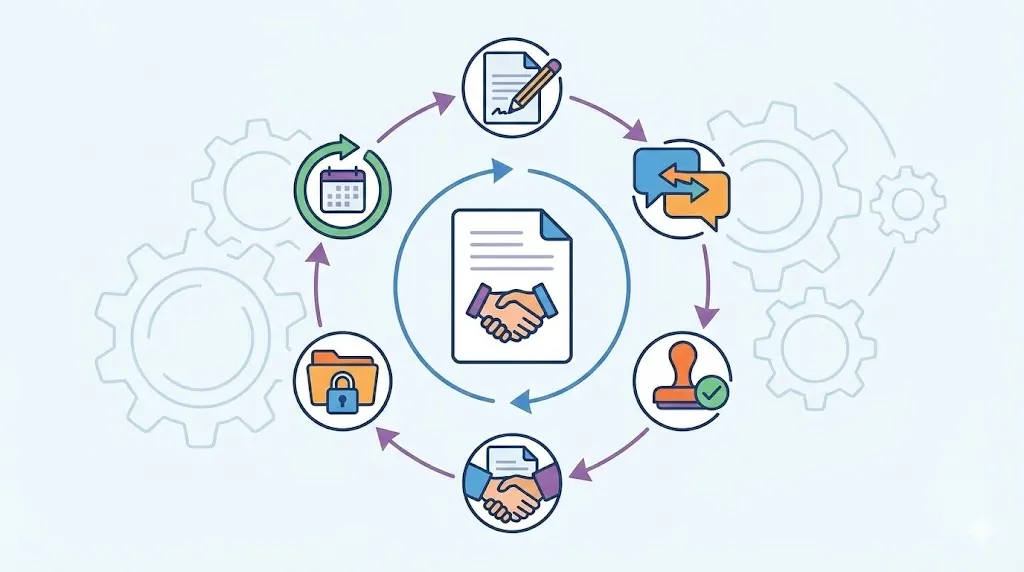
Contract management solutions centralize contract creation, negotiation, approval, and storage. Additionally, when these solutions connect seamlessly to systems like CRM platforms, CPQ tools, and ERP suites, they form a unified repository encompassing all contract-related data.
This software often includes AI-powered features that enhance accuracy and speed:
AI contract drafting: Automatically create drafts from templates and clause libraries.
AI contract review: Identify potentially problematic clauses and flag absent critical provisions.
Obligation tracking: Keep track of essential deadlines, deliverables, and renewal dates.
Approval workflows: Facilitate contract routing and send automated reminders.
Advanced search: Enable rapid retrieval of contracts through keyword searches and metadata filtering.
Related Article: Essential Contract Resources Every Sales Team Needs to Win
These functionalities mitigate legal risks, shorten sales cycles, and enhance revenue recognition.
Handling intricate legal workflows demands an intelligent, centralized platform. Moreover, Curious how this technology can streamline your legal processes? Explore Volody's CLM Software.
FAQ
What primary advantage comes from integrating CLM with CRM, CPQ, and ERP?
This integration ensures contract information synchronizes accurately across sales automation, pricing configuration, and enterprise resource planning systems, reducing errors, accelerating approvals, and improving revenue tracking.
Which factors should guide my decision between point-to-point and middleware integration?
Selecting between direct connections and middleware depends on complexity; point-to-point suits simple pairwise integrations like CLM to CRM, whereas middleware handles intricate setups involving multiple platforms or bespoke workflows.
What are common data mapping challenges?
Differences in data formats, missing fields, and conditional logic complicate mapping. Careful planning and a data dictionary help address these issues.
Furthermore, how can AI improve contract management?
AI automates drafting, reviews contracts for risks, and extracts key data. This speeds workflows and reduces manual errors.
Also, what security measures protect contract data during integration?
Encrypt data, restrict access by roles, maintain audit logs, and follow compliance standards like GDPR or SOC 2.
In what ways should workflow differences between legal, sales, and finance be managed?
Capture detailed process flows for each department and align approval protocols accordingly. Utilize software-driven workflows to automate handoffs and trigger notifications.
What is the best way to test integrations?
Also, start with unit tests, then run end-to-end scenarios using real contract data. Therefore, test error handling and user notifications thoroughly.
How often should I review and update integrations?
Regularly review integrations after major business changes, software upgrades, or contract template updates. Schedule quarterly checks if possible.
Can integration help with contract renewals and obligations?
Yes, integrated systems can trigger alerts for renewals and track obligations automatically, reducing missed deadlines.
What role does user training play in integration success?
Training ensures users understand new workflows and tools, increasing adoption and reducing errors. Clear communication is key.
This comprehensive guide outlines the critical steps and considerations for integrating contract lifecycle management into enterprise systems including CRM, CPQ, and ERP platforms. Following these best practices will help your organization reduce risk, improve revenue accuracy, and streamline contract processes.
About the Company

Volody AI CLM is an Agentic AI-powered Contract Lifecycle Management platform designed to eliminate manual contracting tasks, automate complex workflows, and deliver actionable insights. As a one-stop shop for all contract activities, it covers drafting, collaboration, negotiation, approvals, e-signature, compliance tracking, and renewals. Built with enterprise-grade security and no-code configuration, it meets the needs of the most complex global organizations. Volody AI CLM also includes AI-driven contract review and risk analysis, helping teams detect issues early and optimize terms. Trusted by Fortune 500 companies, high-growth startups, and government entities, it transforms contracts into strategic, data-driven business assets.





" height="216.72211px" id="FYO0bO80Y" transform="translate(3 6.105)" width="206.073px"/><path d="M 108.174 222 C 88.432 222 70.303 217.239 53.785 207.717 C 37.267 198.196 24.173 185.052 14.504 168.285 C 4.835 151.312 0 132.165 0 110.845 C 0 89.731 4.835 70.792 14.504 54.025 C 24.173 37.052 37.267 23.804 53.785 14.282 C 70.303 4.761 88.432 0 108.174 0 C 128.116 0 146.246 4.761 162.562 14.282 C 179.08 23.804 192.073 37.052 201.541 54.025 C 211.21 70.792 216.044 89.731 216.044 110.845 C 216.044 132.165 211.21 151.312 201.541 168.285 C 192.073 185.052 179.08 198.196 162.562 207.717 C 146.044 217.239 127.915 222 108.174 222 Z M 108.174 183.189 C 120.864 183.189 132.044 180.291 141.713 174.495 C 151.382 168.492 158.936 160.006 164.375 149.035 C 169.814 138.064 172.533 125.334 172.533 110.845 C 172.533 96.355 169.814 83.729 164.375 72.965 C 158.936 61.994 151.382 53.611 141.713 47.815 C 132.044 42.02 120.864 39.122 108.174 39.122 C 95.483 39.122 84.202 42.02 74.332 47.815 C 64.663 53.611 57.109 61.994 51.67 72.965 C 46.231 83.729 43.511 96.355 43.511 110.845 C 43.511 125.334 46.231 138.064 51.67 149.035 C 57.109 160.006 64.663 168.492 74.332 174.495 C 84.202 180.291 95.483 183.189 108.174 183.189 Z" fill="rgba(255, 255, 255, 0.12)" height="222px" id="aa1McFcE9" transform="translate(227.183 3)" width="216.04399999999998px"/><path d="M 42.302 182.257 L 111.799 182.257 L 111.799 216.722 L 0 216.722 L 0 0 L 42.302 0 Z" fill="rgba(255, 255, 255, 0.12)" height="216.72211px" id="yRq4AnrsX" transform="translate(477.721 6.105)" width="111.79899999999998px"/><path d="M 108.174 222 C 88.432 222 70.303 217.239 53.785 207.717 C 37.267 198.196 24.173 185.052 14.504 168.285 C 4.835 151.312 0 132.165 0 110.845 C 0 89.731 4.835 70.792 14.504 54.025 C 24.173 37.052 37.267 23.804 53.785 14.282 C 70.303 4.761 88.432 0 108.174 0 C 128.116 0 146.246 4.761 162.562 14.282 C 179.08 23.804 192.073 37.052 201.541 54.025 C 211.21 70.792 216.045 89.731 216.045 110.845 C 216.045 132.165 211.21 151.312 201.541 168.285 C 192.073 185.052 179.08 198.196 162.562 207.717 C 146.044 217.239 127.915 222 108.174 222 Z M 108.174 183.189 C 120.864 183.189 132.044 180.291 141.713 174.495 C 151.382 168.492 158.936 160.006 164.375 149.035 C 169.814 138.064 172.534 125.334 172.534 110.845 C 172.534 96.355 169.814 83.729 164.375 72.965 C 158.936 61.994 151.382 53.611 141.713 47.815 C 132.044 42.02 120.864 39.122 108.174 39.122 C 95.483 39.122 84.202 42.02 74.332 47.815 C 64.663 53.611 57.108 61.994 51.67 72.965 C 46.231 83.729 43.511 96.355 43.511 110.845 C 43.511 125.334 46.231 138.064 51.67 149.035 C 57.108 160.006 64.663 168.492 74.332 174.495 C 84.202 180.291 95.483 183.189 108.174 183.189 Z" fill="rgba(255, 255, 255, 0.12)" height="222px" id="mo8HQspQ0" transform="translate(609.155 3)" width="216.04500000000007px"/><path d="M 73.727 0 C 95.885 0 115.324 4.45 132.044 13.351 C 148.967 22.252 161.957 34.982 171.027 51.541 C 180.287 67.894 184.917 86.937 184.917 108.671 C 184.917 130.405 180.287 149.449 171.027 165.801 C 161.957 181.947 148.967 194.47 132.044 203.371 C 115.324 212.271 95.885 216.722 73.727 216.722 L 0 216.722 L 0 0 Z M 72.216 179.773 C 94.374 179.773 111.497 173.564 123.583 161.144 C 135.669 148.724 141.713 131.233 141.713 108.671 C 141.713 86.109 135.669 68.515 123.583 55.888 C 111.497 43.055 94.374 36.638 72.216 36.638 L 42.302 36.638 L 42.302 179.773 Z" fill="rgba(255, 255, 255, 0.12)" height="216.72211px" id="I3iXX5Hi_" transform="translate(859.693 6.105)" width="184.91699999999992px"/><path d="M 185.22 0 L 113.91 141.273 L 113.91 216.722 L 71.61 216.722 L 71.61 141.273 L 0 0 L 47.74 0 L 93.06 99.046 L 138.08 0 Z" fill="rgba(255, 255, 255, 0.12)" height="216.72211px" id="nzHyWC0_d" transform="translate(1061.78 6.105)" width="185.22000000000003px"/></svg>)