
Enterprise-wide contract management requires more than storing agreements—it requires a reliable view of where every contract stands. When sales waits for approval, finance checks a renewal date, and legal answers the same question across multiple inboxes, delays accumulate and trust erodes. Contract visibility gives every team a clear, authoritative view of progress, ownership, risk, and next steps.
TL;DR
Teams with contract visibility can answer status questions directly, without searching through email, files, or chat.
Additionally, maintaining a shared contract record improves speed and accountability while strengthening risk control and supporting better working relationships.
Clear ownership and automated alerts help teams keep reviews, renewals, and obligations on track.
Leaders can identify process breakdowns by monitoring cycle time, approval delays, search effort, and missed contract commitments.
Clean data and practical workflows form the foundation of reliable contract processes; appropriate user access controls and sustained adoption matter as well.
Modern CLM software brings drafting, review, approval, signing, storage, and monitoring together in a single system.
Why Contract Status Matters Across the Business
A contract rarely belongs to one department; responsibility is usually distributed across the business. Additionally, sales may own the commercial deal. Legal often manages the review. Finance may be responsible for confirming pricing and payment terms. Procurement, security, privacy, and operations may also need to approve it.
Each group needs different information. Sales wants to know when the customer can sign. Legal wants to see open redlines and unresolved risks. Finance needs accurate payment terms. Operations needs to understand service levels and delivery duties.
Without a shared status, teams build their own version of the truth. One person checks a spreadsheet. Another searches a shared drive. Someone else asks legal for an update through email. These small actions repeat across hundreds or thousands of agreements.
That work creates hidden cost. Legal professionals spend time answering status questions instead of reviewing terms. Business teams make follow-up requests without knowing the full context. Leaders lack a reliable view of bottlenecks.
Contract status should answer more than one question. A useful status view should make several points immediately apparent:
Who is responsible for the next step?
Which stage has the contract reached?
What information or approvals remain outstanding?
Moreover, when is the next step due?
Which risks or exceptions require attention?
Which business unit or customer does the agreement affect?
Take a technology company preparing for a major customer renewal. The account team assumes legal has the agreement. Legal, in turn, believes finance still needs to approve the revised pricing. Finance, however, has not reviewed the latest version. The deadline therefore approaches with no clear owner.
A shared workflow would expose the issue earlier. It would show the current stage, the pending approval, and the responsible person. It could also send reminders before the renewal date. That visibility helps teams act before delay becomes a commercial problem.
Research supports the value of better contract processes. The World Commerce and Contracting research library has repeatedly examined the cost of poor contracting and missed value. Its work shows that contract performance depends on more than signing. The agreement and its obligations require management throughout their life.
For enterprise leaders, the distinction is important. Execution continues after signature. It may include price reviews, service duties, reporting dates, security requirements, and renewal rules. Knowing the contract status helps teams manage those duties before they become disputes.
Related articles: Clear Contract Payment Terms: A Guide to Understanding
What Contract Visibility Means in Practice
Contract visibility means that authorized users can find reliable information about an agreement. Additionally, the agreement’s current stage, key dates, owners, documents, and obligations are also visible. They can understand what changed and what needs action.
Visibility does not mean showing every document to every employee. Confidentiality remains essential. Good contract management uses role-based access, which gives each person only the information they need.
A practical status model should use clear stages. Each stage should have a defined meaning and an assigned owner. For example:
Request received
Draft in progress
Internal review
Business approval
External negotiation
Signature pending
Executed
Active monitoring
Renewal or closeout
Your organization may need different stages. The key is consistency. If one team calls a contract “under review” before legal sees it, another team may use the same label after negotiation begins. That creates confusion.
Moreover, each status should point to a specific action. Under an “Approval pending” status, the record identifies both the approver and the due date. For “Negotiation in progress,” it should show the latest version and any open issues. A “Signature pending” entry should specify who must sign and by when.
Status data also needs context. A simple label cannot explain why an agreement has stalled. Strong records include:
Requester and business owner
Contract type and business unit
Counterparty name
Current reviewer or approver
Current document version
Requested completion date
Renewal and expiration dates
Key financial terms
Open risks and exceptions
Related obligations
A central repository supports this model. It stores executed agreements and related records in one searchable location. Metadata makes those records easier to filter. Metadata means structured information about a contract, such as its date, owner, or governing law.
The National Archives provides guidance on managing records with reliable controls and retention practices. Contract teams can apply the same principles to business agreements. They need clear ownership, accurate records, controlled access, and traceable changes.
Search also matters. Users should be able to locate contracts by name, party, keyword, date, or business unit. Scanned agreements become searchable after optical character recognition. Full-text search can then surface terms in older documents.
A strong system should also preserve a complete version history. Each change is attributed to the person who made it, along with the time of the change. Versions can be compared without opening multiple files. As a result, legal teams can verify that approved language reached the final agreement.
Related Article: 7 Contract Management Principles Every Legal Team Needs
Where Contract Processes Lose Visibility
Most visibility problems begin before a contract reaches legal. Additionally, a business user may request an agreement through email, chat, or a meeting. The submission may omit key details, such as the customer entity, pricing model, or required terms.
Legal then spends time collecting basic information. It may remain in an inbox while the team waits for answers. No shared record exists, so other departments cannot see the reason for delay.
Negotiation creates another risk. Several people may edit different copies of the same document. A lawyer reviews one attachment while the business owner sends another version externally. Teams then struggle to determine which draft is current.
Approval gaps cause similar problems. An approval may happen in email without a clear audit trail. A manager may approve an earlier version. Moreover, a later change may require another review, but nobody records that need.
Execution can also create uncertainty. A document may receive signatures, but the final copy may not reach the contract repository. The business may know that a deal closed, yet lack access to the signed terms.
Post-signature work often receives the least attention. Teams may store the agreement without recording its obligations. A notice period can go unrecorded, as can a service credit clause. Although the contract exists, its value and risks can remain obscured.
The following signs commonly indicate a visibility problem:
Employees ask for updates through several channels.
Legal teams frequently resort to personal spreadsheets when they need to track active matters.
Contract ownership may be unclear to business teams.
Several competing versions may coexist in shared folders.
Furthermore, approvers often receive requests before the necessary information has been supplied.
Some executed agreements remain confined to individual email accounts.
Renewal reminders may exist only on personal calendars.
Leaders may have no reliable way to report average contract cycle time.
Often, missed duties surface only when a problem occurs.
Acquisitions, international expansion, and system changes often amplify these problems. New entities can introduce their own templates and approval rules. As contract volume rises, gaps that smaller teams once managed informally become harder to contain.
In-house legal teams can turn to the Association of Corporate Counsel for practical guidance. Its materials address legal operations, process design, collaboration, and related areas. Because status depends on repeatable work, guidance on those areas is directly relevant to contract visibility.
Poor visibility also harms internal relationships. Business users may view legal as slow when legal lacks a complete request. Legal may view the business as careless when requests arrive without context. A shared process replaces blame with facts.
Related articles: Key Contract Process KPIs That Impact Business Success
How to Build a Reliable Contract Status Process
A reliable process starts with a clear service model. Additionally, define how employees should request each common contract type. Explain what information they must provide. Set expected response times for standard and complex requests.
Do not begin with software alone. First map the current process. Interview legal, sales, procurement, finance, security, and business owners. Ask where work starts, where it pauses, and where information gets lost.
Then define the future process. Keep routine agreements simple. Route unusual terms to the right experts. Avoid routing every contract through the same lengthy approval chain.
A practical design sequence is:
Start by cataloging the contract types your organization handles.
Then identify everyone responsible for requesting, reviewing, approving, signing, and monitoring those contracts.
For each contract type, map the status stages it requires.
Give every stage a clearly designated owner.
Moreover, define the required request fields alongside the applicable approval rules.
Set alerts for approaching deadlines and stalled work.
Before finalizing the design, test it against real examples.
Refine the design based on what those examples reveal.
Pay particular attention to the intake form. Ask only for information that supports a decision or action. Too many fields frustrate users. Too few fields create more work for legal.
Useful intake fields may include the business purpose, counterparty, contract value, term length, countries involved, requested date, and data access. The form can then route the request based on risk and type.
Consistent drafting depends in part on well-maintained templates and clause libraries. Users should start from an approved template that provides a controlled foundation for drafting. Meanwhile, the clause library provides standard language and approved fallback positions. Maintaining version history allows legal to retire outdated language.
Furthermore, approval rules should match risk. A low value order might require only one business approval. A global data processing agreement, depending on its terms, may also require privacy and security review. High value supplier agreements may warrant finance and executive approval as well.
At well-defined control points, automation can take care of tasks such as:
Routing requests to the appropriate team.
Alerting reviewers when work arrives.
Reminding owners about overdue actions.
Escalating approvals that remain stalled.
Keeping a record of every decision.
Creating renewal tasks from contract dates.
Giving teams advance notice of upcoming notice deadlines.
Automation cannot replace human judgment. Its role is to move work forward and expose risk. Also, it should not remove the need for legal review where terms require professional judgment.
The process will succeed only if change management is handled effectively. Users need to understand why each new step was introduced. Short examples make training more effective. Provide a clear channel for their questions. Review adoption after launch.
The U.S. National Institute of Standards and Technology offers a useful privacy risk framework. Its approach highlights the need to identify, govern, control, and communicate risk. Contract workflows should follow a similar pattern, especially when agreements include personal or sensitive data.
When the process is complex, start with one contract family. The pilot could focus on sales agreements, procurement contracts, or renewals. Apply the practical lessons from that pilot before extending the process to every department.
Related articles: How Legal and Finance Can Collaborate Better on Contracts
How Contract Visibility Improves Business Performance
The greatest value often comes from modest improvements that compound across the enterprise. Additionally, a legal team may save a few minutes each time someone requests a status update. Across thousands of contracts, that saved time can create meaningful capacity.
Faster responses also improve revenue timing. If sales has visibility into the approval stage, they can set better customer expectations. If legal can see missing information early, it can avoid repeated follow-ups.
Procurement gains a stronger view of supplier commitments. The team can locate pricing terms, renewal rules, and notice dates. It can then negotiate before automatic renewal or identify suppliers that need performance review.
Finance benefits from better contract data. Payment terms, fees, credits, and price changes become easier to confirm. Finance can compare contracted amounts with invoices and forecast upcoming obligations.
Operations can see what the business promised. Furthermore, responsibility for meeting response times and providing regular reports may rest with the service team. With clear obligation records, that team can plan its work and document performance.
Risk teams also gain a clearer view of exposure. They can find unusual liability terms, missing insurance language, or nonstandard data provisions. They can also focus reviews on contracts that matter most.
Contract visibility can improve internal trust in several ways:
Business users receive updates without interrupting legal.
Also, shared records give legal a way to demonstrate progress.
Managers can pinpoint approvals that require attention.
Finance receives reliable commercial information.
Operations gains visibility into its post-signature duties.
Executives can assess broader trends across departments and entities.
Measurement should capture both speed and control. Therefore, speed alone is not enough: a process that misses obligations creates new risk. Conversely, excessive process time can impede business growth, even when controls are effective.
Useful measures include:
Duration from request to first draft
Cycle time between draft and approval
Elapsed time awaiting business input
Elapsed time awaiting external comments
Percentage of requests with complete intake data
Percentage of agreements stored after signature
Number of overdue obligations
Number of renewals with advance notice
Search time for executed contracts
Percentage of contracts using approved templates
Avoid measuring activity without context. A high contract volume does not show whether the process works. Therefore, pair volume with cycle time, risk level, and business outcome.
The International Association for Contract and Commercial Management provides research on contracting performance and commercial value. Its work supports a broader view of contracts as business tools. Teams should assess agreements by the outcomes they help the organization achieve, not merely by the number processed.
Consequently, dashboards make these measures more useful because they place them in an operational context. As backlog grows, legal leaders gain a clearer view of the change. Operations leaders can monitor approaching commitments with less effort. Executives can then review risk by region, contract type, or business unit.
Data quality remains central. A dashboard cannot fix missing dates or incorrect owners. Assign responsibility for contract data and review key fields during the process.
Visibility also supports better planning. If leaders know where work stalls, they can adjust staffing or approval rules. If one contract type causes repeated delays, they can improve its template or intake form.
Related articles: How Asset Managers Can Reveal Value Hidden in Contracts
What Enterprise Leaders Should Ask Before Selecting a Platform
A platform should support the way your organization works. It should not force every team into an identical process. Determine whether it can accommodate different contract types, business units, entities, and approval rules.
Start with user needs. Business users need simple intake and clear updates throughout the process. Lawyers, by contrast, need robust tools for drafting, review, negotiation, and search. Executives meanwhile need accurate reports without reading every contract.
Security deserves careful review. Determine how the platform protects documents and user access. Moreover, its authentication, encryption, backups, audit logs, and permission controls all warrant review. Confirm that it supports regional and entity-based access where needed.
Integration also affects visibility. A contract system should connect with the tools people already use. Useful connections may include Microsoft 365, customer relationship management, enterprise resource planning, procurement, human resources, and electronic signature systems.
A disconnected platform can create another information gap. Users may sign in one system, update a spreadsheet, and store the final document elsewhere. Integration reduces duplicate entry and keeps records aligned.
Review the platform against practical questions:
Can users search contracts by text and metadata?
Can users quickly determine which document is the current version?
Is an owner and due date assigned to every stage?
Can the workflow route work based on contract type or value?
Can administrators configure forms without writing code?
Will the platform support importing older agreements?
Can it extract dates, parties, and obligations from the agreements?
Does it track renewals and notice periods?
Also, does it maintain a complete audit history as well?
Can administrators set different access levels for users?
Artificial intelligence can help with contract data, but teams need controls. AI may extract key terms, summarize agreements, flag unusual language, or suggest approved clauses. Important outputs should undergo human review before anyone makes a legal or commercial decision.
A useful evaluation process includes a real business test. Provide vendors with sample contracts and common requests. Ask them to show the full path from intake through monitoring. Therefore, do not accept a demonstration that covers only document storage.
Therefore, test difficult cases. Include a contract with several redline rounds, unusual liability language, multiple approvers, and a near-term renewal. These cases reveal whether the platform can support real work.
Adoption should form part of the business case. A system creates little value if users continue working through email. Look for simple forms, familiar editing tools, clear notifications, and useful search.
Roll out the platform in stages. Begin by establishing governance and cleaning key legacy data. Consequently, once that work is complete, configure workflows and templates. Before launch, train users; afterward, measure activity and outcomes.
Ownership should remain clear after launch. Workflow management may sit with a legal operations team. Information security may manage access. Business leaders should own contract data for their areas. A platform needs accountable people behind it.
Related articles: 10 Key Contract Clauses Every Business Should Know in 2026
How Contract Management Software Helps
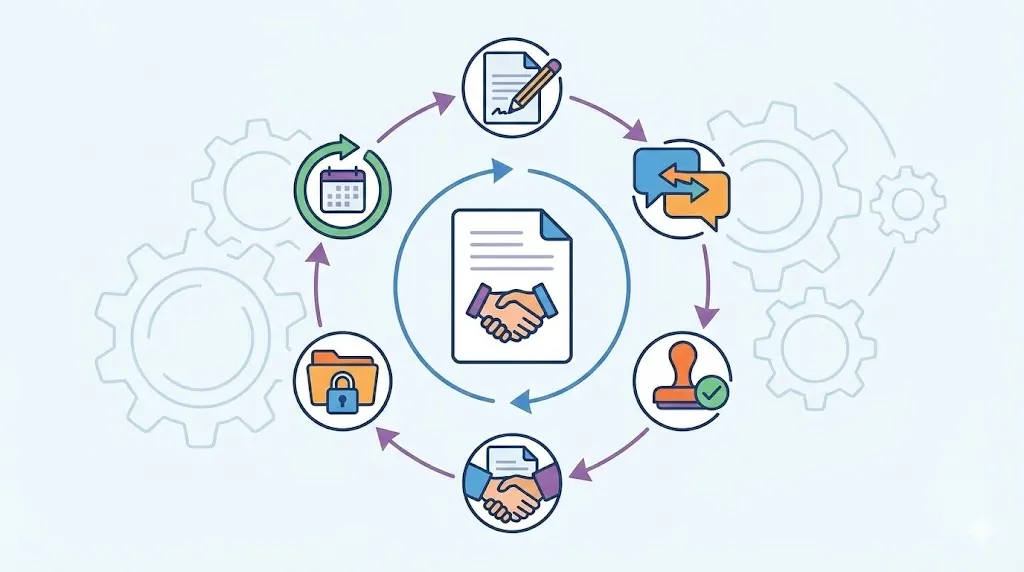
Generic contract management software gives teams one place to request, draft, review, approve, sign, store, and monitor agreements. Additionally, the software can also show current status, next actions, key dates, and ownership. This reduces manual follow-up and improves control across the contract lifecycle.
Volody adds AI drafting, review, summaries, metadata extraction, obligation tracking, alerts, search, version control, and configurable workflows. Teams can use approved templates and clauses while keeping a clear audit history. These tools help legal and business users find answers faster without changing their familiar Microsoft Word workflow.
Looking for a better way to manage contracts? Discover Volody's CLM Software.
FAQ
What does contract visibility mean?
Additionally, contract visibility means authorized users can find accurate information about an agreement. They can see its status, owner, documents, dates, obligations, and next steps.
Why is contract status important to business teams?
With reliable status information, teams can plan work and set accurate expectations. That visibility cuts down on repeated questions, delays, missed approvals, and uncertainty about ownership.
What information should a contract status record include?
A useful record includes the contract stage, responsible owner, next action, due date, document version, counterparty, and important dates. It may also capture the contract's value, risk profile, obligations, and business unit.
How can teams move away from tracking contracts through email?
Start with a structured intake process and a shared contract record. Use workflow alerts, clear owners, approved templates, and a central repository for final agreements.
Can contract management software track obligations after signature?
Yes. Many platforms can track deliverables, renewal dates, payment dates, notice periods, and compliance duties. Alerts can remind owners before an action becomes overdue.
How does AI improve contract visibility?
AI can extract metadata from contracts and create summaries of key terms. It can also identify risks and suggest approved language, while people retain final decision authority.
What should leaders measure after improving contract visibility?
Track cycle time, approval delays, intake quality, search time, storage rates, overdue obligations, and renewal preparation. Review these measures across contract types and business units.
How should an enterprise begin a contract visibility project?
Start by mapping the current process, selecting a focused contract group for a pilot, and testing it with real agreements. Measure results, refine the workflow, and expand with confidence.
About the Company

Volody AI CLM is an Agentic AI-powered Contract Lifecycle Management platform designed to eliminate manual contracting tasks, automate complex workflows, and deliver actionable insights. As a one-stop shop for all contract activities, it covers drafting, collaboration, negotiation, approvals, e-signature, compliance tracking, and renewals. Built with enterprise-grade security and no-code configuration, it meets the needs of the most complex global organizations. Volody AI CLM also includes AI-driven contract review and risk analysis, helping teams detect issues early and optimize terms. Trusted by Fortune 500 companies, high-growth startups, and government entities, it transforms contracts into strategic, data-driven business assets.





" height="216.72211px" id="FYO0bO80Y" transform="translate(3 6.105)" width="206.073px"/><path d="M 108.174 222 C 88.432 222 70.303 217.239 53.785 207.717 C 37.267 198.196 24.173 185.052 14.504 168.285 C 4.835 151.312 0 132.165 0 110.845 C 0 89.731 4.835 70.792 14.504 54.025 C 24.173 37.052 37.267 23.804 53.785 14.282 C 70.303 4.761 88.432 0 108.174 0 C 128.116 0 146.246 4.761 162.562 14.282 C 179.08 23.804 192.073 37.052 201.541 54.025 C 211.21 70.792 216.044 89.731 216.044 110.845 C 216.044 132.165 211.21 151.312 201.541 168.285 C 192.073 185.052 179.08 198.196 162.562 207.717 C 146.044 217.239 127.915 222 108.174 222 Z M 108.174 183.189 C 120.864 183.189 132.044 180.291 141.713 174.495 C 151.382 168.492 158.936 160.006 164.375 149.035 C 169.814 138.064 172.533 125.334 172.533 110.845 C 172.533 96.355 169.814 83.729 164.375 72.965 C 158.936 61.994 151.382 53.611 141.713 47.815 C 132.044 42.02 120.864 39.122 108.174 39.122 C 95.483 39.122 84.202 42.02 74.332 47.815 C 64.663 53.611 57.109 61.994 51.67 72.965 C 46.231 83.729 43.511 96.355 43.511 110.845 C 43.511 125.334 46.231 138.064 51.67 149.035 C 57.109 160.006 64.663 168.492 74.332 174.495 C 84.202 180.291 95.483 183.189 108.174 183.189 Z" fill="rgba(255, 255, 255, 0.12)" height="222px" id="aa1McFcE9" transform="translate(227.183 3)" width="216.04399999999998px"/><path d="M 42.302 182.257 L 111.799 182.257 L 111.799 216.722 L 0 216.722 L 0 0 L 42.302 0 Z" fill="rgba(255, 255, 255, 0.12)" height="216.72211px" id="yRq4AnrsX" transform="translate(477.721 6.105)" width="111.79899999999998px"/><path d="M 108.174 222 C 88.432 222 70.303 217.239 53.785 207.717 C 37.267 198.196 24.173 185.052 14.504 168.285 C 4.835 151.312 0 132.165 0 110.845 C 0 89.731 4.835 70.792 14.504 54.025 C 24.173 37.052 37.267 23.804 53.785 14.282 C 70.303 4.761 88.432 0 108.174 0 C 128.116 0 146.246 4.761 162.562 14.282 C 179.08 23.804 192.073 37.052 201.541 54.025 C 211.21 70.792 216.045 89.731 216.045 110.845 C 216.045 132.165 211.21 151.312 201.541 168.285 C 192.073 185.052 179.08 198.196 162.562 207.717 C 146.044 217.239 127.915 222 108.174 222 Z M 108.174 183.189 C 120.864 183.189 132.044 180.291 141.713 174.495 C 151.382 168.492 158.936 160.006 164.375 149.035 C 169.814 138.064 172.534 125.334 172.534 110.845 C 172.534 96.355 169.814 83.729 164.375 72.965 C 158.936 61.994 151.382 53.611 141.713 47.815 C 132.044 42.02 120.864 39.122 108.174 39.122 C 95.483 39.122 84.202 42.02 74.332 47.815 C 64.663 53.611 57.108 61.994 51.67 72.965 C 46.231 83.729 43.511 96.355 43.511 110.845 C 43.511 125.334 46.231 138.064 51.67 149.035 C 57.108 160.006 64.663 168.492 74.332 174.495 C 84.202 180.291 95.483 183.189 108.174 183.189 Z" fill="rgba(255, 255, 255, 0.12)" height="222px" id="mo8HQspQ0" transform="translate(609.155 3)" width="216.04500000000007px"/><path d="M 73.727 0 C 95.885 0 115.324 4.45 132.044 13.351 C 148.967 22.252 161.957 34.982 171.027 51.541 C 180.287 67.894 184.917 86.937 184.917 108.671 C 184.917 130.405 180.287 149.449 171.027 165.801 C 161.957 181.947 148.967 194.47 132.044 203.371 C 115.324 212.271 95.885 216.722 73.727 216.722 L 0 216.722 L 0 0 Z M 72.216 179.773 C 94.374 179.773 111.497 173.564 123.583 161.144 C 135.669 148.724 141.713 131.233 141.713 108.671 C 141.713 86.109 135.669 68.515 123.583 55.888 C 111.497 43.055 94.374 36.638 72.216 36.638 L 42.302 36.638 L 42.302 179.773 Z" fill="rgba(255, 255, 255, 0.12)" height="216.72211px" id="I3iXX5Hi_" transform="translate(859.693 6.105)" width="184.91699999999992px"/><path d="M 185.22 0 L 113.91 141.273 L 113.91 216.722 L 71.61 216.722 L 71.61 141.273 L 0 0 L 47.74 0 L 93.06 99.046 L 138.08 0 Z" fill="rgba(255, 255, 255, 0.12)" height="216.72211px" id="nzHyWC0_d" transform="translate(1061.78 6.105)" width="185.22000000000003px"/></svg>)