

Contracts hold the keys to how businesses operate, buy, and sell. Yet, many companies struggle to tap into the rich insights buried in their contract data. This data is often locked away in unstructured documents, making it tough to analyze at scale. Advanced contract analytics changes that by turning complex contract information into clear, actionable insights. These insights help legal and business teams make smarter decisions faster, reduce risks, and improve overall performance.
TL;DR
Contracts hold essential business data, yet their unstructured nature complicates thorough analysis.
By converting contracts into structured, digitized formats, analytics facilitate rapid and thorough examination across large volumes.
Detailed examination uncovers concealed risks, enforceable obligations, and untapped opportunities embedded within contractual language.
These tools enable legal departments to negotiate more efficiently and accurately while enhancing oversight of regulatory compliance.
Connecting contract data with enterprise systems ensures seamless integration into broader business processes.
Utilizing contract analytics enhances operational workflows, reduces manual labor, and supports sustainable organizational advancement.
Why Contract Data Is Hard to Use and What That Costs You
Contracts contain critical information such as payment terms, obligations, penalties, renewal dates, and additional key provisions. Additionally, these components significantly impact revenue generation, risk mitigation, and adherence to regulatory standards. Most contracts, however, are stored as text documents, PDFs, or scanned images. This format complicates the process of extracting and interpreting the data, often resulting in inefficiencies and errors.
Reviewing contracts manually consumes significant time and resources. Legal teams frequently dedicate extensive hours or even days to scrutinize contracts for critical clauses or potential risks. This delays transaction timelines and raises the likelihood of overlooking essential information. For example, a missed renewal clause could cost a company millions in lost revenue or penalties.
According to a Gartner report on contract analytics, many companies face rising contract volumes and complexity. This leads to more manual effort, higher risk, and slower business processes. The report forecasts that artificial intelligence will reduce the time spent on manual contract examination by 50% by 2024. This shows how urgent it is to adopt smarter tools.
The consequences of neglecting contract information are severe. Without precise insights, organizations expose themselves to compliance failures, revenue leakage, and deteriorating supplier or customer relationships. They also forfeit opportunities to renegotiate terms or enhance contract outcomes. In short, contract data is a goldmine, but only if you can mine it efficiently.
Related articles: What Is Contract Analysis? Key Benefits Uncovered
How AI Transforms Contract Analytics
Artificial intelligence changes the game by making contract data readable and searchable at scale. AI models trained on millions of contracts can identify and categorize clauses, terms, and obligations automatically. This process is called contract intelligence.
AI extracts metadata such as parties involved, dates, payment terms, and risk indicators. It also flags unusual or risky language that might otherwise go unnoticed. This helps legal teams focus on high-risk areas instead of sifting through every line manually.
Once contracts are digitized and structured, analytics tools can track trends and patterns. For example, a company can monitor how often certain penalty clauses appear or identify contracts that deviate from standard terms. This enables proactive risk management and better negotiation strategies.
AI-powered contract analytics also supports ongoing contract management. It can alert teams about upcoming renewals, missed obligations, or compliance gaps. This reduces surprises and helps keep contracts on track.
The technology scales well. Companies can import tens of thousands of contracts quickly and analyze them continuously. This is crucial for organizations with large contract portfolios or those undergoing mergers and acquisitions.
Related articles: How Does AI Limitations Impacting Contract Management?
What Insights Advanced Contract Analytics Provides
Advanced contract analytics goes beyond simple keyword search. Additionally, it enables a more nuanced understanding of contract content and performance metrics. Here are some key insights companies can gain:
Risk Identification: Spot clauses that increase legal or financial risk, such as unfavorable penalties or ambiguous terms.
Obligation Tracking: Monitor deliverables, deadlines, and compliance requirements to avoid breaches.
Contract Performance: Analyze contract terms against actual business outcomes to find gaps or opportunities.
Renewal and Expiration Alerts: Stay ahead of contract deadlines by setting alerts that facilitate timely renegotiations or renewals, ensuring favorable terms.
Pricing and Discount Analysis: Examine the impact of discount frameworks and pricing arrangements on overall profitability.
Clause Benchmarking: Evaluate contract clauses relative to internal benchmarks and industry standards to maintain alignment and regulatory adherence.
For example, procurement teams use analytics to identify contracts with embedded early termination penalties that may hinder operational flexibility. They can then negotiate improved conditions or strategize contract transitions. Legal teams can prioritize contracts with high-risk clauses for review, improving compliance and reducing liability.
These insights help companies make data-driven decisions. They also enable legal and business teams to align contract management with overall corporate goals.
Related articles: Contract Process KPIs That Boost Business Performance
Common Challenges in Implementing Contract Analytics
While the benefits are clear, implementing advanced contract analytics comes with challenges. Additionally, a thorough grasp of these obstacles enables companies to prepare effectively and achieve successful outcomes.
Data Quality and Volume: Contracts come in many formats and languages. Cleaning and digitizing this data requires effort and expertise.
Integration with Existing Systems: Contract data must connect with ERP, CRM, and other enterprise systems to provide full context. Integration complexity can slow adoption.
Change Management: Legal and business teams need training and buy-in to trust and use analytics tools effectively.
Customization Needs: Different industries and companies have unique contract types and risk profiles. Moreover, analytics solutions must be sufficiently adaptable to accommodate this diversity.
Security and Compliance: Contract data is sensitive. Solutions must meet strict security and privacy standards to protect information.
Cost and ROI: Upfront investment in technology and process changes must be balanced against expected efficiency gains and risk reduction.
Addressing these challenges requires a clear strategy. Companies should start with pilot projects focused on high-impact contract types. They should also involve cross-functional teams to align legal, procurement, finance, and IT stakeholders.
Related articles: Understanding Contract Risk Exposure in Business
How Contract Analytics Fits into Broader Business Processes
Contracts do not exist in isolation. Additionally, they are inherently intertwined with sales, procurement, finance, and operations functions. Advanced contract analytics links contract data to these broader processes, creating a more complete picture of business performance.
For example, when contract analytics is integrated within procurement systems, it enables detailed tracking of supplier compliance and performance metrics. Linking with sales systems can reveal how contract terms affect revenue recognition or customer retention. Finance teams gain visibility into payment terms and obligations to improve cash flow management.
This integration enables companies to spot bottlenecks or risks earlier. It also supports strategic planning by aligning contract terms with operational goals.
A practical case: a company notices through analytics that certain contract clauses consistently delay approvals or execution. By addressing these clauses, the company speeds up deal cycles and improves customer satisfaction.
By integrating contract data across enterprise platforms, organizations can streamline automation processes. For instance, contract renewals can trigger comprehensive workflows that manage review and approval stages efficiently. Automated alerts notify relevant teams of impending deadlines or compliance requirements.
This comprehensive visibility combined with automation significantly diminishes manual effort and reduces the likelihood of errors. As a result, teams make decisions more rapidly and with greater confidence.
Further reading: How Asset Managers Can Reveal Value Hidden in Contracts
Why Contract Management Software Matters
Contract management software (CLM) is essential for leveraging sophisticated contract analytics capabilities. Additionally, without a centralized platform, contract data remains scattered and hard to analyze.
Additionally, cLM solutions digitize contracts and store them in a secure, searchable repository. It applies AI to extract key data and organize contracts by type, status, and risk level. This creates a single source of truth for legal and business teams.
The software also automates workflows such as contract creation, review, approval, and renewal. This reduces bottlenecks and speeds up contract lifecycles.
Advanced CLM systems provide dashboards and reports that facilitate the visualization of contract metrics. Teams can track turnaround times, risk exposure, and compliance status in real time.
By integrating with other enterprise systems, CLM software connects contract data to broader business functions. This supports better decision-making across the organization.
Related Article: Mastering Sales Agreement Review with AI
How AI-Powered Contract Management Software Helps
AI-powered contract management software brings several key benefits:
Faster Contract Drafting: Automatically generate drafts from templates and approved clauses to save time.
Risk Detection: Scan contracts for risky language or missing provisions to reduce legal exposure.
Clause Recommendations: Suggest compliant or fallback clauses to improve negotiation outcomes.
Summaries and Metadata Extraction: Produce clear contract summaries and extract important data points automatically.
Obligation Management: Efficiently monitor key deadlines, deliverables, and compliance mandates by triggering timely alerts.
Approval Workflow Automation: Facilitate the routing of contracts through complex approval hierarchies, integrating reminders and escalation protocols.
Search and Reporting: Leverage AI-enhanced search capabilities to rapidly locate specific contracts and clauses, alongside comprehensive contract health and performance reports.
Collaboration Tools: Enable real-time commenting and editing between legal and business teams.
Security and Compliance: Protect sensitive contract data with enterprise-grade security and audit trails.
These features reduce manual work and improve accuracy. They help legal teams focus on strategic tasks rather than routine reviews.
Related articles: Streamlining Contract Summaries for Business Teams
How Volody’s Contract Management Software Supports Advanced Analytics
Contract management software plays a crucial role in helping organizations unlock strategic insights from their contractual agreements. Additionally, it digitizes contracts, extracts key data, and provides tools for analysis and action.
Volody delivers a contract management platform equipped with AI-powered capabilities that streamline contract workflows. It automates contract drafting, risk review, and metadata extraction. Volody’s software tracks obligations, manages approvals, and integrates with enterprise systems to provide a full view of contract performance.
Volody’s platform supports legal and business teams with real-time collaboration and advanced search capabilities. It secures contract data while enabling easy access and reporting.
See how Volody's CLM Software helps your team move contracts forward with confidence.
FAQ
What defines advanced contract analytics?
Additionally, this approach employs AI and machine learning techniques to extract, organize, and analyze contract data. It turns unstructured contract text into actionable insights about risk, obligations, and performance.
How does artificial intelligence enhance contract review?
AI automates the identification of key clauses and risky language. It speeds up review by highlighting important sections and reducing manual reading time.
In what ways do contract analytics platforms bolster compliance management?
Yes. Moreover, analytics platforms track obligations, deadlines, and regulatory requirements. It alerts teams to potential compliance gaps before they become issues.
Which contract categories derive the greatest advantage from analytics?
Contracts with complex provisions or high transaction volumes benefit most significantly. Examples frequently encountered are sales agreements, supplier contracts, NDAs, and licensing deals.
In what ways are contract analytics integrated with enterprise systems?
Furthermore, contract analytics platforms frequently interface with ERP, CRM, procurement, and finance systems. This links contract data to broader business processes for better insights.
Do contract analytics solutions provide robust security?
Leading providers implement enterprise-grade security measures. They include encryption, access controls, and audit trails to protect sensitive data.
What challenges should companies expect when adopting contract analytics?
Also, challenges include data quality, system integration, user adoption, and customization. Also, planning and cross-team collaboration help overcome these.
How does contract management software facilitate contract analytics?
CLM software centralizes contract storage, applies AI to extract data, automates workflows, and provides dashboards for analysis. It creates a foundation for advanced analytics.
Are legal costs reduced through the application of contract analytics?
Yes. By automating routine tasks and improving risk detection, contract analytics reduces time spent on contract review and lowers legal exposure.
What is the future of contract analytics?
Future advances will include deeper AI understanding of contract context, predictive analytics, and tighter integration with business systems to drive proactive decision-making.
About the Company
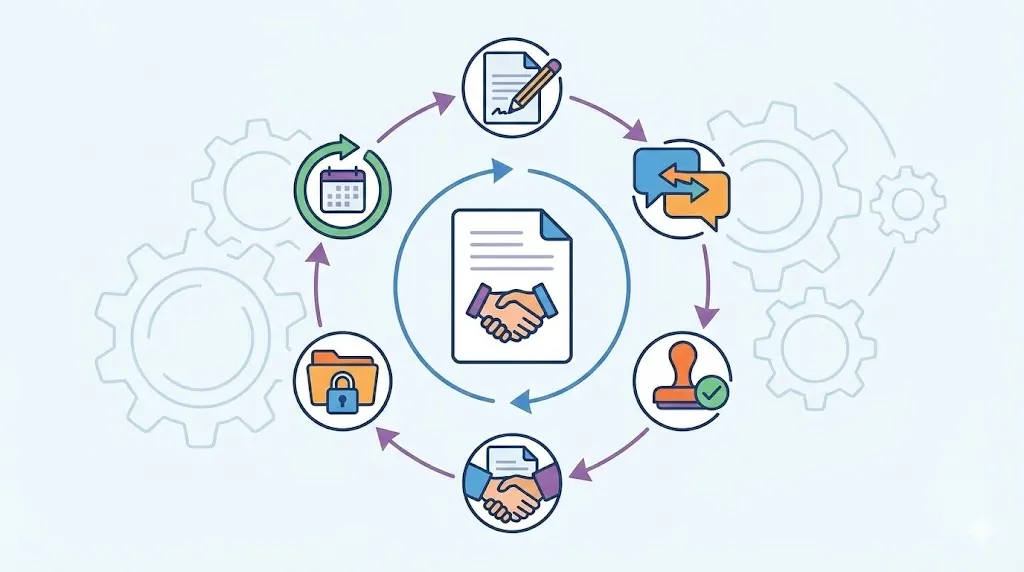
Volody AI CLM is an Agentic AI-powered Contract Lifecycle Management platform designed to eliminate manual contracting tasks, automate complex workflows, and deliver actionable insights. As a one-stop shop for all contract activities, it covers drafting, collaboration, negotiation, approvals, e-signature, compliance tracking, and renewals. Built with enterprise-grade security and no-code configuration, it meets the needs of the most complex global organizations. Volody AI CLM also includes AI-driven contract review and risk analysis, helping teams detect issues early and optimize terms. Trusted by Fortune 500 companies, high-growth startups, and government entities, it transforms contracts into strategic, data-driven business assets.



" height="216.72211px" id="FYO0bO80Y" transform="translate(3 6.105)" width="206.073px"/><path d="M 108.174 222 C 88.432 222 70.303 217.239 53.785 207.717 C 37.267 198.196 24.173 185.052 14.504 168.285 C 4.835 151.312 0 132.165 0 110.845 C 0 89.731 4.835 70.792 14.504 54.025 C 24.173 37.052 37.267 23.804 53.785 14.282 C 70.303 4.761 88.432 0 108.174 0 C 128.116 0 146.246 4.761 162.562 14.282 C 179.08 23.804 192.073 37.052 201.541 54.025 C 211.21 70.792 216.044 89.731 216.044 110.845 C 216.044 132.165 211.21 151.312 201.541 168.285 C 192.073 185.052 179.08 198.196 162.562 207.717 C 146.044 217.239 127.915 222 108.174 222 Z M 108.174 183.189 C 120.864 183.189 132.044 180.291 141.713 174.495 C 151.382 168.492 158.936 160.006 164.375 149.035 C 169.814 138.064 172.533 125.334 172.533 110.845 C 172.533 96.355 169.814 83.729 164.375 72.965 C 158.936 61.994 151.382 53.611 141.713 47.815 C 132.044 42.02 120.864 39.122 108.174 39.122 C 95.483 39.122 84.202 42.02 74.332 47.815 C 64.663 53.611 57.109 61.994 51.67 72.965 C 46.231 83.729 43.511 96.355 43.511 110.845 C 43.511 125.334 46.231 138.064 51.67 149.035 C 57.109 160.006 64.663 168.492 74.332 174.495 C 84.202 180.291 95.483 183.189 108.174 183.189 Z" fill="rgba(255, 255, 255, 0.12)" height="222px" id="aa1McFcE9" transform="translate(227.183 3)" width="216.04399999999998px"/><path d="M 42.302 182.257 L 111.799 182.257 L 111.799 216.722 L 0 216.722 L 0 0 L 42.302 0 Z" fill="rgba(255, 255, 255, 0.12)" height="216.72211px" id="yRq4AnrsX" transform="translate(477.721 6.105)" width="111.79899999999998px"/><path d="M 108.174 222 C 88.432 222 70.303 217.239 53.785 207.717 C 37.267 198.196 24.173 185.052 14.504 168.285 C 4.835 151.312 0 132.165 0 110.845 C 0 89.731 4.835 70.792 14.504 54.025 C 24.173 37.052 37.267 23.804 53.785 14.282 C 70.303 4.761 88.432 0 108.174 0 C 128.116 0 146.246 4.761 162.562 14.282 C 179.08 23.804 192.073 37.052 201.541 54.025 C 211.21 70.792 216.045 89.731 216.045 110.845 C 216.045 132.165 211.21 151.312 201.541 168.285 C 192.073 185.052 179.08 198.196 162.562 207.717 C 146.044 217.239 127.915 222 108.174 222 Z M 108.174 183.189 C 120.864 183.189 132.044 180.291 141.713 174.495 C 151.382 168.492 158.936 160.006 164.375 149.035 C 169.814 138.064 172.534 125.334 172.534 110.845 C 172.534 96.355 169.814 83.729 164.375 72.965 C 158.936 61.994 151.382 53.611 141.713 47.815 C 132.044 42.02 120.864 39.122 108.174 39.122 C 95.483 39.122 84.202 42.02 74.332 47.815 C 64.663 53.611 57.108 61.994 51.67 72.965 C 46.231 83.729 43.511 96.355 43.511 110.845 C 43.511 125.334 46.231 138.064 51.67 149.035 C 57.108 160.006 64.663 168.492 74.332 174.495 C 84.202 180.291 95.483 183.189 108.174 183.189 Z" fill="rgba(255, 255, 255, 0.12)" height="222px" id="mo8HQspQ0" transform="translate(609.155 3)" width="216.04500000000007px"/><path d="M 73.727 0 C 95.885 0 115.324 4.45 132.044 13.351 C 148.967 22.252 161.957 34.982 171.027 51.541 C 180.287 67.894 184.917 86.937 184.917 108.671 C 184.917 130.405 180.287 149.449 171.027 165.801 C 161.957 181.947 148.967 194.47 132.044 203.371 C 115.324 212.271 95.885 216.722 73.727 216.722 L 0 216.722 L 0 0 Z M 72.216 179.773 C 94.374 179.773 111.497 173.564 123.583 161.144 C 135.669 148.724 141.713 131.233 141.713 108.671 C 141.713 86.109 135.669 68.515 123.583 55.888 C 111.497 43.055 94.374 36.638 72.216 36.638 L 42.302 36.638 L 42.302 179.773 Z" fill="rgba(255, 255, 255, 0.12)" height="216.72211px" id="I3iXX5Hi_" transform="translate(859.693 6.105)" width="184.91699999999992px"/><path d="M 185.22 0 L 113.91 141.273 L 113.91 216.722 L 71.61 216.722 L 71.61 141.273 L 0 0 L 47.74 0 L 93.06 99.046 L 138.08 0 Z" fill="rgba(255, 255, 255, 0.12)" height="216.72211px" id="nzHyWC0_d" transform="translate(1061.78 6.105)" width="185.22000000000003px"/></svg>)