

Contracts hold more than just legal terms. For asset managers, they contain vital clues about risk, fees, and operations. Yet, most firms struggle to fully grasp what their contracts say. This gap costs money, time, and compliance headaches. Contract Intelligence for Asset Managers: Unlock Hidden Value shows how firms can turn dense agreements into actionable insights. Imagine knowing every fee detail, regulatory duty, and risk factor across thousands of contracts instantly. That knowledge shapes smarter decisions and sharper competitive edges.
TL;DR
In the portfolios of asset managers, thousands of intricate contracts conceal essential operational and financial information.
Additionally, manual contract review processes are frequently slow and prone to errors, resulting in incomplete visibility of risks and revenue streams.
Undisclosed fee structures and side letters frequently give rise to revenue leakage and present significant compliance challenges.
Growth in business activity drives a surge in contract volume, which in turn exacerbates inefficiencies and inflates operational costs.
Applying AI to contract intelligence enables rapid, comprehensive evaluation of contractual obligations alongside their inherent risks.
By embedding contract data directly into workflows, contract management platforms deliver marked improvements in both operational efficiency and governance.
Related Article: Mastering Advanced Conditions to Maximize Workflow
What Challenges Do Asset Managers Face with Contract Data?
Asset managers navigate an extensive array of agreements daily. Additionally, these encompass investor agreements, ISDA schedules, side letters, custody contracts, and various other documents. Each document contains unique terms about fees, risk, reporting, and compliance. However, most firms store these contracts in shared drives, email chains, or siloed legal folders. The contracts exist but remain largely invisible to business teams.
The real problem is not the volume of contracts but the inability to extract meaningful data from them. Contracts are written in natural language, often with bespoke clauses and complex legalese. This makes manual review slow and prone to errors. For example, compliance officers often have to estimate how many contracts are currently subject to regulatory obligations. Similarly, CFOs may find it challenging to confirm on the spot whether all performance fees have been properly reconciled.
This situation presents three central challenges:
1. Regulatory Risk Is Hard to Track
The regulatory environment for asset managers is in constant flux. Multiple layers of contractual obligations arise from evolving data privacy mandates, disclosure requirements, ESG reporting standards, and cross-border custody rules. Compliance teams still rely on manual contract reviews to assess impact when rules update. Moreover, this approach tends to be slow, incomplete, and exposes firms to significant risk. Sampling contracts creates blind spots that regulators may not accept. Without comprehensive insight, firms risk fines or disruptions to their operations.
2. Revenue Leakage from Complex Fee Terms
Fee structures in asset management are often complex and customized. Contracts may include performance fees, rebates, and investor-specific pricing buried in side letters. Operations teams struggle to track these accurately through manual processes. This leads to missed fees, incorrect rebates, and lost revenue. Fee compression means every basis point counts. Still, many firms are unable to enforce fee terms consistently because contract data is locked in documents.
3. Operational Bottlenecks Grow with Business
As firms grow by launching new funds, onboarding counterparties, or adding investors, contract volumes increase significantly. Furthermore, without scalable systems, legal and operations teams face longer review cycles and delays. ISDA negotiations slow down. Side letters pile up without proper tracking. This operational drag limits growth speed and increases costs. The risk is that business decisions rely on outdated or incomplete contract information.
These challenges are not due to lack of talent. Legal, compliance, and finance teams are skilled professionals. The core issue is that contract data remains unstructured and disconnected from business systems. Firms need a solution that turns contracts into structured, searchable intelligence.
Related articles: What is Contract Risk & How to manage it?
Why Is Contract Intelligence Critical for Asset Managers?
Contract intelligence means using technology to read, understand, and analyze contracts at scale. Additionally, it also converts unstructured contract text into structured data points. This data then integrates with workflows and reporting tools. The benefits for asset managers include:
Faster Regulatory Impact Analysis
When a new rule is announced, contract intelligence software can instantly identify which agreements contain affected clauses. This eliminates weeks of manual review. Compliance teams gain confidence that no contracts are missed. For example, AI can flag all contracts with data transfer provisions impacted by GDPR or the EU AI Act. This speeds up compliance and reduces risk.
Accurate Fee and Revenue Management
Contract intelligence extracts fee terms, performance conditions, and rebate triggers automatically. Finance teams can reconcile fees against negotiated terms without manual cross-checks. This reduces revenue leakage and improves billing accuracy. For instance, side letter modifications to fee structures become visible and enforceable. Firms recover lost revenue and improve investor trust.
Continuous Portfolio Risk Monitoring
Instead of one-off contract reviews, firms gain ongoing visibility into contractual obligations and risks. AI tracks counterparty risk triggers, margining terms, and regulatory representations across thousands of contracts. This real-time insight enables proactive risk management. For example, firms can monitor if any counterparty agreements breach new regulatory limits immediately.
Scalability and Operational Efficiency
Contract intelligence capabilities scale seamlessly alongside organizational expansion. This technology alleviates legal review bottlenecks and accelerates the onboarding workflow. Operations teams experience a marked reduction in the time required to locate specific contract details. As a result, organizations are able to grow rapidly without a proportional rise in staffing requirements. For example, new fund launches proceed smoothly without contract-related delays, enhancing time-to-market.
Data-Driven Decision Making
Contract data integrates with dashboards and analytics tools. Executives gain a clear picture of obligations, risks, and revenue streams. This supports strategic planning and compliance reporting. For example, CFOs can forecast fee income accurately based on contract terms. Compliance officers can prepare audit-ready reports quickly.
Contract intelligence transforms contracts from inert documents into valuable, actionable business assets. Organizations implementing it secure a distinct and quantifiable advantage.
Related articles: Contract Risk Analysis Strengthened By AI In Legal Ops
What Types of Contracts and Data Are Asset Managers Managing?
Asset managers’ contract portfolios are diverse and complex. Additionally, understanding the specific types of agreements and the data they encompass reveals the critical role of intelligence.
Investor Agreements
Investor agreements encompass elements such as subscription terms, fee schedules, redemption rights, and reporting obligations. Individual contracts may present distinct pricing models or specific conditions governing redemptions. Side letters often serve to amend or supplement these provisions. Attempting to manage this data without automation significantly increases the potential for error.
ISDA and Counterparty Agreements
ISDA schedules provide the foundational framework governing derivatives trading and associated risk management protocols. These documents delineate margining requirements, credit events, and pertinent regulatory declarations. Counterparty agreements commonly include risk-related clauses that require continuous monitoring.
Service Provider Contracts
Moreover, agreements with custodians, administrators, and prime brokers specify service levels, data rights, liability limits, and geographic restrictions. These stipulations directly influence operational risk and compliance.
Side Letters
Side letters serve to modify standard contractual terms in accordance with individual investor needs. They often embed bespoke fee structures or detailed reporting obligations. Because these documents rarely feed directly into centralized record systems, they create significant gaps in oversight.
Custody and Brokerage Contracts
These contracts stipulate conditions on asset safekeeping, transaction fees, and regulatory adherence. Clauses within often activate in response to market or regulatory developments.
Each contract type carries critical data points. Firms need to extract and consolidate these to manage risk, revenue, and operations effectively.
Related articles: Significance of tracking data points in contract management
How Does Contract Intelligence Work in Practice?
Contract intelligence uses artificial intelligence and natural language processing to analyze contract text. The process includes several steps:
1. Document Ingestion and OCR
Contracts, often in PDF or scanned formats, are uploaded into the system. Optical character recognition converts scanned images into searchable text.
2. Metadata Extraction
Key metadata such as parties, dates, payment terms, jurisdictions, and contract type are extracted to create a structured contract index.
3. Clause Identification and Classification
AI models recognize standard clauses like termination, indemnity, fees, and compliance obligations. They also detect custom or unusual clauses.
4. Semantic Search and Querying
Users can search contracts using natural language queries. For instance, entering “Show agreements containing GDPR data transfer clauses” returns relevant contracts with highlighted key sections.
5. Risk and Compliance Analysis
Configurable legal playbooks evaluate clauses against regulatory requirements or internal policies. The system flags risky or non-compliant terms.
6. Obligation and Renewal Tracking
In addition, deliverables, milestones, renewal dates, and notices are tracked automatically. Automated alerts prevent missed deadlines.
7. Integration with Business Systems
Contract data feeds into billing, compliance, and risk management platforms. This ensures contract terms drive operational workflows.
Related Article: Contract Data Extraction: A Complete Guide for 2026
Example Scenario
A compliance officer receives notice of a new SEC marketing rule. Instead of manually reviewing hundreds of contracts, a query is entered into the contract intelligence system. Within minutes, agreements with marketing-related clauses are located. The officer conducts a detailed review of the identified contracts before assembling a comprehensive compliance report. What once required weeks of manual effort is now streamlined into a process that takes only a few hours.
Related articles: How Does AI Limitations Impacting Contract Management?
What Are the Top 5 Benefits of Contract Intelligence for Asset Managers?
Contract intelligence delivers measurable value across multiple dimensions. Here are five key benefits:
1. Reduce Compliance Risk
Automated identification of regulatory obligations ensures firms meet evolving rules. Continuous monitoring detects contract changes or breaches early.
2. Recover Lost Revenue
By surfacing hidden fee terms and rebate conditions, firms can enforce agreements accurately, minimizing revenue leakage and preventing billing inaccuracies.
3. Accelerate Operations
Contract review and negotiation cycles become significantly more efficient. The process of onboarding new funds and counterparties accelerates accordingly. Legal and operations teams devote their attention to exceptions rather than routine workflows.
4. Improve Transparency and Control
Executives gain a real-time view of contractual obligations and risks, enabling enhanced decision-making processes and ensuring preparedness for audits.
5. Scale Without Adding Headcount
These intelligence platforms are engineered to manage increasing contract workloads seamlessly. Consequently, firms can prevent operational slowdowns while maintaining strict budget discipline.
Dive deeper into these challenges and solutions in our detailed article: Contract Management Security: Risks, Mistakes and Solutions
What Are the Biggest Obstacles to Adopting Contract Intelligence?
While the advantages of contract intelligence are well-documented, many asset managers remain cautious about its implementation.
Data Quality and Legacy Contracts
Additionally, one significant hurdle lies in the condition of older contracts, which are often scanned documents or suffer from poor formatting.
Achieving precise data extraction typically requires meticulous cleanup efforts and the establishment of stringent validation protocols.
Change Management
Legal and compliance teams often resist transitioning to new workflows.
Successfully addressing this resistance depends on delivering in-depth training programs alongside clear and consistent communication.
Integration Complexity
Connecting contract intelligence with existing systems like billing or compliance platforms can be challenging.
Cost and ROI Concerns
Initial investment in technology and process changes can be significant. Organizations must rigorously assess and justify the anticipated return on investment before proceeding.
Customization Needs
Contract language varies widely across funds and counterparties. It is essential to adapt AI models to the specific terminologies and contextual nuances encountered.
Addressing these obstacles requires careful planning, vendor support, and executive sponsorship.
Related articles: Contract Data Extraction: Unlocking Value from PDF Contracts
How Contract Management Software Solves This
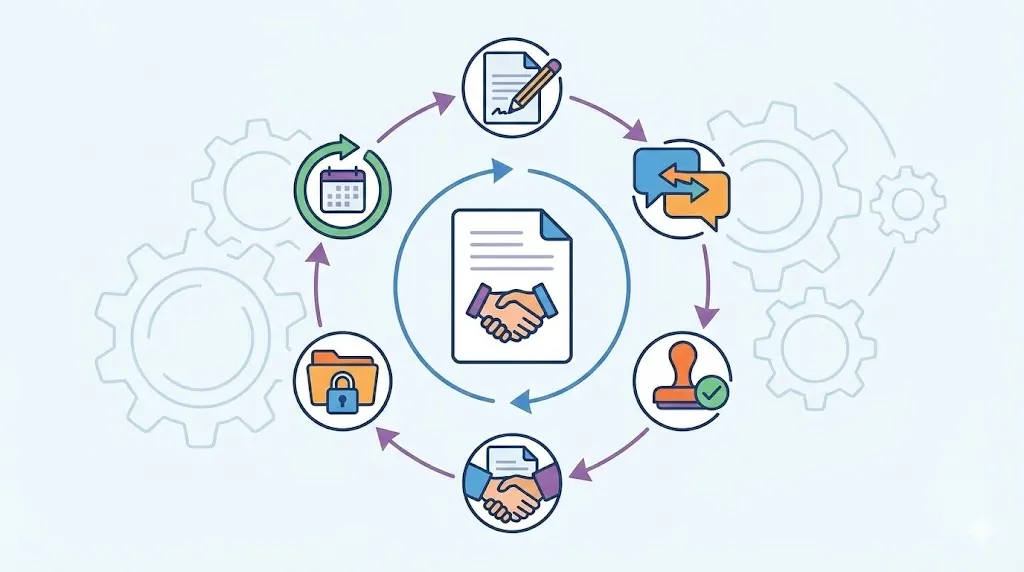
Volody’s solution functions as a centralized repository for contracts while incorporating advanced intelligence layers. Additionally, it also surpasses mere storage capabilities by extracting data and automating workflows. Features such as AI contract review, clause libraries, and obligation tracking significantly reduce manual effort.
Contemporary CLM solutions integrate deeply with finance, compliance, and risk management systems. They provide dashboards delivering real-time insights into contract status, risks, and revenue impacts. This comprehensive integration creates a consistent and reliable data foundation for all contract-related information.
Volody’s platform offers AI-powered capabilities for drafting contracts, conducting reviews, and extracting metadata. It tracks obligations, streamlines approval workflows, and facilitates electronic signatures. These functionalities enable asset managers to enforce fee terms accurately, stay ahead of regulatory changes, and accelerate onboarding.
Want to see how Volody's CLM Software can simplify your legal workflows?
FAQ
What is contract intelligence in asset management?
Contract intelligence uses AI to analyze and extract data from contracts. It turns unstructured text into searchable, structured information. Furthermore, this helps asset managers track fees, risks, and obligations across thousands of agreements quickly.
Why do asset managers face difficulties managing contract data?
Contracts are often dispersed across various folders or emails, containing complex and customized language that challenges manual analysis. This situation leads to gaps in compliance, revenue assurance, and operational oversight.
In what ways does contract intelligence improve compliance?
It promptly identifies all contracts impacted by regulatory changes. Also, this accelerates review processes and guarantees that no obligations go unnoticed. Additionally, continuous monitoring notifies teams of emerging risks.
Is it possible for contract intelligence to assist in recovering lost fees?
Yes. It uncovers hidden fee terms, rebates, and side letter modifications. This enables finance teams to reconcile fees accurately and minimize revenue leakage.
What types of contracts benefit most from intelligence?
Investor agreements, ISDA schedules, side letters, custody contracts, and service provider agreements all contain critical data. Therefore, contract intelligence helps manage these complex documents at scale.
Is AI reliable for contract analysis?
Recent AI models trained specifically on legal language demonstrate a high degree of accuracy. They are capable of precisely identifying clauses and extracting relevant metadata. Nevertheless, expert review remains crucial to address exceptions.
How does contract intelligence support business expansion?
By automating routine contract analysis, it alleviates manual workload. Consequently, this scalability allows firms to manage increased contract volumes without proportionate growth in headcount or delays.
What challenges do firms face adopting contract intelligence?
Common challenges include ensuring high data quality, managing organizational change, integrating with existing systems, controlling costs, and customizing solutions. Effective adoption depends on thorough planning and strong vendor support.
Can contract intelligence connect with other systems?
Yes. Most platforms integrate with billing, compliance, risk, and CRM systems. As a result, this connectivity ensures contract data drives operational workflows.
How quickly can firms realize ROI from contract intelligence?
Return on investment varies with contract volume and complexity. Many firms recoup their investment within months by mitigating compliance risks and recovering fees.
What distinguishes contract intelligence from contract management?
Contract intelligence focuses on extracting and analyzing contract data. Contract management involves storing contracts, automating workflows, and managing approvals. Together, they provide end-to-end contract control.
This article has covered the challenges asset managers face with contract data, the benefits of contract intelligence, and how modern software solutions help. Unlocking hidden value in contracts is now possible with AI-powered tools that turn dense legal documents into actionable business insights.
About the Company

Volody AI CLM is an Agentic AI-powered Contract Lifecycle Management platform designed to eliminate manual contracting tasks, automate complex workflows, and deliver actionable insights. As a one-stop shop for all contract activities, it covers drafting, collaboration, negotiation, approvals, e-signature, compliance tracking, and renewals. Built with enterprise-grade security and no-code configuration, it meets the needs of the most complex global organizations. Volody AI CLM also includes AI-driven contract review and risk analysis, helping teams detect issues early and optimize terms. Trusted by Fortune 500 companies, high-growth startups, and government entities, it transforms contracts into strategic, data-driven business assets.





" height="216.72211px" id="FYO0bO80Y" transform="translate(3 6.105)" width="206.073px"/><path d="M 108.174 222 C 88.432 222 70.303 217.239 53.785 207.717 C 37.267 198.196 24.173 185.052 14.504 168.285 C 4.835 151.312 0 132.165 0 110.845 C 0 89.731 4.835 70.792 14.504 54.025 C 24.173 37.052 37.267 23.804 53.785 14.282 C 70.303 4.761 88.432 0 108.174 0 C 128.116 0 146.246 4.761 162.562 14.282 C 179.08 23.804 192.073 37.052 201.541 54.025 C 211.21 70.792 216.044 89.731 216.044 110.845 C 216.044 132.165 211.21 151.312 201.541 168.285 C 192.073 185.052 179.08 198.196 162.562 207.717 C 146.044 217.239 127.915 222 108.174 222 Z M 108.174 183.189 C 120.864 183.189 132.044 180.291 141.713 174.495 C 151.382 168.492 158.936 160.006 164.375 149.035 C 169.814 138.064 172.533 125.334 172.533 110.845 C 172.533 96.355 169.814 83.729 164.375 72.965 C 158.936 61.994 151.382 53.611 141.713 47.815 C 132.044 42.02 120.864 39.122 108.174 39.122 C 95.483 39.122 84.202 42.02 74.332 47.815 C 64.663 53.611 57.109 61.994 51.67 72.965 C 46.231 83.729 43.511 96.355 43.511 110.845 C 43.511 125.334 46.231 138.064 51.67 149.035 C 57.109 160.006 64.663 168.492 74.332 174.495 C 84.202 180.291 95.483 183.189 108.174 183.189 Z" fill="rgba(255, 255, 255, 0.12)" height="222px" id="aa1McFcE9" transform="translate(227.183 3)" width="216.04399999999998px"/><path d="M 42.302 182.257 L 111.799 182.257 L 111.799 216.722 L 0 216.722 L 0 0 L 42.302 0 Z" fill="rgba(255, 255, 255, 0.12)" height="216.72211px" id="yRq4AnrsX" transform="translate(477.721 6.105)" width="111.79899999999998px"/><path d="M 108.174 222 C 88.432 222 70.303 217.239 53.785 207.717 C 37.267 198.196 24.173 185.052 14.504 168.285 C 4.835 151.312 0 132.165 0 110.845 C 0 89.731 4.835 70.792 14.504 54.025 C 24.173 37.052 37.267 23.804 53.785 14.282 C 70.303 4.761 88.432 0 108.174 0 C 128.116 0 146.246 4.761 162.562 14.282 C 179.08 23.804 192.073 37.052 201.541 54.025 C 211.21 70.792 216.045 89.731 216.045 110.845 C 216.045 132.165 211.21 151.312 201.541 168.285 C 192.073 185.052 179.08 198.196 162.562 207.717 C 146.044 217.239 127.915 222 108.174 222 Z M 108.174 183.189 C 120.864 183.189 132.044 180.291 141.713 174.495 C 151.382 168.492 158.936 160.006 164.375 149.035 C 169.814 138.064 172.534 125.334 172.534 110.845 C 172.534 96.355 169.814 83.729 164.375 72.965 C 158.936 61.994 151.382 53.611 141.713 47.815 C 132.044 42.02 120.864 39.122 108.174 39.122 C 95.483 39.122 84.202 42.02 74.332 47.815 C 64.663 53.611 57.108 61.994 51.67 72.965 C 46.231 83.729 43.511 96.355 43.511 110.845 C 43.511 125.334 46.231 138.064 51.67 149.035 C 57.108 160.006 64.663 168.492 74.332 174.495 C 84.202 180.291 95.483 183.189 108.174 183.189 Z" fill="rgba(255, 255, 255, 0.12)" height="222px" id="mo8HQspQ0" transform="translate(609.155 3)" width="216.04500000000007px"/><path d="M 73.727 0 C 95.885 0 115.324 4.45 132.044 13.351 C 148.967 22.252 161.957 34.982 171.027 51.541 C 180.287 67.894 184.917 86.937 184.917 108.671 C 184.917 130.405 180.287 149.449 171.027 165.801 C 161.957 181.947 148.967 194.47 132.044 203.371 C 115.324 212.271 95.885 216.722 73.727 216.722 L 0 216.722 L 0 0 Z M 72.216 179.773 C 94.374 179.773 111.497 173.564 123.583 161.144 C 135.669 148.724 141.713 131.233 141.713 108.671 C 141.713 86.109 135.669 68.515 123.583 55.888 C 111.497 43.055 94.374 36.638 72.216 36.638 L 42.302 36.638 L 42.302 179.773 Z" fill="rgba(255, 255, 255, 0.12)" height="216.72211px" id="I3iXX5Hi_" transform="translate(859.693 6.105)" width="184.91699999999992px"/><path d="M 185.22 0 L 113.91 141.273 L 113.91 216.722 L 71.61 216.722 L 71.61 141.273 L 0 0 L 47.74 0 L 93.06 99.046 L 138.08 0 Z" fill="rgba(255, 255, 255, 0.12)" height="216.72211px" id="nzHyWC0_d" transform="translate(1061.78 6.105)" width="185.22000000000003px"/></svg>)