

Contracts shape every major business deal. Yet, many legal and operations teams struggle to measure how well their contract workflows perform. Without clear insights, delays, errors, and risks quietly hurt revenue and slow growth. Contract process KPIs that drive business outcomes help you see exactly where contracts stall, where risks hide, and how your team’s work affects the bottom line. Imagine knowing precisely how long each contract stage takes, spotting bottlenecks early, and proving your legal team’s value with hard data.
TL;DR
Contract process KPIs track performance at every contract stage, from request to renewal.
Additionally, measuring cycle time identifies bottlenecks in the contract process and accelerates deal closure.
Quality KPIs ensure faster contracts don’t sacrifice accuracy or compliance.
Risk KPIs catch missed deadlines and obligations before they cause losses.
Regular KPI reviews help teams fix issues early and show leadership the legal team’s impact.
AI-powered contract management tools automate KPI tracking and improve data accuracy.
What Are Contract Process KPIs and Why Do They Matter?
Contract process KPIs are specific, measurable goals that track how efficiently and effectively your contract workflow operates. Additionally, these metrics span the entire lifecycle of a contract, from the moment a request is submitted through to final execution, renewal, or termination. These KPIs answer a critical question legal and operations teams face: “How do we know our contract process is working?”
It helps to distinguish KPIs from simple metrics. A metric is a raw number, like the total contracts processed last month. A KPI ties that number to a goal, such as reducing contract cycle time by 20% this quarter. Metrics tell you what happened. KPIs tell you if the results meet your business objectives.
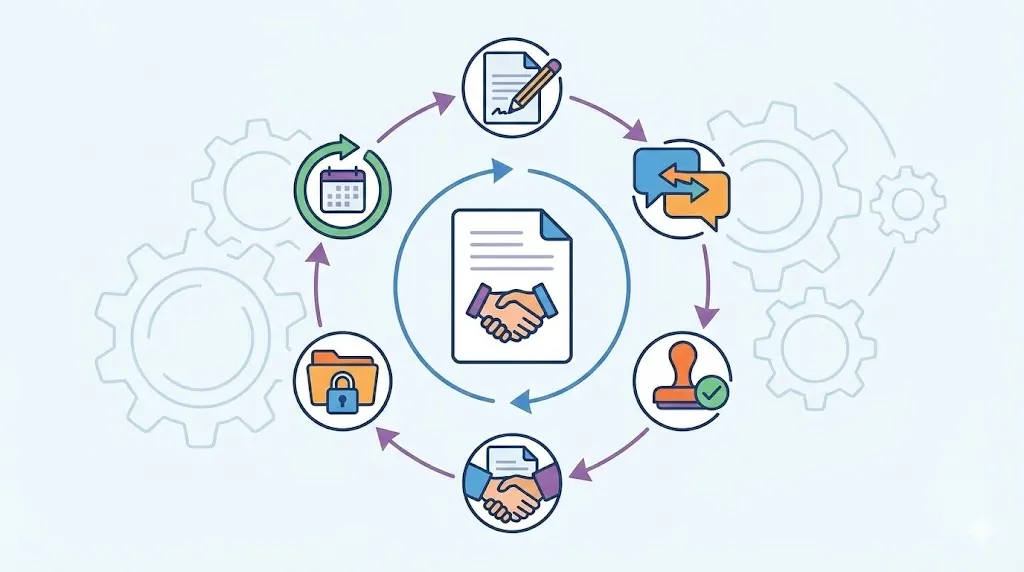
Contracts move through many stages, and KPIs can measure each one:
Intake: How fast contract requests enter the system and reach the right team.
Drafting: Measures the duration required to produce the initial contract draft.
Negotiation: Assesses both how often and how long each review iteration takes.
Approval: Tracks the waiting period for internal sign-off on contracts.
Execution: Captures the interval between contract approval and final signature.
Renewal and Obligations: Tracking adherence to key deadlines, deliverables, and upcoming renewal events.
By aligning KPIs with each phase, organizations gain nuanced visibility into specific bottlenecks or errors emerging during the contract lifecycle. Rather than speculating on delays, data-driven insights pinpoint the precise stage that demands corrective action.
Without KPIs, teams rely on gut feel or anecdotal evidence. This leads to missed deadlines, compliance gaps, and lost revenue. According to the 2025 Legal Operations Field Guide, poor contract management causes companies to lose 5-9% of annual revenue. KPIs provide the data to fix these issues and prove the legal team’s value to leadership.
Related Article: Contract Process KPIs That Boost Business Performance
How to Choose Contract Process KPIs That Align With Business Goals
You don’t need to track every possible KPI at once. Choose KPIs that reflect your current priorities, whether that’s speeding up contracts, improving contract quality, or reducing risk. Here are some categories and examples to consider:
Speed and Cycle Time KPIs
Speed is often the first focus because it’s easy to measure and understand. These KPIs track how quickly contracts move through each stage.
Average Duration from Request to Execution: Days from contract request to full execution. This shows overall process health.
Time to Signature: Days between final approval and signed contract. Highlights execution delays.
Negotiation Duration: Total days spent in back-and-forth redlining. Reveals negotiation bottlenecks.
Approval Turnaround: Time contracts spend waiting for internal sign-off. Pinpoints internal delays.
Start by measuring overall cycle duration from contract initiation to execution. If it’s longer than expected, drill down into individual stages to find the cause.
Quality and Throughput KPIs
Speed is insufficient if contracts are riddled with errors or fail to meet compliance standards, as these issues can lead to significant complications downstream. Indicators that measure accuracy and defect rates are essential for upholding quality standards.
Error Frequency: The share of contracts requiring amendments after execution.
Contract Amendments: Total modifications recorded post-signature.
Compliance Adherence: Share of contracts conforming to internal policies and external regulations. Also, ensures risk is controlled.
Contract Volume: Number of contracts processed in a period. Measures team throughput and capacity.
Balancing speed with quality prevents teams from rushing contracts at the expense of accuracy.
Risk and Compliance KPIs
Contracts carry legal and financial risks. These KPIs focus on tracking deadlines, obligations, and compliance to avoid costly mistakes.
Renewal Monitoring Accuracy: Share of contracts with renewal deadlines systematically tracked. Therefore, prevents missed renewals or auto-renewals.
Obligation Fulfillment Rate: Percentage of contract obligations met on time. Ensures contractual promises are kept.
Compliance Gap Incidents: Count of contracts found out of compliance during audits. Also, highlights risk exposure.
Missed Deadline Count: Number of missed contract milestones or deliverables. Signals process weaknesses.
Risk KPIs serve as critical early indicators, enabling teams to address issues before they affect revenue or reputation.
Customer and Stakeholder Satisfaction KPIs
Contracts affect many internal and external stakeholders. Measuring satisfaction can reveal hidden pain points.
Requestor Satisfaction Score: Ratings from business units regarding contract turnaround times and clarity.
Counterparty Feedback: Assessments from external parties on the efficiency of negotiation and contract execution.
Internal Legal Team Efficiency: Self-evaluations reflecting workload balance and process efficacy.
These KPIs help align contract management with user needs and improve collaboration.
How to Track and Report Contract Process KPIs Effectively
Tracking contract KPIs requires consistent data collection and clear reporting. Here are best practices for success:
Centralize Contract Data
Gather all contract-related data in one place. Avoid scattered spreadsheets, email threads, or shared drives. Centralized contract management systems automatically log information and minimize errors.
Define Clear KPI Targets
Set realistic, measurable goals for each KPI. For example, reduce average cycle time from 30 to 20 days in six months. Clear targets guide improvement efforts and show progress.
Use Visual Dashboards
Present KPI data visually with charts and graphs. Dashboards make it easy for teams and leadership to spot trends and issues quickly.
Review KPIs Regularly
Hold monthly operational reviews to identify bottlenecks early. Use quarterly executive summaries to demonstrate the legal team’s impact on business outcomes.
Combine Quantitative and Qualitative Data
Numbers tell part of the story. Combine KPIs with feedback from stakeholders to get a full picture of contract performance.
Automate Where Possible
Manual tracking is slow and error-prone. Use contract lifecycle management (CLM) software or AI tools to automatically record data throughout each stage.
What Contract Process KPIs Reveal About Your Workflow
KPIs do more than measure speed or volume. Additionally, beyond these metrics, they reveal how complex your contract lifecycle is and shed light on how well your team collaborates.
Bottlenecks: When approval turnaround times stretch out, it often signals that sign-off procedures require refinement or that resources should be reallocated.
Negotiation Challenges: Extended negotiation timelines or repeated revision cycles frequently stem from ambiguous contract clauses or counterparties with stringent requirements.
Quality Issues: Frequent amendments often expose deficiencies in drafting accuracy, inefficiencies in review protocols, or problematic base templates.
Risk Exposure: Missed deadlines and compliance failures typically reveal gaps in obligation tracking or a lack of sufficient oversight.
Team Capacity: Analyzing contract throughput relative to cycle duration can clarify whether current staffing aligns with workload demands or if augmentation is necessary.
Addressing these factors enables reduction of bottlenecks, enhancement of contract integrity, and mitigation of operational risk.
Related articles: Contract Review, Faster: A Step-by-Step Playbook
Common Contract Process KPIs to Track With Examples
Here is a detailed list of KPIs with practical examples to help you get started:
KPI Name | What It Measures | Why It Matters | Example Target |
|---|---|---|---|
Total days from request to execution | Shows overall process speed | Reduce from 30 to 20 days in 6 months | |
Time to Signature | Days from approval to signed contract | Identifies delays in final execution | Under 5 days |
Negotiation Duration | Days spent in redlining and review | Highlights negotiation bottlenecks | Less than 10 days |
Approval Turnaround | Time contracts wait for internal sign-off | Reveals internal routing delays | Under 48 hours |
Error Rate | Portion of contracts requiring amendments post-signature | Ensures contract quality | Less than 5% |
Percentage of contracts adhering to policies and regulations | Controls legal and regulatory risk | 100% compliance | |
Renewal Tracking Accuracy | Proportion of contracts with monitored renewal dates | Prevents missed renewals and revenue loss | 100% tracked |
Obligation Fulfillment Rate | Percentage of contract obligations met on time | Ensures contractual promises are kept | 95% or higher |
Contract Volume | Number of contracts processed | Measures team throughput and capacity | Increase by 10% annually |
Requestor Satisfaction | Internal feedback on contract process | Aligns legal service with business needs | 90% positive or higher |
Related articles: Legal AI Accuracy: Can It Really Match Human Review?
How AI and Contract Management Software Support Contract Process KPIs
Manual tracking of contract KPIs is time-consuming and prone to errors. Leveraging contract lifecycle management (CLM) software with integrated AI capabilities significantly enhances the accuracy and scalability of KPI monitoring.
Automated Data Capture
AI-driven CLM platforms facilitate the extraction of structured data at each stage of the contract lifecycle with minimal manual intervention. The system captures exact timestamps for critical milestones, including contract intake, drafting, negotiation, approval, and execution.
Real-Time KPI Dashboards
These platforms provide live dashboards showing cycle times, bottlenecks, and compliance risks. Teams can react quickly to emerging issues.
Risk and Compliance Monitoring
AI scans contracts for missing clauses, deadlines, or compliance gaps. It alerts teams before problems escalate.
Workflow Automation
In addition, AI streamlines routine processes including contract routing, approval reminders, and renewal notifications. This reduces delays and human error.
Enhanced Reporting
Generate detailed KPI reports with minimal effort. Share insights with leadership to demonstrate the legal team’s business impact.
Example Use Case
A mid-sized company used AI-enabled CLM to track contract cycle times. They identified approval queues causing two-week delays. After automating reminders and delegating authority, cycle time dropped by 40%, accelerating deal closure and boosting revenue.
According to a 2026 Contracting Benchmark Report, organizations using AI in contract management saw cycle times reduced by 30% on average.
Why Legal AI Software Makes a Difference
Legal technology enables teams to accurately track contract KPIs and accelerate insight-driven actions. Additionally, it also minimizes manual processes while enhancing the quality of contract data.
Lawxy offers an AI-powered legal assistant designed to streamline contract drafting, review, risk assessment, and workflow coordination. This platform extracts granular contract information and delivers real-time analytics for comprehensive KPI monitoring throughout the contract lifecycle. Lawxy’s intelligent agents automate routine operations, preserving human oversight for critical decision-making.
> Discover how Lawxy empowers your team to operate with greater confidence.
FAQ
What is the difference between a contract metric and a contract KPI?
Additionally, a metric quantifies raw data, such as the total number of contracts processed. A KPI, on the other hand, connects that figure to a strategic objective, like reducing cycle time by 15%. They serve as benchmarks to evaluate how well business objectives are being met.
Which contract process KPI should I track first?
The initial focus should be on average contract cycle time. It provides a comprehensive perspective on process efficiency and helps identify stages requiring further analysis.
How can I prevent faster contracts from sacrificing quality?
To maintain quality alongside speed, integrate KPIs that measure error rates and compliance levels. This approach ensures that contracts are executed both swiftly and with precision.
How often should I review contract KPIs?
Conduct monthly operational reviews to promptly detect bottlenecks. Share quarterly summaries with leadership to demonstrate your team’s impact.
Furthermore, can AI track contract KPIs automatically?
Yes. Moreover, AI-powered contract management tools capture data at every stage and generate real-time KPI dashboards, reducing manual work.
What types of risks can contract KPIs help identify?
These indicators highlight missed renewal deadlines, unfulfilled obligations, and compliance gaps that may lead to financial losses or legal complications.
In what ways do contract KPIs help legal teams prove their value?
By demonstrating the influence of contract turnaround times on deal velocity and revenue generation, legal teams can clearly articulate their contribution to overall business outcomes.
Also, what is a good target for contract approval turnaround time?
A common goal is under 48 hours. This ensures contracts don’t sit too long waiting for internal sign-off.
How do I track contract renewal accuracy?
Use a system that monitors renewal dates and alerts the team ahead of deadlines. Aim for 100% of contracts with tracked renewals.
Can contract KPIs improve collaboration between legal and business teams?
Yes. Sharing KPI data and feedback helps align expectations and smooth contract workflows across departments.
About the Company

Volody AI CLM is an Agentic AI-powered Contract Lifecycle Management platform designed to eliminate manual contracting tasks, automate complex workflows, and deliver actionable insights. As a one-stop shop for all contract activities, it covers drafting, collaboration, negotiation, approvals, e-signature, compliance tracking, and renewals. Built with enterprise-grade security and no-code configuration, it meets the needs of the most complex global organizations. Volody AI CLM also includes AI-driven contract review and risk analysis, helping teams detect issues early and optimize terms. Trusted by Fortune 500 companies, high-growth startups, and government entities, it transforms contracts into strategic, data-driven business assets.




" height="216.72211px" id="FYO0bO80Y" transform="translate(3 6.105)" width="206.073px"/><path d="M 108.174 222 C 88.432 222 70.303 217.239 53.785 207.717 C 37.267 198.196 24.173 185.052 14.504 168.285 C 4.835 151.312 0 132.165 0 110.845 C 0 89.731 4.835 70.792 14.504 54.025 C 24.173 37.052 37.267 23.804 53.785 14.282 C 70.303 4.761 88.432 0 108.174 0 C 128.116 0 146.246 4.761 162.562 14.282 C 179.08 23.804 192.073 37.052 201.541 54.025 C 211.21 70.792 216.044 89.731 216.044 110.845 C 216.044 132.165 211.21 151.312 201.541 168.285 C 192.073 185.052 179.08 198.196 162.562 207.717 C 146.044 217.239 127.915 222 108.174 222 Z M 108.174 183.189 C 120.864 183.189 132.044 180.291 141.713 174.495 C 151.382 168.492 158.936 160.006 164.375 149.035 C 169.814 138.064 172.533 125.334 172.533 110.845 C 172.533 96.355 169.814 83.729 164.375 72.965 C 158.936 61.994 151.382 53.611 141.713 47.815 C 132.044 42.02 120.864 39.122 108.174 39.122 C 95.483 39.122 84.202 42.02 74.332 47.815 C 64.663 53.611 57.109 61.994 51.67 72.965 C 46.231 83.729 43.511 96.355 43.511 110.845 C 43.511 125.334 46.231 138.064 51.67 149.035 C 57.109 160.006 64.663 168.492 74.332 174.495 C 84.202 180.291 95.483 183.189 108.174 183.189 Z" fill="rgba(255, 255, 255, 0.12)" height="222px" id="aa1McFcE9" transform="translate(227.183 3)" width="216.04399999999998px"/><path d="M 42.302 182.257 L 111.799 182.257 L 111.799 216.722 L 0 216.722 L 0 0 L 42.302 0 Z" fill="rgba(255, 255, 255, 0.12)" height="216.72211px" id="yRq4AnrsX" transform="translate(477.721 6.105)" width="111.79899999999998px"/><path d="M 108.174 222 C 88.432 222 70.303 217.239 53.785 207.717 C 37.267 198.196 24.173 185.052 14.504 168.285 C 4.835 151.312 0 132.165 0 110.845 C 0 89.731 4.835 70.792 14.504 54.025 C 24.173 37.052 37.267 23.804 53.785 14.282 C 70.303 4.761 88.432 0 108.174 0 C 128.116 0 146.246 4.761 162.562 14.282 C 179.08 23.804 192.073 37.052 201.541 54.025 C 211.21 70.792 216.045 89.731 216.045 110.845 C 216.045 132.165 211.21 151.312 201.541 168.285 C 192.073 185.052 179.08 198.196 162.562 207.717 C 146.044 217.239 127.915 222 108.174 222 Z M 108.174 183.189 C 120.864 183.189 132.044 180.291 141.713 174.495 C 151.382 168.492 158.936 160.006 164.375 149.035 C 169.814 138.064 172.534 125.334 172.534 110.845 C 172.534 96.355 169.814 83.729 164.375 72.965 C 158.936 61.994 151.382 53.611 141.713 47.815 C 132.044 42.02 120.864 39.122 108.174 39.122 C 95.483 39.122 84.202 42.02 74.332 47.815 C 64.663 53.611 57.108 61.994 51.67 72.965 C 46.231 83.729 43.511 96.355 43.511 110.845 C 43.511 125.334 46.231 138.064 51.67 149.035 C 57.108 160.006 64.663 168.492 74.332 174.495 C 84.202 180.291 95.483 183.189 108.174 183.189 Z" fill="rgba(255, 255, 255, 0.12)" height="222px" id="mo8HQspQ0" transform="translate(609.155 3)" width="216.04500000000007px"/><path d="M 73.727 0 C 95.885 0 115.324 4.45 132.044 13.351 C 148.967 22.252 161.957 34.982 171.027 51.541 C 180.287 67.894 184.917 86.937 184.917 108.671 C 184.917 130.405 180.287 149.449 171.027 165.801 C 161.957 181.947 148.967 194.47 132.044 203.371 C 115.324 212.271 95.885 216.722 73.727 216.722 L 0 216.722 L 0 0 Z M 72.216 179.773 C 94.374 179.773 111.497 173.564 123.583 161.144 C 135.669 148.724 141.713 131.233 141.713 108.671 C 141.713 86.109 135.669 68.515 123.583 55.888 C 111.497 43.055 94.374 36.638 72.216 36.638 L 42.302 36.638 L 42.302 179.773 Z" fill="rgba(255, 255, 255, 0.12)" height="216.72211px" id="I3iXX5Hi_" transform="translate(859.693 6.105)" width="184.91699999999992px"/><path d="M 185.22 0 L 113.91 141.273 L 113.91 216.722 L 71.61 216.722 L 71.61 141.273 L 0 0 L 47.74 0 L 93.06 99.046 L 138.08 0 Z" fill="rgba(255, 255, 255, 0.12)" height="216.72211px" id="nzHyWC0_d" transform="translate(1061.78 6.105)" width="185.22000000000003px"/></svg>)