
During a crisis, contract data becomes a critical business asset. 5 Contract Questions AI Can Answer in a Crisis demonstrates how legal and operations teams can identify contractual obligations, prioritize exposure, and make informed decisions before disruption becomes financial loss. Whether facing a supplier shutdown, office closure, or canceled event, leaders need reliable answers from hundreds of agreements—not a week of manual searches across drives, emails, and filing cabinets.
TL;DR
Across large contract collections, AI can locate force majeure, continuity, location, supplier, and cancellation terms.
When disruption occurs, legal, finance, and operations teams can rely on a central contract repository as their trusted source of information.
AI accelerates discovery, but lawyers still need to assess the surrounding context, notice requirements, and applicable local law before anyone acts.
Teams can use those search results to rank risks and identify which parties need to be contacted, while shaping practical response options.
Faster, more reliable crisis response depends on sound contract data, clear playbooks, and regular testing.
CLM software extends a one-time crisis search into ongoing monitoring of renewals, duties, and risk.
Why Contract Data Matters in a Crisis
During normal operations, teams can tolerate slow contract searches. Additionally, a lawyer may spend hours locating an agreement, checking amendments, and confirming whether a clause still applies. In a crisis, there is little time for that work, and decisions often have to be made within hours.
Contracts define the rights and obligations that shape many emergency choices. They may explain when a party can delay performance, suspend service, claim relief, or end an agreement. They may also set notice periods, payment duties, insurance requirements, and dispute procedures.
The challenge rarely comes from a lack of contracts. Most large organizations have plenty of them. The challenge comes from poor access, inconsistent filing, scanned documents, and missing metadata.
A business may store agreements in several places:
Shared drives owned by different departments
Email inboxes and local computer folders
Procurement and sales systems
Legacy contract databases
Paper files and scanned documents
Outside counsel repositories
This fragmented setup creates risk. Two teams may review different versions of the same agreement. A business unit may instead rely on a summary that omits a key amendment. Staff may still be searching for the signed copy when a notice deadline expires.
AI can shorten the time required to find relevant information. It can scan text, identify terms, extract dates, and group agreements by risk. It can also answer natural language questions, such as, “Which customer contracts require service delivery from a named location?”
The result does not replace legal judgment. It gives legal and business leaders a faster starting point. The team can then confirm the exact clause, review related documents, and choose a response.
The Association of Corporate Counsel highlights the value of clear contract processes and accessible legal information in its Legal Operations Maturity Model. A crisis tests those processes. It also shows whether the organization can turn contract records into useful decisions.
Related articles: Contract Risk Analysis Strengthened By AI In Legal Ops
Force Majeure and Business Continuity Clauses
A crisis often starts with a simple question: can a party excuse a failure to perform? Additionally, the answer instead turns on force majeure, business continuity, disaster recovery, or service interruption language.
Such provisions generally address events outside a party’s control. Common examples include natural disasters, war, government action, labor disruption, and public health emergencies. Their wording can vary considerably: some enumerate specific events, while others adopt broader language and provide examples.
AI can search for these clauses across an entire portfolio. It can find agreements that mention:
Epidemics, pandemics, or quarantine
Government orders or travel restrictions
Utility failure or infrastructure damage
Labor shortages or transportation delays
Business continuity and disaster recovery
Suspension, delay, or excused performance
Notice and mitigation requirements
AI can also compare clause language. For example, it may group contracts that include pandemic references separately from contracts that use only general disaster language. That distinction can guide legal review.
Such a clause rarely provides an automatic escape from every duty. Depending on the agreement, invoking the provision may require the affected party to establish that the event caused the failure and that no reasonable alternative was available. The agreement may also call for prompt written notice, continued mitigation, or partial performance.
Suppose a manufacturing company cannot receive parts from a closed facility. AI identifies 180 supply agreements containing such provisions. It then highlights 24 contracts that mention government restrictions and 11 that require notice within five business days. Moreover, counsel can review those 11 first.
A useful review process includes these steps:
Find all agreements with relevant clauses.
Group clauses by trigger, remedy, and notice period.
Check amendments, schedules, and incorporated policies.
Confirm the affected duty and the date of disruption.
Prepare notices that match each contract.
Record the legal basis and next action.
The United Nations Commission on International Trade Law provides international guidance on contract performance and impediments under the CISG. That framework does not answer every dispute, but it shows why legal teams must examine causation, notice, and reasonable alternatives.
AI can surface the language. AI cannot determine whether a force majeure claim will succeed. The outcome depends on the courts, governing law, contractual facts, and evidentiary record.
Related reading: How to Simplify Contract Review with AI? Comprehensive Guide
Remote Work and Service Delivery Rights
Office closures can disrupt obligations beyond ordinary internal work practices. Additionally, certain contracts, for example, require services to be delivered from a designated location. Others also limit access to customer systems, facilities, or data.
A legal team may first need to determine whether employees may perform their duties remotely. The answer may sit in a services agreement, security exhibit, data processing addendum, or statement of work. A general policy permitting remote work does not, by itself, amend the contract.
AI can search for terms related to:
Onsite staffing
Named service locations
Physical access requirements
Customer premises
Background checks at specific sites
Data residency and geographic limits
Remote access and approved devices
Subcontractor restrictions
Security controls and audit rights
The tool can also extract the parties, service scope, location, and affected obligation. This gives teams a way to relate the contractual language to the underlying business issue.
Consider a technology provider that supports a customer’s finance platform. Under the agreement, support staff must operate from approved locations. A crisis closes those offices. AI can identify the applicable contract language, trace related security terms, and determine whether the contract permits remote work subject to customer approval.
That answer may require a broader review. The review should address whether remote work changes:
Data protection duties
Cybersecurity controls
Insurance coverage
Background check rules
Response time commitments
Customer audit rights
Confidentiality protections
A contract may permit remote work but still require written approval. Moreover, another may allow remote access only through company devices. A third may require staff to remain in a certain country. AI can help separate these cases.
The National Institute of Standards and Technology provides a recognized privacy framework for managing privacy risk. The same privacy-risk discipline is useful when contract teams assess remote-work provisions. The location provisions must be considered together with data-access requirements, identity controls, and vendor oversight.
Legal and operations leaders can prepare a brief decision record for each affected agreement. That record should capture the governing contract language, describe the operational change, note any approval requirement, and name the person responsible. That documentation enables prompt action while preserving an evidentiary trail for later review.
AI should not infer permission from silence. Where the agreement is silent on remote work, silence alone does not establish that remote delivery is risk-free. It should review the full agreement and seek consent where needed.
Related articles: AI Contract Review: Enhancing Legal Workflow Efficiency
Geographic Exposure and Supplier Alternatives
A crisis may affect a region before it affects the rest of the business. Leaders need to know which suppliers, customers, workers, and facilities connect to that area.
Many organizations cannot answer that question quickly. Their contract records may use different names for the same location. A supplier agreement may list a parent company in one country and a performance site in another. Sometimes, a statement of work contains the only usable detail about the relevant location.
AI can process contract text, extracting geographic information and organizing it for review. That search may extend across countries and cities, as well as facilities, delivery points, and governing entities. It can also identify related terms such as export controls, customs duties, delivery routes, and local law.
A procurement team might ask:
Which suppliers operate in the affected region?
Do any agreements require delivery from that region?
Which contracts, if any, designate an alternate facility?
Moreover, have suppliers received approval to use subcontractors?
Where do the agreements permit substitution?
Which vendors are subject to minimum purchase commitments?
What termination or suspension rights do the contracts provide?
Once they have those answers, leaders can build a response plan. They can rank suppliers by business impact, identify alternate sources, and review the legal steps required before switching providers.
Imagine a retailer that depends on packaging from three locations. AI identifies every agreement tied to the affected site. It also finds two contracts that allow supply from an approved alternative facility. Procurement can focus on those agreements first, instead of reviewing the entire vendor base.
Furthermore, supplier alternatives require careful review. A substitute can introduce additional exposure across quality, regulatory compliance, data, and intellectual property terms. Before changing materials or production sites, a supplier may need to obtain customer approval under the contract.
For continuity, supplier disruption, and recovery planning, the Federal Emergency Management Agency advises businesses to prepare. Its guidance underscores the need for that preparation. Contract data supports that planning by showing who provides critical goods and what rights exist when supply fails.
Use AI to create a risk map, not a final sourcing decision. Review the following factors before a change:
Product or service criticality
Replacement lead time
Contracted pricing
Quality and certification requirements
Data and security exposure
Approval and notice duties
Exit costs and remaining commitments
Teams should also check whether supplier records remain current. A contract may identify one legal entity, while invoices and operations use another. AI can flag mismatches for human confirmation.
Related articles: What is Contract Risk & How to manage it?
Event Cancellations and Financial Consequences
Canceled events create a mix of legal and financial questions. A venue contract may address postponement, cancellation, deposits, refunds, minimum spend, force majeure, and insurance. The business needs to know those terms before it announces a change.
AI can identify event agreements and extract the terms that matter. It can search for phrases such as:
Cancellation fee
Rescheduling or postponement
Deposit refund
Nonrefundable payment
Minimum attendance or spend
Government restriction
Venue closure
Insurance coverage
Notice deadline
Credit toward a future event
A search result can help finance estimate exposure. It can also help legal teams prioritize agreements with near-term deadlines or high deposits.
For example, a company plans a series of customer conferences. A health order makes the original dates impractical. AI finds 45 venue agreements and identifies 12 with cancellation windows ending within ten days. It also shows which contracts offer a credit instead of a refund.
The team can then compare options:
Cancel and accept the stated fee.
Request a postponement under the contract.
Negotiate a credit for a later date.
Move the event online.
Pursue relief under a force majeure clause.
Before notice goes out, review the available insurance coverage.
The costs and obligations associated with each option differ. Although postponement can preserve the deposit, it can bring new staffing or technology costs. Cancellation reduces operational risk while potentially producing a substantial financial loss.
The technology can locate the relevant wording, yet commercial context can escape it. The venue may have issued a separate email agreement. An amendment executed later may change the date or fee. There may also be a partial payment that the business team made but never entered in the contract record.
The International Association of Contract and Commercial Management publishes guidance on managing contracts and commercial relationships. Its guidance rests on a useful principle: contracts should be managed as business relationships, rather than merely as legal documents.
Create a cancellation file for each event. Include the signed agreement, amendments, payment record, AI findings, legal review, business choice, and notice proof. That file helps the company defend its position and track future credits or refunds.
Related articles: How Does AI Limitations Impacting Contract Management?
Notices, Deadlines, and Required Actions
A crisis response often fails because a team misses a small procedural step. Additionally, written notice may be a condition to receiving contractual relief. It may require notice within a set number of days, through a named method, to a specific address.
AI can identify notice clauses and extract key dates. It can also find renewal dates, cure periods, delivery milestones, reporting duties, and insurance updates. Those details turn a broad crisis review into a task list.
A useful contract search should identify:
What event activates the obligation
Who must send the notice
Who should receive it
Which delivery method applies
How much time the party has
What information the notice must contain
Whether the duty continues during disruption
What happens after the notice
AI can rank tasks by urgency. A notice due tomorrow needs a different workflow from a renewal due in six months. Automated reminders can then direct work to legal, finance, procurement, or operations.
Consider a customer agreement that requires notice of service disruption within 24 hours. The business learns about an outage after a supplier fails. AI finds the clause and routes it to the account owner and legal team. That prompt can help preserve rights and reduce avoidable disputes.
Notice language demands close review. Delivery may be required by courier, certified mail, or a named email address. Sending a message to the usual business contact may not satisfy the clause.
Teams should also track actions after sending notice. Moreover, the notice can also trigger a meeting, mitigation plan, revised forecast, or follow-up report. Contract management tools can assign owners and record completion.
The U.S. General Services Administration offers detailed federal contracting resources that show how notice, performance, and modification rules can shape contract administration. Commercial agreements differ, but the operational lesson remains useful. A right is only useful when the team can comply with the process required to preserve it.
Start with a crisis notice checklist:
Confirm the contract and current version.
Identify the event giving rise to the duty and the obligation it affects.
Establish the notice deadline.
Before sending anything, confirm which delivery method the agreement permits.
Prepare a factual account, and leave out unsupported legal conclusions.
Before it goes out, secure any internal approval the agreement or process requires.
Send the notice, then preserve evidence showing how and when it was delivered.
Schedule follow-up actions.
AI can support the process, while counsel remains responsible for the ultimate legal judgment. Counsel should approve notices asserting rights, denying liability, or changing performance.
For a related discussion, read What the 2026 State of Contracting Report Reveals About AI
How to Use AI Contract Answers Safely
AI search results can accelerate review, but faster answers are useful only if they remain accurate. Additionally, in a crisis, the pressure to accept the first answer on screen can be especially strong. Legal teams therefore need a workflow that pairs machine-assisted review with human oversight.
Start with a clear question. “Find all risky contracts” creates noise. “Find customer agreements that require onsite support in the affected city” gives the system a defined task.
Then set the review scope. Decide whether the search should include:
Executed contracts only
Drafts and unsigned agreements
Amendments and exhibits
Statements of work
Supplier terms
Insurance and security schedules
The answer may change based on that scope. A clause in an exhibit may control over a general term in the main agreement. A later amendment may replace the original notice period.
Require the system to show its work. A useful result should lead the reviewer to the source document and pinpoint the relevant clause. It should indicate its confidence level, surface related documents, and identify gaps in the available information. Without the underlying source text, however, the summary may leave material parts of the review unverified.
Use the following sequence to validate the result:
Begin by reading the cited clause in its entirety.
Read the defined terms together with the sections to which they relate.
Review any amendments, schedules, and incorporated policies.
Verify the governing law and the contract hierarchy.
Assess the facts against the requirements of the clause.
Before acting, obtain counsel’s approval.
Security also matters. Crisis searches may involve sensitive customer, employee, pricing, or supplier data. Organizations should control access, protect documents, and understand how the AI tool handles submitted information.
The Information Commissioner’s Office provides guidance on artificial intelligence and data protection. Its guidance supports a practical approach: define the purpose, protect personal data, keep people accountable, and document decisions.
Do not rely on AI for unsupported legal conclusions. Avoid prompts such as, “Tell me whether we can breach this contract without liability.” Ask a narrower question instead: “Find clauses that address delayed performance, termination, notice, and liability.”
This approach helps teams use AI as a research assistant. The system finds patterns and relevant text. Qualified people assess meaning, risk, and strategy.
Related articles: AI Contract Review vs. Human Lawyers: Speed, Accuracy & ROI
Building a Crisis Ready Contract Process
A crisis search works best when the organization prepares in advance. Additionally, that preparation does not require perfect data. It requires a clear starting point and a plan for improvement.
First, create a central contract inventory. Record the parties, contract type, business owner, effective date, renewal date, governing law, and storage location. Add risk tags for critical suppliers, customer services, sensitive data, and geographic exposure.
Next, digitize legacy records. Optical character recognition, or OCR, converts scanned pages into searchable text. Without OCR, AI may not find a key clause inside an image based PDF.
Then create review playbooks. Moreover, a playbook gives the system and the legal team a consistent set of checks. A crisis playbook might cover force majeure, continuity, location, notice, insurance, termination, and substitution rights.
Set clear ownership. Legal may interpret clauses, but operations may own the response. Procurement may contact suppliers. Finance may also track credits and fees. A workflow should move each issue to the person who can act.
Furthermore, run controlled tests. Choose a sample of contracts and ask known questions. Check whether the system finds the right clauses, cites the correct text, and captures the right metadata. Correct errors while there is still time to address them.
Track useful measures:
Time needed to find an agreement
Percentage of contracts with extracted metadata
Number of missing or duplicate records
Notice tasks completed on time
Contracts reviewed under the crisis playbook
High risk issues without assigned owners
Review these measures with legal, procurement, finance, and technology leaders. Each group sees different gaps. A repository may look complete to legal but miss operational schedules held by procurement.
Also, training also affects results. Business users should know how to submit a contract request, search approved records, and escalate uncertain findings. They should not create private copies that bypass version control.
Therefore, a mature process includes a post crisis review. Ask which questions took too long to answer, which documents were missing, and which workflows failed. Update the playbook and contract data based on those findings.
Preparation creates more than emergency value. The same data can support renewal planning, supplier reviews, sales negotiations, audit requests, and compliance checks. Crisis readiness becomes part of sound contract operations.
Related articles: How Contract AI Archives Transform Legal Workflows
How Contract Management Software Solves This
Contract management software gives teams one secure repository, searchable text, version history, access controls, and automated alerts. Additionally, it can also use AI to extract metadata, summarize agreements, flag risk, and route review tasks. These features help teams move from urgent document searches to controlled contract workflows.
Volody supports AI review, clause recommendations, summaries, metadata extraction, playbooks, advanced search, obligation tracking, workflow automation, and audit trails. Teams can use those tools to find crisis terms, assign owners, protect sensitive records, and monitor deadlines from one system.
Looking for a better way to manage contracts? Discover Volody's CLM Software.
FAQ
Can AI review every contract during a crisis?
Additionally, aI can review large contract collections more quickly than a person searching them manually. Teams should still check results against the full agreement, amendments, exhibits, and governing law.
Can AI decide whether a force majeure clause applies?
AI can find and compare force majeure language. It cannot make the final legal decision because application depends on facts, causation, notice, and local law.
What contract documents should a crisis search include?
Include executed agreements, amendments, statements of work, exhibits, policies, order forms, and relevant side letters. The right scope depends on the business question and contract structure.
How does AI find remote work restrictions?
AI searches for location, onsite staffing, data residency, facility access, security, and remote access terms. It can also connect those clauses with the affected service or customer.
Can contract AI identify alternative suppliers?
It can identify suppliers by location, service, product, and contract terms. Moreover, procurement and legal teams must then confirm capacity, quality, approval duties, and commercial impact.
How can teams protect confidential contract data?
Protect the data with role based access, encryption, audit trails, approved integrations, and clear retention rules. Before deployment, confirm the provider’s practices for storing and processing any data submitted to the system.
What role should an AI-generated summary play in a legal team's review?
Use it as a review aid, not as a legal opinion. Open the cited source text, check related provisions, confirm the facts, and record the person who approved the response.
How can companies prepare before a crisis?
Build a central contract inventory, digitize scanned files, extract key metadata, define playbooks, and assign owners. Test sample searches so teams know where gaps remain.
Does contract management software replace lawyers?
No. Contract management software strengthens legal teams by reducing repetitive search and tracking work while preserving human oversight. Adopt a centralized CLM process to improve visibility, accelerate response, and support confident legal decisions.
About the Company
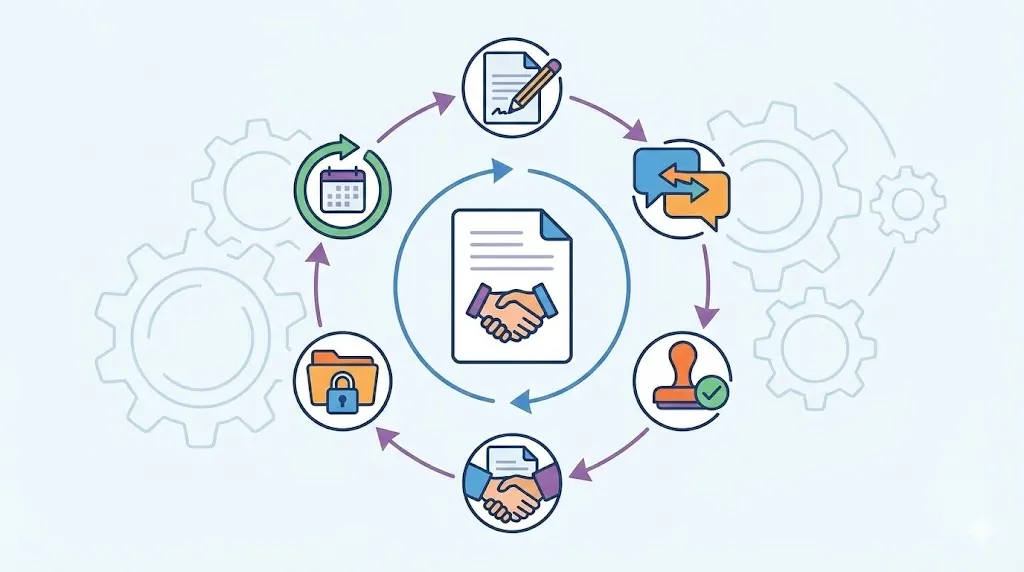
Volody AI CLM is an Agentic AI-powered Contract Lifecycle Management platform designed to eliminate manual contracting tasks, automate complex workflows, and deliver actionable insights. As a one-stop shop for all contract activities, it covers drafting, collaboration, negotiation, approvals, e-signature, compliance tracking, and renewals. Built with enterprise-grade security and no-code configuration, it meets the needs of the most complex global organizations. Volody AI CLM also includes AI-driven contract review and risk analysis, helping teams detect issues early and optimize terms. Trusted by Fortune 500 companies, high-growth startups, and government entities, it transforms contracts into strategic, data-driven business assets.



" height="216.72211px" id="FYO0bO80Y" transform="translate(3 6.105)" width="206.073px"/><path d="M 108.174 222 C 88.432 222 70.303 217.239 53.785 207.717 C 37.267 198.196 24.173 185.052 14.504 168.285 C 4.835 151.312 0 132.165 0 110.845 C 0 89.731 4.835 70.792 14.504 54.025 C 24.173 37.052 37.267 23.804 53.785 14.282 C 70.303 4.761 88.432 0 108.174 0 C 128.116 0 146.246 4.761 162.562 14.282 C 179.08 23.804 192.073 37.052 201.541 54.025 C 211.21 70.792 216.044 89.731 216.044 110.845 C 216.044 132.165 211.21 151.312 201.541 168.285 C 192.073 185.052 179.08 198.196 162.562 207.717 C 146.044 217.239 127.915 222 108.174 222 Z M 108.174 183.189 C 120.864 183.189 132.044 180.291 141.713 174.495 C 151.382 168.492 158.936 160.006 164.375 149.035 C 169.814 138.064 172.533 125.334 172.533 110.845 C 172.533 96.355 169.814 83.729 164.375 72.965 C 158.936 61.994 151.382 53.611 141.713 47.815 C 132.044 42.02 120.864 39.122 108.174 39.122 C 95.483 39.122 84.202 42.02 74.332 47.815 C 64.663 53.611 57.109 61.994 51.67 72.965 C 46.231 83.729 43.511 96.355 43.511 110.845 C 43.511 125.334 46.231 138.064 51.67 149.035 C 57.109 160.006 64.663 168.492 74.332 174.495 C 84.202 180.291 95.483 183.189 108.174 183.189 Z" fill="rgba(255, 255, 255, 0.12)" height="222px" id="aa1McFcE9" transform="translate(227.183 3)" width="216.04399999999998px"/><path d="M 42.302 182.257 L 111.799 182.257 L 111.799 216.722 L 0 216.722 L 0 0 L 42.302 0 Z" fill="rgba(255, 255, 255, 0.12)" height="216.72211px" id="yRq4AnrsX" transform="translate(477.721 6.105)" width="111.79899999999998px"/><path d="M 108.174 222 C 88.432 222 70.303 217.239 53.785 207.717 C 37.267 198.196 24.173 185.052 14.504 168.285 C 4.835 151.312 0 132.165 0 110.845 C 0 89.731 4.835 70.792 14.504 54.025 C 24.173 37.052 37.267 23.804 53.785 14.282 C 70.303 4.761 88.432 0 108.174 0 C 128.116 0 146.246 4.761 162.562 14.282 C 179.08 23.804 192.073 37.052 201.541 54.025 C 211.21 70.792 216.045 89.731 216.045 110.845 C 216.045 132.165 211.21 151.312 201.541 168.285 C 192.073 185.052 179.08 198.196 162.562 207.717 C 146.044 217.239 127.915 222 108.174 222 Z M 108.174 183.189 C 120.864 183.189 132.044 180.291 141.713 174.495 C 151.382 168.492 158.936 160.006 164.375 149.035 C 169.814 138.064 172.534 125.334 172.534 110.845 C 172.534 96.355 169.814 83.729 164.375 72.965 C 158.936 61.994 151.382 53.611 141.713 47.815 C 132.044 42.02 120.864 39.122 108.174 39.122 C 95.483 39.122 84.202 42.02 74.332 47.815 C 64.663 53.611 57.108 61.994 51.67 72.965 C 46.231 83.729 43.511 96.355 43.511 110.845 C 43.511 125.334 46.231 138.064 51.67 149.035 C 57.108 160.006 64.663 168.492 74.332 174.495 C 84.202 180.291 95.483 183.189 108.174 183.189 Z" fill="rgba(255, 255, 255, 0.12)" height="222px" id="mo8HQspQ0" transform="translate(609.155 3)" width="216.04500000000007px"/><path d="M 73.727 0 C 95.885 0 115.324 4.45 132.044 13.351 C 148.967 22.252 161.957 34.982 171.027 51.541 C 180.287 67.894 184.917 86.937 184.917 108.671 C 184.917 130.405 180.287 149.449 171.027 165.801 C 161.957 181.947 148.967 194.47 132.044 203.371 C 115.324 212.271 95.885 216.722 73.727 216.722 L 0 216.722 L 0 0 Z M 72.216 179.773 C 94.374 179.773 111.497 173.564 123.583 161.144 C 135.669 148.724 141.713 131.233 141.713 108.671 C 141.713 86.109 135.669 68.515 123.583 55.888 C 111.497 43.055 94.374 36.638 72.216 36.638 L 42.302 36.638 L 42.302 179.773 Z" fill="rgba(255, 255, 255, 0.12)" height="216.72211px" id="I3iXX5Hi_" transform="translate(859.693 6.105)" width="184.91699999999992px"/><path d="M 185.22 0 L 113.91 141.273 L 113.91 216.722 L 71.61 216.722 L 71.61 141.273 L 0 0 L 47.74 0 L 93.06 99.046 L 138.08 0 Z" fill="rgba(255, 255, 255, 0.12)" height="216.72211px" id="nzHyWC0_d" transform="translate(1061.78 6.105)" width="185.22000000000003px"/></svg>)