

Contracts hold critical details that shape business outcomes. Yet, vital terms often sit buried in PDFs or scanned files, hidden from teams that need them most. Contract data extraction uses AI to pull these details into clear, searchable data. This article explains how contract data extraction works, why it matters, and how to get started without disrupting your existing contract processes.
TL;DR
Extracting data from contracts involves transforming unstructured text into organized, searchable information that accelerates insight generation and reduces errors.
Additionally, this process also uncovers essential elements such as parties, dates, payment terms, and obligations through advanced natural language processing techniques.
Ineffective contract management can result in losses amounting to 5-9% of a company’s annual revenue, primarily due to overlooked renewals and regulatory noncompliance.
An effective approach begins with targeting 5-10 pivotal fields within a single contract category to demonstrate tangible benefits prior to broader implementation.
Accuracy improves with human review and confidence scoring; expect gradual model learning.
Extracted data supports legal, procurement, finance, sales, and compliance teams with actionable contract intelligence.
What is Contract Data Extraction?
Contract data extraction means pulling specific information from contracts and turning it into organized data. Instead of manually reading each contract to find renewal dates or payment terms, extraction lets you search across thousands of contracts instantly. This process goes beyond simple keyword searches by using AI to understand context and meaning.
For example, a keyword search for “renewal” misses clauses that say “this agreement automatically extends for successive one-year terms.” AI recognizes this as a renewal clause even without the word “renewal.” It also distinguishes between dates that trigger payments and those that mark contract expiration.
Common data points extracted include:
Parties: Names of the legal entities involved
Key dates: Effective dates, expiration, and renewal periods
Financial terms: Payment schedules, pricing, liability limits
Obligations: Deliverables, service levels, performance metrics
Clauses: Termination rights, confidentiality, indemnity, governing law
Extraction converts these details into structured fields. This lets teams filter, sort, and analyze contract data quickly without opening each file.
Related articles: How Does AI Limitations Impacting Contract Management?
Why Contract Data Extraction Matters for Businesses Today
Contracts impact revenue, risk, and operations. Yet, when contract details stay locked in static documents, organizations lose visibility and control. According to The Legal Operations Field Guide, poor contract management causes companies to lose 5-9% of annual revenue. These losses stem largely from missed renewal deadlines, overlooked compliance gaps, and financial obligations that remain unmonitored.
Contract data extraction addresses these challenges by transforming contract terms into accessible, actionable information. Procurement teams gain the ability to monitor auto-renewals well in advance, preventing inadvertent contract extensions. Legal departments streamline their review of liability limits across numerous agreements. Finance teams match invoices to contract payment terms efficiently, eliminating the need to sift through countless documents.
Leadership benefits from comprehensive dashboards that provide insight into contract volume, processing times, and areas of financial risk. Such transparency is crucial for anticipating issues like unplanned auto-renewals or audit-related compliance failures.
In the absence of extraction, teams often find themselves reacting to problems only after they have manifested. Extraction, conversely, enables organizations to anticipate and address contract-related risks before they escalate.
For further reading, see: Understanding AI Limitations in Contract Management
What is Contract Metadata?
Contract metadata is the organized information that describes a contract’s content. Additionally, it can be understood as “data about the contract data.” Metadata fields make contracts searchable, sortable, and reportable once extracted.
Typical metadata fields include:
Parties and signatories
Effective and expiration dates
Renewal terms and auto-renewal flags
Contract value or payment terms
Governing law and jurisdiction
Contract type (NDA, MSA, SOW, etc.)
Contract status (active, expired, pending)
Some teams tag metadata manually for small contract volumes. But manual tagging breaks down when managing hundreds or thousands of contracts. Automated extraction tools handle large volumes efficiently, reducing errors and saving time.
Related articles: How Does AI Limitations Impacting Contract Management?
Key Features and Capabilities of Contract Data Extraction Tools
Choosing the right extraction tool means focusing on features that deliver real value. Here are essential capabilities to look for:
Optical Character Recognition (OCR): Converts scanned contracts and image PDFs into machine-readable text. Without OCR, AI cannot read scanned documents.
Natural Language Processing (NLP): Understands contract language context, not just keywords. It detects clauses and interprets meaning.
Confidence Scoring: This metric assesses the trustworthiness of each extracted element, helping prioritize areas for human verification.
Human-in-the-Loop Validation: Incorporating user corrections into the workflow allows the system to learn and enhance accuracy over time.
Template and Clause Recognition: Identifying recurring clauses and categorizing contract types accelerates and refines the extraction workflow.
Integration Capabilities: Designed to link effortlessly with contract management, ERP, CRM, or procurement platforms, these tools facilitate uninterrupted data exchange.
Search and Reporting: Featuring sophisticated search across metadata and full text, coupled with analytic dashboards, the system delivers comprehensive insights into contract datasets.
Collectively, these functionalities ensure that extraction tools deliver reliable results across diverse contract structures and complex linguistic variations.
Related articles: How Does AI Limitations Impacting Contract Management?
How Does AI Improve Contract Data Extraction Accuracy?
AI models learn contract language patterns from large datasets. Additionally, they leverage natural language processing (NLP) techniques to analyze legal phrasing and contextual nuances. This lets AI extract complex clauses and distinguish subtle differences in meaning.
Accuracy depends on:
Training Data Quality: The breadth and variety of contracts used during training significantly influence how well models generalize across different industries.
Confidence Scores: Systems assign reliability metrics to extractions, flagging uncertain instances for human review to reduce potential inaccuracies.
Human Feedback Loops: Reviewer corrections are systematically incorporated to continuously enhance model precision and adaptability.
Continuous Model Updates: Ongoing refinement enables the AI to keep pace with evolving contract structures and changes in legal language over time.
Expect initial accuracy to improve steadily with use. Combining AI with human validation strikes the best balance between speed and precision.
Related articles: How Does AI Limitations Impacting Contract Management?
How to Start Using Contract Data Extraction
Begin small to show quick wins and build confidence:
Identify Top Metadata Fields: Pick 5-10 key fields that matter most, like renewal dates or payment terms.
Select a Contract Type: Focus initially on one category, for example, NDAs or vendor agreements, to streamline efforts.
Pilot the Extraction Tool: Apply the extraction process to a representative sample and conduct a thorough review with your team.
Set Up Validation Workflows: Develop detailed protocols that empower human reviewers to verify the precision of the extracted data.
Measure Impact: Evaluate performance gains, including reductions in processing time, error frequency, and exposure to risks.
Expand Gradually: As proficiency increases, incrementally add new contract categories and expand the scope of metadata fields extracted.
This phased approach helps avoid operational disruptions and provides tangible evidence of value early in the implementation journey.
Related articles: How Do AI Limitations Affect Contract Management?
Contract Data Extraction vs. Contract Data Extraction Services
Contract data extraction comes in two main forms:
Automated Extraction Tools: Software that uses AI to extract data at scale. Additionally, these solutions excel when managing ongoing contract workflows and handling high-volume datasets.
Extraction Services: Manual data extraction performed by specialized teams focusing on legacy contracts. This approach is particularly suited to one-time data migrations or comprehensive remediation of outdated contract repositories.
Services can be expensive and slow but may be necessary for scanned paper contracts or complex legacy portfolios. Automated tools handle new contracts and continuous extraction more efficiently.
Related articles: How Does AI Limitations Impacting Contract Management?
Why Contract Data Analysts Still Matter for Legacy Contracts
Legacy contracts often exist as scanned images or unstructured documents. Additionally, in many cases, AI tools cannot accurately process poor-quality scans or unusual formats. Contract data analysts provide:
Manual review and correction of extracted data
Tagging of metadata fields missed by AI
Quality control for large-scale contract digitization projects
They bridge the gap until automated extraction can handle legacy files reliably.
Related articles: How Does AI Limitations Impacting Contract Management?
Contract Data Extraction Use Cases Across Departments
Contract data extraction benefits more than legal teams. Here are some examples:
Procurement: Maintains oversight of vendor contract renewals and tracks pricing adjustments to effectively manage expenditure.
Finance: By linking payment terms directly with invoice records, the process enhances billing accuracy and provides a more reliable basis for financial forecasting.
Sales: Contract clause analysis reveals potential negotiation challenges early, allowing sales teams to accelerate the closing process.
Compliance: It facilitates the creation of detailed audit trails that confirm contract compliance with relevant regulatory standards.
Operations: Monitors service level agreements (SLAs) in conjunction with deliverables to guarantee optimal vendor performance.
Ensuring contract data is readily available across multiple departments empowers better decision-making and mitigates operational risks.
Related articles: How Does AI Limitations Impacting Contract Management?
5 Challenges in Maintaining Accurate Contract Data Extraction
Varied Contract Formats: The diversity of contract layouts, compounded by the inclusion of multiple languages, significantly complicates the extraction of accurate data.
Poor Document Quality: When contracts are scanned or handwritten, the resulting degradation in image clarity can severely undermine the performance of OCR technologies.
Complex Legal Language: The presence of ambiguous terminology and intricately nested clauses presents formidable obstacles for AI systems striving to accurately interpret contract content.
Evolving Contract Templates: Continuous modifications to contract templates necessitate frequent updates and retraining of extraction models.
User Adoption: Teams must trust and engage with extraction tools to validate and improve data.
Address these challenges with strong data governance, training, and continuous improvement.
Related articles: How Does AI Limitations Impacting Contract Management?
How to Measure Success with Contract Data Extraction
Track these key performance indicators (KPIs):
Extraction Accuracy Rate represents the percentage of fields correctly extracted after thorough validation.
The metric for Time Saved quantifies how many hours have been reclaimed by automating manual contract reviews and data entry operations.
Contract Visibility indicates the proportion of contracts supplemented with structured metadata relative to the entire contract repository.
Instances where overlooked renewals or compliance risks were averted contribute to the overall measurement of Risk Reduction.
User Satisfaction is derived from qualitative and quantitative feedback obtained from legal, procurement, and finance stakeholders concerning the tool’s practical effectiveness.
Regularly review KPIs to refine processes and maximize ROI.
Related articles: How Does AI Limitations Impacting Contract Management?
Why Contract Management Software Matters
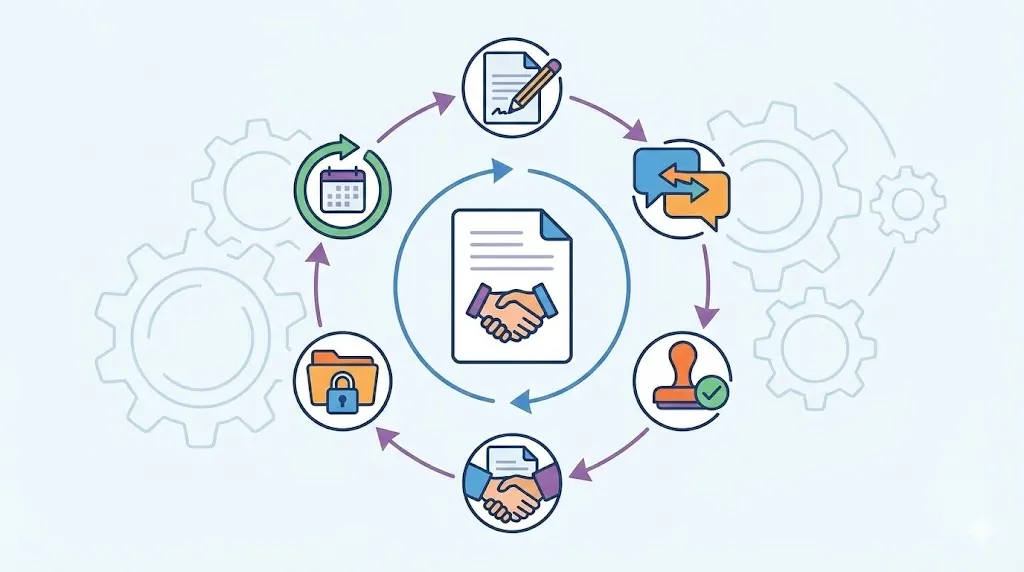
Contract management platforms act as centralized repositories that not only store contracts but also enhance workflow automation processes. Additionally, these systems also enable efficient organization, monitoring, and in-depth analysis of contracts at every stage of their lifecycle. Leveraging AI-driven data extraction, they convert static contract documents into valuable, actionable business resources.
Modern solutions in this space provide capabilities such as:
Centralized repositories with secure storage and version control
Automated capture of contract metadata and obligations
Workflow automation for approvals, renewals, and alerts
Integration with ERP, CRM, and e-signature tools
Dashboards and reports for contract analytics
These features reduce manual work, improve compliance, and speed contract cycles.
Managing complex legal workflows requires a centralized and intelligent solution. Volody’s Contract Lifecycle Management (CLM) software integrates AI-powered capture of contract details, obligation tracking, and workflow automation. It supports teams with features like AI contract summaries, clause recommendations, and advanced search. The platform integrates seamlessly with existing systems and adapts as your business grows.
Interested in discovering how these solutions can streamline your legal workflows? Check out Volody's CLM Software.
FAQ
What types of contract data can AI extract?
AI can extract parties, key dates (effective, expiration, renewal), financial terms like payment schedules, obligations such as deliverables and SLAs, and standard clauses like termination or confidentiality. It recognizes these elements by analyzing the contextual language within contracts.
How reliable is the extraction of contract data using AI?
Moreover, the accuracy depends on the specific tool and the complexity of the contracts. Initial precision usually falls between 70-85% and improves with continuous human validation and refinement of the models. Confidence metrics assist in prioritizing the review of uncertain data points to uphold data quality.
Are scanned or handwritten contracts compatible with contract data extraction?
These extraction tools depend heavily on OCR (Optical Character Recognition) technology to transform scanned documents into machine-readable text. The effectiveness of OCR is closely tied to the quality of the scans. Handwritten contracts, however, present considerable difficulties and generally require manual intervention or specialized processing techniques.
Furthermore, extraction tools rely on OCR to convert scanned documents into text. OCR accuracy depends on scan quality. Handwritten contracts pose significant challenges and often require manual review or specialized processing.
How does contract data extraction improve contract management?
Extraction makes contract terms searchable and reportable. Teams can track renewals, monitor obligations, audit risks, and generate reports without opening each contract. Furthermore, this reduces missed deadlines, compliance gaps, and manual workload.
Is manual tagging still necessary?
Manual tagging remains suitable for small contract volumes or particularly complex agreements. For extensive portfolios, automated extraction significantly reduces time expenditures and errors. Human review continues to be essential to validate and correct AI outputs.
How does contract data extraction support different departments?
Legal applies it for risk audits and compliance. Procurement tracks vendor contracts and spend. Finance reconciles invoices with payment terms. Sales analyzes negotiation patterns. Compliance generates audit-ready reports. Extraction democratizes contract insights.
Also, what challenges should I expect when implementing extraction?
Address these with good data governance, training, and iterative improvements.
How do I get started with contract data extraction?
Begin by selecting 5-10 critical metadata fields and focusing on one contract type. Pilot extraction on a limited dataset, validate accuracy, and measure impact. Gradually expand usage as confidence increases to minimize disruption.
Can contract data extraction replace contract lawyers?
No. While extraction automates data capture and expedites review processes, it cannot substitute for legal judgment. Lawyers remain responsible for interpreting contract risks, negotiating terms, and making final decisions.
What is the difference between contract data extraction tools and services?
Extraction tools utilize AI software for ongoing, scalable data capture. Services deploy manual teams to extract data from legacy or complex contracts, often for one-time initiatives such as migrations.
This comprehensive overview equips legal, operations, and enterprise technology leaders with the knowledge to harness contract insights effectively. The path to AI-powered contract insights starts with understanding your contract data and applying the right tools to unlock its value.
About the Company

Volody AI CLM is an Agentic AI-powered Contract Lifecycle Management platform designed to eliminate manual contracting tasks, automate complex workflows, and deliver actionable insights. As a one-stop shop for all contract activities, it covers drafting, collaboration, negotiation, approvals, e-signature, compliance tracking, and renewals. Built with enterprise-grade security and no-code configuration, it meets the needs of the most complex global organizations. Volody AI CLM also includes AI-driven contract review and risk analysis, helping teams detect issues early and optimize terms. Trusted by Fortune 500 companies, high-growth startups, and government entities, it transforms contracts into strategic, data-driven business assets.





" height="216.72211px" id="FYO0bO80Y" transform="translate(3 6.105)" width="206.073px"/><path d="M 108.174 222 C 88.432 222 70.303 217.239 53.785 207.717 C 37.267 198.196 24.173 185.052 14.504 168.285 C 4.835 151.312 0 132.165 0 110.845 C 0 89.731 4.835 70.792 14.504 54.025 C 24.173 37.052 37.267 23.804 53.785 14.282 C 70.303 4.761 88.432 0 108.174 0 C 128.116 0 146.246 4.761 162.562 14.282 C 179.08 23.804 192.073 37.052 201.541 54.025 C 211.21 70.792 216.044 89.731 216.044 110.845 C 216.044 132.165 211.21 151.312 201.541 168.285 C 192.073 185.052 179.08 198.196 162.562 207.717 C 146.044 217.239 127.915 222 108.174 222 Z M 108.174 183.189 C 120.864 183.189 132.044 180.291 141.713 174.495 C 151.382 168.492 158.936 160.006 164.375 149.035 C 169.814 138.064 172.533 125.334 172.533 110.845 C 172.533 96.355 169.814 83.729 164.375 72.965 C 158.936 61.994 151.382 53.611 141.713 47.815 C 132.044 42.02 120.864 39.122 108.174 39.122 C 95.483 39.122 84.202 42.02 74.332 47.815 C 64.663 53.611 57.109 61.994 51.67 72.965 C 46.231 83.729 43.511 96.355 43.511 110.845 C 43.511 125.334 46.231 138.064 51.67 149.035 C 57.109 160.006 64.663 168.492 74.332 174.495 C 84.202 180.291 95.483 183.189 108.174 183.189 Z" fill="rgba(255, 255, 255, 0.12)" height="222px" id="aa1McFcE9" transform="translate(227.183 3)" width="216.04399999999998px"/><path d="M 42.302 182.257 L 111.799 182.257 L 111.799 216.722 L 0 216.722 L 0 0 L 42.302 0 Z" fill="rgba(255, 255, 255, 0.12)" height="216.72211px" id="yRq4AnrsX" transform="translate(477.721 6.105)" width="111.79899999999998px"/><path d="M 108.174 222 C 88.432 222 70.303 217.239 53.785 207.717 C 37.267 198.196 24.173 185.052 14.504 168.285 C 4.835 151.312 0 132.165 0 110.845 C 0 89.731 4.835 70.792 14.504 54.025 C 24.173 37.052 37.267 23.804 53.785 14.282 C 70.303 4.761 88.432 0 108.174 0 C 128.116 0 146.246 4.761 162.562 14.282 C 179.08 23.804 192.073 37.052 201.541 54.025 C 211.21 70.792 216.045 89.731 216.045 110.845 C 216.045 132.165 211.21 151.312 201.541 168.285 C 192.073 185.052 179.08 198.196 162.562 207.717 C 146.044 217.239 127.915 222 108.174 222 Z M 108.174 183.189 C 120.864 183.189 132.044 180.291 141.713 174.495 C 151.382 168.492 158.936 160.006 164.375 149.035 C 169.814 138.064 172.534 125.334 172.534 110.845 C 172.534 96.355 169.814 83.729 164.375 72.965 C 158.936 61.994 151.382 53.611 141.713 47.815 C 132.044 42.02 120.864 39.122 108.174 39.122 C 95.483 39.122 84.202 42.02 74.332 47.815 C 64.663 53.611 57.108 61.994 51.67 72.965 C 46.231 83.729 43.511 96.355 43.511 110.845 C 43.511 125.334 46.231 138.064 51.67 149.035 C 57.108 160.006 64.663 168.492 74.332 174.495 C 84.202 180.291 95.483 183.189 108.174 183.189 Z" fill="rgba(255, 255, 255, 0.12)" height="222px" id="mo8HQspQ0" transform="translate(609.155 3)" width="216.04500000000007px"/><path d="M 73.727 0 C 95.885 0 115.324 4.45 132.044 13.351 C 148.967 22.252 161.957 34.982 171.027 51.541 C 180.287 67.894 184.917 86.937 184.917 108.671 C 184.917 130.405 180.287 149.449 171.027 165.801 C 161.957 181.947 148.967 194.47 132.044 203.371 C 115.324 212.271 95.885 216.722 73.727 216.722 L 0 216.722 L 0 0 Z M 72.216 179.773 C 94.374 179.773 111.497 173.564 123.583 161.144 C 135.669 148.724 141.713 131.233 141.713 108.671 C 141.713 86.109 135.669 68.515 123.583 55.888 C 111.497 43.055 94.374 36.638 72.216 36.638 L 42.302 36.638 L 42.302 179.773 Z" fill="rgba(255, 255, 255, 0.12)" height="216.72211px" id="I3iXX5Hi_" transform="translate(859.693 6.105)" width="184.91699999999992px"/><path d="M 185.22 0 L 113.91 141.273 L 113.91 216.722 L 71.61 216.722 L 71.61 141.273 L 0 0 L 47.74 0 L 93.06 99.046 L 138.08 0 Z" fill="rgba(255, 255, 255, 0.12)" height="216.72211px" id="nzHyWC0_d" transform="translate(1061.78 6.105)" width="185.22000000000003px"/></svg>)