

Introduction: The Architect and the Bricklayer
Imagine a master architect, renowned for designing skyline-altering skyscrapers. Their value lies in their vision, their understanding of structural integrity, and their ability to navigate complex zoning laws. Now, imagine if that architect was forced to spend eighty percent of their day manually laying bricks. Every hour spent mixing mortar and aligning individual bricks is an hour stolen from high-level design. The building might eventually get built, but the architect is exhausted, the timeline is bloated, and the unique genius of the designer is wasted on repetitive labor.
For decades, this has been the reality for corporate legal departments. Highly trained General Counsels and senior attorneys, strategic architects of the business have been forced to act as bricklayers. They spend their days (and nights) buried in the "mortar" of routine Non-Disclosure Agreements (NDAs), standard vendor contracts, and repetitive licensing terms. They scan endless pages for simple errors, cross-reference dates manually, and fix formatting issues. It is necessary work, but it is not strategic work.
The emergence of Artificial Intelligence (AI) in the legal sector has triggered a predictable, yet misplaced, anxiety: "Will AI replace lawyers?" This question misses the point entirely. A robot does not replace the architect; it replaces the manual labor of laying bricks, allowing the architect to focus on the skyline.
In 2026, the debate is no longer about human versus machine. It is about the amplified lawyer. It is about a new model of Enterprise CLM Software where AI handles the speed and scale of data processing, while human attorneys provide the judgment, empathy, and strategic risk assessment that no algorithm can replicate. This article explores the comparative strengths of AI and human review, not as adversaries, but as partners in a new era of legal operations. We will examine how shifting from manual "bricklaying" to AI-assisted management drives speed, enhances accuracy, and fundamentally transforms the Return on Investment (ROI) of the legal function.
The Hidden Tax of the Status Quo

To understand the value of AI, we must first honestly assess the state of traditional contract review. For many organizations, the "standard" process is a patchwork of emails, Word documents saved on local drives, and spreadsheets that are outdated the moment they are saved. This manual approach creates a landscape riddled with hidden costs and invisible risks.
Related Article: What AI Agents Really Do for Legal Operations Today
The Cognitive Ceiling (Fatigue vs. Accuracy)
The human brain is an incredible engine for strategy, but it is a poor machine for repetitive data processing. When a lawyer is asked to review their fifth complex Service Level Agreement (SLA) of the day usually late in the afternoon, cognitive fatigue sets in. Attention wavers. A missing "not" in a liability clause or an ambiguous renewal date can easily slip through.
In a manual environment, accuracy is often a function of energy levels. The contract reviewed at 9:00 AM gets a gold-standard analysis; the contract reviewed at 7:00 PM gets a "good enough" glance. This inconsistency is dangerous. It introduces a variable level of risk into the corporate portfolio that is impossible to measure until a dispute arises. Without a Centralized Contract Repository to standardize language across all agreements, every contract becomes a unique artisanal creation, increasing the chance of conflicting terms across the enterprise.
The Velocity Drag
Speed is the currency of modern business. Sales teams, procurement officers, and executives operate in real-time. They view the legal department not as a protector, but as a toll booth. In a manual workflow, contracts sit in queues. They wait for a lawyer to return from court, to finish a phone call, or simply to clear their inbox.
This "queue time" kills deal momentum. A contract that sits for weeks waiting for a preliminary review gives the counterparty time to reconsider, look for other vendors, or change their demands. The friction of manual review does not just annoy internal stakeholders; it directly impacts revenue recognition. When the Legal Department is the bottleneck, the entire company slows down. The "Department of No" reputation is often just a symptom of the "Department of Slow."
The Black Box of Institutional Knowledge
Perhaps the most significant deficit of the manual model is the lack of data retention. When a human lawyer reviews a contract, the insights from that review often live and die in that lawyer's head. If a senior attorney leaves the firm, their memory of why a specific clause was negotiated a certain way leaves with them.
Manual review creates data silos. There is no easy way to answer critical questions like, "How many of our contracts have a Force Majeure clause that includes pandemics?" or "Which vendors have automatic price escalators?" To answer these questions, a team of paralegals must manually open hundreds of PDF files. This lack of visibility paralyzes decision-making during crises and mergers. Without the structured data provided by Enterprise CLM Software, the legal team is operating blindly, reacting to problems rather than proactively managing the corporate risk profile.
The Hybrid Revolution: Engineering a New Workflow

The solution to these challenges is not to fire the lawyers and hire a server farm. It is to implement a hybrid workflow where AI and humans play to their respective strengths. This is where the true ROI is generated: by assigning the right task to the right intelligence.
Speed: The AI Sprint vs. The Human Marathon
When it comes to pure processing speed, AI is unrivaled. An AI engine can ingest, read, and analyze a hundred-page Master Services Agreement in seconds. It can instantly flag that the indemnification clause is missing, the jurisdiction is set to a non-preferred state, and the payment terms deviate from company policy.
For a human to perform this initial triage, it would take hours of deep reading. By offloading this "first pass" review to AI, the legal team achieves an immediate, drastic reduction in cycle time. The lawyer does not start at page one with a blank stare; they start with a prioritized list of issues. They jump straight to the high-risk clauses that require judgment.
However, speed without direction is chaos. This is where No-Code Approval Workflows become critical. Speed is not just about reading fast; it is about moving the document to the right person instantly. Once the AI completes its review, the CLM system automatically routes the contract. If the contract value is low and risks are low, it might go to a junior associate. If the AI detects a high-stakes IP clause, the workflow instantly routes it to the General Counsel and the IP specialist simultaneously. This automated choreography ensures that speed is maintained throughout the entire lifecycle, not just the review phase.
Contextual Intelligence: The Human Domain
AI excels at consistency. It does not get tired. It does not get bored. It will flag a deviation from the standard playbook every single time, whether it is the first contract of the month or the last contract of the year. This ensures a baseline of compliance that human teams struggle to match at scale.
But accuracy is not just about spotting keywords; it is about understanding intent. This is the human domain. An AI might flag a clause as "non-standard," but a human lawyer understands why it is there. Perhaps the counterparty is a strategic partner, and we are willing to accept higher risk for a long-term relationship. Perhaps the clause is non-standard but legally harmless in this specific jurisdiction.
The hybrid model combines AI’s "micro-accuracy" (spotting every detail) with the human’s "macro-accuracy" (understanding the business context). The AI acts as the ultimate safety net, catching the objective errors, freeing the lawyer to make subjective judgment calls.
The Foundation: The Centralized Contract Repository
None of this advanced review is possible if your contracts are scattered. The Centralized Contract Repository is the beating heart of the modern legal operation. It transforms static files into dynamic assets.
In this environment, every contract is ingested, indexed, and made searchable. The AI doesn't just read the text; it tags it. It extracts metadata, dates, values, names, clauses and structures it. This turns the "Black Box" into a "Glass House." A General Counsel can now search the entire repository for "Liability Cap > $1M" and get an instant, accurate list. This capability transforms the legal team from a reactive review service into a proactive risk management hub.
ROI: Shifting from Cost Center to Value Creator
TThe return is concrete and structural.
Cost Reduction: Automating routine contracts such as NDAs cuts external counsel spend. Standard work no longer consumes billable hours.
Productivity Gain: In-house lawyers exit administrative work and focus on high-impact matters: litigation strategy, M&A, and executive advisory.
Revenue Velocity: Faster contract cycles pull revenue forward. Earlier signatures translate directly into earlier revenue recognition.
The Blueprint for Transformation
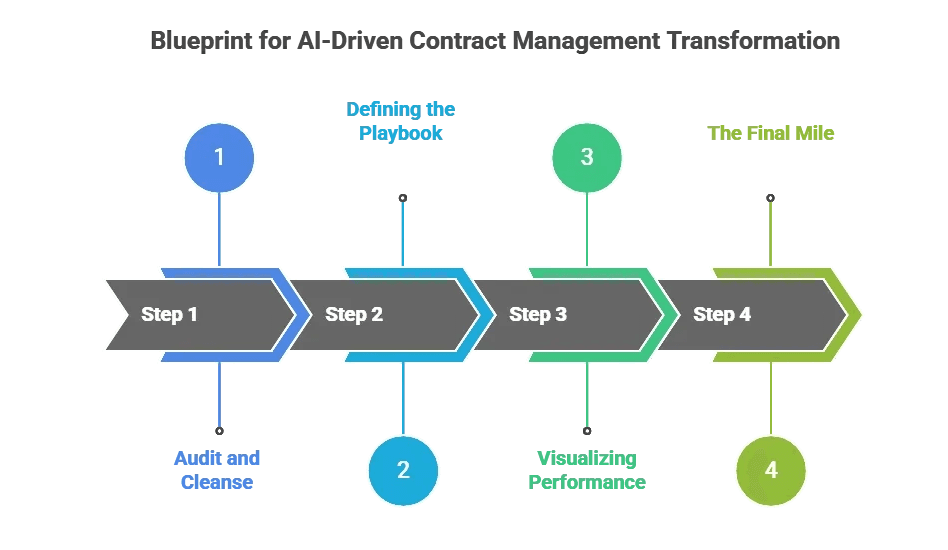
Moving from a manual process to an AI-driven ecosystem requires a deliberate operational strategy. It is not a plug-and-play fix; it is a transformation of how the department functions.
Step 1: The Audit and Cleanse
Before you can train an AI, you must understand your own data. This begins with populating your Centralized Contract Repository. You must gather every legacy contract from every hard drive and email inbox. This process often reveals the extent of the "hidden risk" mentioned earlier.
Once centralized, the AI helps "cleanse" the data. It identifies duplicate vendor agreements, expired contracts that are still being paid, and conflicting terms with the same customer. This initial audit often pays for the software implementation by identifying immediate cost savings in terminated or redundant services.
Step 2: Defining the Playbook
AI needs rules to follow. The legal team must define its "Digital Playbook." What is our standard position on payment terms? What are our fallback positions? What is an absolute "deal-breaker"?
By encoding these rules into Enterprise CLM Software, you create the standard against which the AI measures every incoming contract. This forces the legal team to align on risk tolerance. It eliminates the "subjective variance" where one lawyer accepts a term that another lawyer rejects. The playbook becomes the single source of truth for the department’s risk appetite.
Step 3: Visualizing Performance
You cannot manage what you cannot measure. This is where Real-time Dashboards and Reporting transform legal operations. In a manual world, reporting is a monthly exercise in guesswork. In a CLM environment, it is live.
Legal leaders can view a dashboard that shows exactly how many contracts are in "Drafting," "Negotiation," or "Signature." They can see which business units are generating the most volume and which internal lawyers are overloaded. They can identify process bottlenecks—for example, seeing that contracts consistently stall at the "Finance Approval" stage.
This data empowers the General Counsel to have evidence-based conversations with the CFO. Instead of saying, "We are busy," they can say, "Our volume has doubled, but our turnaround time has remained stable thanks to automation, yet we need one more headcount to handle the specific surge in procurement contracts."
Step 4: The Final Mile
The perfect review process is useless if the execution is clumsy. Printing a contract, signing it with a wet ink pen, scanning it, and emailing it back is a relic of the past. It breaks the data chain.
Integrated eSign capabilities are essential. They ensure that the approved document flows seamlessly into the signature phase within the same platform. This closes the loop. It automatically triggers the "active" status in the repository and starts the clock on renewal tracking. It ensures that the signed version is identical to the approved version, preventing the old trick of slipping in a change right before signature.
Change Management: Overcoming the "Replacement" Myth

As we look toward the horizon, the role of AI in legal operations will shift from purely defensive (spotting risks) to predictive (optimizing value).
Future iterations of Enterprise CLM Software will not just tell you that a clause is risky; they will tell you the probability of that risk materializing based on global data. They will analyze the negotiation history with a specific counterparty and predict, "Vendor X usually accepts 45-day payment terms if you push back twice."
We will see the rise of "self-negotiating" contracts for low-value, high-volume agreements. Two AI agents, representing buyer and seller, will instantly compare playbooks, identify the common ground, and agree on a standard contract in milliseconds, leaving humans to simply ratify the result.
This future does not eliminate the lawyer. It elevates them to the role of "Risk Architect" and "Business Strategist," armed with data-driven insights that were previously impossible to obtain.
Conclusion
The choice between AI contract review and human lawyers is a false dichotomy. The winning formula is the synthesis of both. The human lawyer provides the nuance, the strategy, and the ethical judgment. The AI provides the speed, the consistency, and the data structure.
By adopting Enterprise CLM Software, organizations can finally break free from the manual trap. They can leverage No-Code Approval Workflows to accelerate business velocity, use Real-time Dashboards and Reporting to gain operational clarity, and rely on a Centralized Contract Repository to secure their intellectual property.
The legal department of the future is not a bottleneck; it is a launchpad. It is time to stop laying bricks and start designing the skyline.
Ready to transform your legal department into a strategic powerhouse? Book a demo with Volody today to experience the power of Integrated eSign and AI-driven contract management.
About the Company

Volody AI CLM is an Agentic AI-powered Contract Lifecycle Management platform designed to eliminate manual contracting tasks, automate complex workflows, and deliver actionable insights. As a one-stop shop for all contract activities, it covers drafting, collaboration, negotiation, approvals, e-signature, compliance tracking, and renewals. Built with enterprise-grade security and no-code configuration, it meets the needs of the most complex global organizations. Volody AI CLM also includes AI-driven contract review and risk analysis, helping teams detect issues early and optimize terms. Trusted by Fortune 500 companies, high-growth startups, and government entities, it transforms contracts into strategic, data-driven business assets.




" height="216.72211px" id="FYO0bO80Y" transform="translate(3 6.105)" width="206.073px"/><path d="M 108.174 222 C 88.432 222 70.303 217.239 53.785 207.717 C 37.267 198.196 24.173 185.052 14.504 168.285 C 4.835 151.312 0 132.165 0 110.845 C 0 89.731 4.835 70.792 14.504 54.025 C 24.173 37.052 37.267 23.804 53.785 14.282 C 70.303 4.761 88.432 0 108.174 0 C 128.116 0 146.246 4.761 162.562 14.282 C 179.08 23.804 192.073 37.052 201.541 54.025 C 211.21 70.792 216.044 89.731 216.044 110.845 C 216.044 132.165 211.21 151.312 201.541 168.285 C 192.073 185.052 179.08 198.196 162.562 207.717 C 146.044 217.239 127.915 222 108.174 222 Z M 108.174 183.189 C 120.864 183.189 132.044 180.291 141.713 174.495 C 151.382 168.492 158.936 160.006 164.375 149.035 C 169.814 138.064 172.533 125.334 172.533 110.845 C 172.533 96.355 169.814 83.729 164.375 72.965 C 158.936 61.994 151.382 53.611 141.713 47.815 C 132.044 42.02 120.864 39.122 108.174 39.122 C 95.483 39.122 84.202 42.02 74.332 47.815 C 64.663 53.611 57.109 61.994 51.67 72.965 C 46.231 83.729 43.511 96.355 43.511 110.845 C 43.511 125.334 46.231 138.064 51.67 149.035 C 57.109 160.006 64.663 168.492 74.332 174.495 C 84.202 180.291 95.483 183.189 108.174 183.189 Z" fill="rgba(255, 255, 255, 0.12)" height="222px" id="aa1McFcE9" transform="translate(227.183 3)" width="216.04399999999998px"/><path d="M 42.302 182.257 L 111.799 182.257 L 111.799 216.722 L 0 216.722 L 0 0 L 42.302 0 Z" fill="rgba(255, 255, 255, 0.12)" height="216.72211px" id="yRq4AnrsX" transform="translate(477.721 6.105)" width="111.79899999999998px"/><path d="M 108.174 222 C 88.432 222 70.303 217.239 53.785 207.717 C 37.267 198.196 24.173 185.052 14.504 168.285 C 4.835 151.312 0 132.165 0 110.845 C 0 89.731 4.835 70.792 14.504 54.025 C 24.173 37.052 37.267 23.804 53.785 14.282 C 70.303 4.761 88.432 0 108.174 0 C 128.116 0 146.246 4.761 162.562 14.282 C 179.08 23.804 192.073 37.052 201.541 54.025 C 211.21 70.792 216.045 89.731 216.045 110.845 C 216.045 132.165 211.21 151.312 201.541 168.285 C 192.073 185.052 179.08 198.196 162.562 207.717 C 146.044 217.239 127.915 222 108.174 222 Z M 108.174 183.189 C 120.864 183.189 132.044 180.291 141.713 174.495 C 151.382 168.492 158.936 160.006 164.375 149.035 C 169.814 138.064 172.534 125.334 172.534 110.845 C 172.534 96.355 169.814 83.729 164.375 72.965 C 158.936 61.994 151.382 53.611 141.713 47.815 C 132.044 42.02 120.864 39.122 108.174 39.122 C 95.483 39.122 84.202 42.02 74.332 47.815 C 64.663 53.611 57.108 61.994 51.67 72.965 C 46.231 83.729 43.511 96.355 43.511 110.845 C 43.511 125.334 46.231 138.064 51.67 149.035 C 57.108 160.006 64.663 168.492 74.332 174.495 C 84.202 180.291 95.483 183.189 108.174 183.189 Z" fill="rgba(255, 255, 255, 0.12)" height="222px" id="mo8HQspQ0" transform="translate(609.155 3)" width="216.04500000000007px"/><path d="M 73.727 0 C 95.885 0 115.324 4.45 132.044 13.351 C 148.967 22.252 161.957 34.982 171.027 51.541 C 180.287 67.894 184.917 86.937 184.917 108.671 C 184.917 130.405 180.287 149.449 171.027 165.801 C 161.957 181.947 148.967 194.47 132.044 203.371 C 115.324 212.271 95.885 216.722 73.727 216.722 L 0 216.722 L 0 0 Z M 72.216 179.773 C 94.374 179.773 111.497 173.564 123.583 161.144 C 135.669 148.724 141.713 131.233 141.713 108.671 C 141.713 86.109 135.669 68.515 123.583 55.888 C 111.497 43.055 94.374 36.638 72.216 36.638 L 42.302 36.638 L 42.302 179.773 Z" fill="rgba(255, 255, 255, 0.12)" height="216.72211px" id="I3iXX5Hi_" transform="translate(859.693 6.105)" width="184.91699999999992px"/><path d="M 185.22 0 L 113.91 141.273 L 113.91 216.722 L 71.61 216.722 L 71.61 141.273 L 0 0 L 47.74 0 L 93.06 99.046 L 138.08 0 Z" fill="rgba(255, 255, 255, 0.12)" height="216.72211px" id="nzHyWC0_d" transform="translate(1061.78 6.105)" width="185.22000000000003px"/></svg>)