

Contracts sit at the heart of business operations, shaping profitability, risk, and efficiency. The 2026 State of Contracting Report reveals how AI is no longer a future promise but a present reality in contract management. Imagine a legal team handling thousands of contracts monthly, where AI tools flag risks, suggest edits, and even negotiate terms autonomously. This report uncovers the data behind such transformations and what leaders must know to keep pace.
Related Article: 2026 AI in Contracting Report: Key Insights
TL;DR
44% of companies use AI to improve contract workflows like review and redlining.
More than 50% of executives anticipate that AI will be capable of negotiating deals autonomously within the next year.
Data quality issues and concerns about AI reliability remain significant barriers for nearly half of organizations.
Certain industries, such as healthcare and banking, face particularly complex challenges in contract management.
While AI adoption enhances both speed and accuracy, it necessitates the implementation of comprehensive governance frameworks.
Legal AI tools facilitate scaling contract management processes and significantly cut down manual labor.
How Is AI Changing Contracting Workflows in 2026?
AI capabilities have advanced significantly, transitioning from experimental phases to becoming integral components of everyday contract management processes. Nearly half of organizations deploy AI-driven solutions for contract review, redlining, and summarization tasks. These sophisticated systems parse contractual language, detect high-risk provisions, and propose amendments at speeds unattainable by manual reviewers.
For example, when examining a supplier contract, AI systems can identify atypical indemnity clauses or the absence of necessary compliance provisions. This cuts review time from days to hours. Contract teams can then focus on complex negotiations instead of routine checks.
The adoption of AI in contracting is not just about speed. It also improves accuracy. AI models trained on thousands of contracts recognize patterns and flag inconsistencies that humans might miss, significantly diminishing the risk of errors that could escalate into disputes or regulatory penalties.
Despite these advances, AI has yet to achieve full autonomy; expert oversight remains crucial to apply nuanced judgment and ensure regulatory compliance.
In practice, organizations tend to deploy AI as a complement to human expertise, maintaining rigorous evaluation protocols before contracts are finalized.
Data from the World Commerce & Contracting association indicates that 44% of companies currently incorporate AI into their contract workflows.
Related articles: AI Contract Review vs. Human Lawyers: Speed, Accuracy & ROI
What Are the Biggest Barriers to Trusting AI in Contracting?
Despite widespread AI use, trust remains a major barrier. Concerns about the reliability of AI-generated data affect approximately 55% of organizations. Many remain uncertain whether AI can deliver consistent and accurate contract analysis.
Common concerns include:
The potential for AI to misinterpret legal terms or overlook nuanced contextual elements.
The risk that overdependence on AI might cause critical risks to be missed.
The opacity surrounding the decision-making processes of AI systems.
The challenge posed by insufficient domain-specific training data for certain industries or contract categories.
For example, a healthcare company might hesitate to trust AI that isn’t trained on medical compliance contracts. Errors in such contracts could lead to costly regulatory violations.
Another 44% of executives say they do not fully trust AI to negotiate contracts autonomously. They fear AI agents might accept unfavorable terms or fail to adapt to complex negotiation dynamics.
Building trust requires transparency and explainability. Organizations need AI tools that show how they reach conclusions and allow human override. Continuous training with domain-specific data also improves AI accuracy.
Legal teams should consider AI as an assistive resource rather than an inscrutable system. Involving subject-matter experts in validating outputs and conducting rigorous audits is essential to maintaining trust in AI-assisted contracting.
Related articles: How Does AI Limitations Impacting Contract Management?
How Are Different Industries Using AI in Contracting?
Contracting challenges vary widely across sectors. Additionally, the 2026 report further dissects AI adoption and use cases by industry, demonstrating how leaders customize AI solutions to meet their specific demands.
Public Sector
Government agencies handle vast volumes of contracts with strict compliance requirements. AI helps automate contract review to ensure adherence to regulations and flag non-compliant clauses. It also speeds up procurement cycles, reducing delays in public projects.
Healthcare and Life Sciences
Contracts in healthcare involve complex regulatory language and patient privacy clauses. AI tools trained on healthcare contracts identify risks related to HIPAA compliance and clinical trial agreements. This reduces legal bottlenecks and helps manage vendor relationships efficiently.
Banking and Insurance
Moreover, financial institutions operate under intense pressure regarding contract risk management. By analyzing loan agreements, insurance policies, and service contracts, AI uncovers potential risk exposures. Beyond this, it facilitates regulatory reporting and prepares organizations for audits by automatically extracting critical data points.
Manufacturing and Supply Chain
Supplier contracts, tariffs, and trade compliance are key areas where manufacturers leverage AI. The technology pinpoints clauses concerning delivery terms, penalties, and customs duties, which enhances risk mitigation amid global supply chain disruptions.
Each industry adapts AI tools to its unique contract language and risk profile. This specialization improves AI effectiveness and user trust.
Related articles: Top 5 Contract Management Solutions for Karnataka in 2026
What Are the Key Metrics Showing AI’s Impact on Contracting?
The report compiles over 30 data points measuring AI’s effect on contract management. Here are some highlights:
44% of organizations report faster contract turnaround times due to AI.
38% see improved contract accuracy and fewer disputes.
35% note reduced legal costs by automating routine tasks.
53% of executives expect AI agents to negotiate deals without human help within 12 months.
55% cite concerns about AI data quality, signaling room for improvement.
These metrics reveal tangible advantages alongside areas that warrant careful oversight. AI adoption does not represent an instantaneous solution. Sustained calibration and robust governance frameworks are essential.
For instance, faster contract cycles help sales teams close deals quicker. Enhanced precision diminishes the likelihood of litigation or regulatory penalties. Legal professionals can thus allocate more time to strategic initiatives that add greater organizational value.
Nevertheless, organizations must exercise continuous vigilance when reviewing AI-generated outputs. Failure to detect errors or subtle contextual issues risks consequential negative outcomes.
Explore further: Effectively use AI in Contract Drafting
What Are 5 Challenges in Scaling AI for Contract Management?
Scaling AI across contract workflows involves several hurdles:
Data Quality and Consistency
AI needs clean, standardized contract data to perform well. Additionally, fragmented or poorly organized contract repositories continue to pose significant challenges for many organizations.
Integration with Existing Systems
Contract management often spans multiple platforms. Integrating AI tools with document management, CRM, and ERP systems requires technical effort.
Change Management and User Adoption
Legal and business teams may resist new AI tools due to fear of job loss or lack of trust. Training and clear communication are essential.
Regulatory and Compliance Risks
Compliance with industry regulations is mandatory for AI deployment. To meet legal standards, organizations must implement robust controls governing AI outputs.
Maintaining Human Oversight
Excessive reliance on AI without expert review can lead to critical errors. It is essential to maintain a balance between automation and human judgment.
Addressing these challenges demands a strategic approach combining technology, people, and processes.
Related articles: Insurance Contracts Made Easy with AI CLM
What Are Agentic Workflows and Why Do They Matter?
Agentic workflows use AI agents that autonomously execute contract tasks while humans oversee decisions. These workflows integrate various AI capabilities—such as drafting, review, negotiation, and approval—into a unified process.
For example, an AI agent might draft a contract based on input terms, pass it to another agent for risk scoring, then route it to legal for approval. Human intervention remains possible when complications occur.
By minimizing manual handoffs, this method accelerates contract lifecycles significantly. Embedding compliance checks throughout the process further improves overall accuracy.
Agentic workflows represent a shift from isolated AI tools to integrated contract lifecycle management. They enable organizations to scale contracting without adding headcount.
Related articles: How Does AI Limitations Impacting Contract Management?
How Can Organizations Prepare for AI-Driven Contracting?
Leaders should take these steps to get ready:
Assess Current Contract Processes: Identify bottlenecks and manual tasks ripe for automation.
Build Clean Contract Data Sets: Standardize and digitize contracts for AI training.
Select AI Tools with Transparency: Choose solutions that explain their analysis and allow human control.
Train Teams on AI Use: Provide education to build trust and skills.
Establish Governance Frameworks: Define rules for AI use, review, and escalation.
Pilot Agentic Workflows: Start small with AI agents handling specific tasks before full rollout.
This phased approach reduces risk and maximizes AI benefits.
Related articles: Top 5 Contract Management Solutions for Karnataka in 2026
How Legal AI Software Solves This
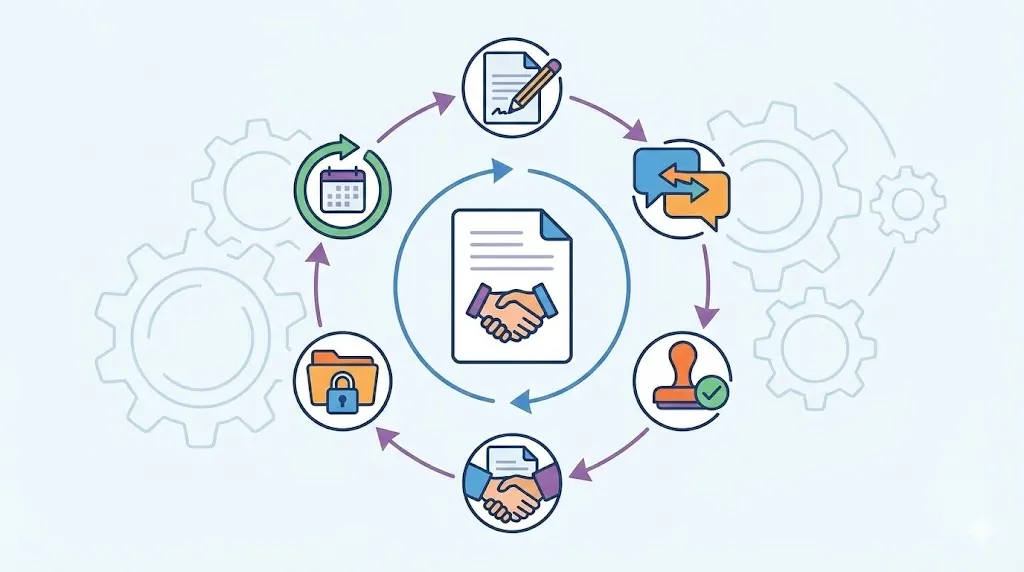
Contract workflow automation and acceleration are achieved by integrating artificial intelligence with enterprise processes. Additionally, it also supports teams in drafting, reviewing, and managing contracts more efficiently and accurately.
Modern platforms unify multiple legal tasks in one place. They offer AI-powered contract drafting, clause analysis, risk scoring, and automated redlining. They also support legal research, due diligence, and document intelligence.
For example, AI can extract key dates and obligations from contracts, alerting teams to upcoming renewals or compliance deadlines. It can also compare contract versions and generate executive summaries.
These tools reduce manual work, improve consistency, and help legal teams scale without growing headcount. They maintain human oversight through transparent suggestions from AI and structured approval workflows.
Managing complex legal workflows demands a centralized, intelligent platform. Interested in how artificial intelligence can streamline legal tasks? Discover Lawxy’s contract automation solutions.
Related articles: Effectively leverage AI for Contract Drafting
FAQ
What percentage of organizations currently use AI in contract management?
About 44% of organizations have integrated AI into their contract workflows, primarily for review, redlining, and summarization tasks. Moreover, this marks a significant increase from previous years, showing growing confidence in AI's practical value.
Can AI negotiate contracts without human involvement?
While over half of executives anticipate autonomous negotiation capabilities within the next year, most companies still require human oversight. AI handles routine negotiations, but complex deals necessitate human judgment to mitigate risks and preserve relationships.
What are the main concerns regarding artificial intelligence adoption in contracting?
Data quality and trust top the list. Many worry AI might misinterpret contract language or miss subtle risks. Transparency in AI decision-making and continuous training on domain-specific contracts help address these concerns.
In what ways does artificial intelligence enhance contract accuracy?
Machine learning models trained on extensive contract corpora identify inconsistencies, omitted clauses, or potentially risky terms more rapidly and reliably than manual review. This reduces the likelihood of errors that could lead to disputes or regulatory noncompliance.
Furthermore, which industries derive the greatest advantage from implementing AI technologies for contracts?
Sectors such as public administration, healthcare, finance, insurance, and manufacturing all experience benefits while navigating distinct challenges unique to their regulatory and operational environments.
What are agentic workflows as applied to contract processes?
Agentic workflows deploy autonomous AI agents to execute contract-related tasks under human supervision. This hybrid model accelerates contract lifecycles and reduces manual handoffs, enabling scalable contract management.
How has artificial intelligence impacted contract turnaround times?
Organizations report faster contract cycles due to AI automating routine reviews and risk assessments. This accelerates deal closure and improves operational efficiency.
What functionalities should advanced legal software incorporate to optimize contract management?
Essential features include AI contract drafting, automated review and redlining, risk scoring, clause extraction, version comparison, and workflow automation with human approval controls. Integration with document and enterprise systems is also critical.
About the Company

Volody AI CLM is an Agentic AI-powered Contract Lifecycle Management platform designed to eliminate manual contracting tasks, automate complex workflows, and deliver actionable insights. As a one-stop shop for all contract activities, it covers drafting, collaboration, negotiation, approvals, e-signature, compliance tracking, and renewals. Built with enterprise-grade security and no-code configuration, it meets the needs of the most complex global organizations. Volody AI CLM also includes AI-driven contract review and risk analysis, helping teams detect issues early and optimize terms. Trusted by Fortune 500 companies, high-growth startups, and government entities, it transforms contracts into strategic, data-driven business assets.




" height="216.72211px" id="FYO0bO80Y" transform="translate(3 6.105)" width="206.073px"/><path d="M 108.174 222 C 88.432 222 70.303 217.239 53.785 207.717 C 37.267 198.196 24.173 185.052 14.504 168.285 C 4.835 151.312 0 132.165 0 110.845 C 0 89.731 4.835 70.792 14.504 54.025 C 24.173 37.052 37.267 23.804 53.785 14.282 C 70.303 4.761 88.432 0 108.174 0 C 128.116 0 146.246 4.761 162.562 14.282 C 179.08 23.804 192.073 37.052 201.541 54.025 C 211.21 70.792 216.044 89.731 216.044 110.845 C 216.044 132.165 211.21 151.312 201.541 168.285 C 192.073 185.052 179.08 198.196 162.562 207.717 C 146.044 217.239 127.915 222 108.174 222 Z M 108.174 183.189 C 120.864 183.189 132.044 180.291 141.713 174.495 C 151.382 168.492 158.936 160.006 164.375 149.035 C 169.814 138.064 172.533 125.334 172.533 110.845 C 172.533 96.355 169.814 83.729 164.375 72.965 C 158.936 61.994 151.382 53.611 141.713 47.815 C 132.044 42.02 120.864 39.122 108.174 39.122 C 95.483 39.122 84.202 42.02 74.332 47.815 C 64.663 53.611 57.109 61.994 51.67 72.965 C 46.231 83.729 43.511 96.355 43.511 110.845 C 43.511 125.334 46.231 138.064 51.67 149.035 C 57.109 160.006 64.663 168.492 74.332 174.495 C 84.202 180.291 95.483 183.189 108.174 183.189 Z" fill="rgba(255, 255, 255, 0.12)" height="222px" id="aa1McFcE9" transform="translate(227.183 3)" width="216.04399999999998px"/><path d="M 42.302 182.257 L 111.799 182.257 L 111.799 216.722 L 0 216.722 L 0 0 L 42.302 0 Z" fill="rgba(255, 255, 255, 0.12)" height="216.72211px" id="yRq4AnrsX" transform="translate(477.721 6.105)" width="111.79899999999998px"/><path d="M 108.174 222 C 88.432 222 70.303 217.239 53.785 207.717 C 37.267 198.196 24.173 185.052 14.504 168.285 C 4.835 151.312 0 132.165 0 110.845 C 0 89.731 4.835 70.792 14.504 54.025 C 24.173 37.052 37.267 23.804 53.785 14.282 C 70.303 4.761 88.432 0 108.174 0 C 128.116 0 146.246 4.761 162.562 14.282 C 179.08 23.804 192.073 37.052 201.541 54.025 C 211.21 70.792 216.045 89.731 216.045 110.845 C 216.045 132.165 211.21 151.312 201.541 168.285 C 192.073 185.052 179.08 198.196 162.562 207.717 C 146.044 217.239 127.915 222 108.174 222 Z M 108.174 183.189 C 120.864 183.189 132.044 180.291 141.713 174.495 C 151.382 168.492 158.936 160.006 164.375 149.035 C 169.814 138.064 172.534 125.334 172.534 110.845 C 172.534 96.355 169.814 83.729 164.375 72.965 C 158.936 61.994 151.382 53.611 141.713 47.815 C 132.044 42.02 120.864 39.122 108.174 39.122 C 95.483 39.122 84.202 42.02 74.332 47.815 C 64.663 53.611 57.108 61.994 51.67 72.965 C 46.231 83.729 43.511 96.355 43.511 110.845 C 43.511 125.334 46.231 138.064 51.67 149.035 C 57.108 160.006 64.663 168.492 74.332 174.495 C 84.202 180.291 95.483 183.189 108.174 183.189 Z" fill="rgba(255, 255, 255, 0.12)" height="222px" id="mo8HQspQ0" transform="translate(609.155 3)" width="216.04500000000007px"/><path d="M 73.727 0 C 95.885 0 115.324 4.45 132.044 13.351 C 148.967 22.252 161.957 34.982 171.027 51.541 C 180.287 67.894 184.917 86.937 184.917 108.671 C 184.917 130.405 180.287 149.449 171.027 165.801 C 161.957 181.947 148.967 194.47 132.044 203.371 C 115.324 212.271 95.885 216.722 73.727 216.722 L 0 216.722 L 0 0 Z M 72.216 179.773 C 94.374 179.773 111.497 173.564 123.583 161.144 C 135.669 148.724 141.713 131.233 141.713 108.671 C 141.713 86.109 135.669 68.515 123.583 55.888 C 111.497 43.055 94.374 36.638 72.216 36.638 L 42.302 36.638 L 42.302 179.773 Z" fill="rgba(255, 255, 255, 0.12)" height="216.72211px" id="I3iXX5Hi_" transform="translate(859.693 6.105)" width="184.91699999999992px"/><path d="M 185.22 0 L 113.91 141.273 L 113.91 216.722 L 71.61 216.722 L 71.61 141.273 L 0 0 L 47.74 0 L 93.06 99.046 L 138.08 0 Z" fill="rgba(255, 255, 255, 0.12)" height="216.72211px" id="nzHyWC0_d" transform="translate(1061.78 6.105)" width="185.22000000000003px"/></svg>)