
Contracts contain critical operational data, yet most organizations cannot access or act on it reliably. Missed renewals can reduce revenue, disrupt services, and trigger urgent legal reviews. AI contract intelligence can connect contract terms with enterprise systems—but only when IT establishes the right controls for accuracy, security, governance, and human oversight.
TL;DR
AI reads contract language and turns key terms into data that business teams can use.
That requires accuracy testing, safeguards for sensitive records, and human involvement in decision-making.
Those contract details can then flow into CRM, ERP, procurement, and office tools through integrations.
If governance is ineffective, organizations may end up with shadow systems, inadequate access controls, and unreliable AI results.
A phased rollout gives teams a way to demonstrate value before they expand the system across the enterprise.
Contract software can bring drafting and review together with search, alerts, and analytics on a single platform.
Why Contract Intelligence Matters to IT
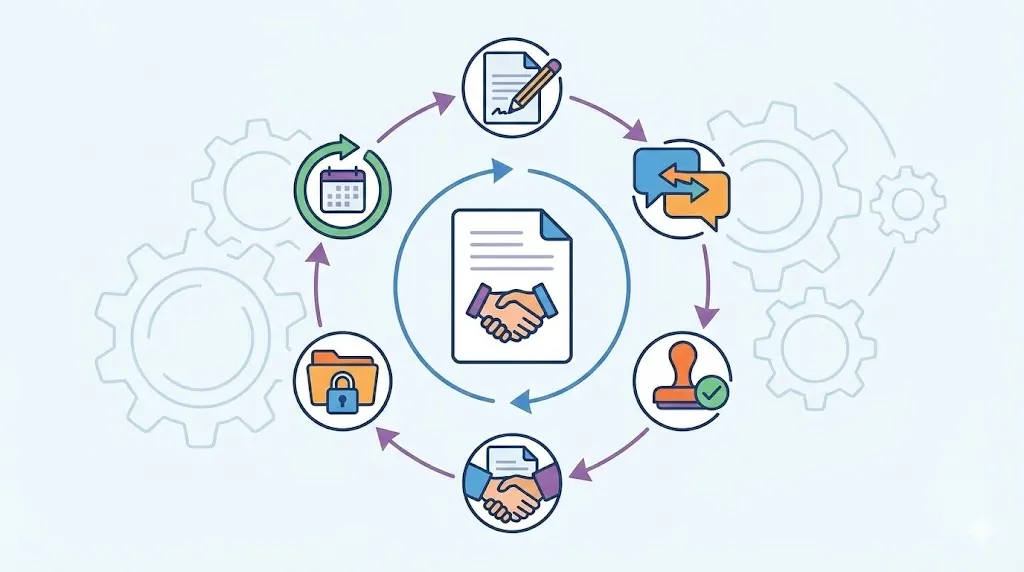
Contract lifecycle management (CLM) organizes the work that surrounds an agreement. Additionally, the scope runs from drafting and review through approval, signing, storage, and renewal. Additionally, contract intelligence extends that process by interpreting the agreement and surfacing the facts embedded in it.
A CLM system can show where a contract sits in the approval process. Contract intelligence, by contrast, can surface its renewal date, liability cap, pricing model, or service commitments. That distinction matters because IT teams support systems that drive business decisions rather than merely store documents.
How CLM and contract intelligence differ
Basic CLM tools focus on workflow control. They route requests, assign tasks, store files, and send reminders. Together, these functions reduce manual work and give the process greater consistency.
AI enables the examination of contract content at scale. It can find terms across thousands of agreements, including documents created before the company adopted a CLM platform. It can compare contract language with company rules or approved clauses.
The two capabilities work best together. Workflow without useful contract data leaves teams with a clean process but limited insight. Moreover, aI without workflow may identify risks but fail to move them to the right person.
Consider a supplier portfolio with 4,000 active agreements. The procurement team wants to find price increase rights before the next budget cycle. A manual review could take months. An AI system can locate likely clauses, group similar terms, and send exceptions to a reviewer.
The reviewer still decides whether each result matters. AI narrows the search and supports the decision. It should not make a final legal judgment without suitable human oversight.
What business data sits inside contracts
Contracts contain more than legal language. They often record the operating rules for a commercial relationship. These rules affect sales, finance, procurement, security, and service delivery.
Common data points include:
Parties, subsidiaries, and signing entities
Effective dates, renewal dates, and notice periods
Prices, discounts, taxes, and payment schedules
Delivery milestones and performance standards
Data protection, security, and audit rights
Insurance levels, liability limits, and indemnities
Service credits, termination rights, and dispute terms
Governing law and dispute venues
Reporting duties and regulatory commitments
This data often remains trapped in PDF files, scanned documents, email attachments, or shared drives. Furthermore, business users then recreate the same information in spreadsheets. Duplicating the data, however, creates further opportunities for errors, stale values, and missed updates.
With AI extraction, those documents become a searchable record. Each extracted fact can be linked to its source text. Before acting, users can verify the original language.
Where contract intelligence creates business value
For each AI use case, IT leaders should define the business result they intend to measure. A broad promise about “better visibility” does not establish a useful project target. The initiative also needs an accountable owner and a cost that can be quantified.
One company may, for example, be focused on reducing missed renewal notices. Another may be looking to identify supplier agreements that permit annual price increases. For a sales organization, the priority may be quicker access to approved customer terms.
Contract intelligence can support each goal in different ways:
Find relevant clauses across existing documents.
Also, it can also extract dates, amounts, duties, and restrictions.
It compares terms with policy or approved language.
Exceptions then go to an assigned owner.
The response remains trackable, with the audit record preserved.
The World Commerce and Contracting association has reported that poor contract management can reduce the value companies receive from agreements. Its research often points to missed obligations, weak processes, and poor visibility as major causes. IT teams can use this finding to frame contract intelligence as an operations project, not only a legal project.
The business case should include both savings and risk reduction. Faster review may reduce outside counsel costs. Better obligation tracking may prevent service failures. More complete pricing data may help finance forecast cash flow with greater confidence.
Related articles: AI Contract Review: Enhancing Legal Workflow Efficiency
How AI Extracts Data From Contracts
AI does not understand a contract in the same way a lawyer does. Additionally, it also identifies patterns in text, structure, and context. Additionally, its results reflect the document, model, instructions, and review process.
IT teams need a clear view of those limits before they approve production use. A system that produces fluent answers can still produce incorrect answers. Good governance treats every AI result as a claim that needs the right level of validation.
What contract AI can identify
Across many document types, modern systems can locate specific terms. These may include native word processing files, PDFs, scanned pages, and amendments. Scanned pages become searchable after optical character recognition, or OCR, converts their contents into text.
From there, it can extract facts including:
A renewal date from a long term and renewal section
A notice period from a termination clause
A payment obligation from a pricing schedule
A data duty from a security or privacy section
A liability limit from a limitation of liability clause
A deviation from the company’s preferred contract language
The system may also create a short summary. A useful summary should point to obligations, financial terms, key risks, and governing law. It should not hide uncertainty or replace the complete agreement.
Generative AI makes search more natural. A user might ask, “Which supplier contracts require annual security reviews?” Likely matches can then be returned with citations to the relevant clauses. IT should require source citations in the user interface.
Why training data and context matter
The model’s quality reflects the data used to build or tune it. A model trained on broad legal text may still struggle with a company’s industry terms. A model may also confuse similar clauses if users provide little context.
Ask vendors how they train and test their models. Review whether they use customer data for training. Vendor due diligence should cover tenant separation, model controls, and available data deletion options.
NIST’s AI Risk Management Framework sets out practices for managing AI risk.
These practices cover risk mapping, system performance measurement, and the ongoing management of results. IT teams can apply this framework to contract use cases without building a separate governance program.
Test the organization’s own documents. Include standard agreements, unusual terms, scanned files, amendments, schedules, and older templates. Test both easy examples and difficult edge cases.
Track more than one accuracy score. Useful measures include:
Precision, or the proportion of flagged results that are correct
Recall, measured by the share of relevant results that the system identifies
Citation quality, assessing whether the source passage supports the answer
Review time, measured by how long a person needs to validate the result
Escalation rate, showing how often the system sends work to experts
A high recall score may still create too many false alerts. High precision does not guarantee that important risks will be detected. Select the balance that fits the business use case.
How human review should work
The appropriate scope of human review depends on the task’s risk. Moreover, routine renewal reminders may need nothing more than confirmation from the contract owner. Findings involving unlimited liability warrant legal review and documented approval.
Create review rules before launch. Define who can approve an AI result, who can reject it, and who must investigate uncertainty. Give users a clear way to correct extracted data.
Corrections can improve future rules, prompts, or model settings. They also create an audit record. The audit trail should show the original document, extracted result, reviewer action, and final value.
AI must not change a contract without authorization. Drafting tools can, however, suggest language from approved templates and clause libraries. A lawyer or other authorized user must assess whether that language fits the deal.
In the United Kingdom, the Information Commissioner’s Office provides guidance on AI and data protection. Its guidance stresses accountability, transparency, and suitable controls. Those principles apply when contract tools process personal data, confidential pricing, or sensitive business terms.
How to handle old and poor quality documents
Many companies begin with a contract archive that contains gaps. File names may lack useful details. Scanned pages may contain errors. Amendments may sit apart from the original agreement.
Start with an inventory. Assess the document types, where they are stored, who owns them, and their likely data quality. Prioritize them according to business value and risk.
One workable sequence looks like this:
Collect documents from approved repositories.
Consolidate duplicate files and locate any missing amendments.
Run OCR on scanned files.
Extract core metadata and key clauses.
Route low-confidence results to reviewers.
Log corrections alongside their source citations.
Move approved records into the central repository.
Historical data from a single scan will not be perfect. Manage the migration as a controlled data project. Define confidence thresholds and identify the contracts that require manual review.
Related Article: AI in Law: Smart Contracts & Legal Automation Tools
How Contract Data Connects Enterprise Systems
Contract intelligence creates value only when people can use its results. Additionally, a procurement manager should be able to locate a supplier commitment without combing through five repositories. Additionally, a sales representative needs a current source for verifying customer terms, rather than an outdated attachment.
Because contract data sits within the wider enterprise architecture, IT teams need to account for it in their design. This architecture needs integrations, identity, data ownership, event handling, and monitoring.
Which systems need contract data
The right connections depend on the company’s processes. Most organizations should assess at least these systems:
CRM platforms for customer terms, sales requests, and account data
ERP platforms for suppliers, payments, entities, and financial records
Procurement tools for sourcing events and purchase commitments
HR systems for employment agreements and worker information
Identity platforms for user access and role changes
E signature tools for execution status and completed documents
Office tools for drafting, review, and collaboration
Integration should support more than a one-time data export. Contract records change after renewal, amendment, assignment, or termination. Connected systems need reliable updates.
For example, an executed supplier agreement may create a payment rule in an ERP system. A later amendment may change that rule. The integration should show the change, identify its source, and alert the right owner.
Design the integration model first
Begin with data ownership. Moreover, decide which system owns each field and which system only displays it. Moreover, if two systems can edit the same date, teams may create conflicting records.
Then define the data flow. Map the events that matter, such as contract creation, signature, amendment, renewal, and termination. Assign a response for each event.
A strong integration plan answers these questions:
Which fields must move between systems?
Which system serves as the master record?
What update frequency is appropriate?
What is the procedure when the system cannot complete a transfer?
Who investigates conflicts between data records?
How does IT test changes before releasing them?
Furthermore, which users should have permission to view or edit each field?
Furthermore, use standard interfaces wherever they are available. Application programming interfaces, or APIs, often provide better control than manual exports. A controlled file transfer may still suit a legacy system, but IT should monitor it closely.
There is no need to move every extracted field into every application. Each transfer should be limited to the data required for a defined business process. Sending unnecessary data broadens privacy exposure and complicates support.
Protect contract data across the environment
Contracts may contain bank details, personal information, product plans, security requirements, and confidential pricing. Integration expands the number of systems that can expose that information.
Use role based access controls. Also, finance teams may need payment terms, without visibility into legal negotiation comments. Also, sales teams may need customer obligations, while access to unrelated employment agreements remains restricted.
Also, identity controls should cover single sign on, multi factor authentication, and prompt access removal. Review permissions after department changes, acquisitions, and contractor offboarding.
Encryption should protect data in transit and at rest. Maintain audit logs for document views, downloads, edits, exports, and permission changes. Set retention rules that match legal, business, and regulatory needs.
IBM’s Cost of a Data Breach research has repeatedly identified lost or compromised data as a major cost for organizations. Contract platforms form part of that risk profile. IT should assess the vendor, integrations, backup design, incident process, and subcontractors.
Ask vendors for clear answers about:
Data hosting locations and regional storage
Customer data use for model training
Encryption and key management
Backup schedules and recovery testing
Security certifications and independent audits
Incident notification duties
Subprocessor management
Data deletion after contract termination
Stop shadow contract systems before they spread
Shadow deployment happens when users adopt tools without IT approval. It often begins with a shared spreadsheet, an AI chatbot, or a personal document repository. Users create these workarounds when the official process feels slow or difficult.
As a result, shadow tools create several risks. Such tools can expose confidential documents, bypass approval requirements, or preserve outdated contract terms. They also make it difficult to establish who approved a change.
Making the approved service easy to use is one way for IT to reduce this risk. Put contract requests inside familiar business tools where possible. Provide simple forms, clear service levels, and useful search.
Track adoption after launch. Low use may signal a design problem, not user resistance. Interview legal, sales, procurement, and finance teams about where work still happens outside the platform.
This does not mean controlling every spreadsheet. Instead, provide a trusted path for contract work. The resulting process should meet business needs while applying security and governance controls.
Related articles: 8 Strategies to reduce cost for AI Contract Management
What IT Should Check Before Buying Contract AI
A product demonstration can hide important limits. Additionally, vendors frequently demonstrate clean documents, ideal workflows, and prepared questions rather than the conditions your team will encounter. Additionally, evidence from their own use cases is what IT leaders need.
Before selecting a vendor, create a test set. Include real documents after removing sensitive content, or use representative samples with similar structure. Ask each vendor to process the same set.
Score the results against agreed criteria. Include accuracy, source citations, processing time, configuration effort, integration support, and user experience.
Evaluate the AI itself
Begin by asking how the system handles uncertainty; specifically, determine whether it displays confidence levels. Next, test whether it can identify a missing clause. It should also be able to state when the available text does not support an answer.
Check whether users can trace each answer to a clause. Source links give reviewers both a basis for trust and a faster path through the material. Answers without evidence should not drive important decisions.
Test the product with:
Amendments that change original terms
Tables with pricing and volume tiers
Clauses split across pages
Multiple languages, if needed
Handwritten or low quality scanned pages
Conflicting terms across related documents
Defined terms with unusual meanings
Review the vendor’s update process. Model changes can affect results without changes from your team. Require release notes, test access, and a method to compare results after updates.
Evaluate the product architecture
IT should review the full architecture, not only the AI feature. Review the product's file storage, text indexing, metadata management, and data transfers to external services.
Examine tenancy design and access boundaries. Ask whether customer records share model training systems. The vendor should also explain the controls that isolate one customer from another.
Check integration methods and limits. Review API documentation, authentication methods, rate limits, webhooks, and error handling. Confirm whether the product supports your CRM, ERP, office suite, identity provider, and signing service.
Also test administration. Business teams may need to update templates, approval rules, clause libraries, and alerts. No code configuration can reduce IT workload, but changes still need approval and audit controls.
Plan the rollout in stages
A pilot should solve one meaningful problem. Good starting points include renewal tracking, legacy contract search, or supplier obligation review. Avoid launching every department and document type at once.
Set a baseline before the pilot. Also, record current review time, search effort, missed alerts, and manual data entry. Compare pilot results against that baseline.
Use a simple rollout path:
Select one business process and owner.
Define data, risk, and success measures.
Configure roles, workflows, and review rules.
Test representative contracts.
Provide users with training on results and escalation steps.
During the pilot, provide hands-on support.
Once it concludes, assess the outcomes and identify any control gaps.
Broaden the scope only after the team approves the next phase.
This approach also supports change management. Users need to know what the system does, what it cannot do, and when they must ask a human expert. Clear guidance improves trust more than broad claims about AI.
Measure outcomes that matter
Track operational and control metrics together. Speed alone can reward risky shortcuts. Accuracy alone may not show whether users act on the information.
Useful measures include:
Time from request to first draft
Time from draft to approval
Percentage of contracts with complete metadata
Number of missed or late obligation alerts
AI result accuracy by clause type
Percentage of users working inside the approved platform
Number of policy exceptions found before signature
Integration failures and unresolved data conflicts
Review results with legal, procurement, finance, security, and business owners. Since each group interacts with a different part of the contract process, their findings will not be the same. IT can then improve the system without losing sight of business impact.
Related articles: AI Contract Review vs. Human Lawyers: Speed, Accuracy & ROI
How CLM Software Supports Contract Intelligence
Contract management software gives teams a central place to request, draft, review, approve, sign, store, and track agreements. Additionally, aI features can also extract metadata, summarize terms, flag policy deviations, and monitor obligations. Additionally, these capabilities help IT connect contract work with the systems employees already use.
Volody supports AI drafting, review, summaries, clause recommendations, metadata extraction, advanced search, workflow automation, audit trails, and enterprise integrations. Its controls also support role based access, OCR, version history, alerts, and configurable playbooks.
Ready to make contract management more efficient? Learn more about Volody's CLM Software.
FAQ
What is meant by contract intelligence?
Additionally, contract intelligence uses AI to locate and organize information inside contracts. Additionally, it can extract terms, dates, obligations, risks, and commercial details. Teams can then use those data points to search, report, and take action.
How is contract intelligence different from CLM software?
CLM software manages the contract process and related tasks. Contract intelligence examines the contract content and turns it into structured data. Most organizations gain the best results by using both capabilities together.
Can AI read contracts stored as scanned PDFs?
Moreover, many systems can read scanned PDFs through OCR. Moreover, the quality of those results depends on image quality, layout, handwriting, and document structure. IT should test scanned documents during vendor evaluation and route low confidence results for review.
Should AI have the final say on contract risk?
AI can support the risk review, but the final call belongs to a human reviewer. It may identify unusual language, missing provisions, or deviations from policy. Before the company acts, a qualified reviewer needs to confirm that each finding is valid.
What systems should connect to contract intelligence software?
Furthermore, common connections include CRM, ERP, procurement, HR, identity, office, and electronic signature systems. Furthermore, the right scope depends on the company’s contract processes. Start with the systems that need contract data for a defined business task.
How can IT prevent contract data from entering unauthorized AI tools?
Give users a practical approved service with strong search, simple intake, and reasonable response times. Train staff on data handling rules and monitor access patterns. Apply identity controls, data loss prevention, and vendor review to approved AI services.
What security questions should IT ask a contract AI vendor?
Also, ask about encryption, hosting locations, model training, data isolation, backups, retention, subprocessors, and incident response. Also, request independent audit reports and security certifications. IT should also examine API security and the permission controls governing connected systems.
What is the best way to begin a contract intelligence project?
Where is the right place to begin a contract intelligence project? Choose one process with a clear owner and a measurable pain point. Build a test set from representative contracts, define accuracy standards, and run a controlled pilot. Expansion should follow the team’s review of results, adoption rates, and control performance.
Therefore, what is legal's role in an IT led project?
Therefore, the legal team establishes acceptable clause language, review rules, and escalation points. IT oversees architecture, access, integration, and operational support. Both teams should approve the data model, test cases, and production controls.
How can teams measure the value of contract intelligence?
Measure faster drafting and review, better metadata quality, fewer missed obligations, and stronger policy compliance. Search success and adoption should also be tracked. Establish a measurable baseline, validate results with business owners, and scale the approved platform when it demonstrates clear operational value.
About the Company
Volody AI CLM is an Agentic AI-powered Contract Lifecycle Management platform designed to eliminate manual contracting tasks, automate complex workflows, and deliver actionable insights. As a one-stop shop for all contract activities, it covers drafting, collaboration, negotiation, approvals, e-signature, compliance tracking, and renewals. Built with enterprise-grade security and no-code configuration, it meets the needs of the most complex global organizations. Volody AI CLM also includes AI-driven contract review and risk analysis, helping teams detect issues early and optimize terms. Trusted by Fortune 500 companies, high-growth startups, and government entities, it transforms contracts into strategic, data-driven business assets.




" height="216.72211px" id="FYO0bO80Y" transform="translate(3 6.105)" width="206.073px"/><path d="M 108.174 222 C 88.432 222 70.303 217.239 53.785 207.717 C 37.267 198.196 24.173 185.052 14.504 168.285 C 4.835 151.312 0 132.165 0 110.845 C 0 89.731 4.835 70.792 14.504 54.025 C 24.173 37.052 37.267 23.804 53.785 14.282 C 70.303 4.761 88.432 0 108.174 0 C 128.116 0 146.246 4.761 162.562 14.282 C 179.08 23.804 192.073 37.052 201.541 54.025 C 211.21 70.792 216.044 89.731 216.044 110.845 C 216.044 132.165 211.21 151.312 201.541 168.285 C 192.073 185.052 179.08 198.196 162.562 207.717 C 146.044 217.239 127.915 222 108.174 222 Z M 108.174 183.189 C 120.864 183.189 132.044 180.291 141.713 174.495 C 151.382 168.492 158.936 160.006 164.375 149.035 C 169.814 138.064 172.533 125.334 172.533 110.845 C 172.533 96.355 169.814 83.729 164.375 72.965 C 158.936 61.994 151.382 53.611 141.713 47.815 C 132.044 42.02 120.864 39.122 108.174 39.122 C 95.483 39.122 84.202 42.02 74.332 47.815 C 64.663 53.611 57.109 61.994 51.67 72.965 C 46.231 83.729 43.511 96.355 43.511 110.845 C 43.511 125.334 46.231 138.064 51.67 149.035 C 57.109 160.006 64.663 168.492 74.332 174.495 C 84.202 180.291 95.483 183.189 108.174 183.189 Z" fill="rgba(255, 255, 255, 0.12)" height="222px" id="aa1McFcE9" transform="translate(227.183 3)" width="216.04399999999998px"/><path d="M 42.302 182.257 L 111.799 182.257 L 111.799 216.722 L 0 216.722 L 0 0 L 42.302 0 Z" fill="rgba(255, 255, 255, 0.12)" height="216.72211px" id="yRq4AnrsX" transform="translate(477.721 6.105)" width="111.79899999999998px"/><path d="M 108.174 222 C 88.432 222 70.303 217.239 53.785 207.717 C 37.267 198.196 24.173 185.052 14.504 168.285 C 4.835 151.312 0 132.165 0 110.845 C 0 89.731 4.835 70.792 14.504 54.025 C 24.173 37.052 37.267 23.804 53.785 14.282 C 70.303 4.761 88.432 0 108.174 0 C 128.116 0 146.246 4.761 162.562 14.282 C 179.08 23.804 192.073 37.052 201.541 54.025 C 211.21 70.792 216.045 89.731 216.045 110.845 C 216.045 132.165 211.21 151.312 201.541 168.285 C 192.073 185.052 179.08 198.196 162.562 207.717 C 146.044 217.239 127.915 222 108.174 222 Z M 108.174 183.189 C 120.864 183.189 132.044 180.291 141.713 174.495 C 151.382 168.492 158.936 160.006 164.375 149.035 C 169.814 138.064 172.534 125.334 172.534 110.845 C 172.534 96.355 169.814 83.729 164.375 72.965 C 158.936 61.994 151.382 53.611 141.713 47.815 C 132.044 42.02 120.864 39.122 108.174 39.122 C 95.483 39.122 84.202 42.02 74.332 47.815 C 64.663 53.611 57.108 61.994 51.67 72.965 C 46.231 83.729 43.511 96.355 43.511 110.845 C 43.511 125.334 46.231 138.064 51.67 149.035 C 57.108 160.006 64.663 168.492 74.332 174.495 C 84.202 180.291 95.483 183.189 108.174 183.189 Z" fill="rgba(255, 255, 255, 0.12)" height="222px" id="mo8HQspQ0" transform="translate(609.155 3)" width="216.04500000000007px"/><path d="M 73.727 0 C 95.885 0 115.324 4.45 132.044 13.351 C 148.967 22.252 161.957 34.982 171.027 51.541 C 180.287 67.894 184.917 86.937 184.917 108.671 C 184.917 130.405 180.287 149.449 171.027 165.801 C 161.957 181.947 148.967 194.47 132.044 203.371 C 115.324 212.271 95.885 216.722 73.727 216.722 L 0 216.722 L 0 0 Z M 72.216 179.773 C 94.374 179.773 111.497 173.564 123.583 161.144 C 135.669 148.724 141.713 131.233 141.713 108.671 C 141.713 86.109 135.669 68.515 123.583 55.888 C 111.497 43.055 94.374 36.638 72.216 36.638 L 42.302 36.638 L 42.302 179.773 Z" fill="rgba(255, 255, 255, 0.12)" height="216.72211px" id="I3iXX5Hi_" transform="translate(859.693 6.105)" width="184.91699999999992px"/><path d="M 185.22 0 L 113.91 141.273 L 113.91 216.722 L 71.61 216.722 L 71.61 141.273 L 0 0 L 47.74 0 L 93.06 99.046 L 138.08 0 Z" fill="rgba(255, 255, 255, 0.12)" height="216.72211px" id="nzHyWC0_d" transform="translate(1061.78 6.105)" width="185.22000000000003px"/></svg>)