

Healthcare organizations juggle complex contracts with payers, suppliers, and partners every day. These contracts set the rules for care delivery, payments, and partnerships. But keeping all these agreements compliant with ever-changing regulations is a tough task. Poor contract compliance can lead to costly penalties, damaged reputations, and operational disruptions. Understanding how to avoid poor healthcare contract compliance with contract intelligence can help healthcare leaders protect their organizations and improve operational efficiency.
Imagine a large hospital network managing thousands of contracts across multiple departments. Manual tracking and siloed systems make it nearly impossible to spot regulatory risks or update contracts quickly. Contract intelligence offers a way to automate and centralize contract management, providing clear visibility and control. This article explains why contract compliance matters in healthcare, the risks of poor contract management, and how contract intelligence can help organizations stay ahead.
TL;DR
Compliance with healthcare contracts requires navigating a multifaceted array of legal and regulatory mandates that govern interactions with payers, providers, and vendors.
Additionally, managing contracts manually increases the likelihood of missing critical updates, misinterpreting terms, and facing substantial financial repercussions.
Healthcare organizations confront rigorous regulatory frameworks, such as the Stark Law and HIPAA, which necessitate thorough contract monitoring.
AI-driven contract intelligence enables organizations to overhaul conventional workflows by digitizing, analyzing, and automating processes to enhance compliance and reduce risk.
Centralized contract data enables quick identification of noncompliant clauses and supports mass contract updates.
Contract management software streamlines contract creation, review, approval, and tracking for better control and audit readiness.
What Does Healthcare Contract Compliance Really Mean?
Healthcare contract compliance requires that each agreement fully conforms to relevant laws, regulations, and internal policies. Additionally, these arrangements establish the framework for interactions among insurance payers, healthcare providers, suppliers, and strategic partners. Contracts must:
Comply with legal mandates such as anti-kickback statutes and patient privacy regulations.
Incorporate detailed terms and provisions that protect the organization’s interests.
Be executed and administered with precision, ensuring all obligations are carefully monitored and met.
Maintain rigorous data security and confidentiality standards consistent with healthcare industry requirements.
For example, the Stark Law prevents doctors from referring patients to providers where they have financial interests, avoiding conflicts of interest. Contracts must reflect these restrictions clearly. Similarly, HIPAA requires contracts with vendors to protect patient data privacy. Maintaining compliance with healthcare contracts goes beyond their initial execution; it demands ongoing management and oversight to ensure every agreement remains enforceable and aligned with current regulations.
Healthcare organizations must also respond to frequent regulatory changes. Medicare and Medicaid rules update regularly, requiring contract terms to be revised. Without a system to track and enforce compliance, organizations risk operating under outdated agreements that expose them to legal and financial penalties.
Related articles: Healthcare Contract Management for Modern Organizations
Why Poor Healthcare Contract Management Leads to Compliance Risks
Healthcare is one of the most regulated industries. Additionally, government programs such as Medicare and Medicaid have a significant impact on provider operations through their contractual requirements. Yet, many healthcare organizations still rely on manual processes or disconnected systems to manage contracts. This creates several problems:
Lack of Visibility: Contracts stored in emails, shared drives, or paper make it hard to find key terms or spot noncompliance.
Slow Reaction to Change: When regulations change, identifying affected contracts and updating them manually takes too long.
Inconsistent Language: Without standardized clauses, contracts may include risky or outdated terms.
Data Errors: Manual data entry leads to mistakes in contract metadata, causing missed deadlines or wrong payments.
Audit Challenges: Gathering proof of compliance during audits becomes a time-consuming, error-prone task.
These issues significantly amplify the chances of violations and financial penalties. For instance, a healthcare provider might unknowingly continue billing under contracts with illegal referral terms. In 2014, a health system faced a $24.5 million fine for violating the Stark Law due to outdated contracts inherited through mergers. This example illustrates how deficient contract management practices can deeply entrench compliance vulnerabilities within an organization.
Healthcare mergers and acquisitions complicate matters by consolidating contracts that differ extensively in terms and compliance standards. The absence of a centralized system complicates the process of pinpointing and rectifying problematic clauses. Such obstacles often prolong integration timelines and elevate the risk of regulatory exposure.
Explore further: How Does AI Limitations Impacting Contract Management?
How Contract Intelligence Transforms Healthcare Contract Compliance
Contract intelligence applies artificial intelligence and automation to contract management. Additionally, it converts contracts from static documents into structured data that organizations can analyze and act upon. Here is how contract intelligence improves healthcare contract compliance:
Centralizes Contracts: Stores all contracts in one secure digital repository with full-text search and metadata tagging.
Extracts Key Data: AI algorithms identify and retrieve critical elements such as parties involved, payment structures, obligations, and regulatory provisions without manual input.
Monitors Compliance: Contracts undergo thorough analysis by rule-based engines designed to identify and highlight clauses that could pose compliance risks prior to contract finalization.
Speeds Updates: Automated workflows facilitate the application of bulk amendments, thereby optimizing the process of updating contracts in response to shifting regulatory landscapes.
Provides Insights: Organizations gain access to dynamic dashboards and comprehensive reports that deliver continuous monitoring of contract lifecycles, risk assessments, and imminent contractual obligations.
Supports Audits: Keeps an audit trail of contract changes and approvals for easy compliance verification.
For example, when a new healthcare regulation is introduced, contract intelligence software can scan thousands of contracts in minutes to find affected clauses. Updates can then be deployed en masse through electronic processes, minimizing manual intervention and the potential for errors. This agility keeps healthcare organizations compliant and responsive.
Contract intelligence also helps standardize contract language. By maintaining approved templates and clause libraries, organizations reduce the chance of noncompliant terms slipping into agreements. Automated contract review detects deviations from policy promptly, enabling early rectification of issues within the legal team.
Related articles: Contract Risk Analysis Strengthened By AI In Legal Ops
What Challenges Does Healthcare Contract Compliance Present?
Healthcare contract compliance faces several unique challenges that make manual management ineffective:
Complex Regulatory Environment: Laws like Stark Law, Anti-Kickback Statute, HIPAA, and CMS rules impose strict and varied requirements.
Volume and Variety of Contracts: Providers navigate a diverse array of contracts involving payers, vendors, physicians, and partners, each encompassing distinct terms and risk profiles.
Frequent Policy Changes: As regulations evolve rapidly, contract reviews must be accelerated and amendments implemented swiftly to uphold compliance standards.
Data Privacy and Security: It is essential that contracts are carefully designed to protect sensitive patient data while meeting stringent privacy regulations.
Mergers and Consolidations: The integration of contracts from multiple organizations entails complex efforts to harmonize terms and establish consistent compliance frameworks.
Audit and Reporting Pressure: Healthcare organizations face rigorous demands during audits, necessitating clear and easily accessible contract documentation to verify compliance.
These factors make it difficult to keep contracts compliant without automation. Manual processes slow down contract lifecycle management and increase the risk of costly errors.
Related articles: Mastering International Contracts: Compliance & Risk
What Are the Risks of Poor Contract Compliance in Healthcare?
Failing to maintain contract compliance can cause serious consequences for healthcare organizations:
Financial Penalties: Violations of laws like Stark Law or HIPAA can lead to multi-million dollar fines.
Legal Action: Noncompliance may trigger lawsuits or government investigations.
Reputation Damage: When compliance failures become public, they significantly erode confidence among patients, payers, and strategic partners.
Operational Disruptions: Disputes arising from contract ambiguities or invalid agreements often result in delays to payments and interruptions in service delivery.
Lost Revenue: Errors in billing or denied claims stemming from contract inaccuracies directly diminish organizational income.
Increased Audit Burden: Deficient record-keeping practices extend audit durations, increase associated costs, and elevate stress levels for compliance teams.
For example, a hospital that fails to update contracts after a regulatory change might face denied reimbursements or penalties. These risks highlight the need for proactive contract compliance management.
Related articles: 9 Legal Issues in Hospital & Healthcare Everyone Should Know
How Can Healthcare Organizations Improve Contract Compliance?
Healthcare providers can take practical steps to strengthen contract compliance:
Centralize Contract Storage: Keep all contracts in a single digital repository accessible to authorized users.
Standardize Contract Templates: Use approved language and clauses to reduce compliance risks.
Automate Data Extraction: Use AI tools to pull key contract data automatically, reducing manual errors.
Set Compliance Rules: Define policies that flag risky terms during contract drafting and review.
Monitor Contract Obligations: Track deadlines, renewals, and deliverables to avoid breaches.
Enable Mass Contract Updates: Use automated workflows to update contracts quickly when regulations change.
Train Staff: Educate legal, procurement, and operations teams on compliance requirements and tools.
Prepare for Audits: Maintain clear audit trails and easy access to contract data for compliance verification.
These steps reduce manual workload and improve contract accuracy, helping organizations avoid costly compliance failures.
Related articles: How to Simplify Contract Review with AI? Comprehensive Guide
How Contract Management Software Solves This
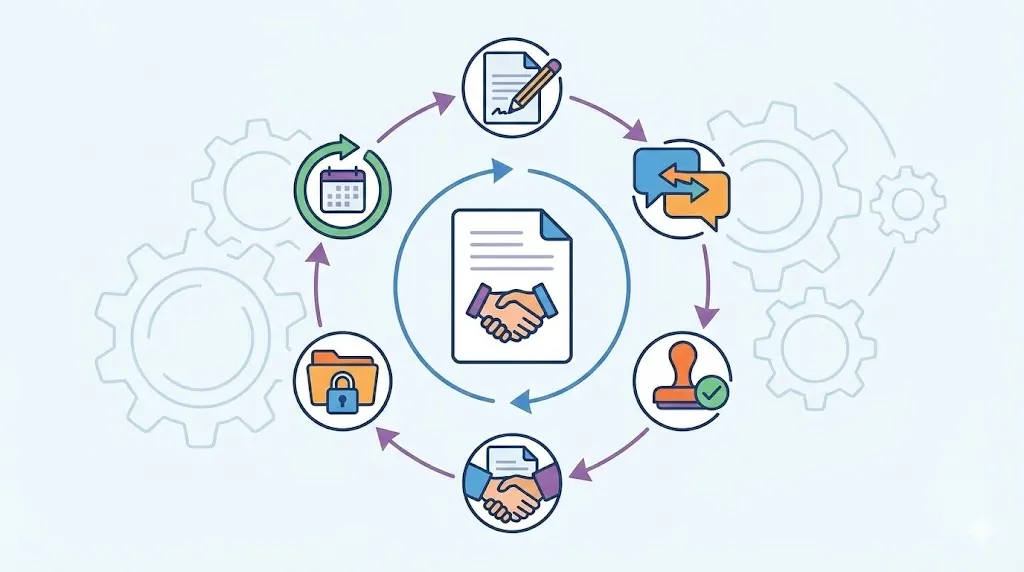
Contract management software consolidates contract workflows into a unified platform, automating key processes to enhance both compliance and operational efficiency. Additionally, it offers capabilities such as secure digital storage enhanced by advanced search and tagging functionalities. AI-powered tools facilitate drafting and reviewing contracts, bolstered by sophisticated metadata extraction techniques. The system streamlines approval workflows to ensure tight integration with e-signature platforms. Users receive immediate alerts regarding renewals, obligations, and compliance matters. Robust dashboards provide detailed analytics on contract performance alongside comprehensive risk analysis.
Such solutions enable healthcare professionals to accelerate contract lifecycles while minimizing the incidence of errors. In addition, they reinforce regulatory compliance by standardizing contractual language and maintaining comprehensive change tracking.
Volody’s contract management platform includes AI-assisted drafting tools, comprehensive clause libraries, obligation monitoring, and audit trails. It integrates with Microsoft Word and other enterprise systems for smooth workflows. These features reduce legal risks and speed contract processes.
> Discover how Volody's CLM Software helps legal departments streamline contract lifecycle management with greater precision and oversight.
FAQ
What does compliance entail in healthcare contracts?
Additionally, ensuring that agreements among payers, providers, and vendors fully adhere to all applicable legal and regulatory requirements is essential.
It ensures contracts meet laws like Stark Law and HIPAA and that obligations are tracked and fulfilled properly.
It ensures contracts meet laws like Stark Law and HIPAA and that obligations are tracked and fulfilled properly.
Why is contract compliance important in healthcare?
Maintaining contract compliance safeguards healthcare organizations against legal penalties, financial losses, and reputational harm. It guarantees that agreements align with lawful business operations and uphold patient care standards.
What risks come from poor contract compliance?
Moreover, poor compliance can lead to fines, lawsuits, denied claims, operational delays, and audit failures. It also increases the chance of contract disputes and lost revenue.
In what ways does contract intelligence enhance compliance?
Contract intelligence employs AI capabilities to digitize agreements, extract critical data, identify potential risks, and automate required updates. This accelerates compliance verification and minimizes human error.
Can contract management software handle regulatory changes?
Yes. It allows quick identification of affected contracts and mass updates through automated workflows, keeping agreements current with new rules.
Furthermore, what features should healthcare contract software have?
Look for AI contract review, clause libraries, obligation tracking, audit trails, approval workflows, and integration with existing systems.
How does contract intelligence assist during audits?
It provides a clear audit trail, searchable contract data, and compliance reports, making it easier to prove adherence to regulations.
Are manual contract processes still viable in healthcare?
Manual processes are slow, error-prone, and risky given healthcare’s regulatory complexity. Automation is essential to manage volume and compliance effectively.
Also, how do mergers affect contract compliance?
Mergers consolidate contracts that encompass varied terms and risk profiles. Contract intelligence facilitates comprehensive evaluation and integration of these agreements, ensuring continuous compliance.
What initial measure should be taken to enhance compliance in healthcare agreements?
Establishing a centralized, secure, and searchable digital repository for contracts is a crucial first step.
Following that, leveraging automation and AI technologies can significantly improve compliance oversight.
This article has covered the critical role of contract intelligence in preventing poor healthcare contract compliance. Healthcare leaders who adopt smart contract management tools can reduce risk, improve efficiency, and stay ready for regulatory changes.
About the Company

Volody AI CLM is an Agentic AI-powered Contract Lifecycle Management platform designed to eliminate manual contracting tasks, automate complex workflows, and deliver actionable insights. As a one-stop shop for all contract activities, it covers drafting, collaboration, negotiation, approvals, e-signature, compliance tracking, and renewals. Built with enterprise-grade security and no-code configuration, it meets the needs of the most complex global organizations. Volody AI CLM also includes AI-driven contract review and risk analysis, helping teams detect issues early and optimize terms. Trusted by Fortune 500 companies, high-growth startups, and government entities, it transforms contracts into strategic, data-driven business assets.




" height="216.72211px" id="FYO0bO80Y" transform="translate(3 6.105)" width="206.073px"/><path d="M 108.174 222 C 88.432 222 70.303 217.239 53.785 207.717 C 37.267 198.196 24.173 185.052 14.504 168.285 C 4.835 151.312 0 132.165 0 110.845 C 0 89.731 4.835 70.792 14.504 54.025 C 24.173 37.052 37.267 23.804 53.785 14.282 C 70.303 4.761 88.432 0 108.174 0 C 128.116 0 146.246 4.761 162.562 14.282 C 179.08 23.804 192.073 37.052 201.541 54.025 C 211.21 70.792 216.044 89.731 216.044 110.845 C 216.044 132.165 211.21 151.312 201.541 168.285 C 192.073 185.052 179.08 198.196 162.562 207.717 C 146.044 217.239 127.915 222 108.174 222 Z M 108.174 183.189 C 120.864 183.189 132.044 180.291 141.713 174.495 C 151.382 168.492 158.936 160.006 164.375 149.035 C 169.814 138.064 172.533 125.334 172.533 110.845 C 172.533 96.355 169.814 83.729 164.375 72.965 C 158.936 61.994 151.382 53.611 141.713 47.815 C 132.044 42.02 120.864 39.122 108.174 39.122 C 95.483 39.122 84.202 42.02 74.332 47.815 C 64.663 53.611 57.109 61.994 51.67 72.965 C 46.231 83.729 43.511 96.355 43.511 110.845 C 43.511 125.334 46.231 138.064 51.67 149.035 C 57.109 160.006 64.663 168.492 74.332 174.495 C 84.202 180.291 95.483 183.189 108.174 183.189 Z" fill="rgba(255, 255, 255, 0.12)" height="222px" id="aa1McFcE9" transform="translate(227.183 3)" width="216.04399999999998px"/><path d="M 42.302 182.257 L 111.799 182.257 L 111.799 216.722 L 0 216.722 L 0 0 L 42.302 0 Z" fill="rgba(255, 255, 255, 0.12)" height="216.72211px" id="yRq4AnrsX" transform="translate(477.721 6.105)" width="111.79899999999998px"/><path d="M 108.174 222 C 88.432 222 70.303 217.239 53.785 207.717 C 37.267 198.196 24.173 185.052 14.504 168.285 C 4.835 151.312 0 132.165 0 110.845 C 0 89.731 4.835 70.792 14.504 54.025 C 24.173 37.052 37.267 23.804 53.785 14.282 C 70.303 4.761 88.432 0 108.174 0 C 128.116 0 146.246 4.761 162.562 14.282 C 179.08 23.804 192.073 37.052 201.541 54.025 C 211.21 70.792 216.045 89.731 216.045 110.845 C 216.045 132.165 211.21 151.312 201.541 168.285 C 192.073 185.052 179.08 198.196 162.562 207.717 C 146.044 217.239 127.915 222 108.174 222 Z M 108.174 183.189 C 120.864 183.189 132.044 180.291 141.713 174.495 C 151.382 168.492 158.936 160.006 164.375 149.035 C 169.814 138.064 172.534 125.334 172.534 110.845 C 172.534 96.355 169.814 83.729 164.375 72.965 C 158.936 61.994 151.382 53.611 141.713 47.815 C 132.044 42.02 120.864 39.122 108.174 39.122 C 95.483 39.122 84.202 42.02 74.332 47.815 C 64.663 53.611 57.108 61.994 51.67 72.965 C 46.231 83.729 43.511 96.355 43.511 110.845 C 43.511 125.334 46.231 138.064 51.67 149.035 C 57.108 160.006 64.663 168.492 74.332 174.495 C 84.202 180.291 95.483 183.189 108.174 183.189 Z" fill="rgba(255, 255, 255, 0.12)" height="222px" id="mo8HQspQ0" transform="translate(609.155 3)" width="216.04500000000007px"/><path d="M 73.727 0 C 95.885 0 115.324 4.45 132.044 13.351 C 148.967 22.252 161.957 34.982 171.027 51.541 C 180.287 67.894 184.917 86.937 184.917 108.671 C 184.917 130.405 180.287 149.449 171.027 165.801 C 161.957 181.947 148.967 194.47 132.044 203.371 C 115.324 212.271 95.885 216.722 73.727 216.722 L 0 216.722 L 0 0 Z M 72.216 179.773 C 94.374 179.773 111.497 173.564 123.583 161.144 C 135.669 148.724 141.713 131.233 141.713 108.671 C 141.713 86.109 135.669 68.515 123.583 55.888 C 111.497 43.055 94.374 36.638 72.216 36.638 L 42.302 36.638 L 42.302 179.773 Z" fill="rgba(255, 255, 255, 0.12)" height="216.72211px" id="I3iXX5Hi_" transform="translate(859.693 6.105)" width="184.91699999999992px"/><path d="M 185.22 0 L 113.91 141.273 L 113.91 216.722 L 71.61 216.722 L 71.61 141.273 L 0 0 L 47.74 0 L 93.06 99.046 L 138.08 0 Z" fill="rgba(255, 255, 255, 0.12)" height="216.72211px" id="nzHyWC0_d" transform="translate(1061.78 6.105)" width="185.22000000000003px"/></svg>)