

Vendor due diligence is a critical control for making informed supplier decisions before financial, operational, or regulatory exposure materializes. A disciplined review enables leaders to assess financial health, security, performance, compliance, and contract terms with confidence, while establishing a clear record of risk, mitigation, and approval.
TL;DR
Before signing, assess the prospective provider across five areas: financial health, security, compliance, operations, and reputation.
The review’s depth should be proportionate to the provider’s access, the service’s criticality, the data involved, and the potential business impact.
To keep reviews moving, define evidence requests, assign owners, set deadlines, and establish approval rules.
Maintain a reliable audit trail that captures risks, controls, exceptions, and decisions.
Because risk changes throughout the relationship, continue monitoring important vendors after onboarding.
By linking intake and review with approvals, obligations, and renewal alerts, contract management software can provide continuity across the process.
What is vendor due diligence?
Vendor due diligence is the examination of a supplier before the company enters into a business relationship with it. Additionally, the review assesses whether the vendor can deliver its service safely, lawfully, and reliably. It also asks whether the resulting terms create risks that your business can accept.
Depending on the relationship, the vendor may handle personal data, confidential files, payments, customer support, or core operations. Each type of access creates a different risk profile. A marketing agency with no system access needs less scrutiny than a payroll provider with employee records.
A sound review usually covers these areas:
Financial condition and business continuity
Information security and data protection
Legal, regulatory, and contractual compliance
Service quality and operational resilience
Ownership, reputation, and conflicts of interest
Insurance, subcontractors, and geographic exposure
Pricing, renewal terms, and exit rights
The point is to understand the risk and decide whether controls reduce it enough. A useful process gives decision makers facts, not assumptions.
The National Institute of Standards and Technology offers a useful reference in its Cybersecurity Supply Chain Risk Management guidance. NIST connects supplier risk with security planning, supplier selection, contract terms, and ongoing monitoring. For most enterprise procurement programs, that approach provides a suitable framework.
Moreover, a simple vendor questionnaire, however, is only one part of due diligence. Its purpose is to gather information from the supplier. Due diligence checks that information against evidence, internal policies, external records, and contract protections.
For example, the supplier might claim that it encrypts customer data. The team should request a current security report, policy summary, or certification. It should also confirm where the contract defines security duties, breach notice periods, and audit rights.
The process should produce a decision record. That record can show:
What the business needed from the vendor
Which risks the team identified
What evidence the vendor supplied
Which controls reduced the risks
Who approved any exceptions
What actions remain open
When the team will review the vendor again
This record helps legal, procurement, security, finance, and operations work from the same facts. It also supports audits and future renewals. Most importantly, it prevents the business from treating onboarding as the end of risk review.
Related articles: Procurement Contract Risks That Could Sink Your Business
How should you approach vendor due diligence?
Start with a risk based process. Additionally, do not send every supplier the same 100 question form. Long forms consume time, create weak answers, and frustrate low risk vendors.
First, classify the vendor. Consider what the vendor does, what it can access, and what happens if it fails. Then assign a review level that reflects those facts.
A simple model can include three levels:
Review level | Typical vendor profile | Typical review |
|---|---|---|
Basic | Low spend, no sensitive data, easy replacement | Company details, sanctions check, insurance, and contract review |
Standard | Business data, recurring service, moderate operational impact | Security evidence, financial review, privacy terms, references, and continuity plans |
Enhanced | Critical service, sensitive data, broad system access, or difficult replacement | Detailed control testing, executive approval, financial analysis, resilience testing, and stronger contract rights |
This model does not replace judgment. Even an inexpensive vendor can pose serious risk if it handles regulated data. Conversely, a costly vendor may pose little risk when it supplies ordinary office materials.
Set clear ownership
Assign one owner for the full review. That person coordinates evidence, tracks questions, records decisions, and communicates with the vendor. Each specialist should own a defined area.
In its review, Legal should concentrate on liability, privacy, intellectual property, and termination terms. Controls, access, encryption, and incident response fall within the security team's assessment. Moreover, for Finance, the review should examine the vendor's solvency, payment terms, and financial exposure.
Procurement typically manages the timeline and commercial information. The business owner must confirm service needs and accept operational risks. Exceptions beyond the normal risk limit require senior-leader approval.
When ownership is unclear, teams may assume someone else checked an issue. Such gaps often surface during a renewal, audit, or incident. A responsibility matrix can prevent this problem.
Request useful evidence
Ask for evidence that answers a decision, rather than evidence that fills a folder. Each request should explain what the team needs and why it matters. Give the vendor a secure way to submit documents.
Useful evidence may include:
Company registration and ownership details
Recent financial statements or credit information
Security certifications and independent assessment reports
Privacy notices and data processing terms
Business continuity and disaster recovery summaries
Insurance certificates
Subcontractor lists
Incident response procedures
Service level commitments
References from similar customers
Set an expiry date for evidence. Furthermore, a report from three years ago may not show current controls. Also ask vendors to explain gaps instead of forcing them to claim full compliance.
The Information Commissioner’s Office vendor guidance highlights the need for clear processor contracts and oversight. The same principle applies broadly: define duties, check performance, and keep records.
Review exceptions openly
Most reviews uncover issues. The vendor might lack a preferred certification, reject an audit clause, or use a subcontractor in another country. That does not always mean the business must reject the vendor.
Record each exception in plain language. State the risk, the reason for accepting it, the person approving it, and any compensating control. For example, the vendor could lack a formal certification but provide an independent assessment and agree to stronger incident reporting.
Avoid vague approvals such as “security reviewed.” Write what the reviewer checked and what remains unresolved. A precise record helps future teams understand the decision without restarting the entire review.
Related articles: How AI-Powered Vendor Contract Review Saves Time
What are the benefits of vendor due diligence?
A disciplined process helps the business make better decisions before money, data, and operational dependence accumulate. Additionally, it also creates shared accountability between business teams and control functions.
Reduce financial and operational surprises
Sales discussions can give the impression of stability even when the vendor is under cash pressure behind the scenes. Financial review can reveal late filings, debt concerns, ownership changes, or dependence on a small number of customers.
The operational review examines whether the vendor has the people, processes, and capacity to deliver the promised service. That review should cover staffing and support coverage, along with capacity, backup providers, and recovery targets. These questions matter most when the service underpins customer activity or revenue.
The U.S. Small Business Administration explains why financial records help businesses manage cash flow and make sound decisions. Buyers can apply the same discipline to strategic suppliers.
Moreover, depending on the results, the vendor may need to accept a deposit, shorter payment terms, or a transition plan. Those actions cost less than discovering the problem after a service failure.
Protect data and systems
A supplier can increase your attack surface even if it never enters your office. It may connect through an application interface, access a shared drive, or process information in its own environment.
Security due diligence should examine access control, authentication, encryption, logging, vulnerability management, employee training, and incident response. Its depth should correspond to the data and access involved.
Ask practical questions about how the supplier handles access and controls:
Which systems can it access?
Which of the supplier's personnel can view customer information?
Are subcontractors involved in delivering the service?
Furthermore, how quickly must an incident be reported?
Will your team be able to revoke access when the relationship ends?
How will the supplier return or delete data?
The Cybersecurity and Infrastructure Security Agency recommends basic practices such as strong authentication, timely updates, and incident planning. Your vendor review should confirm how suppliers apply those practices.
Strengthen compliance and audit readiness
Work performed by a vendor may affect privacy, financial reporting, employment, export controls, or industry rules. Also, your company may remain responsible even after outsourcing the task.
Legal and compliance teams should identify the rules that apply before the contract reaches signature. Then they should convert those rules into vendor duties, evidence requests, and monitoring steps.
Keep the evidence with the decision record. A central file should show the review date, documents received, open issues, approvals, and renewal actions. Also, that structure reduces audit effort and improves response speed.
It also helps during internal reviews. A new legal or security lead can understand why the company approved a vendor without relying on personal memory.
Improve commercial outcomes
Due diligence gives procurement stronger facts during negotiation. Therefore, the team can ask for better service levels, clearer remedies, stronger insurance, or more flexible termination rights.
Contract terms should match the actual risk. A critical technology provider may need recovery commitments, transition help, data deletion, audit rights, and restrictions on subcontractors. A low risk supplier may need only basic service and payment terms.
Better information can also expose unnecessary costs. The review can also uncover unused licenses, automatic price increases, duplicate services, or unclear ownership of deliverables. Procurement can address those points before signing.
Related articles: What is Contract Risk & How to manage it?
What should a vendor due diligence checklist include?
Use a checklist that guides work without turning the process into a paperwork exercise. Additionally, give each item an owner, a status, a due date, and a place for evidence.
Company and ownership checks
Confirm the vendor’s identity first. Obtain its legal name, registration details, headquarters, ownership structure, and main operating locations.
Check for any recent change in the supplier’s ownership. A merger, acquisition, or major investor change may affect service plans, data location, or financial stability.
Review these items:
Legal entity name and registration number
Parent companies and beneficial owners
Operating countries and delivery locations
Key executives and relevant experience
Litigation, enforcement, or regulatory history
Conflicts of interest with your employees
Sanctions and restricted party screening
Business references and customer history
Do not rely only on information from the vendor. Compare its answers with public filings, official registers, trusted databases, and references. For each important finding, note its source and date.
Financial and insurance checks
Review financial health in proportion to service importance. The depth of review should reflect replaceability: a vendor that can be replaced quickly needs less financial review than one that supports a critical platform.
Ask for financial statements, credit information, ownership details, or a parent guarantee when appropriate. Moreover, private vendors may not share full statements, so agree on alternative evidence.
Check insurance coverage against the likely loss. Relevant policies may include professional liability, cyber coverage, general liability, and workers’ compensation. Confirm policy limits, exclusions, and renewal dates.
Also review pricing and payment terms. Give particular scrutiny to large prepayments, automatic increases, minimum commitments, and data-export fees. Even a well-performing vendor may impose terms that increase exposure.
Security and privacy checks
The level of security questioning should track the access the vendor has and the data it handles. A supplier handling only public information warrants less scrutiny than a payroll processor.
Request evidence about:
Identity and access management
Multifactor authentication
Encryption at rest and in transit
Security monitoring and alert response
Vulnerability testing and patching
Employee background checks and training
Backup schedules and recovery testing
Incident response and notification
Data retention and secure deletion
Subcontractor security controls
Confirm where the vendor stores and processes data. Establish whether the arrangement crosses borders or involves additional service providers. The contract should identify those parties and set approval rules for changes.
Furthermore, for personal data, define each party’s role and duties. Cover processing instructions, confidentiality, security measures, assistance with rights requests, breach notices, audits, and deletion. Even with a privacy schedule in place, operational review remains necessary.
Service and resilience checks
Review the vendor's day-to-day service delivery. Identify the key staff, facilities, systems, and third parties involved in that delivery. Then consider how the service would continue if any of those resources became unavailable.
A continuity review should address:
Recovery time and recovery point goals
Backup locations and testing frequency
Staff coverage and succession planning
Critical subcontractors
Communication during an outage
Customer support hours
Incident escalation contacts
Exit and transition support
Service level terms should use measurable targets. Define uptime, response times, resolution targets, maintenance notice, and service credits. Also state what happens after repeated failures.
Ask for evidence of testing. A plan that has never been exercised may not work during a real disruption. The vendor should explain test results and corrective actions.
Legal and contract checks
Legal review should cover the full agreement, not merely the vendor’s order form. Also, read the main terms, schedules, data terms, service levels, security addendum, and online policies together.
Focus on:
Clear service descriptions and deliverables
Payment, tax, and price change rules
Intellectual property ownership and licenses
Confidentiality and data use limits
Security and incident obligations
Warranties and performance standards
Indemnities and liability caps
Insurance requirements
Audit and information rights
Subcontracting controls
Suspension and termination rights
Data return, deletion, and transition help
Governing law and dispute terms
Watch for terms that change without notice. Online policies may therefore reserve broad rights to revise security, privacy, or service rules. Require notice and a reasonable response if a change increases risk.
Check the contract against the evidence. Any control promised during review should appear in the agreement. Unwritten assurances become difficult to enforce.
Reputation and ethics checks
Reputation risk can affect customers, employees, investors, and regulators. Search reliable public sources for fraud, bribery, forced labor, discrimination, environmental violations, and serious service failures.
An unverified allegation is not proof. Confirm the facts, assess relevance, and allow the vendor to respond. Therefore, the source, date, and conclusion should be documented.
The U.S. Department of Justice Evaluation of Corporate Compliance Programs discusses third party management, due diligence, and ongoing monitoring. Its guidance supports a practical principle: document why the company selected, managed, and reviewed each important third party.
Decision and approval checks
End the review with a clear decision. Use one of these outcomes:
Approved
Approved with conditions
Pending more evidence
Escalated for senior review
Rejected
Conditions should include owners and deadlines. Do not approve a vendor with open issues that nobody must resolve. Link each condition to a contract clause, control, or monitoring action.
A senior approver should understand the remaining risk. Summarize the issue, business reason, mitigation, and review date. Keep the summary short enough for a decision, but specific enough for later review.
Related articles: Key Contract Process KPIs That Impact Business Success
How do you manage vendor risk after onboarding?
Onboarding is the start of the relationship, not the end of due diligence. Additionally, after signature, a vendor’s ownership, controls, systems, staff, and subcontractors can all change.
Set a review cycle based on risk. Critical vendors often warrant annual reviews, with more frequent monitoring where appropriate. For lower-risk vendors, schedule review at renewal or following a major change.
Trigger an early review after:
A security incident or service outage
A change in ownership
A new subcontractor
A material change in data use
A new country of operation
Repeated service failures
A regulatory inquiry
A major price or contract change
A merger, restructuring, or insolvency concern
Track performance against the contract. Record missed service levels, unresolved tickets, security findings, and corrective actions. A vendor that performs well on paper may still fail to meet business needs.
Keep a current list of critical vendors. Identify which suppliers support key services, access sensitive data, or create difficult exit problems. This list helps leaders focus time where failure would hurt most.
Create an exit plan before a dispute begins. Confirm how the business will retrieve data, transfer work, revoke access, replace the supplier, and communicate with customers. Test the plan for the most critical services.
The Federal Financial Institutions Examination Council third party guidance describes oversight across the relationship lifecycle. It covers planning, due diligence, contract negotiation, ongoing monitoring, and termination. Enterprises outside financial services can use the same lifecycle view.
Related articles: How Tech Firms Can Use Contracts to Cut Risk in 2026
How can you improve the vendor due diligence process?
Many teams struggle because review work happens across email, spreadsheets, shared drives, and chat. Additionally, that arrangement leaves status opaque and makes evidence difficult to locate. As a result, teams may approve a vendor without a complete record.
Set out a few operating rules to make the process more reliable:
Collect new vendor requests through a single intake form.
Early in the process, capture data access, system access, spend, and service importance.
Before issuing a questionnaire, determine the review tier.
Assign one person as the single accountable owner for each review.
Give both teams explicit deadlines for submitting evidence.
For each risk level, work from an approved question set.
Moreover, keep the evidence and decisions together in a controlled location.
Automatically escalate overdue or high-risk items.
Link contract clauses and remediation tasks to the risks they address.
Set the next review date before onboarding is closed.
The intake form should be designed around business users' needs. Ask straightforward questions about the service, data, access, countries, and replacement options. Leave the classification of complex legal or security risks to the reviewers, rather than asking users to do it themselves.
Furthermore, create playbooks for common vendor types. A cloud provider, staffing agency, marketing firm, and facilities supplier each require different evidence. Playbooks reduce repeated work while preserving specialist review.
Use standard fallback positions for contracts. Legal can define acceptable terms for audit rights, breach notice, insurance, liability, termination, and data deletion. Reviewers can then escalate only true exceptions.
Measure process performance. Also, useful measures include review time, overdue requests, exception volume, repeat findings, contract cycle time, and vendors reviewed on schedule. Do not treat speed as the only goal. Also, a faster process that misses material risk creates false efficiency.
Review the process after incidents and major audits. Identify the warning signs the team missed and the controls that failed. Use those findings to update the checklist, contract language, or approval rules.
Technology can support the process, but judgment remains essential. The right system should make evidence easier to find, decisions easier to explain, and obligations easier to track. People still need to decide whether a risk fits the business.
Related articles: Missed Contract Obligations? What to Do Next?
How Contract Management Software Helps
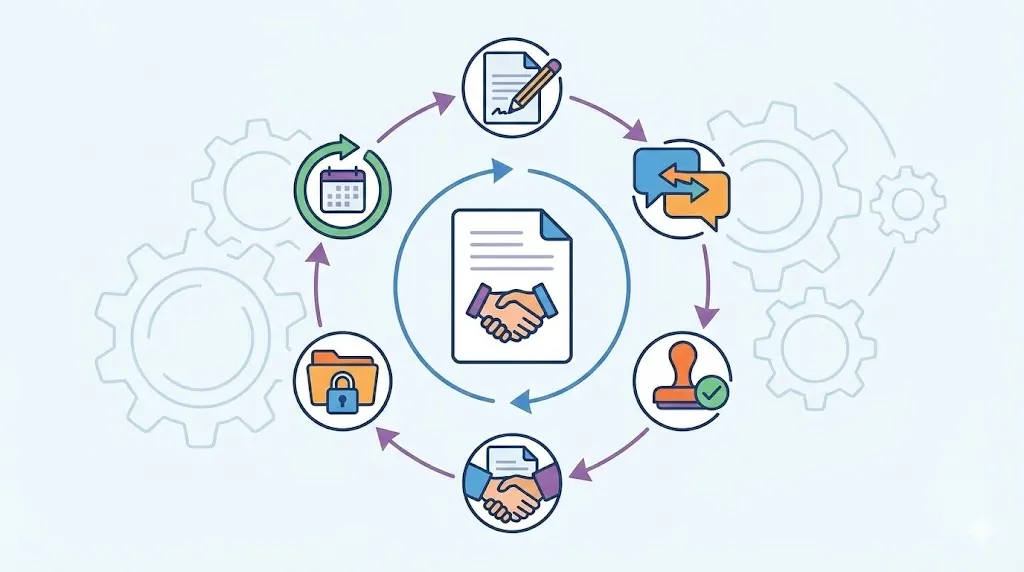
Contract management software can link the full process, from vendor intake and drafting through review, approvals, signatures, and post signing obligations. Additionally, teams can use it as a single repository for agreements, evidence, metadata, risk decisions, and renewal dates. AI can summarize contracts, identify unusual clauses, extract key terms, and support review against approved playbooks.
Volody supports these tasks with AI drafting, AI contract review, metadata extraction, approval workflows, a searchable contract repository, obligation tracking, alerts, audit trails, and role based access. Teams can connect due diligence findings to the contract and monitor key duties after signature.
Looking for a better way to manage contracts? Discover Volody's CLM Software.
FAQ
Why conduct vendor due diligence?
Additionally, it gives a company a clearer view of the risks associated with working with a supplier. It checks whether the vendor can deliver services safely, lawfully, and reliably. The process supports an informed approval decision before onboarding.
Who should lead the review?
One person should coordinate the full review and maintain the decision record. Procurement often manages the process, while legal, security, finance, privacy, and business teams review their areas. Any material exception should go to senior leadership for approval.
At what intervals should vendors be reviewed?
Moreover, set the review frequency according to the vendor’s risk profile. Annual reviews and event-driven checks may be appropriate for critical suppliers. For lower-risk suppliers, review may occur at renewal or following a significant change.
What evidence should a vendor provide?
Evidence may include security reports, financial records, insurance certificates, privacy terms, continuity plans, ownership details, and subcontractor information. Ask for current documents that support specific decisions. Do not collect documents without a clear purpose.
Is a vendor questionnaire enough?
No. Furthermore, a questionnaire records the supplier’s responses, but it does not establish their accuracy. Compare responses with independent evidence, contract terms, testing results, and internal requirements.
What happens if a vendor fails due diligence?
The business can reject the vendor, request remediation, add contract protections, or approve the relationship with conditions. The appropriate decision turns on the risk, business need, and controls available. Document both the rationale and the approver.
What contract terms should the review inform?
The review should shape security duties, service levels, audit rights, insurance, liability, data handling, subcontracting, termination, and transition terms. Also, any material vendor commitment should also be incorporated into the agreement. If it is not included, enforcing that commitment may be difficult.
Can small vendors satisfy enterprise-level review requirements?
Yes, provided the process remains proportionate. Small vendors may lack formal certifications, yet they can provide policies, test results, insurance, references, and written explanations. Where appropriate, rely on alternative evidence if it provides sufficient confidence.
After a vendor incident, what steps should follow?
Activate the contractual notice and response procedures immediately, preserve relevant records, assess business impact, restrict access where necessary, and track corrective actions through resolution. Complete a documented reassessment before restoring the vendor to normal status, and use the findings to strengthen ongoing oversight.
About the Company

Volody AI CLM is an Agentic AI-powered Contract Lifecycle Management platform designed to eliminate manual contracting tasks, automate complex workflows, and deliver actionable insights. As a one-stop shop for all contract activities, it covers drafting, collaboration, negotiation, approvals, e-signature, compliance tracking, and renewals. Built with enterprise-grade security and no-code configuration, it meets the needs of the most complex global organizations. Volody AI CLM also includes AI-driven contract review and risk analysis, helping teams detect issues early and optimize terms. Trusted by Fortune 500 companies, high-growth startups, and government entities, it transforms contracts into strategic, data-driven business assets.




" height="216.72211px" id="FYO0bO80Y" transform="translate(3 6.105)" width="206.073px"/><path d="M 108.174 222 C 88.432 222 70.303 217.239 53.785 207.717 C 37.267 198.196 24.173 185.052 14.504 168.285 C 4.835 151.312 0 132.165 0 110.845 C 0 89.731 4.835 70.792 14.504 54.025 C 24.173 37.052 37.267 23.804 53.785 14.282 C 70.303 4.761 88.432 0 108.174 0 C 128.116 0 146.246 4.761 162.562 14.282 C 179.08 23.804 192.073 37.052 201.541 54.025 C 211.21 70.792 216.044 89.731 216.044 110.845 C 216.044 132.165 211.21 151.312 201.541 168.285 C 192.073 185.052 179.08 198.196 162.562 207.717 C 146.044 217.239 127.915 222 108.174 222 Z M 108.174 183.189 C 120.864 183.189 132.044 180.291 141.713 174.495 C 151.382 168.492 158.936 160.006 164.375 149.035 C 169.814 138.064 172.533 125.334 172.533 110.845 C 172.533 96.355 169.814 83.729 164.375 72.965 C 158.936 61.994 151.382 53.611 141.713 47.815 C 132.044 42.02 120.864 39.122 108.174 39.122 C 95.483 39.122 84.202 42.02 74.332 47.815 C 64.663 53.611 57.109 61.994 51.67 72.965 C 46.231 83.729 43.511 96.355 43.511 110.845 C 43.511 125.334 46.231 138.064 51.67 149.035 C 57.109 160.006 64.663 168.492 74.332 174.495 C 84.202 180.291 95.483 183.189 108.174 183.189 Z" fill="rgba(255, 255, 255, 0.12)" height="222px" id="aa1McFcE9" transform="translate(227.183 3)" width="216.04399999999998px"/><path d="M 42.302 182.257 L 111.799 182.257 L 111.799 216.722 L 0 216.722 L 0 0 L 42.302 0 Z" fill="rgba(255, 255, 255, 0.12)" height="216.72211px" id="yRq4AnrsX" transform="translate(477.721 6.105)" width="111.79899999999998px"/><path d="M 108.174 222 C 88.432 222 70.303 217.239 53.785 207.717 C 37.267 198.196 24.173 185.052 14.504 168.285 C 4.835 151.312 0 132.165 0 110.845 C 0 89.731 4.835 70.792 14.504 54.025 C 24.173 37.052 37.267 23.804 53.785 14.282 C 70.303 4.761 88.432 0 108.174 0 C 128.116 0 146.246 4.761 162.562 14.282 C 179.08 23.804 192.073 37.052 201.541 54.025 C 211.21 70.792 216.045 89.731 216.045 110.845 C 216.045 132.165 211.21 151.312 201.541 168.285 C 192.073 185.052 179.08 198.196 162.562 207.717 C 146.044 217.239 127.915 222 108.174 222 Z M 108.174 183.189 C 120.864 183.189 132.044 180.291 141.713 174.495 C 151.382 168.492 158.936 160.006 164.375 149.035 C 169.814 138.064 172.534 125.334 172.534 110.845 C 172.534 96.355 169.814 83.729 164.375 72.965 C 158.936 61.994 151.382 53.611 141.713 47.815 C 132.044 42.02 120.864 39.122 108.174 39.122 C 95.483 39.122 84.202 42.02 74.332 47.815 C 64.663 53.611 57.108 61.994 51.67 72.965 C 46.231 83.729 43.511 96.355 43.511 110.845 C 43.511 125.334 46.231 138.064 51.67 149.035 C 57.108 160.006 64.663 168.492 74.332 174.495 C 84.202 180.291 95.483 183.189 108.174 183.189 Z" fill="rgba(255, 255, 255, 0.12)" height="222px" id="mo8HQspQ0" transform="translate(609.155 3)" width="216.04500000000007px"/><path d="M 73.727 0 C 95.885 0 115.324 4.45 132.044 13.351 C 148.967 22.252 161.957 34.982 171.027 51.541 C 180.287 67.894 184.917 86.937 184.917 108.671 C 184.917 130.405 180.287 149.449 171.027 165.801 C 161.957 181.947 148.967 194.47 132.044 203.371 C 115.324 212.271 95.885 216.722 73.727 216.722 L 0 216.722 L 0 0 Z M 72.216 179.773 C 94.374 179.773 111.497 173.564 123.583 161.144 C 135.669 148.724 141.713 131.233 141.713 108.671 C 141.713 86.109 135.669 68.515 123.583 55.888 C 111.497 43.055 94.374 36.638 72.216 36.638 L 42.302 36.638 L 42.302 179.773 Z" fill="rgba(255, 255, 255, 0.12)" height="216.72211px" id="I3iXX5Hi_" transform="translate(859.693 6.105)" width="184.91699999999992px"/><path d="M 185.22 0 L 113.91 141.273 L 113.91 216.722 L 71.61 216.722 L 71.61 141.273 L 0 0 L 47.74 0 L 93.06 99.046 L 138.08 0 Z" fill="rgba(255, 255, 255, 0.12)" height="216.72211px" id="nzHyWC0_d" transform="translate(1061.78 6.105)" width="185.22000000000003px"/></svg>)