

IT and professional services firms face complex challenges every day. They juggle multiple projects, clients, and jurisdictions, all while racing against tight deadlines. Operational risks lurk in missed contract obligations, unclear terms, and compliance gaps. How IT and professional services can reduce operational risks with CLM is a crucial question. Contracts are the backbone of these businesses, governing every deal and project. Managing them well can prevent costly mistakes and protect reputation.
Imagine a global IT firm that unknowingly delivers services after a contract expires because it lacked clear visibility into contract dates. This mistake cost millions in lost revenue and strained client trust. This example shows why firms need a reliable way to track contracts and obligations. Contract lifecycle management (CLM) offers a structured way to control contracts from creation to renewal. This article explains how CLM reduces risks and improves operational control in IT and professional services.
Related Article: How to Improve HR Contract Management with CLM
TL;DR
Operating across diverse geographic regions combined with complex contractual arrangements exposes the IT and professional services sectors to substantial operational and compliance risks.
Additionally, as the blueprint for outlining duties, pricing mechanisms, and adherence to regulations, contracts demand rigorous oversight to ensure organizational objectives are met.
Overlooking critical contractual clauses can result in considerable revenue loss, legal repercussions, and damage to corporate standing.
Consolidating contract information within CLM systems enhances oversight capabilities and mitigates the probability of manual errors.
The use of automated systems to monitor contractual obligations and renewal schedules is integral to ensuring adherence to client requirements and regulatory mandates.
Modern CLM platforms incorporate sophisticated AI tools that accelerate the review process while actively detecting potential contractual risks.
Why Contracts Are Central to IT and Professional Services Risks
Contracts are the legal foundation of every client engagement and service delivery. Additionally, service agreements commonly include master service agreements (MSAs), statements of work (SOWs), engagement letters, and general business terms. Each document spells out what the service provider must deliver, deadlines, pricing, and legal protections.
These contracts create a chain of obligations that flow from the top-level MSA down to individual project documents. If one link breaks, the whole project can suffer. For example, if a statement of work expires but the team continues working, the company risks delivering unpaid services. This risk is common when contract visibility is poor.
Contracts also carry compliance risks. Moreover, many IT firms conduct operations across various countries, each governed by distinct legal frameworks. Contracts must include clauses that meet local regulations, such as data privacy rules like the European Union’s General Data Protection Regulation (GDPR). Missing or incorrect clauses can lead to fines and legal trouble.
Client expectations add another layer of complexity. Contracts frequently contain stringent service level agreements (SLAs) outlining required performance metrics. Non-compliance with these SLAs can result in financial penalties or harm to the company’s reputation. Furthermore, without effective tracking mechanisms, teams risk overlooking these critical commitments.
The situation becomes more complicated when clients mandate the use of their proprietary contract templates. These external documents may introduce unfamiliar or high-risk provisions. Organizations providing technology and consulting services need to carefully assess and mitigate these risks to prevent disadvantageous contractual obligations.
In short, contracts represent both a potential source of risk and an essential instrument for its mitigation. Maintaining comprehensive visibility and control over every contractual component throughout its lifecycle is essential.
Related articles: 10 Crucial Legal Issues Every SaaS Company Must Address
What Operational Risks Do IT and Professional Services Face?
Operational risks in IT and professional services arise from many sources tied to contract management. Here are some key risks:
Revenue Leakage: Work done outside contract terms or after expiration may go unpaid. Without contract tracking, teams may unknowingly deliver services that cannot be billed.
Missed Obligations: Failure to meet deadlines, deliverables, or SLAs can lead to penalties or lost clients. These risks increase with complex contracts and multiple projects.
Non-Compliance: Operating in multiple jurisdictions requires compliance with local laws. Contracts must reflect these rules, or the company risks fines and legal action.
Poor Visibility: When contracts are scattered across departments or stored in silos, obtaining a comprehensive overview becomes challenging. Such dispersion frequently results in mistakes and delayed reactions.
Inefficient Processes: The reliance on manual contract management consumes excessive time and is prone to mistakes.
Slow approvals within contract workflows impede the initiation of projects and the timely recognition of revenue.
Reputational Damage: Disputes over contracts or failures in compliance can erode client confidence and damage the company’s brand, thereby affecting future engagements.
For example, a professional services firm might fail to renew a critical contract before its deadline.
Related Article: Understanding Contract Risk Exposure in Business
This lapse could prompt the client to engage a competitor, leading to both financial setbacks and damage to the firm's reputation. Another example is an IT company that fails to include necessary data privacy clauses in subcontractor agreements, risking GDPR violations.
According to a report by the International Association for Contract & Commercial Management (IACCM), poor contract management costs companies 9% of their revenue on average. This statistic highlights how operational risks from contracts directly affect the bottom line.
Related articles: How much are you losing without a CLM platform?
How Contract Lifecycle Management Helps Control Risks
Contract lifecycle management (CLM) is a systematic approach to managing contracts from creation through execution to renewal or expiration. CLM software centralizes contracts and automates key processes. This reduces errors, improves compliance, and speeds up contract cycles.
Here are ways CLM reduces operational risks in IT and professional services:
Centralized Repository: Store all contracts in one secure place. This eliminates silos and makes it easy to find contracts and related documents.
Visibility and Tracking: CLM tracks key dates, obligations, and milestones. Automated alerts remind teams about renewals, deliverables, and approvals.
Standardized Templates and Clauses: Use approved templates and clause libraries to ensure consistent language across agreements, mitigating risks associated with external contract drafts.
Automated Workflows: Contracts are routed for review and approval through predefined processes without manual intervention.
Audit Trails: Maintain a full history of contract changes, approvals, and communications. This supports compliance and dispute resolution.
Risk Analysis: Some CLM tools use AI to flag risky clauses or missing provisions. This early detection helps legal teams intervene before contracts are signed.
Integration with Other Systems: Connect CLM with ERP, CRM, and project management tools to align contract data with operations and finance.
For example, a CLM system can alert a project manager when a statement of work is about to expire. The company can then renegotiate or renew the contract before work stops. Another example is using AI-powered clause analysis to detect a non-compliant data privacy clause in a client’s contract template.
According to Gartner, organizations using CLM reduce contract cycle times by up to 50% and cut contract risk exposure by 30%. These improvements translate into faster revenue recognition and fewer disputes.
Related articles: How AI CLM Ensures Contract Compliance and Audit Readiness
Common Contract Types and Their Risk Points in IT and Professional Services
Understanding the main contract types helps identify where risks arise and how CLM can help manage them.
Master Service Agreements (MSAs)
Additionally, mSAs establish the foundational terms that govern the relationship between client and provider. Core provisions typically address payment structures, liability allocations, intellectual property rights, confidentiality commitments, and mechanisms for resolving disputes. The duration of MSAs often extends over several years, encompassing numerous individual projects.
Risks:
Overlooking critical deadlines related to contract expiration or renewal processes.
Neglecting necessary revisions to pricing models or legal clauses as conditions evolve.
Applying terms inconsistently across different project engagements.
Statements of Work (SOWs)
SOWs define the specific projects that fall under the umbrella of an MSA. They outline comprehensive details such as deliverables, timelines, key milestones, and criteria for evaluating performance.
Risks:
Performing tasks that exceed the agreed-upon scope or extend beyond the contract duration.
Omitting essential key performance indicators (KPIs) or service level agreements (SLAs).
Failing to correctly link SOWs to their corresponding MSAs.
Engagement Letters and General Business Terms
Engagement letters and general business terms are prevalent within audit, tax, and assurance engagements. Moreover, these instruments clarify the engagement’s scope, fee arrangements, and the parties’ respective obligations with precision.
Risks:
Contract terms that lack completeness or demonstrate inconsistent application across engagements.
Insufficient transparency regarding aggregate contractual commitments.
Challenges in administering renewals or contractual amendments.
Third-Party Contracts
It is common for clients to mandate the use of their own contract templates. Often, these templates introduce unfamiliar clauses or increase the overall risk profile.
Risks:
Agreeing to unfavorable contract terms without thorough legal evaluation.
Overlooking clauses required for compliance with applicable local regulations.
Encountering complexity in managing obligations when multiple template versions are in use.
CLM software helps by linking related contracts, enforcing template use, and providing alerts on critical dates. It also supports legal review workflows to catch risky clauses before signing.
Related articles: How to Improve HR Contract Management with CLM
How Global Operations Increase Contract Risks
IT and professional services companies often operate across many countries. This global footprint adds layers of risk:
Regulatory Compliance: Different countries have unique laws on data privacy, labor, taxation, and export controls. It is essential to incorporate clauses that ensure adherence to each jurisdiction’s specific requirements.
Multiple Legal Entities: Organizations often maintain numerous subsidiaries or branches, necessitating clear identification of the appropriate legal entities and the applicable governing laws within contracts.
Language and Cultural Differences: Contracts frequently demand translation or must be tailored to reflect local customs and legal norms.
Currency and Taxation: Payment terms should comprehensively cover issues such as currency exchange fluctuations, applicable taxes, and invoicing regulations.
Failing to address these factors may result in regulatory penalties, tax audits, or contract disputes. For example, missing GDPR clauses in European contracts can lead to fines up to 4% of global turnover.
A CLM system with multi-jurisdiction support helps by:
Storing contracts by region or entity.
Enabling the use of templates and clauses customized to the legal frameworks of specific jurisdictions.
Monitoring adherence to diverse local regulatory requirements.
Creating comprehensive audit records that demonstrate compliance across all operational territories.
This approach guarantees that contracts fulfill all legal mandates while mitigating risks inherent in international dealings.
Related articles: How CLM and Analytics Reduce Legal Costs Effectively
How to Improve Contract Visibility and Control Across Departments
Contract management often involves multiple teams: legal, sales, finance, project managers, and operations. Additionally, communication gaps and isolated data repositories further exacerbate risk exposure.
To improve visibility and control:
Centralize Contracts: Use a shared platform accessible to authorized users across departments.
Define Roles and Permissions: Control who can view, edit, or approve contracts.
Use Metadata and Tags: Implement classifications such as client, project, region, or risk level to enable targeted and efficient contract searches.
Automate Notifications: Implement solutions that proactively alert stakeholders about renewals, approvals, and contractual obligations well in advance.
Enable Collaboration: Facilitate cross-functional input by providing tools for commenting, negotiating, and tracking revisions within a unified environment.
Provide Dashboards: Develop comprehensive visual reports that highlight contract status, potential risks, and critical KPIs for executive oversight.
For example, project managers are able to access all active contracts related to their projects, including important upcoming deadlines. The finance team can monitor contract values and payment terms. Legal can review pending approvals and flagged risks.
This transparency reduces errors, speeds decision-making, and aligns teams on contract compliance.
Related articles: IT Teams Choosing a CLM Platform: A Effective Guide
How Contract Management Software Solves This
Contract management software brings structure and automation to contract workflows. Additionally, it also serves as the authoritative repository for all contract-related information. This software helps IT and professional services firms reduce operational risks by:
Centralizing contracts and related documents securely.
It sends automated alerts to notify stakeholders about critical dates, obligations, and upcoming renewal deadlines.
The platform enforces the use of standardized templates and clauses to maintain regulatory compliance.
Review and approval workflows are streamlined to significantly reduce turnaround times.
Advanced AI capabilities identify potential risks, missing provisions, or atypical contract language.
Moreover, integrations with ERP, CRM, and project management systems ensure uninterrupted data synchronization.
Volody provides a contract lifecycle management platform tailored for industries with complex, contract-intensive operations. The solution features AI-driven contract drafting, review, and obligation management functionalities. Designed to handle multi-entity and multi-jurisdictional challenges, Volody’s system incorporates granular role-based access controls and detailed audit trails.
Volody enables legal and business teams to collaborate efficiently, minimize errors, and maintain compliance. Its dashboards deliver real-time analytics on contract performance and risk indicators, supporting informed and proactive decision-making.
See how Volody's CLM Software helps legal teams manage contracts faster and with greater control.
Related Article: 7 Contract Management Principles Every Legal Team Needs
FAQ
What activities are involved in managing the contract lifecycle?
Additionally, this process covers contract creation, execution, performance monitoring, and renewal management.
Why are contracts so essential in the IT and professional services sectors?
In these sectors, contracts delineate the scope of work, pricing structures, deadlines, and the legal safeguards necessary to protect all parties involved.
Contracts specify work scope, pricing models, key deadlines, and legal protections.
They regulate client relationships and clarify responsibilities.
How does CLM reduce operational risks?
How does CLM reduce operational risks?
CLM enhances contract transparency, monitors timelines and commitments, enforces standardized templates, and streamlines workflows.
It also helps prevent missed renewals, unbilled work, and compliance failures.
Can CLM handle contracts across multiple countries?
Yes. Good CLM platforms support multi-jurisdictional contracts by applying region-specific templates, clauses, and compliance rules. Moreover, they also manage contracts by legal entities and languages.
What role does AI play in modern CLM?
AI can analyze contracts for risky clauses, extract key data, suggest clause alternatives, and summarize contract terms. This speeds review and helps legal teams spot issues early.
How does CLM improve collaboration across departments?
In addition, CLM centralizes contracts and allows multiple users to access, comment, and approve documents.
Automated notifications keep everyone informed about deadlines and obligations.
What are the risks of not using CLM in professional services?
Without CLM, firms risk revenue leakage, missed obligations, legal penalties, and damaged client trust.
Manual processes are slow and prone to errors, which heightens operational risk.
How do service level agreements (SLAs) in contracts influence risk?
What influence do SLAs in contracts exert on risk?
Furthermore, sLAs set performance standards and specify penalties for breaches.
Missing SLA obligations can result in financial penalties and harm to reputation.
CLM also facilitates tracking of SLA compliance.
Is CLM software expensive to implement?
Is CLM software costly to deploy?
Costs vary by solution and company size. However, the savings from reducing risks, speeding contract cycles, and improving compliance often outweigh implementation costs.
How can I measure the success of CLM adoption?
Track metrics like contract cycle time, renewal rates, compliance levels, and reduction in disputes or penalties. Improved visibility and faster approvals are also key indicators.
This comprehensive guide shows how companies in IT and professional service fields can mitigate operational risks through enhanced contract management. CLM software provides the tools to control contracts, meet obligations, and stay compliant. The right CLM platform is a vital asset in today’s complex business environment.
About the Company
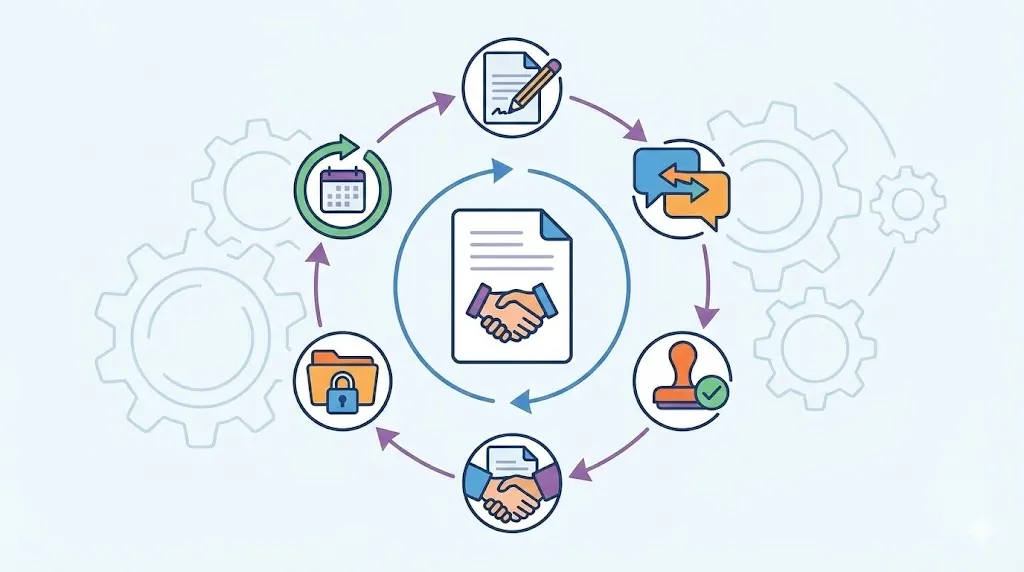
Volody AI CLM is an Agentic AI-powered Contract Lifecycle Management platform designed to eliminate manual contracting tasks, automate complex workflows, and deliver actionable insights. As a one-stop shop for all contract activities, it covers drafting, collaboration, negotiation, approvals, e-signature, compliance tracking, and renewals. Built with enterprise-grade security and no-code configuration, it meets the needs of the most complex global organizations. Volody AI CLM also includes AI-driven contract review and risk analysis, helping teams detect issues early and optimize terms. Trusted by Fortune 500 companies, high-growth startups, and government entities, it transforms contracts into strategic, data-driven business assets.




" height="216.72211px" id="FYO0bO80Y" transform="translate(3 6.105)" width="206.073px"/><path d="M 108.174 222 C 88.432 222 70.303 217.239 53.785 207.717 C 37.267 198.196 24.173 185.052 14.504 168.285 C 4.835 151.312 0 132.165 0 110.845 C 0 89.731 4.835 70.792 14.504 54.025 C 24.173 37.052 37.267 23.804 53.785 14.282 C 70.303 4.761 88.432 0 108.174 0 C 128.116 0 146.246 4.761 162.562 14.282 C 179.08 23.804 192.073 37.052 201.541 54.025 C 211.21 70.792 216.044 89.731 216.044 110.845 C 216.044 132.165 211.21 151.312 201.541 168.285 C 192.073 185.052 179.08 198.196 162.562 207.717 C 146.044 217.239 127.915 222 108.174 222 Z M 108.174 183.189 C 120.864 183.189 132.044 180.291 141.713 174.495 C 151.382 168.492 158.936 160.006 164.375 149.035 C 169.814 138.064 172.533 125.334 172.533 110.845 C 172.533 96.355 169.814 83.729 164.375 72.965 C 158.936 61.994 151.382 53.611 141.713 47.815 C 132.044 42.02 120.864 39.122 108.174 39.122 C 95.483 39.122 84.202 42.02 74.332 47.815 C 64.663 53.611 57.109 61.994 51.67 72.965 C 46.231 83.729 43.511 96.355 43.511 110.845 C 43.511 125.334 46.231 138.064 51.67 149.035 C 57.109 160.006 64.663 168.492 74.332 174.495 C 84.202 180.291 95.483 183.189 108.174 183.189 Z" fill="rgba(255, 255, 255, 0.12)" height="222px" id="aa1McFcE9" transform="translate(227.183 3)" width="216.04399999999998px"/><path d="M 42.302 182.257 L 111.799 182.257 L 111.799 216.722 L 0 216.722 L 0 0 L 42.302 0 Z" fill="rgba(255, 255, 255, 0.12)" height="216.72211px" id="yRq4AnrsX" transform="translate(477.721 6.105)" width="111.79899999999998px"/><path d="M 108.174 222 C 88.432 222 70.303 217.239 53.785 207.717 C 37.267 198.196 24.173 185.052 14.504 168.285 C 4.835 151.312 0 132.165 0 110.845 C 0 89.731 4.835 70.792 14.504 54.025 C 24.173 37.052 37.267 23.804 53.785 14.282 C 70.303 4.761 88.432 0 108.174 0 C 128.116 0 146.246 4.761 162.562 14.282 C 179.08 23.804 192.073 37.052 201.541 54.025 C 211.21 70.792 216.045 89.731 216.045 110.845 C 216.045 132.165 211.21 151.312 201.541 168.285 C 192.073 185.052 179.08 198.196 162.562 207.717 C 146.044 217.239 127.915 222 108.174 222 Z M 108.174 183.189 C 120.864 183.189 132.044 180.291 141.713 174.495 C 151.382 168.492 158.936 160.006 164.375 149.035 C 169.814 138.064 172.534 125.334 172.534 110.845 C 172.534 96.355 169.814 83.729 164.375 72.965 C 158.936 61.994 151.382 53.611 141.713 47.815 C 132.044 42.02 120.864 39.122 108.174 39.122 C 95.483 39.122 84.202 42.02 74.332 47.815 C 64.663 53.611 57.108 61.994 51.67 72.965 C 46.231 83.729 43.511 96.355 43.511 110.845 C 43.511 125.334 46.231 138.064 51.67 149.035 C 57.108 160.006 64.663 168.492 74.332 174.495 C 84.202 180.291 95.483 183.189 108.174 183.189 Z" fill="rgba(255, 255, 255, 0.12)" height="222px" id="mo8HQspQ0" transform="translate(609.155 3)" width="216.04500000000007px"/><path d="M 73.727 0 C 95.885 0 115.324 4.45 132.044 13.351 C 148.967 22.252 161.957 34.982 171.027 51.541 C 180.287 67.894 184.917 86.937 184.917 108.671 C 184.917 130.405 180.287 149.449 171.027 165.801 C 161.957 181.947 148.967 194.47 132.044 203.371 C 115.324 212.271 95.885 216.722 73.727 216.722 L 0 216.722 L 0 0 Z M 72.216 179.773 C 94.374 179.773 111.497 173.564 123.583 161.144 C 135.669 148.724 141.713 131.233 141.713 108.671 C 141.713 86.109 135.669 68.515 123.583 55.888 C 111.497 43.055 94.374 36.638 72.216 36.638 L 42.302 36.638 L 42.302 179.773 Z" fill="rgba(255, 255, 255, 0.12)" height="216.72211px" id="I3iXX5Hi_" transform="translate(859.693 6.105)" width="184.91699999999992px"/><path d="M 185.22 0 L 113.91 141.273 L 113.91 216.722 L 71.61 216.722 L 71.61 141.273 L 0 0 L 47.74 0 L 93.06 99.046 L 138.08 0 Z" fill="rgba(255, 255, 255, 0.12)" height="216.72211px" id="nzHyWC0_d" transform="translate(1061.78 6.105)" width="185.22000000000003px"/></svg>)