

Contract clauses shape risk, cost, rights, and business outcomes. Small wording changes can alter an entire agreement. Contract Clause Version Governance gives teams control over those changes. It connects ownership, approval, search, review, and retirement in one clear process.
TL;DR
Govern clauses through drafting, review, approval, publishing, monitoring, replacement, and retirement.
Build a tagged library with owners, status, dates, permissions, linked clauses, and change history.
Use risk-based approvals for preferred, fallback, restricted, and negotiated contract language.
Prevent duplicate clauses, hidden edits, stale fallbacks, weak adoption, and regional inconsistency.
Test clause interactions, review important language often, and retire old versions safely.
Use CLM software to centralize clauses, automate approvals, track obligations, and support accountable governance.
Clause Version Governance Fundamentals
Defining a governed clause version
A clause is one contract provision, such as a liability cap. A clause family contains related wording for one business purpose. For example, one family may include preferred, fallback, and restricted liability language.
An approved version has passed the required review. A fallback version supports negotiation when standard language fails. Contract-specific language reflects a deal and needs separate approval.
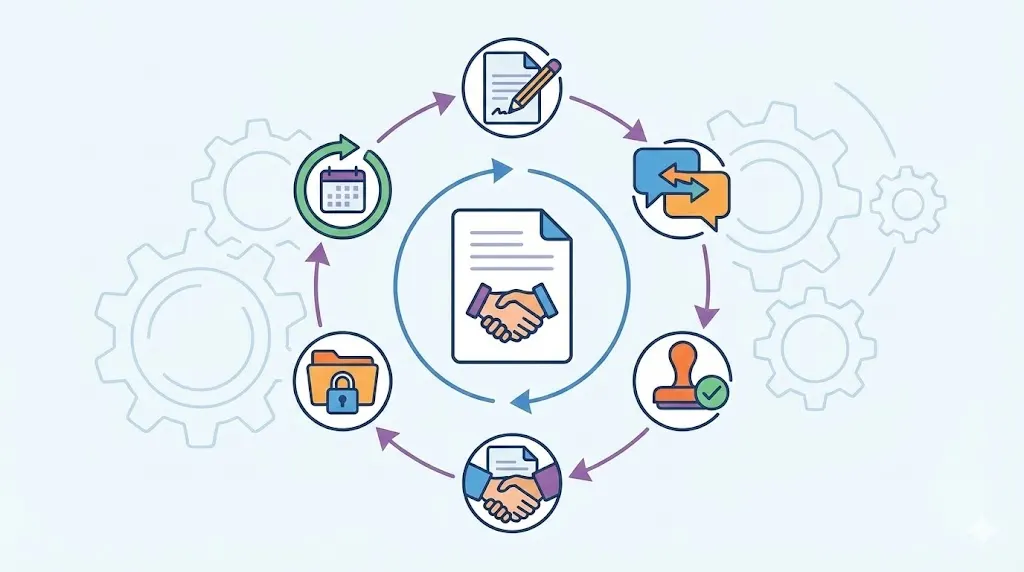
Governance covers the whole lifecycle. It starts with drafting and continues through review, approval, publishing, use, replacement, and retirement. Storage alone cannot show which wording teams should use.
The business and legal case for control
Uncontrolled edits create different risk positions across similar deals. Teams may also reuse old language from shared drives or local templates. That uncertainty slows review and weakens accountability.
Governed language gives people one trusted source. It also makes contract template management more consistent. Reviewers can see who approved wording, when it became active, and what changed.
Unmanaged practice: Local files contain copied clauses. Teams edit them without records. Reviewers debate which file is current.
Governed practice: One repository holds approved clauses. Owners manage edits. Workflows record approval, status, effective dates, and history.
Related articles: Contract Access Governance Across Departments
Designing the Clause Library and Metadata Model
Organizing clauses by function and risk
Start with clear groups. Include indemnification, liability, confidentiality, termination, force majeure, and governing law. Add dispute resolution, data protection, service levels, and audit rights.
Group clauses by business purpose and risk. This helps users find relevant language quickly. It also supports focused review by the right subject matter expert.
Capturing the context behind each version
Each record needs useful context. Capture jurisdiction, agreement type, business unit, risk rating, owner, and effective date. Record the superseded version and fallback status too.
Add linked obligations when the clause creates duties after signing. A data clause may create notice duties. A service clause may create delivery reviews or service credits.
Connecting related clauses
Clauses rarely work alone. A liability cap may exclude indemnity claims. Termination rights may require transition assistance. Governing law should fit the dispute resolution process.
Map these relationships before approving material changes. Then reviewers can test the wider agreement. This practice turns clause library management into risk control.
Applying Clause Tags and Search Rules
Use consistent tags for jurisdiction, entity, contract type, and risk tier. Add negotiation position and status tags. Mark each item as preferred, fallback, restricted, current, or retired.
Support synonyms and semantic search. Semantic search finds related meaning, not only exact words. Filters should still narrow results by region, entity, and approval status.
Related articles: Governing AI-Generated Contract Clauses at Enterprise Scale
Building Approval and Ownership Workflows
Assigning accountable clause owners
Legal subject matter experts usually own wording. Compliance, security, procurement, sales, and business teams add needed views. Assign one accountable owner for each clause family.
Separate wording ownership from use ownership. Legal may approve a data clause. Security may monitor its controls. Procurement may track supplier use during sourcing.
Setting approval thresholds
Use risk, materiality, and deviation to set review depth. A small wording fix may need one owner. A new contractual liability position may need legal, finance, and executive approval.
Escalate nonstandard indemnity, data use, termination, and liability language. Consider jurisdiction and counterparty importance too. Clear thresholds prevent both weak review and needless delay.
Preserving decision history
Record the business reason for every material change. Save comments, reviewers, approval dates, rejection reasons, and effective dates. Store the prior version beside the new version.
This history supports audits and future negotiations. It also protects institutional knowledge when employees leave. Good contract version management explains not only what changed, but why.
Low risk, standard wording: Owner review and recorded approval.
Medium risk, modest deviation: Legal and business review with documented rationale.
High risk, major deviation: Cross-functional review, senior approval, and explicit expiry.
Related articles: Contract Guidelines vs Playbooks: Choosing the Right Legal
5 Key Challenges in Contract Clause Version Governance
1. Duplicate and conflicting clause language
Multiple contract repositories often hold different versions. Local templates may contain edits that nobody approved. Drafting teams then waste time comparing competing language.
The contract outcome is inconsistent risk. One customer may receive stronger protection than another. Reviewers also lose confidence in the approved contract template.
2. Undocumented negotiated changes
Redlines can become hidden standards. A sales team may reuse a concession without recording its limits. The next deal then treats a one-time exception as normal plain language.
This creates legal and commercial drift. Teams cannot tell whether the clause is reusable. They also lose the reason behind the original decision.
3. Outdated or incomplete fallback positions
Fallback clauses can become stale after law, products, or risk policies change. Old alternatives may no longer protect the business. They can also conflict with newer preferred wording.
Negotiations then slow down. Reviewers must rebuild positions during live deals. Stale fallback language may also create hidden exposure.
4. Weak adoption across business teams
People bypass libraries when search feels difficult. They also avoid workflows when ownership seems unclear. Poor training can make approved clauses harder to use than local files.
Weak adoption defeats governance. Teams may still create duplicate templates. Leaders then see activity records without reliable control over contract language.
Governance problem: Duplicate clauses. Likely outcome: Conflicting risk positions.
Governance problem: Hidden redlines. Likely outcome: Unapproved precedent.
Governance problem: Stale fallbacks. Likely outcome: Slower negotiation and exposure.
Governance problem: Low adoption. Likely outcome: Continued use of local templates.
Related articles: Contract Law: Understanding Legal Agreements
Operating Review, Testing, and Change Controls
Scheduling risk-based clause reviews
Set review timing by risk and change. High-risk data, liability, and security clauses need closer attention. Review other clauses when business impact or legal exposure rises.
Use event triggers as well. Litigation, policy updates, product changes, and security incidents should prompt review. Record the trigger, owner, findings, and resulting decision.
Testing clauses against realistic scenarios
Review clauses inside complete agreements, not only alone. Check defined terms, cross-references, exceptions, and internal consistency. Test common negotiation requests against approved fallback positions.
Ask whether users can apply the clause correctly. Check ambiguity and practical enforceability. Review connected provisions for contradictions before approval.
Retiring and replacing obsolete versions
Mark old wording as retired and explain the replacement. Remove it from active search results. Restrict editing and reuse, while keeping history available for audits.
Create a migration plan for active templates. Add warnings when users open old versions. New workflows should block retired language unless an approved exception exists.
Review trigger: Scheduled date, legal change, dispute, or business change. Evidence: Findings, owner decision, approval, and effective date.
Retirement control: Status change, search restriction, template update, and migration record.
Related articles: Dispute Resolution Clause: How to Draft a Strong One
Measuring Governance Quality and Business Impact
Metrics for clause performance
Track approved-language adoption and deviation frequency. Measure review time, fallback use, exception volume, and update approval time. Monitor clause disputes and failed obligations too.
These measures show both risk and usability. High adoption may signal trust. High fallback use may signal weak preferred language or poor deal fit.
Audit and traceability indicators
A useful record shows who changed wording and who approved it. It also shows when the version became active. Link that version to contracts that used it.
Track what replaced each retired clause. Separate repository activity from real outcomes. A high number of edits does not prove strong governance.
Feedback loops for continuous improvement
Use negotiation outcomes to improve clause positions. Review obligation failures and user comments. Add legal developments and policy changes to the next review cycle.
This keeps language useful for business teams. It also prevents contract template standardization from becoming rigid. Good standards reduce risk without blocking sensible deals.
Comparing Risk, Adoption, and Cycle Time Metrics
Risk metrics help legal and compliance teams focus effort. Adoption metrics show whether users trust and find approved language. Cycle-time metrics help procurement and sales spot process delays.
Executives need the combined view. A fast process may still create high risk. A strict process may fail if teams avoid it. Dashboards should connect each measure to an accountable stakeholder.
Risk measure: Exceptions, disputes, and high-risk deviations. Owner: Legal and compliance.
Adoption measure: Approved clause use and fallback frequency. Owner: Legal operations and sales.
Quality measure: Failed obligations and clause defects. Owner: Legal and business owners.
Cycle-time measure: Review and approval duration. Owner: Procurement and operations.
Related articles: Contract Audit Trails: Complete Guide & Best Practices 2026
Implementing a Practical 2027 Governance Program
Establishing the baseline
Inventory clauses, templates, repositories, and approval habits. Include shared drives, contract tools, and local business files. Identify the source that teams currently trust.
Prioritize high-risk families first. Start with liability, indemnity, data protection, termination, and security. Record known exceptions and gaps before setting new controls.
Introducing controls in stages
Begin with taxonomy, owners, metadata, and current status. Add approval workflows and publishing rules next. Then migrate history, connect obligations, and monitor use.
Run a focused pilot with one business unit. Measure adoption, review speed, and exception quality. Expand only after users can find and apply approved language.
Discovery: Inventory content, owners, risks, and exceptions.
Design: Set taxonomy, metadata, permissions, and approval rules.
Pilot: Govern priority clauses with one business group.
Scale: Migrate more content and connect contract workflows.
Optimize: Review measures, feedback, and emerging risks.
Related articles: Contract Management Maturity in 2026: A Practical Roadmap
Why Contract Management Software Matters
Contract management software can centralize approved clause versions. It can connect related provisions and route changes for review. It also preserves a clear audit trail.
The right CLM tool supports contract template management, clause search, approval rules, and obligation tracking. It can alert owners when clauses need review. These controls help teams apply governance at scale.
Volody's CLM Software includes AI Contract Review, AI Contract Summaries, and Approval Workflow Automation. It can flag risky wording, highlight obligations and renewal dates, and route changes through review. Its central repository also supports searchable records and controlled access.
For example, a legal owner can review a liability change, approve the fallback version, and track related renewals.
Centralize current, approved, fallback, and retired clauses.
Route edits through owners and approval thresholds.
Track obligations, renewal dates, risks, and change history.
Want to see how contract management software can simplify your legal workflows? Check out Volody's CLM Software.
FAQ
What is contract clause version governance?
Contract clause version governance controls how teams create, approve, publish, use, and retire clause language. It assigns owners and records each change. It also identifies the current approved version. This process connects clause libraries with contract workflows, negotiation rules, audit records, and post-signature obligations.
Why do contract clauses need version control?
Version control prevents teams from using inconsistent or outdated wording. It limits unauthorized edits and clarifies which language is current. Teams can also review why changes happened. That record reduces negotiation risk, supports audits, and protects useful knowledge when staff or policies change.
Which contract clauses require the strongest governance controls?
Prioritize clauses that change financial, legal, or operational risk. These often include indemnity, liability, confidentiality, termination, data protection, and security. Governing law and dispute resolution also need careful control. Review service levels and audit rights when they create major customer or supplier duties.
How should organizations approve changes to standard clauses?
Use risk, materiality, and deviation to set approval levels. Assign a clear owner and require written rationale for material changes. Route high-risk edits to the right legal and business reviewers. Record comments, decisions, effective dates, and rejected versions before publishing new language.
How can teams prevent retired clause versions from being reused?
Mark retired clauses clearly and remove them from active search results. Restrict editing and block their use in new templates. Add warnings and migrate current documents where needed. Keep historical versions available for audits, disputes, and contract interpretation.
Can contract management software support clause version governance?
Yes, CLM software can centralize clauses and show current status. It can record owners, approvals, permissions, effective dates, and audit history. Search tools help users find approved language quickly. Alerts and obligation tracking also connect clause decisions with live contract duties.
About the Company

Volody AI CLM is an Agentic AI-powered Contract Lifecycle Management platform designed to eliminate manual contracting tasks, automate complex workflows, and deliver actionable insights. As a one-stop shop for all contract activities, it covers drafting, collaboration, negotiation, approvals, e-signature, compliance tracking, and renewals. Built with enterprise-grade security and no-code configuration, it meets the needs of the most complex global organizations. Volody AI CLM also includes AI-driven contract review and risk analysis, helping teams detect issues early and optimize terms. Trusted by Fortune 500 companies, high-growth startups, and government entities, it transforms contracts into strategic, data-driven business assets.





" height="216.72211px" id="FYO0bO80Y" transform="translate(3 6.105)" width="206.073px"/><path d="M 108.174 222 C 88.432 222 70.303 217.239 53.785 207.717 C 37.267 198.196 24.173 185.052 14.504 168.285 C 4.835 151.312 0 132.165 0 110.845 C 0 89.731 4.835 70.792 14.504 54.025 C 24.173 37.052 37.267 23.804 53.785 14.282 C 70.303 4.761 88.432 0 108.174 0 C 128.116 0 146.246 4.761 162.562 14.282 C 179.08 23.804 192.073 37.052 201.541 54.025 C 211.21 70.792 216.044 89.731 216.044 110.845 C 216.044 132.165 211.21 151.312 201.541 168.285 C 192.073 185.052 179.08 198.196 162.562 207.717 C 146.044 217.239 127.915 222 108.174 222 Z M 108.174 183.189 C 120.864 183.189 132.044 180.291 141.713 174.495 C 151.382 168.492 158.936 160.006 164.375 149.035 C 169.814 138.064 172.533 125.334 172.533 110.845 C 172.533 96.355 169.814 83.729 164.375 72.965 C 158.936 61.994 151.382 53.611 141.713 47.815 C 132.044 42.02 120.864 39.122 108.174 39.122 C 95.483 39.122 84.202 42.02 74.332 47.815 C 64.663 53.611 57.109 61.994 51.67 72.965 C 46.231 83.729 43.511 96.355 43.511 110.845 C 43.511 125.334 46.231 138.064 51.67 149.035 C 57.109 160.006 64.663 168.492 74.332 174.495 C 84.202 180.291 95.483 183.189 108.174 183.189 Z" fill="rgba(255, 255, 255, 0.12)" height="222px" id="aa1McFcE9" transform="translate(227.183 3)" width="216.04399999999998px"/><path d="M 42.302 182.257 L 111.799 182.257 L 111.799 216.722 L 0 216.722 L 0 0 L 42.302 0 Z" fill="rgba(255, 255, 255, 0.12)" height="216.72211px" id="yRq4AnrsX" transform="translate(477.721 6.105)" width="111.79899999999998px"/><path d="M 108.174 222 C 88.432 222 70.303 217.239 53.785 207.717 C 37.267 198.196 24.173 185.052 14.504 168.285 C 4.835 151.312 0 132.165 0 110.845 C 0 89.731 4.835 70.792 14.504 54.025 C 24.173 37.052 37.267 23.804 53.785 14.282 C 70.303 4.761 88.432 0 108.174 0 C 128.116 0 146.246 4.761 162.562 14.282 C 179.08 23.804 192.073 37.052 201.541 54.025 C 211.21 70.792 216.045 89.731 216.045 110.845 C 216.045 132.165 211.21 151.312 201.541 168.285 C 192.073 185.052 179.08 198.196 162.562 207.717 C 146.044 217.239 127.915 222 108.174 222 Z M 108.174 183.189 C 120.864 183.189 132.044 180.291 141.713 174.495 C 151.382 168.492 158.936 160.006 164.375 149.035 C 169.814 138.064 172.534 125.334 172.534 110.845 C 172.534 96.355 169.814 83.729 164.375 72.965 C 158.936 61.994 151.382 53.611 141.713 47.815 C 132.044 42.02 120.864 39.122 108.174 39.122 C 95.483 39.122 84.202 42.02 74.332 47.815 C 64.663 53.611 57.108 61.994 51.67 72.965 C 46.231 83.729 43.511 96.355 43.511 110.845 C 43.511 125.334 46.231 138.064 51.67 149.035 C 57.108 160.006 64.663 168.492 74.332 174.495 C 84.202 180.291 95.483 183.189 108.174 183.189 Z" fill="rgba(255, 255, 255, 0.12)" height="222px" id="mo8HQspQ0" transform="translate(609.155 3)" width="216.04500000000007px"/><path d="M 73.727 0 C 95.885 0 115.324 4.45 132.044 13.351 C 148.967 22.252 161.957 34.982 171.027 51.541 C 180.287 67.894 184.917 86.937 184.917 108.671 C 184.917 130.405 180.287 149.449 171.027 165.801 C 161.957 181.947 148.967 194.47 132.044 203.371 C 115.324 212.271 95.885 216.722 73.727 216.722 L 0 216.722 L 0 0 Z M 72.216 179.773 C 94.374 179.773 111.497 173.564 123.583 161.144 C 135.669 148.724 141.713 131.233 141.713 108.671 C 141.713 86.109 135.669 68.515 123.583 55.888 C 111.497 43.055 94.374 36.638 72.216 36.638 L 42.302 36.638 L 42.302 179.773 Z" fill="rgba(255, 255, 255, 0.12)" height="216.72211px" id="I3iXX5Hi_" transform="translate(859.693 6.105)" width="184.91699999999992px"/><path d="M 185.22 0 L 113.91 141.273 L 113.91 216.722 L 71.61 216.722 L 71.61 141.273 L 0 0 L 47.74 0 L 93.06 99.046 L 138.08 0 Z" fill="rgba(255, 255, 255, 0.12)" height="216.72211px" id="nzHyWC0_d" transform="translate(1061.78 6.105)" width="185.22000000000003px"/></svg>)