

Contracts form the backbone of business relationships, yet many teams struggle to trace their history accurately. Imagine being asked in an audit who approved a contract change two months ago, only to find yourself piecing together emails and versions scattered across drives. This scenario highlights why a complete guide to contract audit trails in 2026 is vital. As contracts grow more complex and regulatory scrutiny tightens, understanding and managing audit trails becomes a critical business capability.
TL;DR
Contract audit trails record every action on a contract, from draft to signature and beyond, with timestamps and user details.
A strong audit trail tracks edits, approvals, signatures, access, and status changes to ensure accountability and compliance.
Without a reliable audit trail, teams waste time reconstructing contract history during audits or disputes.
Automated contract lifecycle management (CLM) software captures audit data instantly, reducing risk and speeding workflows.
Audit trails support financial audits, compliance mandates, and governance by providing clear evidence of contract evolution.
Contract management software centralizes and secures audit trails, making contract histories easy to access and verify.
Related Article: Audit Rights Clause: Best Practices for 2026
What Exactly Is a Contract Audit Trail?
A contract audit trail is a detailed, chronological record of every step in a contract’s life. It shows who did what and when, creating a transparent history from the first draft to execution and even post-signature updates. This record includes changes to contract language, approval actions, signatures, and status updates.
Think of it as a digital logbook for contracts. Each entry timestamps an action and links it to a specific user. For example, if a payment term changes during negotiation, the audit trail shows who made the change and when. If a contract moves from draft to approval, the trail captures that transition and the person responsible.
This level of detail matters because contracts are legally binding documents that often involve significant financial commitments. Without a clear audit trail, organizations face challenges proving the authenticity of contract terms or demonstrating compliance with internal policies and external regulations.
Related articles: What is Contract Audit Summary? Best Practices & KPIs
Why Do Contract Audit Trails Matter?
Contracts are more than paperwork; they are commitments with financial and legal consequences. Audit trails provide the proof businesses need to answer questions like:
Who approved this contract, and when?
Did the signatory have authority?
Which version of the contract was actually signed?
Were any terms altered after approval?
Without this information, teams scramble to reconstruct history from email chains, file names, and shared drives. This process wastes time and introduces risk. Missing or incomplete audit data can lead to costly disputes, failed audits, or regulatory penalties.
Audit trails also support compliance with laws and standards. For example, financial auditors require clear evidence of contract approvals and changes. Data privacy regulations may demand proof of consent or contract execution. Internal governance policies often mandate multi-level approval workflows with traceable records.
A reliable audit trail reduces friction during audits, speeds contract reviews, and strengthens legal defenses. It also fosters accountability by showing who made decisions at every stage.
Related articles: The Ultimate Guide to Contract Review Tools for 2025
What Should a Contract Audit Trail Capture?
Not all audit trails are equal. A simple version log only shows that a document changed. A comprehensive audit trail captures much more. Here’s what a strong audit trail should include:
1. Edits and Version History
Every meaningful change to contract language must be recorded. This includes who made the change, when it happened, and what exactly was altered. This level of detail prevents confusion over shifting terms, such as payment deadlines or liability limits.
For example, if a clause about delivery timelines is added during negotiation, the audit trail shows the original draft, the edit, and the editor’s identity. This transparency discourages unauthorized or accidental changes.
2. Approval Actions
Contracts often require multiple approvals before execution. The audit trail should log when a contract was submitted for approval, who reviewed it, whether they approved or rejected it, and any comments they added.
Tracking multi-level approvals helps ensure the right stakeholders sign off at the right time. Automated workflows can route contracts to approvers based on rules, and the audit trail records each step without manual follow-up.
3. Signature Events
The audit trail must capture signature details, including the signer’s name, email, date and time of signing, and device or IP information. This data confirms the contract was properly executed and by an authorized individual.
If a dispute arises about contract validity, a complete signature record provides clear evidence, reducing legal uncertainty.
4. Access and Viewing History
Knowing who viewed a contract and when provides valuable context. If a counterparty hasn’t opened an agreement, that’s a signal to follow up. Internally, it shows whether decision-makers reviewed the contract before approval.
This data helps teams manage deal progress and avoid bottlenecks.
5. Status Changes
Contracts move through stages: draft, review, pending signature, executed, expired, or terminated. Each status change should be timestamped and attributed to the person who triggered it.
Status logs enable real-time tracking of contract pipelines. Teams can quickly identify stalled contracts and act accordingly.
Related articles: How to Simplify Contract Review with AI? Comprehensive Guide
How Manual Tracking Falls Short
Many teams still rely on manual methods to track contract history. This involves saving versions with specific file names, collecting approval emails, and maintaining spreadsheets. Manual tracking has several drawbacks:
Scattered Data: Approval details live in emails or chat apps, making them hard to find.
Human Error: File naming inconsistencies and lost emails cause gaps.
Time-Consuming: Reconstructing contract histories during audits wastes hours or days.
Risk Exposure: Missing or incomplete records increase legal and compliance risks.
Manual methods also don’t scale well as contract volumes grow. They rely heavily on individual diligence, which is prone to lapses.
Related articles: Contract Management Strategies: Expert Dos & Don'ts
How Automated Audit Trails Work in Contract Management Software
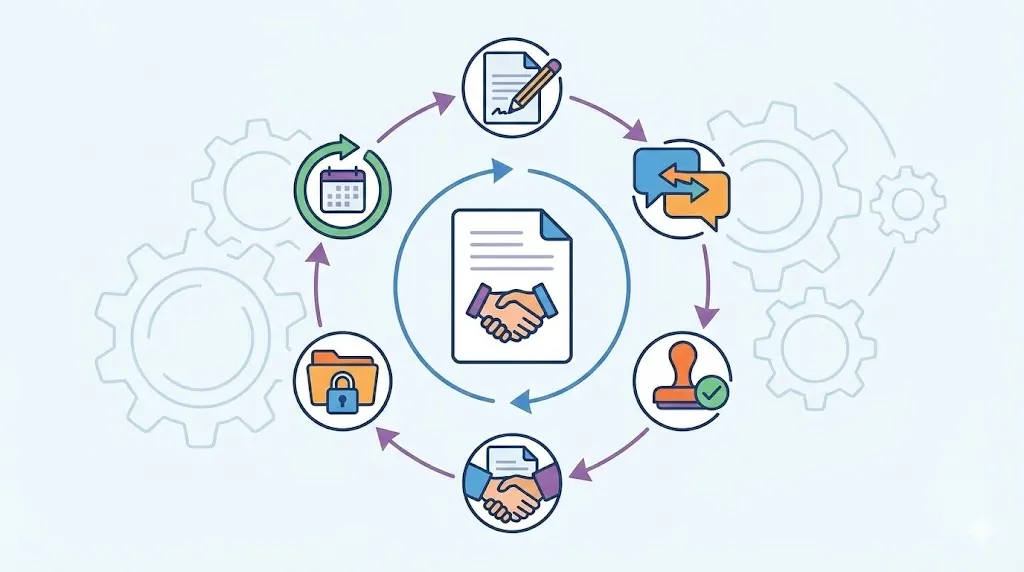
Contract lifecycle management (CLM) software automates audit trails by logging every action as it happens. This includes edits, approvals, signatures, and status updates. The system timestamps and attributes each event to a user, creating an unbroken chain of evidence.
Automation offers several benefits:
Instant Access: Teams can view contract history without digging through emails or file folders.
Complete Records: The system captures all relevant data, reducing risk of missing information.
Faster Audits: Auditors get immediate proof of contract approvals and changes.
Improved Accountability: Clear records show who is responsible for each step.
Workflow Efficiency: Automated approvals and reminders speed contract progress.
For example, when a contract is edited, the CLM records the change, who made it, and when. When it moves to the next approval stage, the system logs the transition and notifies the appropriate reviewer. When the contract is signed electronically, the signature event is stored with detailed metadata.
This approach eliminates manual tracking errors and saves legal and finance teams significant time.
Related articles: Best Contract Management Software in 2026: Top 20 CLM Tools
5 Challenges in Maintaining Reliable Contract Audit Trails
Even with the right tools, teams face challenges keeping audit trails accurate and useful:
1. Fragmented Systems
Contracts often live across multiple platforms: email, shared drives, CRM, and document editors. Without integration, audit data scatters, making a unified trail impossible.
2. Inconsistent Processes
If teams don’t follow standard procedures for approvals and version control, audit trails become patchy. Lack of enforcement leads to missing or incomplete logs.
3. Complex Contract Workflows
Contracts with many stakeholders and conditional approvals require sophisticated tracking. Simple tools may not capture all steps or dependencies.
4. Legacy Contracts
Older contracts not created in digital systems lack audit trails. Migrating these documents into a CLM and reconstructing history is time-consuming.
5. Security and Compliance Risks
Audit trails must be tamper-proof and secure. Weak controls expose organizations to fraud or data breaches.
Addressing these challenges requires both technology and disciplined contract management practices.
Related articles: Legacy Contracts: How to Effectively Migrate to a CLM
What Does a Good Contract Audit Trail Look Like in Practice?
Consider a sales contract negotiated between two companies. The audit trail would show:
The initial draft created from a company-approved template.
Edits made by the sales team to customize terms, each logged with user and timestamp.
Submission for approval routed automatically to legal and finance reviewers.
Approvals recorded with comments and timestamps.
Electronic signatures captured with signer details and device metadata.
Status updates from draft to executed, visible in real time.
Records of who viewed the contract at each stage.
If a question arises about a payment term change, the audit trail pinpoints the exact edit and approver. If an auditor requests proof of contract execution, the signature metadata provides clear evidence.
This level of detail improves transparency, speeds dispute resolution, and supports compliance audits.
Related articles: Top 10 Contract Management Best Practices in 2024
How Contract Management Software Solves This
Contract management software centralizes contracts and their audit trails in one secure platform. It automatically tracks every action, eliminating manual record-keeping. Teams gain instant access to contract histories, approvals, and signatures.
Modern CLM solutions offer features like:
Automated version control with full edit histories.
Multi-level approval workflows with routing and reminders.
Electronic signature capture with detailed metadata.
Real-time status tracking and notifications.
Access logs showing who viewed or edited contracts.
Secure storage with role-based permissions and encryption.
These capabilities reduce risks, save time, and improve contract governance.
Managing complex legal workflows requires a centralized and intelligent solution. > BLOGQUOTE:Want to see how contract management software can simplify your legal workflows? Check out Volody's CLM Software.
Related articles: Top 5 Florida CLM Software Solutions: 2026 Enterprise Guide
FAQ
What is the difference between a contract audit trail and version control?
Version control tracks changes made to a document, often showing different saved versions. An audit trail goes deeper by logging who made each change, when, why, and includes approvals, signatures, and status updates. It provides a full history of contract actions, not just document versions.
Why is an audit trail critical for financial audits?
Financial audits require proof of contract approvals, changes, and execution to verify commitments and payments. An audit trail provides this evidence quickly and accurately, reducing audit time and risk of non-compliance.
Can manual contract tracking be reliable?
Manual tracking is prone to errors, missing data, and inconsistencies. It depends heavily on individuals saving emails and files correctly. This approach often fails in high-volume or complex contract environments.
How do electronic signatures enhance audit trails?
Electronic signatures capture signer identity, timestamp, and device information. This metadata confirms contract execution authenticity and authority, strengthening legal enforceability.
What happens if a contract audit trail is incomplete?
Incomplete audit trails create uncertainty about contract terms and approvals. This can lead to disputes, failed audits, regulatory penalties, and damage to business reputation.
How do contract management systems handle multi-level approvals?
They automate routing contracts to the right approvers based on rules. Each approval or rejection is logged with comments and timestamps, creating a clear, traceable approval path.
Is it possible to track who viewed a contract?
Yes, many CLM platforms log access and viewing history. This helps teams know when to follow up and ensures stakeholders review contracts before approval.
What security measures protect audit trails?
Audit trails are secured with encryption, role-based access controls, and tamper-proof logs. These measures protect sensitive data and maintain compliance with regulations.
How do audit trails support compliance?
They provide documented proof of contract processes, approvals, and execution. This helps meet regulatory requirements and internal governance standards.
Can legacy contracts be added to a modern audit trail?
Legacy contracts without digital histories require manual data entry or scanning. Some CLM tools offer bulk import and OCR to digitize and index older contracts, though full audit trails start from the point of system adoption.
About the Company

Volody AI CLM is an Agentic AI-powered Contract Lifecycle Management platform designed to eliminate manual contracting tasks, automate complex workflows, and deliver actionable insights. As a one-stop shop for all contract activities, it covers drafting, collaboration, negotiation, approvals, e-signature, compliance tracking, and renewals. Built with enterprise-grade security and no-code configuration, it meets the needs of the most complex global organizations. Volody AI CLM also includes AI-driven contract review and risk analysis, helping teams detect issues early and optimize terms. Trusted by Fortune 500 companies, high-growth startups, and government entities, it transforms contracts into strategic, data-driven business assets.




" height="216.72211px" id="FYO0bO80Y" transform="translate(3 6.105)" width="206.073px"/><path d="M 108.174 222 C 88.432 222 70.303 217.239 53.785 207.717 C 37.267 198.196 24.173 185.052 14.504 168.285 C 4.835 151.312 0 132.165 0 110.845 C 0 89.731 4.835 70.792 14.504 54.025 C 24.173 37.052 37.267 23.804 53.785 14.282 C 70.303 4.761 88.432 0 108.174 0 C 128.116 0 146.246 4.761 162.562 14.282 C 179.08 23.804 192.073 37.052 201.541 54.025 C 211.21 70.792 216.044 89.731 216.044 110.845 C 216.044 132.165 211.21 151.312 201.541 168.285 C 192.073 185.052 179.08 198.196 162.562 207.717 C 146.044 217.239 127.915 222 108.174 222 Z M 108.174 183.189 C 120.864 183.189 132.044 180.291 141.713 174.495 C 151.382 168.492 158.936 160.006 164.375 149.035 C 169.814 138.064 172.533 125.334 172.533 110.845 C 172.533 96.355 169.814 83.729 164.375 72.965 C 158.936 61.994 151.382 53.611 141.713 47.815 C 132.044 42.02 120.864 39.122 108.174 39.122 C 95.483 39.122 84.202 42.02 74.332 47.815 C 64.663 53.611 57.109 61.994 51.67 72.965 C 46.231 83.729 43.511 96.355 43.511 110.845 C 43.511 125.334 46.231 138.064 51.67 149.035 C 57.109 160.006 64.663 168.492 74.332 174.495 C 84.202 180.291 95.483 183.189 108.174 183.189 Z" fill="rgba(255, 255, 255, 0.12)" height="222px" id="aa1McFcE9" transform="translate(227.183 3)" width="216.04399999999998px"/><path d="M 42.302 182.257 L 111.799 182.257 L 111.799 216.722 L 0 216.722 L 0 0 L 42.302 0 Z" fill="rgba(255, 255, 255, 0.12)" height="216.72211px" id="yRq4AnrsX" transform="translate(477.721 6.105)" width="111.79899999999998px"/><path d="M 108.174 222 C 88.432 222 70.303 217.239 53.785 207.717 C 37.267 198.196 24.173 185.052 14.504 168.285 C 4.835 151.312 0 132.165 0 110.845 C 0 89.731 4.835 70.792 14.504 54.025 C 24.173 37.052 37.267 23.804 53.785 14.282 C 70.303 4.761 88.432 0 108.174 0 C 128.116 0 146.246 4.761 162.562 14.282 C 179.08 23.804 192.073 37.052 201.541 54.025 C 211.21 70.792 216.045 89.731 216.045 110.845 C 216.045 132.165 211.21 151.312 201.541 168.285 C 192.073 185.052 179.08 198.196 162.562 207.717 C 146.044 217.239 127.915 222 108.174 222 Z M 108.174 183.189 C 120.864 183.189 132.044 180.291 141.713 174.495 C 151.382 168.492 158.936 160.006 164.375 149.035 C 169.814 138.064 172.534 125.334 172.534 110.845 C 172.534 96.355 169.814 83.729 164.375 72.965 C 158.936 61.994 151.382 53.611 141.713 47.815 C 132.044 42.02 120.864 39.122 108.174 39.122 C 95.483 39.122 84.202 42.02 74.332 47.815 C 64.663 53.611 57.108 61.994 51.67 72.965 C 46.231 83.729 43.511 96.355 43.511 110.845 C 43.511 125.334 46.231 138.064 51.67 149.035 C 57.108 160.006 64.663 168.492 74.332 174.495 C 84.202 180.291 95.483 183.189 108.174 183.189 Z" fill="rgba(255, 255, 255, 0.12)" height="222px" id="mo8HQspQ0" transform="translate(609.155 3)" width="216.04500000000007px"/><path d="M 73.727 0 C 95.885 0 115.324 4.45 132.044 13.351 C 148.967 22.252 161.957 34.982 171.027 51.541 C 180.287 67.894 184.917 86.937 184.917 108.671 C 184.917 130.405 180.287 149.449 171.027 165.801 C 161.957 181.947 148.967 194.47 132.044 203.371 C 115.324 212.271 95.885 216.722 73.727 216.722 L 0 216.722 L 0 0 Z M 72.216 179.773 C 94.374 179.773 111.497 173.564 123.583 161.144 C 135.669 148.724 141.713 131.233 141.713 108.671 C 141.713 86.109 135.669 68.515 123.583 55.888 C 111.497 43.055 94.374 36.638 72.216 36.638 L 42.302 36.638 L 42.302 179.773 Z" fill="rgba(255, 255, 255, 0.12)" height="216.72211px" id="I3iXX5Hi_" transform="translate(859.693 6.105)" width="184.91699999999992px"/><path d="M 185.22 0 L 113.91 141.273 L 113.91 216.722 L 71.61 216.722 L 71.61 141.273 L 0 0 L 47.74 0 L 93.06 99.046 L 138.08 0 Z" fill="rgba(255, 255, 255, 0.12)" height="216.72211px" id="nzHyWC0_d" transform="translate(1061.78 6.105)" width="185.22000000000003px"/></svg>)