

Contracts form the backbone of business relationships. Yet many organizations struggle to manage them effectively as they grow. A guide to contract management maturity in 2026 reveals how companies can evolve from chaotic, manual processes into streamlined, data-driven operations. Imagine a mid-sized company juggling hundreds of contracts across departments, losing track of deadlines, and missing out on revenue. This scenario is common but avoidable. Understanding contract management maturity helps leaders identify gaps and build a scalable, efficient contract process that supports business goals.
TL;DR
Contract management maturity gauges how well your contract processes support business growth and risk control.
Low maturity leads to missed deadlines, revenue loss, and operational inefficiencies.
Key maturity factors include process standardization, risk mitigation, automation, and technology use.
Early-stage maturity features manual workflows, fragmented storage, and unclear ownership.
Advanced maturity integrates contract data with business systems and automates routine tasks.
Contract management software centralizes contracts, enforces compliance, and accelerates approvals.
What Does Contract Management Maturity Mean in 2026?
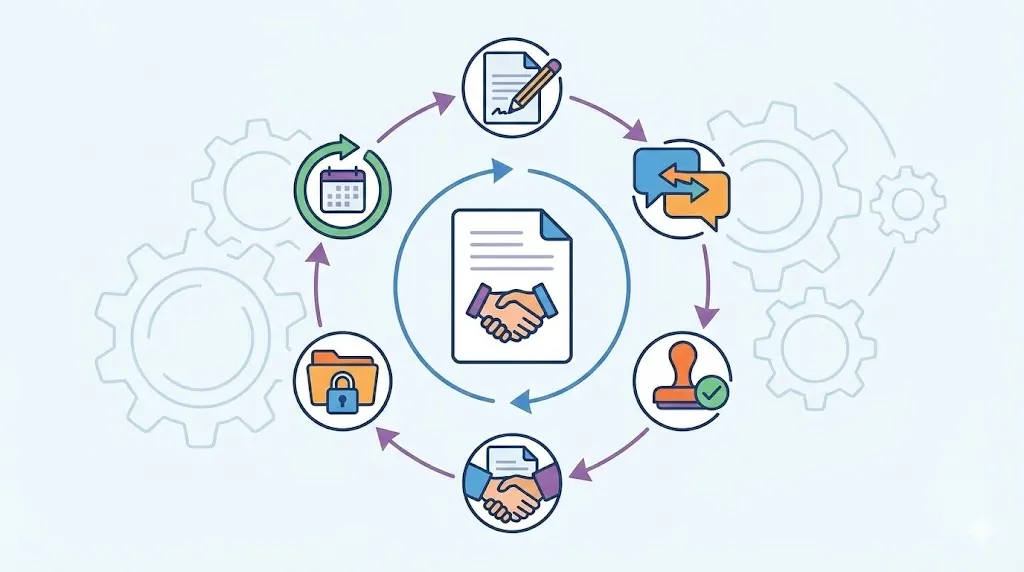
Contract management maturity measures how sophisticated and effective a company’s contract processes are. It looks at how well an organization creates, negotiates, executes, tracks, and analyzes contracts. The goal is to move from reactive, manual handling to proactive, automated, and data-driven management.
A mature contract process supports business growth by minimizing risks and maximizing contract value. It ensures contracts are consistent, compliant, and accessible. Immature processes cause delays, errors, and revenue leakage.
The maturity model is a scale that shows how far along a company is in developing its contract management capabilities. It ranges from chaotic, ad-hoc approaches to fully optimized, integrated systems. This scale helps businesses benchmark their current state and plan improvements.
For example, a startup might draft contracts on the fly without templates or oversight. A mature enterprise uses automated workflows, AI-powered contract review, and real-time analytics. The latter reduces risk and frees legal teams to focus on strategic work.
Related articles: What is Contract Risk & How to manage it?
Why Contract Management Maturity Matters for Business Growth
Poor contract management costs money and time. According to the International Association for Contract & Commercial Management (IACCM), companies lose up to 9% of revenue due to inefficient contract processes. This loss comes from missed deadlines, untracked obligations, and unfavorable terms slipping through.
Other studies show:
40% of organizations lack clarity on contract lifecycle responsibilities.
99% struggle to handle their current contract volumes.
40% of contract value leakage ties directly to poor contract management.
These stats reveal that many businesses still operate with outdated, fragmented contract processes. This creates bottlenecks and risks that grow as contract volumes increase.
In 2026, businesses must adopt smarter contract management to stay competitive. Mature contract processes improve visibility, reduce errors, and speed up deal cycles. They transform contracts from administrative burdens into strategic assets.
Related articles: What is Contract Renewal? Key Terms and Processes in 2026
How to Assess Your Contract Management Maturity
Evaluating contract management maturity requires examining multiple dimensions. Each area reveals strengths and weaknesses that affect overall performance. Consider these key factors:
1. Process Standardization
Are your contract templates and workflows consistent across the organization? Standardization means contracts follow approved formats and clauses. This reduces errors and ensures compliance.
Without standardization, teams create contracts differently, increasing legal risk. For instance, sales might use outdated terms, while procurement uses another template. This inconsistency leads to confusion and potential disputes.
2. Risk Management
Does your contract process identify and mitigate risks effectively? Mature organizations embed risk controls into contract creation and review. They use checklists, playbooks, or automated alerts for risky clauses.
Poor risk management means contracts may expose the company to liabilities, penalties, or compliance failures. For example, missing renewal terms can cause automatic contract extensions with unfavorable conditions.
3. Workflow Efficiency
Are contract tasks automated and streamlined? Efficient workflows reduce manual handoffs and delays. Automation can route contracts for approval, send reminders, and track status.
Manual workflows slow down contract cycles and increase errors. Legal teams get bogged down in routine tasks instead of focusing on negotiation or strategy.
4. Technology Use
What tools support your contract management? Mature companies use contract lifecycle management (CLM) software integrated with CRM, ERP, or HR systems. This centralizes contracts and data.
Fragmented tools or manual processes hinder visibility and collaboration. For example, storing contracts in emails or local drives makes retrieval difficult and insecure.
5. Compliance and Governance
Do your contracts comply with regulations and internal policies? Mature processes enforce governance through approval workflows and audit trails. They ensure contracts meet legal and business standards.
Lack of governance increases risk of non-compliance and damages reputation. For instance, contracts missing required clauses can lead to regulatory penalties.
6. Visibility and Tracking
Can you easily track contract status, obligations, and key dates? Mature organizations have dashboards and alerts to monitor contracts. They extract data like renewal dates and payment terms automatically.
Without visibility, contracts get lost or expire unnoticed. This causes missed opportunities and penalties.
7. Contract Storage and Security
How are contracts stored and protected? Secure, centralized repositories prevent loss or unauthorized access. Features like encryption, access controls, and backups safeguard sensitive information.
Scattered storage increases risk of data breaches and compliance failures.
8. Counterparty Experience
What is the contracting experience for your partners? Mature processes provide clear, efficient interactions like online request portals and electronic signatures. This improves speed and satisfaction.
Clunky, slow contract processes frustrate counterparties and delay deals.
Related articles: What is Contract Lifecycle Management (CLM)? Top CLM in 2026
What Does Each Stage of Contract Management Maturity Look Like?
Contract management maturity usually progresses through five stages. Companies may have different maturity levels across these areas, but the model helps identify where to focus improvement efforts.
Stage 1: Initial (Ad-Hoc and Manual)
At this stage, contract processes are informal and inconsistent. Teams create contracts without templates or oversight. Contracts may be stored in emails or local drives.
Legal involvement is minimal, and most work is manual. There is little visibility into contract status or obligations. Risk is high due to poor controls.
This stage is common in startups or small businesses managing few contracts. But even larger companies can get stuck here if they lack process discipline.
Stage 2: Developing (Basic Standardization)
Organizations start formalizing contract templates and workflows. Teams use shared drives for contract storage. Some contracts follow approved formats, but enforcement is weak.
Electronic signatures may be adopted to speed execution. However, contract data tracking is limited, often relying on spreadsheets.
Legal teams still spend time on routine tasks, and workflows are not integrated with other systems. Risk management is reactive.
Stage 3: Defined (Process Adoption and Automation)
Processes are documented and widely adopted. Contract templates and clause libraries are in use. Electronic signatures and contract management tools help automate approvals and storage.
Some integration with CRM or ERP systems exists. Contract data is tracked systematically, enabling reporting on key metrics.
Legal teams focus more on review and negotiation rather than admin. Risk controls are embedded in workflows.
Stage 4: Managed (Integrated and Data-Driven)
Contract management is integrated with core business systems. Automated workflows handle routing, reminders, and compliance checks. AI tools may assist with drafting and review.
Contract data is analyzed to identify trends, risks, and opportunities. Dashboards provide real-time visibility to legal and business users.
Governance is strong with audit trails and role-based access. Counterparty experience is smooth with portals and e-signatures.
Stage 5: Optimized (Continuous Improvement and Strategic)
Contract management is fully optimized and aligned with business strategy. AI and analytics drive proactive risk management and performance improvement.
Legal teams collaborate seamlessly with business units. Contract processes adapt quickly to changing regulations and market conditions.
Contracts become a source of competitive advantage, supporting faster deals and better terms.
Related articles: Best Contract Management Software in 2026: Top 20 CLM Tools
5 Common Challenges in Advancing Contract Management Maturity
Moving up the maturity scale is not easy. Many organizations face obstacles that slow progress or cause regression.
1. Resistance to Change
Contracting involves multiple stakeholders with different priorities. Legal, sales, procurement, and operations may resist new processes or tools.
Overcoming resistance requires clear communication of benefits and involving users in design.
2. Fragmented Systems
Companies often use disconnected tools for contract creation, storage, and tracking. This fragmentation causes data silos and inefficiencies.
Integrating systems or adopting an all-in-one CLM platform helps unify contract data and workflows.
3. Lack of Clear Ownership
Without assigned roles and responsibilities, contracts fall through the cracks. Teams may be unclear who manages each contract stage.
Defining ownership and accountability is critical for process discipline.
4. Insufficient Training
Users may lack skills or knowledge to use contract tools effectively. This limits adoption and leads to errors.
Regular training and support improve user confidence and process quality.
5. Limited Executive Support
Contract management improvements need backing from leadership. Without sponsorship, projects stall or lack resources.
Demonstrating ROI and risk reduction helps secure executive buy-in.
Related articles: Legacy Contracts: How to Effectively Migrate to a CLM
How to Improve Contract Management Maturity Step-by-Step
Advancing contract management maturity requires a structured approach. Here is a practical roadmap:
Assess Current State: Map existing contract processes, tools, and pain points. Identify gaps against maturity criteria.
Set Clear Goals: Define what maturity means for your organization. Prioritize improvements based on risk and impact.
Standardize Templates and Workflows: Develop approved contract templates and document workflows. Assign roles clearly.
Implement Technology: Adopt contract management software to centralize contracts and automate workflows. Integrate with CRM and ERP.
Train Users: Provide training and resources for legal and business teams. Encourage feedback and continuous learning.
Embed Risk Controls: Use playbooks, checklists, and automated alerts to manage contract risks proactively.
Monitor and Analyze: Track contract metrics like cycle time, renewal rates, and compliance. Use dashboards to inform decisions.
Continuously Improve: Regularly review processes and tools. Adapt to changes in regulations and business needs.
Related articles: Contract Management for Procurement: Elevate Your Strategy
Why Contract Management Software Matters
Contract management software plays a key role in advancing maturity. It centralizes contracts in a secure repository, making them easy to find and manage. Automated workflows reduce manual tasks and speed approvals.
Modern CLM platforms integrate with business systems like CRM, ERP, and HR software. This ensures contract data flows seamlessly across departments. Features like AI-powered drafting, review, and metadata extraction improve accuracy and efficiency.
Governance improves with audit trails, role-based access, and compliance checks built into the software. Notifications and dashboards keep teams proactive about renewals and obligations.
A good CLM solution transforms contract management from a bottleneck into a business enabler.
Managing complex legal workflows requires a centralized and intelligent solution.
Want to see how contract management software can simplify your legal workflows? Check out Volody's CLM Software.
Related articles: Top Contract Lifecycle Management Software in Maharashtra
FAQ
What is contract management maturity?
Contract management maturity measures how advanced and effective a company’s contract processes are. It looks at how well contracts are created, negotiated, executed, tracked, and analyzed to reduce risk and add value.
Why is contract management maturity important?
Higher maturity reduces contract risks, speeds up deal cycles, and prevents revenue loss. It helps companies scale operations while maintaining control and compliance.
How can I assess my organization’s contract management maturity?
Evaluate areas like process standardization, risk management, workflow efficiency, technology use, compliance, visibility, storage, and counterparty experience. Use these criteria to identify strengths and gaps.
What are the common stages of contract management maturity?
Typically, organizations progress from ad-hoc/manual processes to standardized, automated, integrated, and finally optimized contract management.
What risks do immature contract processes pose?
Risks include missed deadlines, revenue leakage, compliance failures, contract disputes, and operational inefficiencies.
How does contract management software help improve maturity?
It centralizes contracts, automates workflows, integrates with business systems, enforces compliance, and provides analytics for better decision-making.
What challenges do companies face when improving contract management?
Challenges include resistance to change, fragmented systems, unclear ownership, lack of training, and limited executive support.
Can small businesses benefit from contract management maturity?
Yes. Even small businesses face risks from poor contract processes. Improving maturity helps them reduce errors and prepare for growth.
How do I get buy-in for contract management improvements?
Show the financial impact of poor contract management and the benefits of maturity. Engage stakeholders early and demonstrate quick wins.
What role does risk management play in contract maturity?
Risk management ensures contracts do not expose the company to legal, financial, or regulatory harm. Mature processes embed risk controls throughout the contract lifecycle.
About the Company

Volody AI CLM is an Agentic AI-powered Contract Lifecycle Management platform designed to eliminate manual contracting tasks, automate complex workflows, and deliver actionable insights. As a one-stop shop for all contract activities, it covers drafting, collaboration, negotiation, approvals, e-signature, compliance tracking, and renewals. Built with enterprise-grade security and no-code configuration, it meets the needs of the most complex global organizations. Volody AI CLM also includes AI-driven contract review and risk analysis, helping teams detect issues early and optimize terms. Trusted by Fortune 500 companies, high-growth startups, and government entities, it transforms contracts into strategic, data-driven business assets.





" height="216.72211px" id="FYO0bO80Y" transform="translate(3 6.105)" width="206.073px"/><path d="M 108.174 222 C 88.432 222 70.303 217.239 53.785 207.717 C 37.267 198.196 24.173 185.052 14.504 168.285 C 4.835 151.312 0 132.165 0 110.845 C 0 89.731 4.835 70.792 14.504 54.025 C 24.173 37.052 37.267 23.804 53.785 14.282 C 70.303 4.761 88.432 0 108.174 0 C 128.116 0 146.246 4.761 162.562 14.282 C 179.08 23.804 192.073 37.052 201.541 54.025 C 211.21 70.792 216.044 89.731 216.044 110.845 C 216.044 132.165 211.21 151.312 201.541 168.285 C 192.073 185.052 179.08 198.196 162.562 207.717 C 146.044 217.239 127.915 222 108.174 222 Z M 108.174 183.189 C 120.864 183.189 132.044 180.291 141.713 174.495 C 151.382 168.492 158.936 160.006 164.375 149.035 C 169.814 138.064 172.533 125.334 172.533 110.845 C 172.533 96.355 169.814 83.729 164.375 72.965 C 158.936 61.994 151.382 53.611 141.713 47.815 C 132.044 42.02 120.864 39.122 108.174 39.122 C 95.483 39.122 84.202 42.02 74.332 47.815 C 64.663 53.611 57.109 61.994 51.67 72.965 C 46.231 83.729 43.511 96.355 43.511 110.845 C 43.511 125.334 46.231 138.064 51.67 149.035 C 57.109 160.006 64.663 168.492 74.332 174.495 C 84.202 180.291 95.483 183.189 108.174 183.189 Z" fill="rgba(255, 255, 255, 0.12)" height="222px" id="aa1McFcE9" transform="translate(227.183 3)" width="216.04399999999998px"/><path d="M 42.302 182.257 L 111.799 182.257 L 111.799 216.722 L 0 216.722 L 0 0 L 42.302 0 Z" fill="rgba(255, 255, 255, 0.12)" height="216.72211px" id="yRq4AnrsX" transform="translate(477.721 6.105)" width="111.79899999999998px"/><path d="M 108.174 222 C 88.432 222 70.303 217.239 53.785 207.717 C 37.267 198.196 24.173 185.052 14.504 168.285 C 4.835 151.312 0 132.165 0 110.845 C 0 89.731 4.835 70.792 14.504 54.025 C 24.173 37.052 37.267 23.804 53.785 14.282 C 70.303 4.761 88.432 0 108.174 0 C 128.116 0 146.246 4.761 162.562 14.282 C 179.08 23.804 192.073 37.052 201.541 54.025 C 211.21 70.792 216.045 89.731 216.045 110.845 C 216.045 132.165 211.21 151.312 201.541 168.285 C 192.073 185.052 179.08 198.196 162.562 207.717 C 146.044 217.239 127.915 222 108.174 222 Z M 108.174 183.189 C 120.864 183.189 132.044 180.291 141.713 174.495 C 151.382 168.492 158.936 160.006 164.375 149.035 C 169.814 138.064 172.534 125.334 172.534 110.845 C 172.534 96.355 169.814 83.729 164.375 72.965 C 158.936 61.994 151.382 53.611 141.713 47.815 C 132.044 42.02 120.864 39.122 108.174 39.122 C 95.483 39.122 84.202 42.02 74.332 47.815 C 64.663 53.611 57.108 61.994 51.67 72.965 C 46.231 83.729 43.511 96.355 43.511 110.845 C 43.511 125.334 46.231 138.064 51.67 149.035 C 57.108 160.006 64.663 168.492 74.332 174.495 C 84.202 180.291 95.483 183.189 108.174 183.189 Z" fill="rgba(255, 255, 255, 0.12)" height="222px" id="mo8HQspQ0" transform="translate(609.155 3)" width="216.04500000000007px"/><path d="M 73.727 0 C 95.885 0 115.324 4.45 132.044 13.351 C 148.967 22.252 161.957 34.982 171.027 51.541 C 180.287 67.894 184.917 86.937 184.917 108.671 C 184.917 130.405 180.287 149.449 171.027 165.801 C 161.957 181.947 148.967 194.47 132.044 203.371 C 115.324 212.271 95.885 216.722 73.727 216.722 L 0 216.722 L 0 0 Z M 72.216 179.773 C 94.374 179.773 111.497 173.564 123.583 161.144 C 135.669 148.724 141.713 131.233 141.713 108.671 C 141.713 86.109 135.669 68.515 123.583 55.888 C 111.497 43.055 94.374 36.638 72.216 36.638 L 42.302 36.638 L 42.302 179.773 Z" fill="rgba(255, 255, 255, 0.12)" height="216.72211px" id="I3iXX5Hi_" transform="translate(859.693 6.105)" width="184.91699999999992px"/><path d="M 185.22 0 L 113.91 141.273 L 113.91 216.722 L 71.61 216.722 L 71.61 141.273 L 0 0 L 47.74 0 L 93.06 99.046 L 138.08 0 Z" fill="rgba(255, 255, 255, 0.12)" height="216.72211px" id="nzHyWC0_d" transform="translate(1061.78 6.105)" width="185.22000000000003px"/></svg>)