

Healthcare and pharmaceutical companies face unique contract challenges. They juggle complex deals, strict regulations, and fast-changing markets. A recent survey reveals these sectors are ahead in adopting contract lifecycle management (CLM) tools. Their experience offers valuable lessons for other industries aiming to improve contract processes and reduce risks.
TL;DR
Contract management teams in healthcare and pharma tend to be more centralized compared to those in other industries.
Additionally, these sectors also adopt CLM technology earlier and integrate it more deeply within their workflows.
A significant portion of contract teams’ efforts remains tied up in administrative duties, which restricts their capacity for strategic initiatives.
New contract formats, including outcome-based and service agreements, add layers of complexity that must be managed after signature.
Budget constraints frequently limit opportunities to enhance contract management capabilities post-execution.
Enhancing and tailoring contract workflows leads to greater operational efficiency while reinforcing financial outcomes and mitigating risks.
What Makes Healthcare and Pharma Stand Out in Contract Management?
Healthcare and pharmaceutical companies operate within a landscape defined by stringent regulatory standards and intense market competition. Their contracts frequently encompass multiple stakeholders, intricate clauses, and stringent compliance mandates. This intricate nature necessitates a more disciplined approach to contract management than is typical in many other industries.
The survey indicates that 72% of respondents from the healthcare and pharma sectors confirm their organizations have clearly defined contract management roles. More than half (57%) report fully centralized contract teams. Centralization means one group handles contracts across the entire company, rather than scattered teams managing deals independently.
Centralized teams can enforce consistent standards, apply best practices, and gain a global view of contract obligations and risks. This arrangement enhances scalability and efficiency, particularly for multinational corporations. It also fosters closer collaboration between legal and procurement departments, facilitating improved data sharing.
Healthcare and pharmaceutical companies were pioneers in adopting contract management software. They understand that relying on manual workflows and spreadsheets is insufficient to manage their contract volume and complexity effectively. Technology automates routine tasks, tracks deadlines, and delivers real-time insights.
Despite these strengths, the survey points to areas where the industry still lags. Many contract teams spend too much time on administrative work, such as data entry and document routing. This leaves less time for strategic activities like risk assessment and contract optimization.
The sector also faces pressure to modernize contract processes. Emerging commercial models—including outcome-based agreements as well as "as-a-service" contracts—require enhanced post-award management capabilities. These contracts link payments directly to performance indicators or involve continuous service delivery rather than one-time transactions.
Effectively managing these agreements requires improved integration among contract management, finance, and operational platforms. Yet, only 23% of respondents within healthcare and pharma report having allocated budgets to advance post-award contract management. This underfunding risks missing opportunities to reduce costs and improve compliance.
Related Article: Healthcare Payer Contract Management
How Contract Complexity Is Changing Healthcare and Pharma Deals
Healthcare and pharmaceutical companies have historically depended on fixed-price agreements when procuring their products and services. A growing number of these organizations now prefer contracts that tie payments to specific performance metrics or consumption levels. This evolution mirrors broader movements in healthcare toward value-based care models and more flexible service delivery frameworks.
Outcome-based contracts establish payment structures that depend on quantifiable clinical outcomes or predefined key performance indicators. For example, a drug manufacturer might receive full payment only if a medication achieves agreed patient results. This model aligns incentives but requires careful contract design and ongoing monitoring.
"As-a-service" contracts are also growing. These agreements allow companies to access software, medical devices, or staffing on a subscription basis. Instead of buying equipment outright, a hospital might license a device and pay based on usage or time.
These contract types introduce new challenges:
They require detailed tracking of performance metrics and milestones.
Contract terms may be adjusted based on validated patient outcomes or consumption metrics.
The frequency and complexity of renewals and amendments increase significantly.
Legal and operational teams must work in close coordination to address risk management.
Conventional contract management platforms often cannot accommodate these dynamic and complex agreements. Without automation and integration, teams struggle to keep up with data collection, reporting, and compliance.
Healthcare and pharma companies must build capabilities to manage contracts throughout their lifecycle, not just at signing. This means investing in tools and skills for post-award contract administration, risk management, and analytics.
Related articles: What is Contract Lifecycle Management (CLM)? Top CLM in 2026
Why Centralized Contract Teams Matter in Healthcare and Pharma
Centralization in contract management is a critical factor in elevating operational maturity within healthcare and pharmaceutical organizations. Having a dedicated team responsible for all contracts creates several advantages:
Consistency: Standard templates, clauses, and processes reduce errors and legal risks.
Visibility: Central teams can monitor contract status, deadlines, and obligations across the company.
Efficiency: By streamlining workflows, approvals are accelerated and bottlenecks minimized.
Data Insights: The consolidation of contract data enables more informed decision-making and enhances risk assessment.
Compliance: Teams focused exclusively on contracts guarantee adherence to regulatory and policy mandates.
For example, a pharmaceutical company with global operations can use a centralized CLM system to track contracts in multiple countries. This setup enables the team to navigate varying local legal requirements while maintaining uniform global standards.
Centralization also supports the expansion of contract management capabilities as organizations grow or enter new markets. Instead of each business unit creating disparate processes, they implement a unified framework.
However, centralization alone is not enough. The survey highlights that many healthcare and pharma teams still spend too much time on manual tasks. This can slow down contract cycles and limit strategic focus.
To improve, companies need to combine centralization with automation and better integration. This allows contract teams to focus on value-added activities like negotiating better terms and managing risks.
Related articles: How can Pharmaceutical Industry Benefit from CLM Software
What Skills and Knowledge Healthcare and Pharma Contract Teams Need Now
The evolving contract landscape demands new skills beyond traditional legal expertise. In addition to legal knowledge, professionals in healthcare and pharma contracts must navigate complex commercial frameworks, analyze multifaceted data sets, and leverage advanced technological solutions.
Key skills include:
Data literacy: Interpreting contract data, performance metrics, and compliance reports with precision.
Technology proficiency: Expertly utilizing CLM software as well as workflow automation and integration platforms to optimize contract lifecycle management.
Commercial acumen: Developing a thorough grasp of pricing mechanisms, reimbursement strategies, and the subtleties of market dynamics.
Collaboration: Fostering effective partnerships among finance, procurement, clinical, and IT stakeholders to ensure cohesive contract goals.
Change management: Spearheading process improvements that align with the organization’s broader digital transformation agenda.
For example, overseeing outcome-based contracts entails meticulous monitoring of clinical outcomes alongside financial results. Contract managers must also coordinate closely with healthcare providers and IT infrastructure to maintain accuracy in reporting.
Training and development programs should focus on these areas. Cross-functional knowledge helps contract teams anticipate risks and identify opportunities for better deals.
According to a report by World Commerce & Contracting, companies that invest in contract management skills see faster contract cycles and improved contract value retention. This means they close deals quicker and capture more revenue from existing contracts.
Related articles: Leading Contract Management Solutions for Pharma in 2026
How Budget Constraints Impact Contract Management Improvements
The survey reveals that just 23% of respondents in the life sciences and healthcare sectors have allocated budgets for enhancing contract management after agreements are finalized. Additionally, this figure falls significantly short of the 43% average observed across all industries.
Under-resourcing the administration of contracts following award introduces several risks:
Missed renewal deadlines or payment terms can lead to revenue loss.
Failure to adequately monitor contractual obligations increases the likelihood of compliance violations.
Limited analytical capabilities reduce transparency regarding contract performance and the exposure to related risks.
Ongoing dependence on manual workflows sustains error-prone and inefficient processes.
Healthcare and pharmaceutical organizations frequently emphasize pre-award phases such as negotiation and approval. While these stages are essential, insufficient focus on managing contracts post-execution compromises their overall value.
To address this, companies should:
Develop a robust business case for investing in comprehensive platforms that support contract administration throughout its lifecycle.
Emphasize the potential for cost reductions and increased revenue derived from improved contract governance.
Designate budgets explicitly for administration and analytics of contracts after award.
Investigate cloud-based solutions that minimize initial expenditures and accelerate implementation.
Without adequate funding, contract teams struggle to keep pace with growing contract complexity. This can expose companies to financial and legal risks.
Related articles: Top Lifecycle Management Solutions for Insurance
What Benefits Healthcare and Pharma Can Gain from Faster Contract Cycles
Improving the speed at which contracts are completed offers several advantages:
Speed to market: Accelerating contract turnaround facilitates quicker product launches and the formation of strategic partnerships.
Revenue growth: Completing deals more rapidly enables organizations to seize market opportunities ahead of competitors.
Cost reduction: Implementing automation significantly decreases administrative overhead and legal expenditures.
Risk mitigation: Identifying contractual issues early in the process helps minimize disputes and potential penalties.
Better relationships: Optimizing workflows enhances collaboration with suppliers and customers.
The survey suggests that healthcare and pharma could reduce the time required to finalize contracts by as much as 80% with the right investments, cutting turnaround from weeks or months down to just days in certain instances.
Achieving this requires assembling centralized contract teams equipped with advanced CLM technology. Moreover, it also involves deploying standardized templates complemented by detailed clause libraries to streamline the drafting process. Automated workflows orchestrate approvals and facilitate electronic signatures to expedite execution. Sophisticated AI applications enhance contract review processes by detecting risk factors and ensuring regulatory compliance. Real-time dashboards offer comprehensive insights into contract progression and critical performance indicators.
Faster contract cycles alleviate the workload on legal and procurement teams, allowing them to prioritize higher-value activities. This shift enables professionals to concentrate on negotiating terms that optimize margins rather than being encumbered by administrative tasks.
Related articles: Atlanta Contract Management: Top AI CLM Solutions
Why Visibility into Contract Risks Is Critical for Healthcare and Pharma
Healthcare and pharmaceutical companies face significant risks from contracts. Additionally, these risks also encompass regulatory penalties, financial exposure, and reputational damage.
Visibility into contract risks means:
Knowing which contracts have problematic clauses or unusual terms.
Ensuring adherence to regulatory requirements and internal policies.
Overseeing obligations such as reporting deadlines, payment schedules, and renewal dates.
Recognizing contracts that carry substantial financial or operational risk.
Without centralized data and analytics, companies rely on manual reviews and fragmented information. This increases the chance of missing critical risks.
Modern CLM systems use AI and configurable playbooks to flag risky clauses and deviations. They provide alerts for upcoming deadlines or compliance gaps.
For example, a pharma company can set rules to detect contracts that lack required regulatory language. The system can automatically notify legal teams to review and fix these contracts.
Enhanced risk transparency facilitates stronger governance while minimizing unexpected costs. It also allows companies to accelerate their responses to audits and regulatory inquiries.
Related articles: Volody's AI CLM Transforms contract with Global Conglomerate
How Contract Management Software Solves This
Contract management software centralizes contracts and automates workflows. Additionally, by minimizing manual input, it enhances precision throughout the contract lifecycle. Key functionalities include a secure central repository that supports full-text search and metadata tagging for efficient contract archiving.
Template and clause libraries: Standardized language expedites drafting while maintaining consistency across documents.
Automated workflows: These facilitate systematic routing of contracts for review and approvals, incorporating notifications and escalation mechanisms.
Electronic signatures: This feature accelerates contract finalization by eliminating reliance on physical documentation.
Obligation tracking: The system actively monitors essential dates such as milestones, renewals, and compliance deadlines without requiring manual oversight.
AI-powered review: Advanced analytical tools identify potentially risky clauses, highlight missing provisions, and flag compliance issues.
Analytics dashboards: Users gain access to detailed visualizations of contract metrics, including volume, cycle times, risk indicators, and overall performance.
The platform integrates these capabilities within a user-friendly interface designed for streamlined navigation. Integration extends across Microsoft Word, ERP, CRM, and e-signature applications to ensure a cohesive workflow. Leveraging sophisticated AI, it supports drafting, reviewing, and summarizing contracts more efficiently.
Volody’s solution enforces role-based access control and maintains audit trails to safeguard sensitive healthcare and pharmaceutical agreements. Its no-code customization ensures adaptability to evolving regulatory and operational requirements.
> See how Volody's contract lifecycle management platform enables legal departments to expedite contract workflows while improving oversight.
Related Article: Healthcare Contract Management for Modern Organizations
FAQ
What is contract lifecycle management (CLM)?
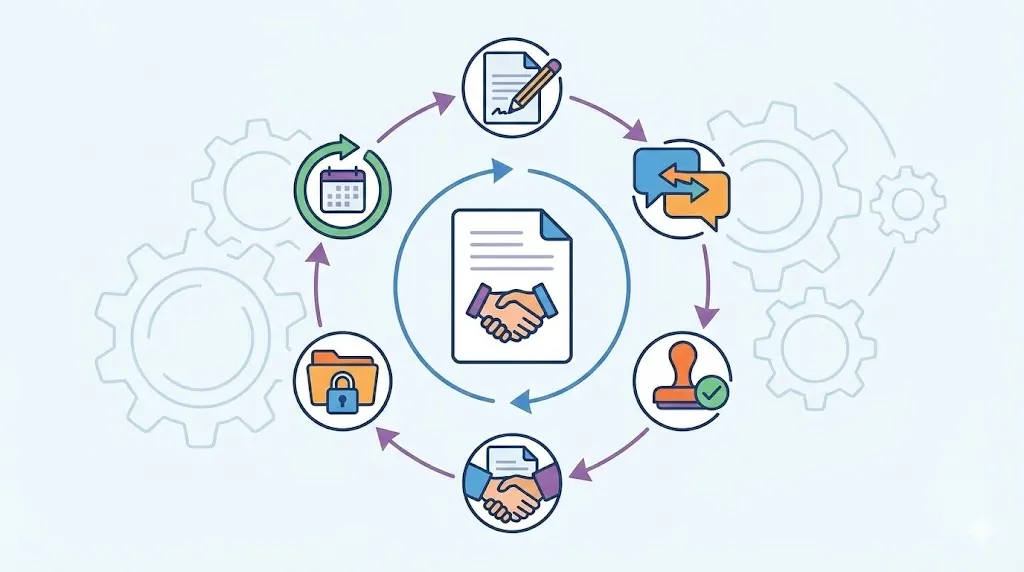
Additionally, CLM involves overseeing contracts from their creation through execution, monitoring performance, and managing renewal or termination.
This encompasses drafting, negotiating, obtaining approvals, securely storing documents, tracking compliance, and generating reports.
Why do companies in healthcare and pharmaceutical industries require specialized contract management?
Entities operating within the healthcare and pharmaceutical domains encounter stringent regulatory frameworks, complex multi-party contracts, and shifting commercial paradigms.
Specialized contract oversight in these sectors ensures regulatory compliance, reduces risks, and supports complex contract types such as outcome-based arrangements.
What challenges do outcome-based contracts present?
Moreover, they also require ongoing monitoring of performance metrics and financial terms linked to results. This adds complexity to contract administration and demands integration with clinical and financial systems.
How does centralizing contract management benefit companies?
Centralized management of contracts enhances uniformity, increases visibility across departments, expedites approval processes, and supports organizational growth.
It helps enforce standards and reduces legal risks across the organization.
What role does technology play in improving contract management?
Furthermore, technology automates routine tasks, tracks obligations, flags risks, and provides analytics. It speeds contract cycles and frees teams to focus on strategic work.
Why is post-award contract management important?
Managing contracts after signing ensures compliance, tracks performance, handles renewals, and prevents revenue leakage. Neglecting this phase risks financial and legal problems.
How can companies overcome budget constraints for contract management improvements?
Also, they should build a business case showing cost savings and revenue benefits. Also, cloud-based CLM solutions offer lower upfront costs and faster deployment.
What new skills do contract managers need in healthcare and pharmaceutical sectors?
Contract managers must cultivate proficiency in data analytics, adept use of technology, commercial insight, collaborative communication, and change management within organizations.
How does AI help in contract management?
AI can review contracts for risky clauses, suggest alternative language, extract key data, and summarize terms. This reduces errors and speeds up legal reviews.
What features should healthcare and pharmaceutical organizations prioritize in CLM software?
Essential capabilities include secure centralized repositories, comprehensive template and clause libraries, automated workflows, AI-assisted contract review, obligation monitoring, electronic signature functionality, and seamless integration with existing enterprise systems.
About the Company
Volody AI CLM is an Agentic AI-powered Contract Lifecycle Management platform designed to eliminate manual contracting tasks, automate complex workflows, and deliver actionable insights. As a one-stop shop for all contract activities, it covers drafting, collaboration, negotiation, approvals, e-signature, compliance tracking, and renewals. Built with enterprise-grade security and no-code configuration, it meets the needs of the most complex global organizations. Volody AI CLM also includes AI-driven contract review and risk analysis, helping teams detect issues early and optimize terms. Trusted by Fortune 500 companies, high-growth startups, and government entities, it transforms contracts into strategic, data-driven business assets.




" height="216.72211px" id="FYO0bO80Y" transform="translate(3 6.105)" width="206.073px"/><path d="M 108.174 222 C 88.432 222 70.303 217.239 53.785 207.717 C 37.267 198.196 24.173 185.052 14.504 168.285 C 4.835 151.312 0 132.165 0 110.845 C 0 89.731 4.835 70.792 14.504 54.025 C 24.173 37.052 37.267 23.804 53.785 14.282 C 70.303 4.761 88.432 0 108.174 0 C 128.116 0 146.246 4.761 162.562 14.282 C 179.08 23.804 192.073 37.052 201.541 54.025 C 211.21 70.792 216.044 89.731 216.044 110.845 C 216.044 132.165 211.21 151.312 201.541 168.285 C 192.073 185.052 179.08 198.196 162.562 207.717 C 146.044 217.239 127.915 222 108.174 222 Z M 108.174 183.189 C 120.864 183.189 132.044 180.291 141.713 174.495 C 151.382 168.492 158.936 160.006 164.375 149.035 C 169.814 138.064 172.533 125.334 172.533 110.845 C 172.533 96.355 169.814 83.729 164.375 72.965 C 158.936 61.994 151.382 53.611 141.713 47.815 C 132.044 42.02 120.864 39.122 108.174 39.122 C 95.483 39.122 84.202 42.02 74.332 47.815 C 64.663 53.611 57.109 61.994 51.67 72.965 C 46.231 83.729 43.511 96.355 43.511 110.845 C 43.511 125.334 46.231 138.064 51.67 149.035 C 57.109 160.006 64.663 168.492 74.332 174.495 C 84.202 180.291 95.483 183.189 108.174 183.189 Z" fill="rgba(255, 255, 255, 0.12)" height="222px" id="aa1McFcE9" transform="translate(227.183 3)" width="216.04399999999998px"/><path d="M 42.302 182.257 L 111.799 182.257 L 111.799 216.722 L 0 216.722 L 0 0 L 42.302 0 Z" fill="rgba(255, 255, 255, 0.12)" height="216.72211px" id="yRq4AnrsX" transform="translate(477.721 6.105)" width="111.79899999999998px"/><path d="M 108.174 222 C 88.432 222 70.303 217.239 53.785 207.717 C 37.267 198.196 24.173 185.052 14.504 168.285 C 4.835 151.312 0 132.165 0 110.845 C 0 89.731 4.835 70.792 14.504 54.025 C 24.173 37.052 37.267 23.804 53.785 14.282 C 70.303 4.761 88.432 0 108.174 0 C 128.116 0 146.246 4.761 162.562 14.282 C 179.08 23.804 192.073 37.052 201.541 54.025 C 211.21 70.792 216.045 89.731 216.045 110.845 C 216.045 132.165 211.21 151.312 201.541 168.285 C 192.073 185.052 179.08 198.196 162.562 207.717 C 146.044 217.239 127.915 222 108.174 222 Z M 108.174 183.189 C 120.864 183.189 132.044 180.291 141.713 174.495 C 151.382 168.492 158.936 160.006 164.375 149.035 C 169.814 138.064 172.534 125.334 172.534 110.845 C 172.534 96.355 169.814 83.729 164.375 72.965 C 158.936 61.994 151.382 53.611 141.713 47.815 C 132.044 42.02 120.864 39.122 108.174 39.122 C 95.483 39.122 84.202 42.02 74.332 47.815 C 64.663 53.611 57.108 61.994 51.67 72.965 C 46.231 83.729 43.511 96.355 43.511 110.845 C 43.511 125.334 46.231 138.064 51.67 149.035 C 57.108 160.006 64.663 168.492 74.332 174.495 C 84.202 180.291 95.483 183.189 108.174 183.189 Z" fill="rgba(255, 255, 255, 0.12)" height="222px" id="mo8HQspQ0" transform="translate(609.155 3)" width="216.04500000000007px"/><path d="M 73.727 0 C 95.885 0 115.324 4.45 132.044 13.351 C 148.967 22.252 161.957 34.982 171.027 51.541 C 180.287 67.894 184.917 86.937 184.917 108.671 C 184.917 130.405 180.287 149.449 171.027 165.801 C 161.957 181.947 148.967 194.47 132.044 203.371 C 115.324 212.271 95.885 216.722 73.727 216.722 L 0 216.722 L 0 0 Z M 72.216 179.773 C 94.374 179.773 111.497 173.564 123.583 161.144 C 135.669 148.724 141.713 131.233 141.713 108.671 C 141.713 86.109 135.669 68.515 123.583 55.888 C 111.497 43.055 94.374 36.638 72.216 36.638 L 42.302 36.638 L 42.302 179.773 Z" fill="rgba(255, 255, 255, 0.12)" height="216.72211px" id="I3iXX5Hi_" transform="translate(859.693 6.105)" width="184.91699999999992px"/><path d="M 185.22 0 L 113.91 141.273 L 113.91 216.722 L 71.61 216.722 L 71.61 141.273 L 0 0 L 47.74 0 L 93.06 99.046 L 138.08 0 Z" fill="rgba(255, 255, 255, 0.12)" height="216.72211px" id="nzHyWC0_d" transform="translate(1061.78 6.105)" width="185.22000000000003px"/></svg>)