

Contract AI tools promise faster reviews, better risk detection, and smarter workflows. But how do you know if your AI is truly delivering value? Many teams get stuck tracking simple accuracy scores and miss the bigger picture. Contract AI metrics go beyond just model performance to include workflow impact and business results. Without this full view, you risk overestimating your AI’s benefits or missing hidden problems. This article breaks down the key metrics you need to track, how to set meaningful targets, and how to report results that matter to your leadership team.
TL;DR
Contract AI metrics cover three layers: AI model accuracy, workflow efficiency, and business outcomes.
Additionally, focusing solely on AI accuracy overlooks the impact these tools have on contract cycle time and the capacity of legal teams.
To accurately assess AI effectiveness, it is essential to analyze performance variations across different contract categories and their associated risk profiles.
Correlating AI performance metrics with specific phases of the contract lifecycle helps identify key bottlenecks that hinder process advancement.
Executive summaries should explicitly demonstrate how AI-generated insights translate into quantifiable improvements in business metrics.
Implementing baseline measurements alongside predefined targets facilitates ongoing monitoring and substantiates the progression of ROI.
What Are Contract AI Metrics and Why Do They Matter?
Contract AI metrics represent the key data points used to evaluate whether your AI tools are functioning correctly. These indicators also provide insights into the AI’s effectiveness in interpreting contracts, the influence on your team’s workflow, and the subsequent impact on business outcomes. Without these measurements, you’re flying blind.
Think of contract AI like a high-performance engine in a car. You don’t just check the engine’s horsepower (model accuracy). You also want to see how the car handles on the road (workflow efficiency) and how much fuel it saves you (business outcomes). Focusing on one without the others can give a false sense of success.
Most teams focus on model accuracy alone because it’s the easiest to measure. But a highly accurate AI that slows down your reviewers or misses risk flags won’t help your company. According to McKinsey, only 39% of organizations see a real profit impact from AI because they don’t measure all three layers.
These evaluation criteria can be grouped into three main areas:
Model performance: Measures the precision with which the AI extracts data and categorizes clauses.
Workflow efficiency: Assesses changes in contract review durations and the frequency of approval bottlenecks.
Business outcomes: Evaluates effects on contract cycle times, risk exposure, and the capacity of legal teams.
Monitoring these dimensions collectively provides a comprehensive understanding of your AI’s overall contribution. This approach allows early identification of problems and supports justification for ongoing investment.
Related articles: Significance of tracking data points in contract management
How Do Contract AI Metrics Differ from Contract Performance Metrics?
Contract performance metrics evaluate the efficiency and effectiveness of your contracting process as a whole. Additionally, examples include contract cycle time, renewal rates, and compliance levels. These indicators reveal whether contracts progress efficiently from initiation to execution.
Contract AI metrics, on the other hand, focus on the performance of artificial intelligence applications within that process. Key measurements include accuracy, speed gains, and risk detection capabilities.
Metric Type | What It Measures | Who Tracks It | Example Metric | Review Frequency |
|---|---|---|---|---|
Contract Performance | Process health and outcomes | Legal ops, Procurement | Average contract duration | Quarterly business review |
Contract AI Performance | AI tool accuracy and workflow impact | Legal ops, IT, AI team | Extraction accuracy rate | Sprint reviews, quarterly calibrations |
Why keep them separate? If your contract cycle duration shortens but accuracy from the AI system remains suboptimal, your team may be spending extra time correcting errors manually, effectively increasing their workload. This hidden cost is overlooked if you only track contract performance.
To avoid this, map each AI metric to the contract performance metric it should influence. For example, high extraction accuracy should speed up metadata tagging, which should reduce cycle time. If cycle times don’t improve, investigate the AI workflow or integration.
Related articles: Contract Risk Analysis Strengthened By AI In Legal Ops
What Contract AI Quality Metrics Should You Track?
Quality metrics reveal how effectively an AI system interprets contractual language. Additionally, they emphasize accuracy, precision, and error rates. These metrics are essential but not sufficient alone.
Key Quality Metrics
Extraction Accuracy: Measures how well critical details such as dates, parties, and amounts are retrieved from contracts.
Classification Accuracy: Assesses whether the AI correctly categorizes clause types like indemnity or termination.
Hallucination Rate: Quantifies instances where the AI generates information absent from the contract.
False Positive/Negative Rates: Indicates the frequency with which the AI erroneously flags or overlooks risk clauses.
Consistency Across Contract Types: Analyzes AI performance differences between straightforward templates and complex negotiated agreements.
Related Article: SLA Obligations Explained: Key Terms and Best Practices
Why These Matter
Moreover, extraction accuracy serves as the cornerstone. If AI cannot reliably pull contract terms, downstream processes suffer. Classification accuracy ensures AI understands contract structure, which helps with risk detection and workflow automation.
Hallucination is a critical risk. AI that fabricates data can mislead reviewers or cause compliance issues. False positives waste time on unnecessary reviews, while false negatives expose the company to risk.
Accuracy varies by contract complexity. Furthermore, aI tends to excel with clean, template-based contracts but encounters challenges with heavily negotiated deals. Track performance by contract type to avoid misleading averages.
Example
In a practical scenario, an organization leverages AI to identify payment terms within NDAs as well as enterprise sales contracts. The system achieves extraction accuracy of 98% on NDAs but only 85% on sales agreements. This discrepancy highlights the necessity for specialized model refinement or additional manual scrutiny when handling more complex documents.
Related articles: How to Simplify Contract Review with AI? Comprehensive Guide
What Contract AI Efficiency Metrics Show Time Savings?
Efficiency metrics reveal how AI changes the speed and effort of contract workflows. Additionally, legal operations teams prioritize these metrics because they directly impact overall productivity.
Important Efficiency Metrics
Review Time Per Contract: Measures how long the initial contract review takes when using AI compared to a traditional manual process.
Touchless Processing Rate: Measures the percentage of contracts finalized without human intervention, typically low-risk agreements.
Queue Depth: Measures the number of contracts waiting for review or approval at any given moment.
Reviewer Load: Captures the average workload per legal team member in terms of contracts reviewed within a specified timeframe.
Cycle Time Reduction: Quantifies the decrease in elapsed time from contract initiation to execution attributable to AI-driven automation.
How to Use These Metrics
Compare review times before and after AI deployment. A 30% reduction in review time means legal can handle more contracts or focus on complex deals.
Moreover, the touchless processing metric provides insight into AI’s effectiveness in managing routine contract types. Increasing this rate reduces bottlenecks and frees legal resources.
Queue depth and reviewer load highlight workflow bottlenecks. If AI accuracy is high but queue depth remains large, the problem may lie in process design or staffing.
Example
A procurement team uses AI to auto-approve low-risk purchase orders. Touchless processing rises from 10% to 45%, cutting average contract cycle time by 20%. Legal capacity increases, allowing the team to support more projects.
Related articles: AI Contract Review vs. Human Lawyers: Speed, Accuracy & ROI
What Contract AI Risk Metrics Help Protect the Business?
Risk metrics track how well AI identifies and flags potential contract risks. Additionally, these indicators contribute significantly to reducing costly mistakes and maintaining regulatory adherence.
Key Risk Metrics
Risk Flag Accuracy: Evaluates the precision with which AI detects clauses that pose potential risks or diverge from established policies.
False Escalation Rate: Tracks the frequency at which AI mistakenly identifies safe items as risky, prompting unnecessary legal intervention.
Missed Risk Rate: Represents the proportion of risky clauses that the AI overlooks.
Policy Compliance Rate: Measures how consistently contracts conform to internal guidelines based on AI evaluation.
Value Leakage Recovered: Measures the amount of revenue retained or expenses avoided through the detection of unfavorable contract provisions.
Why Risk Metrics Matter
Hidden risks within contracts often expose organizations to significant financial losses or legal challenges. Moreover, detecting these vulnerabilities early through AI is essential for managing exposure effectively.
Inaccurate risk flags drain legal resources and slow down the contract review workflow.
Value leakage is a critical business metric. According to The Legal Operations Field Guide, poor contract management causes 5-9% annual revenue loss. Even partial recovery through AI-driven risk detection provides a strong return on investment.
Example
The AI system identifies atypical indemnity clauses within vendor agreements. Following a thorough review, the legal team renegotiates these terms, resulting in an annual savings of $500,000. The system delivers 92% accuracy in risk identification while keeping erroneous escalations below 5%.
Related Article: Mastering Sales Agreement Review with AI
How to Set Baselines and Targets for Contract AI Metrics
Setting baselines and targets turns data into actionable goals. Additionally, without establishing these benchmarks, it’s impossible to determine whether your AI's performance is advancing or deteriorating.
Steps to Set Baselines
Collect Initial Data: Gather measurements of current contract cycle durations, review intervals, AI accuracy levels, and incidence of risk flags.
Segment by Contract Type: Analyze metrics distinctly across simple templates, negotiated agreements, and high-risk contracts.
Understand Current Workflows: Map contract steps and identify bottlenecks.
Engage Stakeholders: Conduct in-depth discussions with legal, procurement, and business teams on the challenges they face and their expectations to ensure comprehensive alignment.
Setting Realistic Targets
Industry benchmarks provide a useful foundation but must be calibrated to reflect the nuances of your contract complexity and transaction volume.
Define progressive objectives, for example, aiming to increase extraction accuracy by 5% within six months.
Align performance targets with strategic business goals, such as achieving a 15% reduction in overall contract processing time.
Monitor the precision of risk flagging to optimize the trade-off between sensitivity and false positive rates.
Tracking Progress
Regularly review metrics in sprint meetings or quarterly business reviews. Use dashboards to visualize trends and spot issues early.
Example
A company benchmarks AI extraction accuracy at 90% and contract processing duration at 30 days. They set a target to reach 95% accuracy and reduce processing time to 25 days within a year. Monthly reports track progress and guide adjustments.
Related articles: Generative AI for Contract Management: An Effective Guide
How to Report Contract AI Performance to Leadership
Leadership cares about business impact, not technical details. Frame your AI metrics in terms of value, capacity, and risk reduction.
Tips for Effective Reporting
Translate AI accuracy into capacity gains. For example, “AI-assisted review freed legal to handle 40 more contracts this quarter.”
Use visuals like charts showing cycle time reductions and risk flags caught.
Highlight cost savings or revenue recovered from AI risk detection.
Explain challenges and next steps clearly.
Connect AI outcomes directly to overarching business priorities, such as accelerating deal closures or enhancing regulatory adherence.
Avoid Overloading with Data
Select only the most impactful metrics to construct a coherent narrative. Minimize the use of specialized terminology that might obscure understanding for executives without a technical background.
Example
Instead of saying “Extraction accuracy improved from 88% to 92%,” say “Improved data extraction cut contract review time by 20%, enabling legal to support more deals.”
Related articles: How Does AI Limitations Impacting Contract Management?
Why Contract Management Software Matters for AI Metrics
Contract lifecycle management (CLM) platforms unify contract documents and optimize associated workflows. Additionally, it establishes the foundation to gather, interpret, and leverage metrics related to AI applied in contract processes.
CLM systems monitor contract progress, maintain metadata, and incorporate AI capabilities for extracting information and evaluating contracts.
This integration makes it easier to measure AI impact on workflows and outcomes.
Modern CLM software offers dashboards for real-time visibility into contract volume, cycle times, and risk exposure. This data helps legal ops teams set baselines, monitor progress, and report results.
A good CLM platform supports:
AI-powered contract drafting and review.
Moreover, automated metadata extraction and tagging.
Risk and compliance assessments with customizable playbooks.
Approval workflow automation and electronic signatures.
Centralized contract repository with robust search capabilities.
Performance tracking through dashboards and analytics.
Managing contracts in one system reduces manual work and errors. Furthermore, it also serves as a single source of truth for AI metrics, enhancing the precision and timeliness of reporting.
> See how Volody's CLM Software helps your team move contracts forward with confidence.
FAQ
What are the three main layers of contract AI metrics?
The key layers include model performance (accuracy of extracting and classifying data), workflow efficiency (impact on review times and approvals), and business outcomes (effects on cycle time, risk, and legal capacity). Tracking all three layers gives a full picture of AI effectiveness.
Why is it not enough to track only AI accuracy?
Also, aI accuracy shows if the tool reads contracts correctly but doesn’t reveal if it speeds up workflows or reduces risk. Also, a highly accurate AI that creates bottlenecks or misses risks may not deliver business value.
How do contract AI metrics relate to contract performance metrics?
Metrics assessing contract performance evaluate the entire contracting lifecycle, including cycle time and compliance adherence. In contrast, AI-related metrics focus on the effectiveness of AI tools within that lifecycle. Both views are critical to comprehensively assess AI’s influence.
Therefore, what is extraction accuracy in contract AI?
Extraction accuracy measures how correctly AI pulls key contract data such as dates, parties, and amounts from unstructured text. High extraction accuracy is essential for downstream automation and reporting.
Therefore, how can workflow metrics show AI’s impact?
Workflow metrics like review time per contract and touchless processing rate reveal if AI speeds up contract handling and reduces manual effort. These metrics highlight efficiency gains or workflow issues.
What does value leakage recovered mean?
This term estimates the revenue or cost savings gained by identifying and fixing unfavorable contract terms through AI risk detection. It quantifies AI’s financial impact.
Consequently, how should I set targets for contract AI metrics?
Start by measuring current performance, segment by contract type, and set realistic, incremental goals aligned with business outcomes. Regularly track progress and adjust targets as needed.
How do I report contract AI results to leadership?
Translate technical metrics into business value, such as capacity gains or risk reductions. Use clear visuals and focus on a few key indicators tied to company goals.
As a result, can contract management software help with AI metrics?
Yes. CLM platforms centralize contracts, streamline workflows, and integrate AI functionalities. They offer dashboards and data required to effectively monitor AI performance along with associated business results.
What risks should contract AI detect?
AI should flag risky clauses like indemnity, termination, liability limits, and deviations from policy. Accurate risk detection helps prevent financial loss and compliance issues.
This comprehensive guide covers everything legal and operations leaders need to understand about contract AI metrics. Tracking these metrics properly helps you move beyond simple accuracy scores to real business transformation.
About the Company
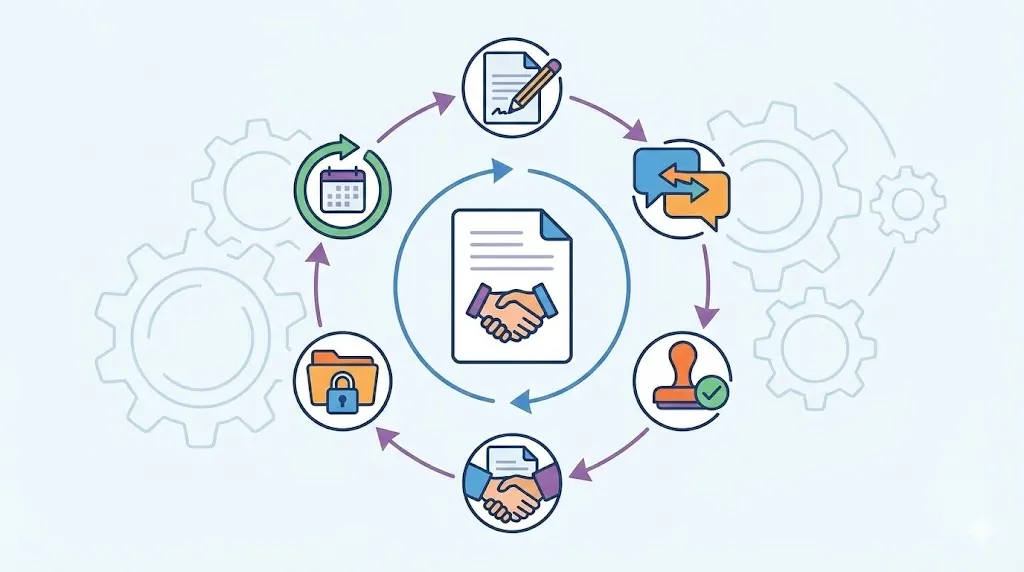
Volody AI CLM is an Agentic AI-powered Contract Lifecycle Management platform designed to eliminate manual contracting tasks, automate complex workflows, and deliver actionable insights. As a one-stop shop for all contract activities, it covers drafting, collaboration, negotiation, approvals, e-signature, compliance tracking, and renewals. Built with enterprise-grade security and no-code configuration, it meets the needs of the most complex global organizations. Volody AI CLM also includes AI-driven contract review and risk analysis, helping teams detect issues early and optimize terms. Trusted by Fortune 500 companies, high-growth startups, and government entities, it transforms contracts into strategic, data-driven business assets.




" height="216.72211px" id="FYO0bO80Y" transform="translate(3 6.105)" width="206.073px"/><path d="M 108.174 222 C 88.432 222 70.303 217.239 53.785 207.717 C 37.267 198.196 24.173 185.052 14.504 168.285 C 4.835 151.312 0 132.165 0 110.845 C 0 89.731 4.835 70.792 14.504 54.025 C 24.173 37.052 37.267 23.804 53.785 14.282 C 70.303 4.761 88.432 0 108.174 0 C 128.116 0 146.246 4.761 162.562 14.282 C 179.08 23.804 192.073 37.052 201.541 54.025 C 211.21 70.792 216.044 89.731 216.044 110.845 C 216.044 132.165 211.21 151.312 201.541 168.285 C 192.073 185.052 179.08 198.196 162.562 207.717 C 146.044 217.239 127.915 222 108.174 222 Z M 108.174 183.189 C 120.864 183.189 132.044 180.291 141.713 174.495 C 151.382 168.492 158.936 160.006 164.375 149.035 C 169.814 138.064 172.533 125.334 172.533 110.845 C 172.533 96.355 169.814 83.729 164.375 72.965 C 158.936 61.994 151.382 53.611 141.713 47.815 C 132.044 42.02 120.864 39.122 108.174 39.122 C 95.483 39.122 84.202 42.02 74.332 47.815 C 64.663 53.611 57.109 61.994 51.67 72.965 C 46.231 83.729 43.511 96.355 43.511 110.845 C 43.511 125.334 46.231 138.064 51.67 149.035 C 57.109 160.006 64.663 168.492 74.332 174.495 C 84.202 180.291 95.483 183.189 108.174 183.189 Z" fill="rgba(255, 255, 255, 0.12)" height="222px" id="aa1McFcE9" transform="translate(227.183 3)" width="216.04399999999998px"/><path d="M 42.302 182.257 L 111.799 182.257 L 111.799 216.722 L 0 216.722 L 0 0 L 42.302 0 Z" fill="rgba(255, 255, 255, 0.12)" height="216.72211px" id="yRq4AnrsX" transform="translate(477.721 6.105)" width="111.79899999999998px"/><path d="M 108.174 222 C 88.432 222 70.303 217.239 53.785 207.717 C 37.267 198.196 24.173 185.052 14.504 168.285 C 4.835 151.312 0 132.165 0 110.845 C 0 89.731 4.835 70.792 14.504 54.025 C 24.173 37.052 37.267 23.804 53.785 14.282 C 70.303 4.761 88.432 0 108.174 0 C 128.116 0 146.246 4.761 162.562 14.282 C 179.08 23.804 192.073 37.052 201.541 54.025 C 211.21 70.792 216.045 89.731 216.045 110.845 C 216.045 132.165 211.21 151.312 201.541 168.285 C 192.073 185.052 179.08 198.196 162.562 207.717 C 146.044 217.239 127.915 222 108.174 222 Z M 108.174 183.189 C 120.864 183.189 132.044 180.291 141.713 174.495 C 151.382 168.492 158.936 160.006 164.375 149.035 C 169.814 138.064 172.534 125.334 172.534 110.845 C 172.534 96.355 169.814 83.729 164.375 72.965 C 158.936 61.994 151.382 53.611 141.713 47.815 C 132.044 42.02 120.864 39.122 108.174 39.122 C 95.483 39.122 84.202 42.02 74.332 47.815 C 64.663 53.611 57.108 61.994 51.67 72.965 C 46.231 83.729 43.511 96.355 43.511 110.845 C 43.511 125.334 46.231 138.064 51.67 149.035 C 57.108 160.006 64.663 168.492 74.332 174.495 C 84.202 180.291 95.483 183.189 108.174 183.189 Z" fill="rgba(255, 255, 255, 0.12)" height="222px" id="mo8HQspQ0" transform="translate(609.155 3)" width="216.04500000000007px"/><path d="M 73.727 0 C 95.885 0 115.324 4.45 132.044 13.351 C 148.967 22.252 161.957 34.982 171.027 51.541 C 180.287 67.894 184.917 86.937 184.917 108.671 C 184.917 130.405 180.287 149.449 171.027 165.801 C 161.957 181.947 148.967 194.47 132.044 203.371 C 115.324 212.271 95.885 216.722 73.727 216.722 L 0 216.722 L 0 0 Z M 72.216 179.773 C 94.374 179.773 111.497 173.564 123.583 161.144 C 135.669 148.724 141.713 131.233 141.713 108.671 C 141.713 86.109 135.669 68.515 123.583 55.888 C 111.497 43.055 94.374 36.638 72.216 36.638 L 42.302 36.638 L 42.302 179.773 Z" fill="rgba(255, 255, 255, 0.12)" height="216.72211px" id="I3iXX5Hi_" transform="translate(859.693 6.105)" width="184.91699999999992px"/><path d="M 185.22 0 L 113.91 141.273 L 113.91 216.722 L 71.61 216.722 L 71.61 141.273 L 0 0 L 47.74 0 L 93.06 99.046 L 138.08 0 Z" fill="rgba(255, 255, 255, 0.12)" height="216.72211px" id="nzHyWC0_d" transform="translate(1061.78 6.105)" width="185.22000000000003px"/></svg>)