

Contracts are the backbone of business deals, yet many organizations struggle to measure how well their contract processes perform. Without clear indicators, teams can’t spot bottlenecks or prove their value to leadership. Contract process KPIs that drive business outcomes provide the insight needed to improve speed, quality, and compliance. This article breaks down the key KPIs, how to track them, and how contract management software supports better decision-making.
TL;DR
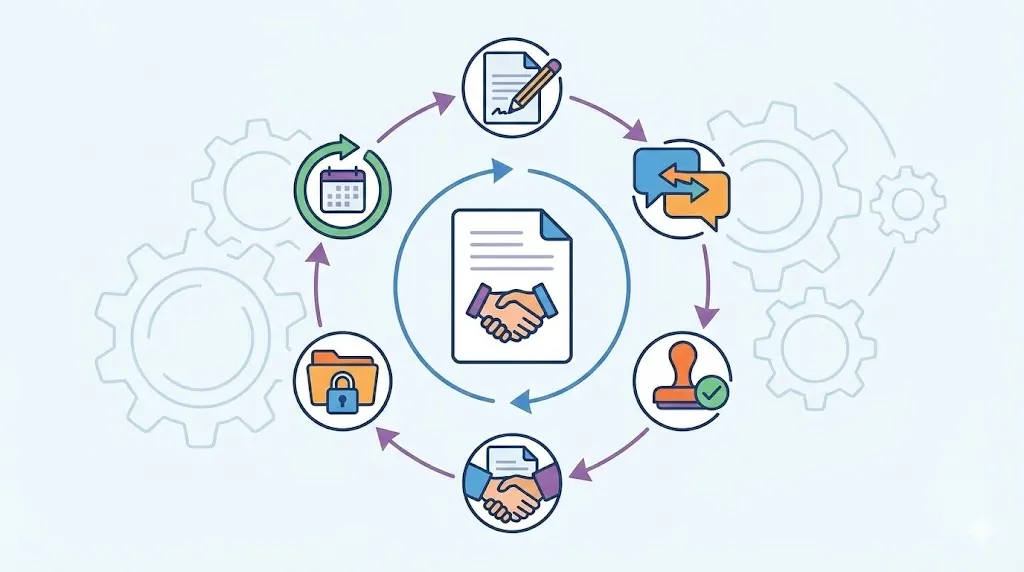
KPIs for the contract process illuminate performance metrics across the entire lifecycle, from initial request through to renewal, pinpointing exact bottlenecks.
Additionally, begin by measuring the average contract cycle time before incorporating KPIs that assess each phase, including intake, drafting, negotiation, approval, and execution.
Integrating speed-focused KPIs with those measuring quality and compliance is crucial to maintaining comprehensive oversight.
Regular operational reviews facilitate prompt issue identification, and quarterly reporting keeps leadership informed with concrete progress data.
Manual tracking is unreliable; contract management software automates data capture and reporting.
Leveraging AI-driven contract tools enhances drafting efficiency, elevates review precision, and delivers actionable insights.
What Are Contract Process KPIs and Why Do They Matter?
Contract process KPIs are measurable goals that show how well your contract workflow performs at each step. These KPIs answer the question: “How do we know if our contract process is working?” Unlike raw metrics, which just count activity, KPIs link those numbers to targets. For example, a metric might be “100 contracts processed last month.” A KPI would be “Reduce average contract cycle time by 15% this quarter.” KPIs tell you if your process meets expectations.
Contracts pass through several stages, and KPIs can track each one:
Intake: How quickly contract requests enter the system and reach the right team member.
Drafting: Measuring the elapsed time required to generate the initial contract draft.
Negotiation: Evaluating both the number of redline iterations and the overall duration of negotiation cycles.
Approval: Measuring how long contracts stay pending before receiving final authorization.
Execution: Tracking the interval from approval to obtaining the fully executed signature.
Renewal and obligations: Supervising critical deadlines and verifying compliance throughout the post-signature lifecycle.
Mapping KPIs to these stages enables pinpointing the exact points where contracts slow down. This targeted insight reveals specific bottlenecks rather than leaving delays unexplained.
These KPIs matter because contracts directly affect revenue, risk, and operational efficiency. According to the 2026 Contracting Benchmark Report, the average contract takes 35 days to execute. Without KPIs, teams rely on gut feelings to explain delays. KPIs provide data-driven answers that help improve processes and justify resource requests.
Related articles: Importance of Contracts: Why do Contracts Matter?
How Do Contract Process KPIs Improve Business Outcomes?
Contract management is more than legal paperwork. Additionally, it also impacts deal velocity, risk exposure, and customer satisfaction. KPIs give you three key advantages:
Spot Bottlenecks Early: Maybe approvals take two weeks, or negotiation stalls on specific clauses. KPIs reveal these slow spots so you can fix them.
Reduce Risk: Missed renewals or overlooked obligations cause revenue loss and compliance issues. KPIs tracking deadlines and obligations alert you before problems arise.
Showcase Legal’s Value: When legal teams prove faster contract turnaround correlates with quicker revenue recognition, leadership sees them as business partners, not just cost centers.
For example, if your team cuts average cycle time from 25 to 15 days, and sales close faster, you have data to back up requests for more budget or headcount. This shifts conversations from opinion to evidence.
Related articles: 6 Key Performance Indicators (KPIs) for Legal Departments
6 Essential Contract Process KPIs to Track
Start with KPIs that align with your current priorities: speed, quality, or risk. Here are six critical KPIs that cover the contract lifecycle:
1. Average Contract Cycle Time
This measures the total days from contract request to full execution. It gives a high-level view of process health. If this number is too high, it signals inefficiencies somewhere in the workflow.
2. Time to Signature
This metric helps pinpoint bottlenecks during execution phases, including delays caused by awaiting counterparty signatures or internal approvals.
3. Average Negotiation Duration
This indicator captures the time allocated to redlining and review by counterparties. Lengthy negotiations typically reveal disputes over specific clauses or external stakeholder-induced delays.
4. Approval Turnaround Time
Moreover, this value reflects how long contracts are stalled in internal approval stages, exposing inefficiencies in routing or decision-making processes.
5. Contract Request Response Time
This measures how fast contract requests are acknowledged and assigned. Quick intake speeds up the entire process.
6. Obligation and Renewal Compliance Rate
This tracks the percentage of contracts with obligations and renewal dates met on time. It helps avoid missed deadlines and penalties.
Related articles: How To Accelerate Contract Review Process? Effective Guide
How to Track and Report Contract Process KPIs Effectively
Tracking KPIs requires accurate, consistent data collection. Additionally, contract information is often dispersed across emails, spreadsheets, and shared drives, complicating visibility and control. Manual tracking under these conditions tends to be both error-prone and inefficient.
Consider the following approach to monitor KPIs:
Define Clear KPI Targets: Establish measurable objectives, such as achieving a 20% reduction in average cycle time.
Map KPIs to Workflow Stages: Each KPI should be clearly linked to the team or individual responsible for that segment of the contract process to ensure accountability.
Automate Data Capture: Implement technology platforms capable of automatically recording timestamps and capturing metadata throughout every phase of the contract lifecycle.
Create Dashboards: Use comprehensive visual tools like charts and graphs to quickly identify trends and detect outliers as they arise.
Schedule Regular Reviews: Conduct monthly operational meetings to identify and resolve bottlenecks, complemented by quarterly executive updates to demonstrate overall impact.
For example, if approval turnaround time spikes, investigate the cause immediately. Is a specific approver overloaded? Is the workflow unclear? Fixing these issues prevents delays from cascading.
Related articles: Effectively use AI in Contract Drafting
Why Pair Speed KPIs With Quality and Compliance Measures?
Focusing only on speed can backfire. Additionally, when contract teams accelerate their workflow, the risk of errors and overlooked compliance requirements rises. This creates downstream problems like disputes, penalties, or costly amendments.
Balance speed KPIs with quality and compliance KPIs; for instance:
Error Rate: The share of contracts necessitating amendments after execution.
Compliance Violations: Instances involving missing essential clauses or absence of required approvals.
Renewal Miss Rate: The portion of agreements renewed late or not renewed at all.
Combining these KPIs helps maintain rapid contract workflows without compromising precision or robust risk management.
Explore further: AI Contract Review vs. Human Lawyers: Speed, Accuracy & ROI
5 Challenges in Maintaining Reliable Contract KPIs
Tracking contract KPIs sounds straightforward but faces real hurdles:
1. Data Fragmentation
Contracts and related data often spread across emails, file shares, and multiple systems, which complicates obtaining a comprehensive overview.
2. Manual Data Entry Errors
Additionally, when teams enter dates or statuses manually, mistakes happen. These errors distort KPI accuracy.
3. Lack of Standardized Processes
Without consistent workflows, KPIs vary widely and lose meaning. Standardizing contract stages and definitions is critical.
4. Resistance to Change
Legal and business teams may resist new tracking processes, fearing extra work or scrutiny.
5. Inadequate Reporting Tools
Basic spreadsheets can’t handle complex KPI tracking or provide real-time insights. Without proper tools, teams fall behind.
Related articles: KPIs for Successful Contract Management
How Contract Management Software Supports Contract Process KPIs
Contract management tools centralize contracts and automate KPI tracking. Additionally, each action is recorded with a precise timestamp, and metadata extraction occurs automatically. This eliminates manual entry and errors.
Key benefits include:
Real-Time Dashboard: See cycle times, bottlenecks, and compliance status at a glance.
Workflow Automation: Contracts are routed directly to the appropriate approvers, accelerating the approval process.
Version Control: Maintain a detailed audit trail of all contract revisions.
Obligation Tracking: Receive notifications for upcoming renewals, deadlines, and key deliverables.
AI Assistance: Use AI to draft contracts faster and flag risky clauses during review.
These features make KPI tracking reliable and actionable. Teams can focus on solving problems instead of hunting for data.
Related articles: CLM Solutions Tailored for Sales Teams | Comprehensive Guide
Why Contract Process KPIs Fail Without Executive Buy-In
Effective KPI implementation hinges on active leadership engagement. Additionally, without such commitment, teams often encounter insufficient resources and diminished motivation to enhance performance. Leaders should:
Establish clear expectations regarding contract performance.
Engage in detailed evaluations of KPI reports to uncover the drivers behind the results.
Ensure dedicated budgets are in place to acquire critical tools and facilitate advanced training programs.
Publicly acknowledge teams that achieve or surpass the specified performance benchmarks.
When executives integrate KPIs into their strategic priorities, it drives alignment across teams and fosters tangible performance improvements.
Related articles: How to Calculate Your Contract Management ROI
How to Use KPIs to Improve Contract Negotiations
KPIs can reveal negotiation inefficiencies. For example, if average negotiation duration is high, analyze which clauses cause delays. You might find:
Certain clauses trigger multiple redlines.
Specific counterparties slow down responses.
Negotiators spend too long on low-value changes.
Armed with this data, you can:
Create fallback clauses to speed agreement.
Train negotiators on common sticking points.
Set deadlines for counterparty responses.
This targeted approach reduces negotiation time and accelerates deal closure.
Related articles: Mastering Contract Clauses: Risk & Performance
4 Ways Contract KPIs Drive Better Risk Management
Risk management improves when you track contract KPIs that focus on compliance and obligations:
Track Contract Expirations: Avoid auto-renewals or lapses that increase risk.
Monitor Clause Deviations: Identify contracts missing key protections or containing unusual language.
Audit Approval Compliance: Ensure contracts follow required approval workflows.
Flag High-Risk Contracts: Use KPIs to highlight contracts with unusual terms or high value.
These insights help legal teams intervene before risks become costly problems.
Related articles: Top Contract Management Tips for Legal Professionals
Why Monthly Operational Reviews and Quarterly Executive Reports Matter
Monthly reviews provide critical insights that enable your team to adapt swiftly to operational shifts. They help you:
Detect bottlenecks at an early stage, preventing escalation.
Reconfigure processes or shift resources dynamically to meet evolving demands.
Enforce stringent accountability measures to ensure team-wide compliance.
Quarterly executive reports contextualize operational metrics within broader business objectives. They show how faster contract turnaround supports revenue growth or risk reduction. This builds trust and secures ongoing support.
Related articles: Legal Playbook: Reasons Why Your Business Needs One
How to Build a Contract KPI Dashboard That Works
An effective dashboard clearly displays KPIs while empowering users to take informed actions based on the data.
Here are some best practices to consider:
Clarity should be the priority; opt for charts and graphs that communicate data without ambiguity.
Highlight KPIs that fail to meet targets by using red for immediate visibility.
Provide filters allowing users to segment data by contract type, team, or stage.
Add trend lines to demonstrate performance trajectories over specified time periods.
Include drill-down features that connect to detailed reports for deeper analysis.
Example dashboard KPIs:
KPI | Target | Current Value | Status |
|---|---|---|---|
Average Cycle Time | ≤ 20 days | 25 days | 🔴 |
Approval Turnaround Time | ≤ 3 days | 2.5 days | 🟢 |
Negotiation Duration | ≤ 10 days | 12 days | 🔴 |
Renewal Compliance Rate | ≥ 95% | 97% | 🟢 |
This layout helps teams focus on problem areas and track improvements.
Related articles: Breach of Contract: Master How to Resolve Legal Disputes
How CLM Software Solves This
Contract lifecycle management (CLM) software provides automated tracking and reporting for key performance indicators related to contracts. Additionally, it captures timestamps and metadata at every stage, which greatly reduces the likelihood of manual errors. CLM solutions optimize the workflows involved in contract initiation, drafting, negotiation, approval, and finalization. They also manage compliance obligations and renewal schedules to reduce risk.
Volody’s platform integrates advanced AI-assisted drafting features, streamlined approval workflows, and dynamic, real-time dashboards. These tools accelerate contract processing while ensuring adherence to quality and regulatory standards.
Explore how Volody's CLM Software empowers your team to manage contracts with greater confidence.
Related Article: How to Amend a Contract After Signing
FAQ
What is the difference between a contract metric and a contract KPI?
A contract metric measures specific data points, for example, the total number of finalized contracts. Moreover, metrics offer a retrospective assessment of performance; KPIs indicate whether strategic goals are being met.
Why should I track contract KPIs at each stage of the contract lifecycle?
Tracking KPIs throughout every phase identifies exactly where delays or issues occur. Rather than only considering the overall timeline, you can determine if contract initiation, drafting, negotiation, approval, or execution is responsible for bottlenecks.
How can contract KPIs help reduce legal risk?
KPIs that monitor obligations, renewals, and compliance flag missed deadlines or approvals promptly. This early detection helps avoid penalties, revenue loss, and contractual disputes.
What are the most important KPIs for contract speed?
Furthermore, average contract cycle time, time to signature, negotiation duration, and approval turnaround time are key speed KPIs. They also provide insights into the pace at which contracts progress through each phase.
How do I ensure speed KPIs don’t sacrifice contract quality?
Combine speed KPIs with quality indicators such as error frequency and compliance breaches. Maintaining this equilibrium prevents teams from rushing contracts and making costly mistakes.
Why is manual tracking of contract KPIs unreliable?
Manual tracking relies on people entering data, which causes errors and delays. Also, contracts spread across emails and drives make consistent tracking nearly impossible.
How often should I review contract KPIs?
Also, monthly operational reviews catch issues early, while quarterly executive reports demonstrate your team’s impact to leadership.
Can contract management software improve KPI tracking?
Indeed, software facilitates automatic data collection, timestamps every action, and generates comprehensive dashboards. These features ensure KPI tracking is precise, timely, and actionable.
What role does AI play in contract process KPIs?
AI expedites drafting, identifies high-risk clauses during review, and automatically extracts essential metadata. These improvements shorten cycle times and enhance contract accuracy.
How do contract KPIs help legal teams gain leadership support?
KPIs provide concrete evidence linking contract performance to business objectives. Demonstrating faster turnaround times tied to revenue growth bolsters legal teams’ arguments for budget and resource allocation.
About the Company

Volody AI CLM is an Agentic AI-powered Contract Lifecycle Management platform designed to eliminate manual contracting tasks, automate complex workflows, and deliver actionable insights. As a one-stop shop for all contract activities, it covers drafting, collaboration, negotiation, approvals, e-signature, compliance tracking, and renewals. Built with enterprise-grade security and no-code configuration, it meets the needs of the most complex global organizations. Volody AI CLM also includes AI-driven contract review and risk analysis, helping teams detect issues early and optimize terms. Trusted by Fortune 500 companies, high-growth startups, and government entities, it transforms contracts into strategic, data-driven business assets.




" height="216.72211px" id="FYO0bO80Y" transform="translate(3 6.105)" width="206.073px"/><path d="M 108.174 222 C 88.432 222 70.303 217.239 53.785 207.717 C 37.267 198.196 24.173 185.052 14.504 168.285 C 4.835 151.312 0 132.165 0 110.845 C 0 89.731 4.835 70.792 14.504 54.025 C 24.173 37.052 37.267 23.804 53.785 14.282 C 70.303 4.761 88.432 0 108.174 0 C 128.116 0 146.246 4.761 162.562 14.282 C 179.08 23.804 192.073 37.052 201.541 54.025 C 211.21 70.792 216.044 89.731 216.044 110.845 C 216.044 132.165 211.21 151.312 201.541 168.285 C 192.073 185.052 179.08 198.196 162.562 207.717 C 146.044 217.239 127.915 222 108.174 222 Z M 108.174 183.189 C 120.864 183.189 132.044 180.291 141.713 174.495 C 151.382 168.492 158.936 160.006 164.375 149.035 C 169.814 138.064 172.533 125.334 172.533 110.845 C 172.533 96.355 169.814 83.729 164.375 72.965 C 158.936 61.994 151.382 53.611 141.713 47.815 C 132.044 42.02 120.864 39.122 108.174 39.122 C 95.483 39.122 84.202 42.02 74.332 47.815 C 64.663 53.611 57.109 61.994 51.67 72.965 C 46.231 83.729 43.511 96.355 43.511 110.845 C 43.511 125.334 46.231 138.064 51.67 149.035 C 57.109 160.006 64.663 168.492 74.332 174.495 C 84.202 180.291 95.483 183.189 108.174 183.189 Z" fill="rgba(255, 255, 255, 0.12)" height="222px" id="aa1McFcE9" transform="translate(227.183 3)" width="216.04399999999998px"/><path d="M 42.302 182.257 L 111.799 182.257 L 111.799 216.722 L 0 216.722 L 0 0 L 42.302 0 Z" fill="rgba(255, 255, 255, 0.12)" height="216.72211px" id="yRq4AnrsX" transform="translate(477.721 6.105)" width="111.79899999999998px"/><path d="M 108.174 222 C 88.432 222 70.303 217.239 53.785 207.717 C 37.267 198.196 24.173 185.052 14.504 168.285 C 4.835 151.312 0 132.165 0 110.845 C 0 89.731 4.835 70.792 14.504 54.025 C 24.173 37.052 37.267 23.804 53.785 14.282 C 70.303 4.761 88.432 0 108.174 0 C 128.116 0 146.246 4.761 162.562 14.282 C 179.08 23.804 192.073 37.052 201.541 54.025 C 211.21 70.792 216.045 89.731 216.045 110.845 C 216.045 132.165 211.21 151.312 201.541 168.285 C 192.073 185.052 179.08 198.196 162.562 207.717 C 146.044 217.239 127.915 222 108.174 222 Z M 108.174 183.189 C 120.864 183.189 132.044 180.291 141.713 174.495 C 151.382 168.492 158.936 160.006 164.375 149.035 C 169.814 138.064 172.534 125.334 172.534 110.845 C 172.534 96.355 169.814 83.729 164.375 72.965 C 158.936 61.994 151.382 53.611 141.713 47.815 C 132.044 42.02 120.864 39.122 108.174 39.122 C 95.483 39.122 84.202 42.02 74.332 47.815 C 64.663 53.611 57.108 61.994 51.67 72.965 C 46.231 83.729 43.511 96.355 43.511 110.845 C 43.511 125.334 46.231 138.064 51.67 149.035 C 57.108 160.006 64.663 168.492 74.332 174.495 C 84.202 180.291 95.483 183.189 108.174 183.189 Z" fill="rgba(255, 255, 255, 0.12)" height="222px" id="mo8HQspQ0" transform="translate(609.155 3)" width="216.04500000000007px"/><path d="M 73.727 0 C 95.885 0 115.324 4.45 132.044 13.351 C 148.967 22.252 161.957 34.982 171.027 51.541 C 180.287 67.894 184.917 86.937 184.917 108.671 C 184.917 130.405 180.287 149.449 171.027 165.801 C 161.957 181.947 148.967 194.47 132.044 203.371 C 115.324 212.271 95.885 216.722 73.727 216.722 L 0 216.722 L 0 0 Z M 72.216 179.773 C 94.374 179.773 111.497 173.564 123.583 161.144 C 135.669 148.724 141.713 131.233 141.713 108.671 C 141.713 86.109 135.669 68.515 123.583 55.888 C 111.497 43.055 94.374 36.638 72.216 36.638 L 42.302 36.638 L 42.302 179.773 Z" fill="rgba(255, 255, 255, 0.12)" height="216.72211px" id="I3iXX5Hi_" transform="translate(859.693 6.105)" width="184.91699999999992px"/><path d="M 185.22 0 L 113.91 141.273 L 113.91 216.722 L 71.61 216.722 L 71.61 141.273 L 0 0 L 47.74 0 L 93.06 99.046 L 138.08 0 Z" fill="rgba(255, 255, 255, 0.12)" height="216.72211px" id="nzHyWC0_d" transform="translate(1061.78 6.105)" width="185.22000000000003px"/></svg>)