

Effective intercompany agreement management requires more than shared folders. Legal, tax, finance, and business teams need a reliable, entity-level view of every agreement, supported by current terms, accountable owners, and defined review dates. A disciplined operating model strengthens records, tax compliance, audit readiness, and the organization’s ability to manage change.
TL;DR
Build one entity-linked inventory showing every agreement, owner, status, obligation, and supporting record across the corporate group.
Define clear categories for services, financing, licensing, property, employment, data, distribution, and cost sharing arrangements.
Address missing documents, outdated terms, unclear authority, system gaps, and agreements that do not match actual business activity.
Use approval workflows, controlled versions, review dates, and event triggers to govern agreements through their full lifecycle.
Align legal terms with pricing, invoices, journal entries, tax files, reconciliations, and supporting transaction evidence.
Use contract management software to improve search, reminders, approvals, reporting, audit trails, and entity-level visibility.
Establish a Central Agreement Inventory and Entity by Entity Coverage Map
Map every agreement to the entity structure
Start with the current legal entity register. This register lists each company, country, ownership link, and legal name. Map every intercompany agreement to the correct contracting parties.
Do not rely on old file names or folder paths. A document may sit with the parent company but serve several subsidiaries. Its record should still show every party and role.
Record whether each party acts as a service provider, recipient, lender, borrower, licensor, or distributor. These roles help teams understand the agreement’s purpose. They also support better reviews when the group structure changes.
Update the map after acquisitions, mergers, liquidations, and new entity formations. A past filing location does not prove current ownership. The map should reflect the group as it operates now.
Capture the data required for oversight
Each inventory record should contain key facts about the agreement. These facts let teams filter records and find gaps quickly.
Capture the agreement type, parties, country, effective date, renewal date, and end date. Add governing law, currency, payment terms, and approval status.
Record the business owner, legal owner, tax contact, and finance contact. Link each agreement to related invoices, pricing files, service records, and board approvals.
Track obligations, notice periods, amendment history, and current document status. Mark whether the record contains a signed copy, draft, or missing document. This simple status view can expose weak coverage.
Assign accountability across the group
A central legal operations owner can manage the inventory. Local legal, tax, finance, and business teams should validate their own records.
The central owner should set data rules and review standards. Local teams should confirm entity names, transactions, approvals, and local requirements.
For example, a tax manager can confirm pricing support. A finance lead can confirm invoice and journal links. A business owner can confirm that services still occur.
No single team can validate every field alone. Shared ownership creates stronger records and fewer hidden gaps. It also makes Intercompany Agreement Management easier to maintain.
Related articles: Legal Enforceability of Terms and Conditions
Define Agreement Types and Business Scope
Shared services and cost allocations
Shared service agreements cover work delivered between group entities. Common examples include technology, human resources, procurement, payroll, legal support, and administration.
Each agreement should describe the services in plain language. It should name the service provider and receiving entities. It should also explain service levels, charging dates, and payment terms.
Cost sharing arrangements need a clear allocation method. The method may use headcount, revenue, usage, transaction volume, or another fair measure. The agreement should explain why that method fits the service.
Keep evidence of performance with the agreement record. This evidence may include reports, tickets, time records, invoices, or service measures. These records show that the agreed work occurred.
Financing, cash management, and guarantees
Financing agreements cover loans, cash pools, guarantees, and capital support. They should define the amount, currency, term, repayment dates, and interest method.
Record any security, covenants, approval limits, and default rights. Note whether the arrangement needs board approval or special local filings. Tax teams should review interest and withholding requirements.
Cash pooling terms should identify each participant and account role. They should also explain how balances, interest, and fees are calculated. Clear terms help finance teams reconcile activity each month.
Capital contributions need separate treatment from loans. The record should show the intended purpose and approval route. It should also explain how each entity records the transaction.
Services: Include management, technology, human resources, procurement, and administrative support.
Intellectual property: Cover trademarks, patents, software, know-how, and permitted use.
Financing: Record loans, cash pools, guarantees, capital support, interest, and repayment.
Real estate: Document leases, shared offices, property costs, and maintenance duties.
Employment: Cover secondments, payroll support, benefits, and employee cost recovery.
Data and licensing: Define access rights, security duties, usage limits, and fees.
Distribution and cost sharing: Explain goods flows, allocation methods, pricing, and evidence.
Related articles: Enterprise Contract Lifecycle Management Software
Key Challenges in Intercompany Agreement Management
1. Incomplete or inconsistent documentation
Some entities may operate without signed Intercompany Contracts. Others may hold several versions with different terms. Informal emails can then replace proper agreements.
This creates risk across legal, tax, accounting, and audit work. Teams may struggle to prove who owed what, and why. They may also apply different prices to similar services.
An agreement can also become inaccurate over time. The document may name old entities, old directors, or services that no longer exist. Its terms may no longer match actual invoices or payment flows.
A central inventory helps expose these issues. It should mark missing signatures, duplicate records, expired terms, and unlinked transactions. Teams can then rank gaps by risk and business impact.
2. Changes to entities and transactions
Corporate groups change often. They add entities, enter countries, close subsidiaries, and move business functions.
A restructuring can alter service providers and recipients. An acquisition can bring new agreements with different terms. A dissolution can leave active contracts assigned to the wrong party.
Director changes can also affect signing authority. New service models may require new pricing or service descriptions. Higher transaction volumes may make old allocation methods unsuitable.
These events should prompt formal review. Waiting for a yearly check can leave major gaps open. Event-based checks help keep agreements aligned with the group.
3. Disconnected teams and systems
Legal may store signed documents in one system. Finance may track invoices elsewhere. Tax may keep pricing files in separate folders.
This split view causes repeated data entry and missed updates. It also makes it harder to confirm whether contracts match transactions. Teams may spend hours searching for basic facts.
Different local processes create further inconsistency. One entity may track renewals carefully. Another may rely on personal reminders or email threads.
Multi-Entity Contract Management needs shared data and clear handoffs. It also needs a system that shows ownership, status, and related records.
Document completeness: Check for signed copies, amendments, and required schedules.
Entity changes: Confirm parties after acquisitions, closures, mergers, and restructurings.
Authority: Verify signatory powers, approvals, and local signing rules.
Commercial alignment: Compare services, prices, terms, and actual business activity.
Tax support: Match pricing, functions, risks, and local documentation needs.
System visibility: Confirm searchable records, owners, dates, links, and audit evidence.
Related articles: 7 Key Contract Clauses Found in Business Contracts
Create a Governance Workflow for Execution and Approval
Confirm parties and signatory authority
Before drafting, confirm the exact legal names of all parties. Check registration details, countries, entity status, and ownership links.
Confirm who may sign for each entity. Review board approvals, delegated authority, signing limits, and local requirements. Some jurisdictions may require special forms or filings.
Do not treat a familiar signatory as automatically authorized. Authority can change after leadership moves or reorganizations. The workflow should capture proof of approval.
Standardize drafting and review
Use approved templates for common Intercompany Service Agreements. Templates should include core terms, defined roles, pricing rules, records, and dispute processes.
Clause guidance can help teams choose suitable language. Fallback clauses can support negotiation without starting from scratch. Local legal teams should still review country-specific needs.
Tax and finance should review terms that affect pricing and accounting. Business owners should confirm service scope and performance measures. This cross-functional review reduces later corrections.
Maintain controlled versions and approvals
Store drafts, comments, approvals, and signed copies in one controlled record. Limit editing rights after approval. Keep a clear version history for later review.
The final record should include signature evidence and approval dates. Amendments should link to the original agreement. Teams should never need to guess which version controls.
Connect contract terms to operations
The final agreement should guide daily work. Finance can use it to set invoice rules, account codes, and journal entries.
Tax teams can use it to support pricing files and compliance reviews. Business teams can use it to track services and deliverables.
The record should also show renewal dates and notice periods. That information supports timely reviews and prevents automatic continuation without assessment.
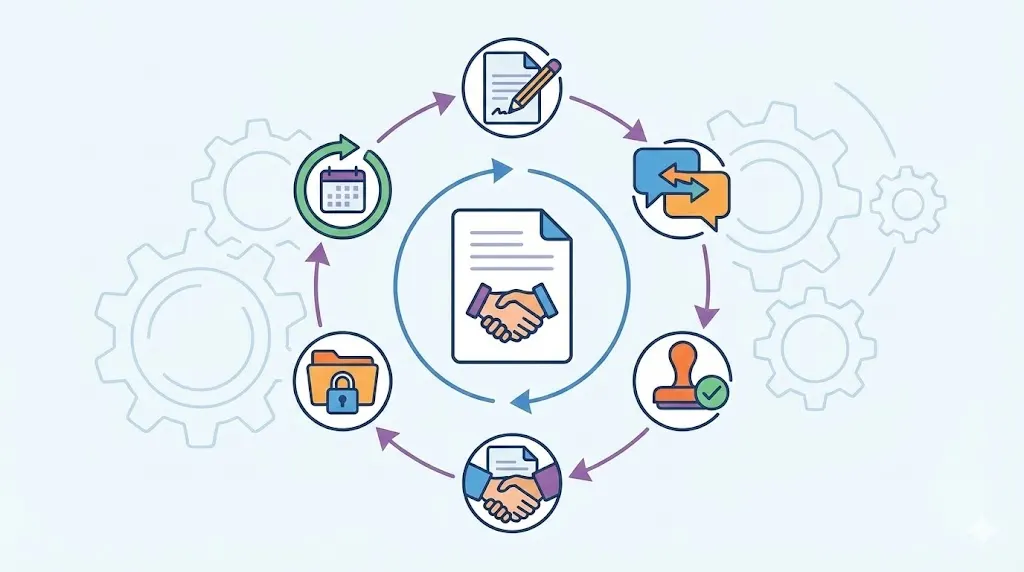
Request: Capture the business need, entities, transaction type, and expected timing.
Drafting: Use an approved template and add transaction-specific terms.
Review: Route the draft to legal, tax, finance, and business owners.
Approval: Record authority checks, comments, decisions, and required evidence.
Signature: Confirm signing order, identity, authority, and completed copies.
Storage: Save the final agreement, schedules, amendments, and related records.
Activation: Link the agreement to invoices, obligations, reporting, and review dates.
Related articles: Drafting Effective Dispute Resolution Clauses: A Practical
Link Reviews to Business and Entity Events
Set review cadences by agreement type
Not every agreement needs the same review schedule. A high-value financing agreement may need closer attention than a simple low-risk service arrangement.
Consider transaction value, duration, complexity, country, and regulatory exposure. Also consider whether the agreement affects tax, cash, intellectual property, or sensitive data.
Assign a review owner and next review date to every record. Define what the review must cover. It may include pricing, services, parties, approvals, and supporting evidence.
A review should produce a clear outcome. The team may approve the agreement, amend it, replace it, or close it. Record that outcome in the central inventory.
Trigger reviews when circumstances change
Event-based reviews catch change sooner than fixed schedules. The system should create a task when a relevant event occurs.
Corporate groups should define events that require review. These triggers should apply across legal, tax, finance, and business processes.
Entity changes: Review new entities, closures, mergers, and liquidations.
Ownership changes: Check transfers, reorganizations, and changes in control.
Signatory changes: Confirm directors, delegates, and approval limits.
Service changes: Update scope, pricing, providers, recipients, and measures.
Regulatory developments: Recheck local rules, tax requirements, and filings.
Transaction changes: Review major volume, currency, funding, or payment changes.
Related articles: Contract Automation: Embracing Legal Transformation
Align Legal, Tax, and Finance Documentation
Reconcile contractual terms with actual transactions
An agreement should describe what entities actually do. Teams should compare the contract with invoices, journal entries, payment records, and service evidence.
Look for differences in prices, dates, currencies, and service descriptions. Check whether the named provider performs the work. Confirm that receiving entities use the stated service.
A mismatch does not always mean wrongdoing. It may show that the business changed without updating the contract. It may also show that invoices use a different process.
Record each difference and assign an owner. The team can then amend the agreement, correct the transaction, or document the reason. This creates a stronger audit record.
Support transfer pricing and tax positions
Agreements should reflect the group’s intended pricing method. They should also describe functions performed, assets used, and risks assumed.
These details help tax teams prepare local support. They can also explain why one entity charges another. The contract should not promise terms that the business cannot support.
Review withholding rules, indirect taxes, and cross-border duties. Check whether local documentation or language rules apply. Local tax teams should confirm the final position.
Improve accounting and consolidation controls
Agreement data can support entity-level accounting. Finance teams can link terms to account codes, currencies, and payment schedules.
The same data can support intercompany reconciliations. It can help identify unmatched invoices and balances. It can also support eliminations during consolidation.
Month-end teams benefit from clear transaction ownership. They can see which entity should record income, expense, assets, or liabilities. Better data can reduce late corrections.
Contract terms: Confirm parties, scope, pricing, currency, timing, and obligations.
Pricing: Compare agreed methods with applied rates and allocation results.
Invoices: Check billed services, dates, amounts, and supporting detail.
Journal entries: Match entries with agreement terms and entity roles.
Tax files: Link pricing support, withholding records, and local documents.
Transaction evidence: Retain reports, approvals, work records, and payment proof.
Related articles: Contract Law: Understanding Legal Agreements
Use Technology to Improve Visibility and Audit Readiness
Create a searchable source of truth
A central repository should hold signed agreements and amendments. It should also store metadata, entity links, obligations, and supporting documents.
Search should work across names, countries, agreement types, and key terms. Users should find all contracts involving one subsidiary quickly. They should also filter records by status, owner, or review date.
Access controls should reflect role and jurisdiction. Local users may need access to their entity records. Group teams may need wider reporting rights.
A secure repository reduces dependence on personal folders. It also supports Subsidiary Agreement Management across the corporate group.
Automate reminders and status tracking
Automated reminders can flag renewals, review dates, and expiring terms. They can also identify missing approvals and unresolved obligations.
Dashboards should show agreement coverage by entity and category. They should highlight unsigned records, overdue reviews, and inactive documents.
Event alerts can start reviews after entity changes. These alerts should connect with relevant legal or finance workflows. A reminder alone is not enough without clear ownership.
Connect agreements with financial systems
Contract data becomes more useful when linked to financial records. Connections can show related invoices, balances, account codes, and reconciliation results.
They can also support multi-currency work and consolidated reporting. Teams can compare expected charges with recorded activity. This helps find gaps before close.
Use clear links between the contract record and financial source. Do not copy every financial field manually. Reduce duplicate entry where systems can share trusted data.
Preserve a complete audit trail
Keep negotiation history, approval records, signature evidence, and change logs. Store transaction support with the relevant agreement where possible.
An audit trail should show who changed a record and when. It should also show the decision, approver, and final version.
This evidence helps teams answer audit requests faster. It also supports internal reviews after disputes or restructurings. Strong records show both the agreement and its business use.
Repository search: Find agreements by entity, party, type, country, or status.
Metadata: Track dates, owners, terms, obligations, and related transactions.
Workflow automation: Route requests, approvals, reviews, signatures, and updates.
System links: Connect contracts with accounting, finance, CRM, and business records.
Permissions: Control access by role, entity, country, and business need.
Dashboards: Show coverage gaps, overdue tasks, renewals, and open reviews.
Audit trails: Preserve versions, decisions, approvals, signatures, and change history.
Related articles: Atlanta Contract Management: Top AI CLM Solutions
Why Contract Management Software Matters
Contract management software gives legal, tax, and finance teams one shared work layer. It centralizes records, controls approvals, and tracks obligations across entities.
The software can standardize intake, drafting, storage, and review tasks. It can also create event-based reviews after restructurings or acquisitions. This reduces manual tracking across local teams.
Volody's CLM Software supports a central contract repository with search and entity-linked records. Its approval workflow automation routes agreements to the right reviewers. Obligation management can track renewals, deliverables, and other commitments.
For example, a new subsidiary service agreement can move through review automatically. The system can store its signed copy, assign owners, and remind teams before review dates.
Want to see how contract management software can simplify your legal workflows? Check out Volody's CLM Software.
FAQ
What is an intercompany agreement?
An intercompany agreement is a binding contract between separate group entities. It documents services, goods transfers, licensing, loans, guarantees, or cost sharing. The agreement defines responsibilities, pricing, approvals, and payment terms. It also supports separate legal and financial records for each entity.
How should intercompany agreements be managed across a corporate group?
Companies should maintain one inventory linked to the legal entity register. Each record should show parties, purpose, owner, status, dates, and related transactions. Legal, tax, finance, and business teams need shared workflows. Reviews should follow acquisitions, restructurings, liquidations, director changes, and material business changes.
Why are formal intercompany agreements important between parent companies and subsidiaries?
Formal agreements document the business reason for related-party transactions. They support transfer pricing, tax work, accounting, approvals, and audit evidence. Clear terms also reduce disputes between entities. Each agreement should explain services, payment duties, responsibilities, and required records.
What types of transactions do intercompany agreements cover?
Common arrangements include shared services, cost allocations, licensing, distribution, financing, and cash pooling. They may also cover guarantees, data sharing, employment support, real estate, and goods transfers. Each agreement should describe the transaction and pricing method. It should also name responsibilities and required evidence.
How often should intercompany agreements be reviewed?
Review timing should reflect risk, value, complexity, duration, and jurisdiction. Higher-risk agreements may need more frequent checks than simple service contracts. Reviews should also follow restructurings, acquisitions, liquidations, and director changes. New countries, services, tax rules, or transaction volumes should trigger review.
How can technology improve intercompany agreement management?
Implement a centralized contract management system to connect agreements, approvals, obligations, financial records, and audit evidence. Establish clear ownership and event-based reviews to improve control, visibility, and readiness across every entity.
About the Company

Volody AI CLM is an Agentic AI-powered Contract Lifecycle Management platform designed to eliminate manual contracting tasks, automate complex workflows, and deliver actionable insights. As a one-stop shop for all contract activities, it covers drafting, collaboration, negotiation, approvals, e-signature, compliance tracking, and renewals. Built with enterprise-grade security and no-code configuration, it meets the needs of the most complex global organizations. Volody AI CLM also includes AI-driven contract review and risk analysis, helping teams detect issues early and optimize terms. Trusted by Fortune 500 companies, high-growth startups, and government entities, it transforms contracts into strategic, data-driven business assets.




" height="216.72211px" id="FYO0bO80Y" transform="translate(3 6.105)" width="206.073px"/><path d="M 108.174 222 C 88.432 222 70.303 217.239 53.785 207.717 C 37.267 198.196 24.173 185.052 14.504 168.285 C 4.835 151.312 0 132.165 0 110.845 C 0 89.731 4.835 70.792 14.504 54.025 C 24.173 37.052 37.267 23.804 53.785 14.282 C 70.303 4.761 88.432 0 108.174 0 C 128.116 0 146.246 4.761 162.562 14.282 C 179.08 23.804 192.073 37.052 201.541 54.025 C 211.21 70.792 216.044 89.731 216.044 110.845 C 216.044 132.165 211.21 151.312 201.541 168.285 C 192.073 185.052 179.08 198.196 162.562 207.717 C 146.044 217.239 127.915 222 108.174 222 Z M 108.174 183.189 C 120.864 183.189 132.044 180.291 141.713 174.495 C 151.382 168.492 158.936 160.006 164.375 149.035 C 169.814 138.064 172.533 125.334 172.533 110.845 C 172.533 96.355 169.814 83.729 164.375 72.965 C 158.936 61.994 151.382 53.611 141.713 47.815 C 132.044 42.02 120.864 39.122 108.174 39.122 C 95.483 39.122 84.202 42.02 74.332 47.815 C 64.663 53.611 57.109 61.994 51.67 72.965 C 46.231 83.729 43.511 96.355 43.511 110.845 C 43.511 125.334 46.231 138.064 51.67 149.035 C 57.109 160.006 64.663 168.492 74.332 174.495 C 84.202 180.291 95.483 183.189 108.174 183.189 Z" fill="rgba(255, 255, 255, 0.12)" height="222px" id="aa1McFcE9" transform="translate(227.183 3)" width="216.04399999999998px"/><path d="M 42.302 182.257 L 111.799 182.257 L 111.799 216.722 L 0 216.722 L 0 0 L 42.302 0 Z" fill="rgba(255, 255, 255, 0.12)" height="216.72211px" id="yRq4AnrsX" transform="translate(477.721 6.105)" width="111.79899999999998px"/><path d="M 108.174 222 C 88.432 222 70.303 217.239 53.785 207.717 C 37.267 198.196 24.173 185.052 14.504 168.285 C 4.835 151.312 0 132.165 0 110.845 C 0 89.731 4.835 70.792 14.504 54.025 C 24.173 37.052 37.267 23.804 53.785 14.282 C 70.303 4.761 88.432 0 108.174 0 C 128.116 0 146.246 4.761 162.562 14.282 C 179.08 23.804 192.073 37.052 201.541 54.025 C 211.21 70.792 216.045 89.731 216.045 110.845 C 216.045 132.165 211.21 151.312 201.541 168.285 C 192.073 185.052 179.08 198.196 162.562 207.717 C 146.044 217.239 127.915 222 108.174 222 Z M 108.174 183.189 C 120.864 183.189 132.044 180.291 141.713 174.495 C 151.382 168.492 158.936 160.006 164.375 149.035 C 169.814 138.064 172.534 125.334 172.534 110.845 C 172.534 96.355 169.814 83.729 164.375 72.965 C 158.936 61.994 151.382 53.611 141.713 47.815 C 132.044 42.02 120.864 39.122 108.174 39.122 C 95.483 39.122 84.202 42.02 74.332 47.815 C 64.663 53.611 57.108 61.994 51.67 72.965 C 46.231 83.729 43.511 96.355 43.511 110.845 C 43.511 125.334 46.231 138.064 51.67 149.035 C 57.108 160.006 64.663 168.492 74.332 174.495 C 84.202 180.291 95.483 183.189 108.174 183.189 Z" fill="rgba(255, 255, 255, 0.12)" height="222px" id="mo8HQspQ0" transform="translate(609.155 3)" width="216.04500000000007px"/><path d="M 73.727 0 C 95.885 0 115.324 4.45 132.044 13.351 C 148.967 22.252 161.957 34.982 171.027 51.541 C 180.287 67.894 184.917 86.937 184.917 108.671 C 184.917 130.405 180.287 149.449 171.027 165.801 C 161.957 181.947 148.967 194.47 132.044 203.371 C 115.324 212.271 95.885 216.722 73.727 216.722 L 0 216.722 L 0 0 Z M 72.216 179.773 C 94.374 179.773 111.497 173.564 123.583 161.144 C 135.669 148.724 141.713 131.233 141.713 108.671 C 141.713 86.109 135.669 68.515 123.583 55.888 C 111.497 43.055 94.374 36.638 72.216 36.638 L 42.302 36.638 L 42.302 179.773 Z" fill="rgba(255, 255, 255, 0.12)" height="216.72211px" id="I3iXX5Hi_" transform="translate(859.693 6.105)" width="184.91699999999992px"/><path d="M 185.22 0 L 113.91 141.273 L 113.91 216.722 L 71.61 216.722 L 71.61 141.273 L 0 0 L 47.74 0 L 93.06 99.046 L 138.08 0 Z" fill="rgba(255, 255, 255, 0.12)" height="216.72211px" id="nzHyWC0_d" transform="translate(1061.78 6.105)" width="185.22000000000003px"/></svg>)