
Introduction
Understanding when terms and conditions are legally enforceable is crucial for businesses and users alike. These agreements establish the contractual framework that governs rights, responsibilities, and liabilities. Without clear, binding terms, companies expose themselves to disputes and legal uncertainty, while users may remain unaware of their obligations and protections. This article provides a comprehensive analysis of the legal principles underpinning terms and conditions, detailing how contracts are formed, the importance of user consent, and best practices to ensure enforceability across jurisdictions.
Key Takeaways
Terms and conditions become legally binding when users clearly accept them, usually by clicking an "I agree" button. These agreements form contracts if they include essential elements like offer, acceptance, and consideration. Clear presentation and proper notice of updates matter greatly for enforceability. Different consent methods, like clickwrap and browsewrap, carry different legal weight. Businesses must tailor terms to meet jurisdictional rules and user expectations to avoid disputes.
Related articles: What are Contract Terms and Legal Jargon? Master the Basics
Contractual Foundations of Terms and Conditions
Offer, Acceptance, and Consideration Explained
Terms and conditions create a contract when certain key elements exist. The first is an offer. This means one party presents terms for agreement. For example, a website offers access to services under specific rules.
Acceptance happens when the other party agrees to these terms. This can be explicit, like clicking a checkbox, or implied through conduct. Without acceptance, no contract forms.
Consideration means both sides exchange value. Usually, the user gains access or a service, while the business gains agreement to the terms. This mutual exchange is essential to form a binding contract.
Legal Capacity and Mutual Intent to Create Legal Relations
Both parties must have the legal capacity to contract. This means they understand the deal and are legally able to enter contracts. Minors, intoxicated persons, or those lacking mental capacity may not form binding agreements.
Mutual intent is also key. Both parties must intend to create legal relations. In commercial settings, courts generally presume this intent. However, if terms seem casual or non-binding, courts may refuse enforcement.
Formation of a Contract Through Terms and Conditions
When users accept terms and conditions, they enter a contract with the business. This contract binds both parties to the stated rules. The terms spell out the rights, duties, and remedies available.
Proper contract formation requires clear offer, acceptance, consideration, capacity, and intent. If these exist, the terms and conditions are legally binding. This means breaching them can lead to legal claims.
In practice, businesses must design terms and consent processes that show these elements clearly. Otherwise, courts may rule the agreement invalid or unenforceable.
Related Article: How Contracts Strengthen Business Partnerships
Methods of User Consent and Their Legal Weight
Clickwrap Agreements: Explicit Consent Mechanisms
Clickwrap agreements require users to take an explicit action to accept terms. Typically, this means checking a box or clicking “I agree” before proceeding. This method offers strong evidence of consent.
Courts favor clickwrap because users must actively acknowledge terms. This reduces claims that users were unaware or did not agree. Clickwrap agreements tend to be enforceable in most jurisdictions.
Browsewrap Agreements and Their Limitations
Browsewrap agreements assume consent through continued use of a website or service. Terms are posted via a link or footer without requiring explicit acceptance.
This method carries weaker legal weight. Courts often find browsewrap unenforceable if users had no real chance to review or accept terms. Visibility and notice are crucial for browsewrap’s validity.
Evidence Required to Prove User Acceptance
To enforce terms, businesses must prove users accepted them. Evidence includes:
Records of clicks on acceptance buttons
Timestamps linked to user accounts
IP addresses showing user activity
Screenshots of terms displayed at acceptance time
Such proof demonstrates explicit consent. Without it, courts may reject claims based on terms and conditions.
Related articles: Summize Review 2025: Can This CLM Handle Real Legal Work?
Clarity and Presentation: Impact on Enforceability
Importance of Plain Language in Terms and Conditions
Clear, plain language improves enforceability. Users must understand what they agree to. Complex legal jargon or ambiguous wording can invalidate terms.
Plain language helps courts interpret intent and scope. It also reduces disputes over unclear clauses. Businesses should avoid dense paragraphs and use straightforward words.
Ensuring Terms Are Visible and Accessible to Users
Terms must be easy to find and read. Hiding terms in obscure links or tiny fonts weakens enforceability. Users should see terms before accepting.
Effective presentation includes:
Placing terms near acceptance buttons
Using readable fonts and layouts
Providing summaries or highlights for complex clauses
Good visibility helps prove users had a chance to review terms.
How Ambiguity Can Invalidate Contractual Terms
Ambiguous terms create risk. Courts often interpret unclear clauses against the drafter. This protects consumers from unfair surprises.
Ambiguity can lead to entire terms being struck down. To avoid this, define key concepts and use precise language. Clarity builds trust and legal strength.
Limitations and Unenforceable Clauses
Identifying Unfair Terms Under Consumer Protection Laws
Many jurisdictions bar unfair terms. These include clauses that:
Exclude liability for gross negligence
Impose excessive penalties on users
Limit statutory consumer rights
Such terms may be invalid regardless of user consent. Businesses must review terms against local consumer laws.
How Jurisdictional Differences Affect Clause Validity
Legal rules vary widely across regions. A term enforceable in one country may be illegal in another. For example, data privacy clauses must comply with GDPR in Europe.
International businesses should adapt terms for each market. Blanket terms risk unenforceability and legal penalties.
Common Terms That Courts Often Strike Down
Courts frequently reject:
Automatic renewal clauses without clear notice
Broad disclaimers of warranties
Mandatory arbitration where prohibited
Terms waiving fundamental rights
Avoid these pitfalls to maintain binding contracts.
Notification and Modification of Terms
Legal Requirements for Updating Terms and Conditions
Updating terms is common. However, businesses must notify users of changes. Silent updates may not bind users.
Legal requirements often include:
Reasonable advance notice of changes
Clear communication method (email, website alert)
Option for users to accept or reject new terms
Failing to notify can void updated terms.
Best Practices for Communicating Changes to Users
Effective notification methods include:
Sending emails with summary of changes
Displaying pop-ups requiring re-acceptance
Highlighting key updates in plain language
Documenting user consent to updates strengthens enforceability.
Risks of Failing to Properly Notify Users
Without proper notice, users may claim ignorance of new terms. Courts may refuse to enforce updated clauses. This can expose businesses to liability or disputes.
Consistent update notifications protect both sides and maintain trust.
International Considerations for Global Businesses
Navigating Cross-Border Consumer Protection Regulations
Global businesses face complex rules. Consumer protection laws differ on contract terms, disclosures, and privacy.
For example, the EU’s Consumer Rights Directive requires clear pre-contractual information. The US has different standards. Compliance means tailoring terms to each jurisdiction.
Challenges from Differing Legal Systems and Standards
Common law and civil law systems interpret contracts differently. Some countries require signed agreements; others accept electronic consent.
Language barriers and cultural differences also affect enforceability. Terms should be localized, not just translated.
Harmonizing Terms for Multinational Compliance
Businesses often create master terms with jurisdiction-specific addendums. This approach balances uniformity and legal compliance.
Using best terms and conditions software can help manage versions and updates across regions.
Jurisdiction | Key Consumer Protection Focus | Consent Standard | Notice Requirement |
|---|---|---|---|
EU | Transparency, data privacy | Explicit consent | Advance notice |
US | Fair terms, disclaimers | Implied/explicit | Reasonable notice |
UK | Unfair contract terms | Explicit consent | Clear communication |
Australia | Consumer guarantees | Explicit consent | Prompt notification |
The Role of Consideration in Free Services and Software
Defining Consideration in Non-Monetary Contexts
Consideration need not be money. In free digital services, users provide value by agreeing to terms. This may include:
Providing personal data
Allowing tracking or ads
Agreeing to usage rules
These exchanges count as consideration supporting contract formation.
Examples of Value Exchange in Free Digital Services
For example, a social media platform offers free access. In return, users consent to data use and content rules. Courts recognize this as valid consideration.
Similarly, free apps require users to accept terms before use. This creates a binding agreement despite no payment.
Case Law Supporting Consideration in Terms and Conditions
Several rulings support non-monetary consideration. For instance, courts have upheld contracts where users exchanged data privacy rights for access.
This broadens enforceability for free services and software.
Enforceability in Digital and Mobile Environments
Unique Challenges of Terms on Mobile Apps and Devices
Small screens limit space to display terms. Users may skip reading or fail to see terms before acceptance.
This raises enforceability issues. Courts require businesses to design interfaces that give users a fair chance to review terms.
Designing Consent Mechanisms for Small Screens
Best practices include:
Using scroll boxes with clear “I agree” buttons
Breaking terms into digestible sections
Providing links to full terms outside the app
These designs help prove explicit user consent on mobile.
Legal Standards for Digital Contract Formation
Courts increasingly recognize electronic agreements. However, they demand clear, affirmative action from users.
Passive consent or vague notices often fail. Digital contracts must meet the same legal elements as paper ones.
Risks of Omitting Terms and Conditions
Potential Legal Disputes Without Clear Terms
Without terms and conditions, businesses face uncertainty. User disputes over refunds, liability, or data use can escalate.
Courts may rely on default laws, which might not favor the business. This increases legal risks.
How Absence of Terms Affects User Expectations
Users expect clear rules. Without terms, they may assume leniency or different obligations. This misalignment leads to conflicts.
Terms set boundaries and clarify expectations for both sides.
Why Businesses Should Implement Terms and Conditions
Terms protect businesses by:
Limiting liability
Defining rights and duties
Managing user behavior
Supporting dispute resolution
Not having terms invites costly legal battles and damages brand reputation.
Best Practices for Drafting Legally Binding Terms
Structuring Terms for Clarity and Legal Compliance
Draft terms with clear headings and simple language. Include essential contract elements and comply with local laws.
Use sample terms and conditions clauses as models but tailor them to your business.
Incorporating Fairness and Consumer Protection Principles
Avoid unfair or one-sided clauses. Include dispute resolution, data privacy, and cancellation rights. Fair terms build trust and reduce litigation.
Using Technology to Document and Secure Consent
Employ best terms and conditions software to:
Track user acceptance
Manage version control
Automate update notifications
This creates an audit trail proving consent and supports compliance.
Feature | Benefit | Recommended Tool Examples |
|---|---|---|
Clickwrap consent capture | Proof of explicit acceptance | Termly, iubenda, Ironclad |
Version control and history | Track term changes over time | Juro, ContractWorks |
Automated update notifications | Ensure legal notice compliance | DocuSign, Adobe Sign |
Conclusion
To ensure terms and conditions are legally binding, businesses must incorporate all fundamental contract elements—offer, acceptance, consideration, capacity, and intent—while securing explicit user consent, preferably through clickwrap agreements. Clear, accessible language and transparent presentation significantly enhance enforceability and reduce legal exposure. Additionally, timely user notifications of updates and jurisdiction-specific tailoring are essential to maintain compliance across markets. Implementing robust consent documentation and leveraging specialized software tools can safeguard your operations, mitigate disputes, and strengthen customer trust. Begin by reviewing your current terms and consent mechanisms to fortify your legal position and protect your business effectively.
Frequently Asked Questions
Are terms and conditions legally binding?
Terms and conditions become legally binding when they meet contract requirements like offer, acceptance, consideration, and mutual intent. Explicit user consent, often via clicking an acceptance box, is critical. Proper drafting and clear presentation increase the chance courts will enforce these terms.
What makes a contract legally binding?
A contract is legally binding if it includes an offer, acceptance, consideration, legal capacity of the parties, and intent to create legal relations. All parties must clearly agree to the terms. Without any of these elements, a contract may not hold up in court.
When are terms and conditions legally binding?
Terms and conditions bind once users receive reasonable notice and accept them. Explicit consent through clickwrap agreements is strongest. Terms must be lawful, clear, and presented so users can review them before agreeing.
Are terms and conditions legally required?
Not all businesses must have terms and conditions by law. However, they are highly recommended to set clear rules, manage risk, and protect against liability. Some sectors, like finance or healthcare, may have specific legal obligations to include terms.
Are all agreements legally binding?
No. Only agreements meeting contract essentials—offer, acceptance, consideration, capacity, and lawful purpose—are enforceable. Informal or social agreements often lack these elements and are not binding.
How to make a contract legally binding?
Ensure the contract includes all core elements. Obtain clear acceptance from all parties through signed documents or digital consent. Confirm all parties have capacity and intend to be bound. Keep records of consent to prove agreement.
What legal challenges arise with terms and conditions on mobile apps?
Mobile apps face space limits for displaying terms and may struggle to get explicit consent. Courts require users to have a fair chance to review and accept terms. Poor design or hidden terms risk unenforceability.
How do international laws affect the enforceability of terms and conditions?
Different countries impose varying consumer protections and contract laws. Businesses must adapt terms to comply with multiple jurisdictions. Failure to do so risks invalid terms and legal penalties.
How can businesses prove that a user accepted the terms and conditions?
Proof includes records of clicks on “I agree” buttons, timestamps, IP addresses, and audit trails. These show users explicitly accepted the terms, which courts require for enforcement.
What happens if terms and conditions are ambiguous or unclear?
Ambiguous terms often become unenforceable. Courts interpret unclear clauses against the business. This protects consumers and encourages fairness. Clear, plain language is essential to uphold terms.
About the Company

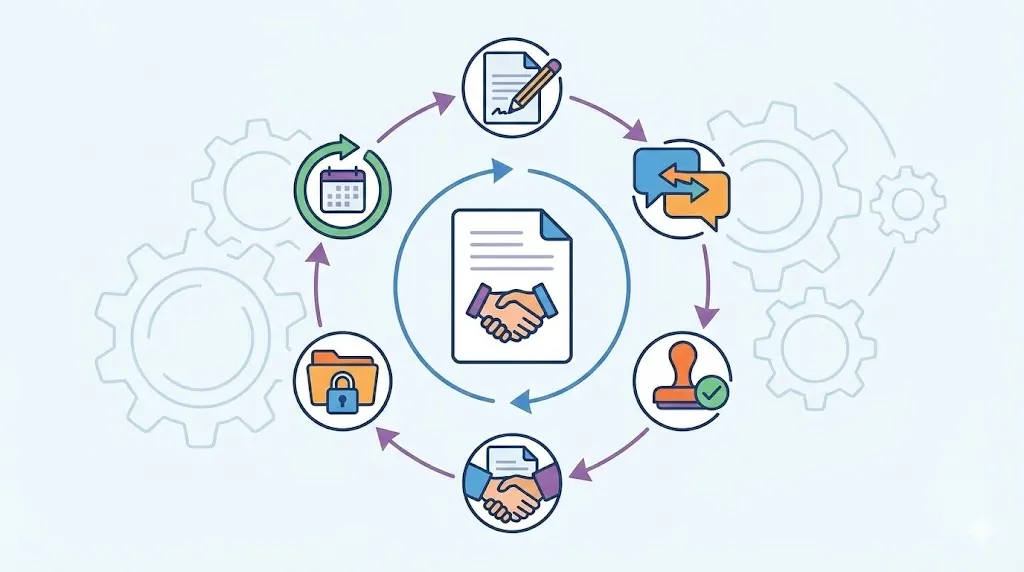
Volody AI CLM is an Agentic AI-powered Contract Lifecycle Management platform designed to eliminate manual contracting tasks, automate complex workflows, and deliver actionable insights. As a one-stop shop for all contract activities, it covers drafting, collaboration, negotiation, approvals, e-signature, compliance tracking, and renewals. Built with enterprise-grade security and no-code configuration, it meets the needs of the most complex global organizations. Volody AI CLM also includes AI-driven contract review and risk analysis, helping teams detect issues early and optimize terms. Trusted by Fortune 500 companies, high-growth startups, and government entities, it transforms contracts into strategic, data-driven business assets.





" height="216.72211px" id="FYO0bO80Y" transform="translate(3 6.105)" width="206.073px"/><path d="M 108.174 222 C 88.432 222 70.303 217.239 53.785 207.717 C 37.267 198.196 24.173 185.052 14.504 168.285 C 4.835 151.312 0 132.165 0 110.845 C 0 89.731 4.835 70.792 14.504 54.025 C 24.173 37.052 37.267 23.804 53.785 14.282 C 70.303 4.761 88.432 0 108.174 0 C 128.116 0 146.246 4.761 162.562 14.282 C 179.08 23.804 192.073 37.052 201.541 54.025 C 211.21 70.792 216.044 89.731 216.044 110.845 C 216.044 132.165 211.21 151.312 201.541 168.285 C 192.073 185.052 179.08 198.196 162.562 207.717 C 146.044 217.239 127.915 222 108.174 222 Z M 108.174 183.189 C 120.864 183.189 132.044 180.291 141.713 174.495 C 151.382 168.492 158.936 160.006 164.375 149.035 C 169.814 138.064 172.533 125.334 172.533 110.845 C 172.533 96.355 169.814 83.729 164.375 72.965 C 158.936 61.994 151.382 53.611 141.713 47.815 C 132.044 42.02 120.864 39.122 108.174 39.122 C 95.483 39.122 84.202 42.02 74.332 47.815 C 64.663 53.611 57.109 61.994 51.67 72.965 C 46.231 83.729 43.511 96.355 43.511 110.845 C 43.511 125.334 46.231 138.064 51.67 149.035 C 57.109 160.006 64.663 168.492 74.332 174.495 C 84.202 180.291 95.483 183.189 108.174 183.189 Z" fill="rgba(255, 255, 255, 0.12)" height="222px" id="aa1McFcE9" transform="translate(227.183 3)" width="216.04399999999998px"/><path d="M 42.302 182.257 L 111.799 182.257 L 111.799 216.722 L 0 216.722 L 0 0 L 42.302 0 Z" fill="rgba(255, 255, 255, 0.12)" height="216.72211px" id="yRq4AnrsX" transform="translate(477.721 6.105)" width="111.79899999999998px"/><path d="M 108.174 222 C 88.432 222 70.303 217.239 53.785 207.717 C 37.267 198.196 24.173 185.052 14.504 168.285 C 4.835 151.312 0 132.165 0 110.845 C 0 89.731 4.835 70.792 14.504 54.025 C 24.173 37.052 37.267 23.804 53.785 14.282 C 70.303 4.761 88.432 0 108.174 0 C 128.116 0 146.246 4.761 162.562 14.282 C 179.08 23.804 192.073 37.052 201.541 54.025 C 211.21 70.792 216.045 89.731 216.045 110.845 C 216.045 132.165 211.21 151.312 201.541 168.285 C 192.073 185.052 179.08 198.196 162.562 207.717 C 146.044 217.239 127.915 222 108.174 222 Z M 108.174 183.189 C 120.864 183.189 132.044 180.291 141.713 174.495 C 151.382 168.492 158.936 160.006 164.375 149.035 C 169.814 138.064 172.534 125.334 172.534 110.845 C 172.534 96.355 169.814 83.729 164.375 72.965 C 158.936 61.994 151.382 53.611 141.713 47.815 C 132.044 42.02 120.864 39.122 108.174 39.122 C 95.483 39.122 84.202 42.02 74.332 47.815 C 64.663 53.611 57.108 61.994 51.67 72.965 C 46.231 83.729 43.511 96.355 43.511 110.845 C 43.511 125.334 46.231 138.064 51.67 149.035 C 57.108 160.006 64.663 168.492 74.332 174.495 C 84.202 180.291 95.483 183.189 108.174 183.189 Z" fill="rgba(255, 255, 255, 0.12)" height="222px" id="mo8HQspQ0" transform="translate(609.155 3)" width="216.04500000000007px"/><path d="M 73.727 0 C 95.885 0 115.324 4.45 132.044 13.351 C 148.967 22.252 161.957 34.982 171.027 51.541 C 180.287 67.894 184.917 86.937 184.917 108.671 C 184.917 130.405 180.287 149.449 171.027 165.801 C 161.957 181.947 148.967 194.47 132.044 203.371 C 115.324 212.271 95.885 216.722 73.727 216.722 L 0 216.722 L 0 0 Z M 72.216 179.773 C 94.374 179.773 111.497 173.564 123.583 161.144 C 135.669 148.724 141.713 131.233 141.713 108.671 C 141.713 86.109 135.669 68.515 123.583 55.888 C 111.497 43.055 94.374 36.638 72.216 36.638 L 42.302 36.638 L 42.302 179.773 Z" fill="rgba(255, 255, 255, 0.12)" height="216.72211px" id="I3iXX5Hi_" transform="translate(859.693 6.105)" width="184.91699999999992px"/><path d="M 185.22 0 L 113.91 141.273 L 113.91 216.722 L 71.61 216.722 L 71.61 141.273 L 0 0 L 47.74 0 L 93.06 99.046 L 138.08 0 Z" fill="rgba(255, 255, 255, 0.12)" height="216.72211px" id="nzHyWC0_d" transform="translate(1061.78 6.105)" width="185.22000000000003px"/></svg>)