

Introduction:
Imagine a bustling international airport. For decades, the legal department has functioned like the security checkpoint. It is a necessary stop where flow is deliberately slowed down to ensure safety. Passengers (business units) view it as a bottleneck, a place of long lines, rigorous scrutiny, and frustration. The primary goal of the security checkpoint is simply to stop bad things from getting through. While vital, this defensive posture adds no speed and provides no strategic insight into the flight path.
However, the modern enterprise has evolved. The volume of transactions is higher, the regulatory airspace is more crowded, and the speed of business has accelerated. A security checkpoint mentality is no longer sufficient. Today, the most effective legal teams are transitioning to the role of Air Traffic Control. They do not just stop dangerous items; they actively manage the flow. They direct traffic, optimize routes, prevent collisions before they happen, and ensure that every flight arrives on schedule.
In this new model, "safety" is assumed, but "efficiency" and "strategic value" are the new deliverables. The problem is that many General Counsels are still reporting security metrics (how many contracts we reviewed) rather than air traffic control metrics (how much faster we got the fleet to its destination). Without the right data, you cannot prove you are guiding the business; you can only prove you are busy.
As we move into 2026, the pressure to demonstrate Return on Investment (ROI) is intensifying. Finance leaders are no longer satisfied with vague assurances of risk mitigation. They demand hard evidence of value. This guide outlines the ten essential Key Performance Indicators (KPIs) that transform your department from a cost center into a strategic partner. We will explore how Enterprise CLM Software empowers you to capture these metrics automatically, proving that your legal team is the engine of corporate velocity, not the brake.
Beyond the Bottleneck: Why Traditional Legal Models Fail

Why do so many legal departments struggle to prove their value? It is rarely a lack of talent or effort. Most in-house counsel work incredibly hard, juggling massive caseloads under tight deadlines. The issue is structural visibility. In many organizations, legal operations remain a "black box" to the rest of the C-suite. Requests go in, and eventually, contracts come out, but what happens inside remains a mystery.
The Fog of Manual Processes
The primary barrier to effective measurement is the reliance on m anual processes. When contracts are managed through email threads and disjointed spreadsheets, data is lost. A General Counsel cannot easily answer simple questions like, "What is our average turnaround time for a Master Service Agreement?" without asking a paralegal to spend three days digging through an inbox.
This lack of automated tracking creates a reliance on "gut feeling" reporting. You might feel that the sales team is sending requests too late, or that a specific vendor is consistently dragging out negotiations. But without data, these remain anecdotes. Anecdotes do not convince CFOs to approve budget increases for new technology or headcount. In a data-driven enterprise, an opinion without a metric is just noise.
The Cost of Invisible Friction
Without clear metrics, you cannot identify the true source of delays. Is the legal team slow, or is the counterparty unresponsive? Is the bottleneck in contract drafting, or is it stuck in a finance approval queue? In a manual environment, the legal department often takes the blame for all delays simply because they are the keepers of the document.
This lack of granular visibility creates significant friction with business units. Sales leaders perceive legal as the "Department of No" or the "Department of Slow," eroding trust. When the legal team cannot defend its performance with objective facts, it loses political capital. You become a target for cost-cutting rather than a candidate for investment.
The Opportunity Cost of Reactive Management
Perhaps the greatest cost of poor metrics is the inability to be strategic. When you are operating in the dark, you are perpetually reactive. You are fighting fires as they arise rather than preventing them. You cannot see that 80% of your team’s time is spent on low-value Non-Disclosure Agreements (NDAs) that could be automated. You cannot see that a specific clause is causing 90% of your negotiation delays.
By failing to track the right KPIs, you leave value on the table. You miss opportunities to standardize terms, automate routine work, and redeploy your expensive legal talent toward high-stakes initiatives. This is the "ROI gap", the difference between the administrative function you are today and the strategic partner you could be. Closing this gap requires a shift from manual tracking to the automated intelligence of Enterprise CLM Software.
Related Article: Overcome Top 5 Contract Management Challenges with Ease
The ROI Scorecard: 10 Metrics That Define High-Performance
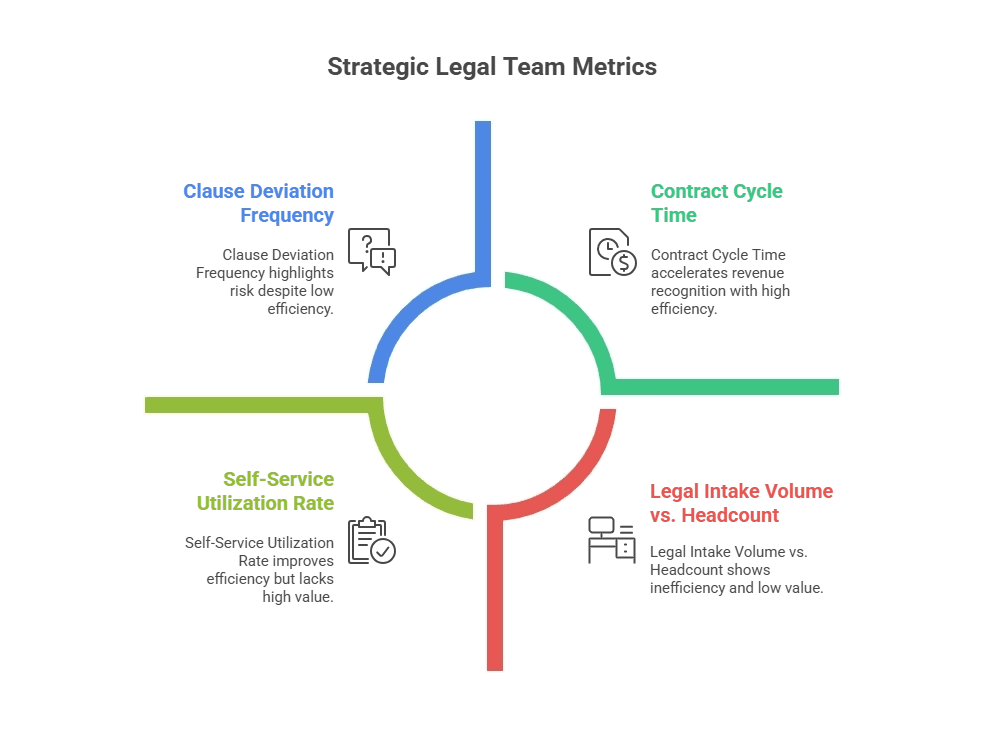
To bridge the gap between activity and value, you must track metrics that tell a business story. We have categorized the ten essential KPIs for 2026 into three strategic buckets: Velocity (Speed), Efficiency (Resource Use), and Value (Risk & Revenue).
Implementing these metrics does not require a degree in data science. It requires a Centralized Contract Repository that serves as a single source of truth, and No-Code Approval Workflows that automatically timestamp every stage of the contract lifecycle.
KPI Group A: Measuring Momentum (Velocity)
These metrics demonstrate how the legal team accelerates revenue recognition and project kickoff.
1. Contract Cycle Time
This is the gold standard for measuring speed. It tracks the total duration from the initial contract request to the final signature.
Why it matters: This directly correlates to "Time to Revenue." A shorter cycle time means the company recognizes revenue sooner.
How technology helps: By using No-Code Approval Workflows, the system automatically records the start and end time of every request, providing an irrefutable record of speed without manual logging.
2. Process Stage Duration
While Cycle Time measures the whole race, Process Stage Duration measures each leg. It breaks down the lifecycle into drafting, internal review, counterparty negotiation, and signature.
Why it matters: This identifies exactly where the bottleneck lives. If the "internal review" stage is short but "counterparty negotiation" is long, you have data to prove the delay is external, not internal.
The Fix: This insight often drives the adoption of pre-approved clause libraries to speed up negotiation.
3. Execution Velocity
This measures the specific time taken between the final approval and the actual signature.
Why it matters: This is the "last mile" problem. A contract can be agreed upon but sit unsigned on a desk for weeks.
How technology helps: Integrated eSign eliminates this friction. By embedding signature capabilities directly into the platform, you reduce this duration from days to minutes.
KPI Group B: Resource Optimization (Efficiency)
These metrics prove that the legal department is a responsible steward of corporate resources.
4. Legal Intake Volume vs. Headcount
This tracks the number of incoming requests relative to the size of your team over time.
Why it matters: This is your primary defense against burnout and your strongest argument for new hires. If volume is trending up sharply while headcount remains flat, you have the visual evidence needed to justify additional budget.
5. Self-Service Utilization Rate
This measures the proportion of contracts generated by business users (like Sales or HR) using compliant templates without direct legal intervention.
Why it matters: High self-service rates demonstrate that Legal is empowering the business to move fast while maintaining control. It shows you are scaling operations without scaling costs.
How technology helps: A robust CLM allows you to publish "pre-approved" templates that business users can generate safely, counting towards your efficiency score.
6. External Counsel Spend vs. Internal Workload
This compares the volume of work sent to expensive outside law firms versus work kept in-house.
Why it matters: Bringing routine work in-house is a massive cost saver. This metric tracks your success in reducing reliance on external billable hours for standard agreements.
7. Renewal Management Efficiency
This tracks the percentage of contracts renewed (or terminated) on time versus those that lapsed or auto-renewed unintentionally.
Why it matters: Missed renewals are silent profit killers. Unwanted auto-renewals waste budget, while lapsed revenue contracts lose income. High efficiency here proves direct financial protection.
KPI Group C: Strategic Defense (Value & Risk)
These metrics demonstrate the strategic wisdom and risk protection the legal team provides.
8. Clause Deviation Frequency
This measures how often negotiated contracts depart from your company’s standard preferred positions.
Why it matters: High deviation indicates high risk. If you constantly accept non-standard liability caps, your risk profile increases. This metric helps GCs enforce standardization.
How technology helps: A Centralized Contract Repository with AI capabilities can scan signed agreements to flag and aggregate these deviations automatically.
9. Obligation Fulfillment Rate
This tracks whether the business is actually doing what the contract says it will do (e.g., delivering on time, providing reports, meeting SLAs).
Why it matters: A contract is only as good as its execution. Low fulfillment rates expose the company to breach of contract claims and damages. Tracking this proves Legal is protecting the company after the signature.
10. Cost Avoidance and Savings
This captures the tangible financial value generated by legal negotiation—such as preventing a price hike, negotiating a discount, or avoiding a specific penalty.
Why it matters: This is the ultimate ROI metric. It puts a dollar figure on the legal team’s negotiation skills, directly countering the "cost center" narrative.
Related Article: What Is a Contract Repository and How Does It Work?
From Theory to Practice: The Technical Ecosystem

Knowing the metrics is one thing; capturing them without drowning in spreadsheets is another. The secret to operationalizing this strategy lies in automation. You cannot rely on lawyers to manually log "time spent" or "clause deviations." The tracking must be a byproduct of the work itself.
Step 1: Establish the Digital Foundation
The first step is to implement a Centralized Contract Repository. You cannot measure what you cannot see. By migrating all active and legacy agreements into a single, searchable digital environment, you create the baseline data set. This allows you to establish your "zero point" for metrics like Total Contract Volume and Renewal Efficiency.
Step 2: Automate the Flow
Next, replace email requests with No-Code Approval Workflows. When a sales rep requests a contract, they should do so through a portal that triggers a workflow.
The Impact: The system automatically logs the "Request Date." As the contract moves to "Drafting," "Review," and "Negotiation," the system timestamps every transition. This automates the collection of Cycle Time and Stage Duration metrics. No one has to "report" on speed; the system observes it.
Step 3: Visualize with Real-Time Intelligence
Data is useless if it is buried in a database. You need Real-time Dashboards and Reporting. These dashboards serve as your cockpit.
For the General Counsel: A high-level view of Risk Exposure (Clause Deviations) and Financial Health (Spend vs. Budget).
For Legal Ops: A tactical view of Team Workload (Who is overloaded?) and Process Bottlenecks (Which department is holding up approvals?).
For the Business: A transparency view showing the status of their requests, reducing the "Where is my contract?" emails.
By implementing these dashboards, you move from "reporting history" (what happened last quarter) to "managing the present" (what is stuck right now?). This shift enables you to intervene proactively, reassigning work to clear bottlenecks before they impact the quarter-end goals.
Step 4: Close the Loop with Integrated Execution
Finally, ensure that the signing process is digital. Integrated eSign is not just a convenience; it is a data capture tool. It provides the definitive "Stop" timestamp for the cycle time metric and the definitive "Start" timestamp for the renewal clock. It ensures that the metrics for Execution Velocity are accurate and that the contract immediately enters the obligation tracking phase without manual upload.
Related Article: How to Manage a Contract Post Execution? Best Practices
The Cultural Shift: Winning the Hearts and Minds of the C-Suite

As we look beyond 2026, the role of metrics will evolve from descriptive to predictive. Today, we measure "How long did it take?" Tomorrow, Enterprise CLM Software powered by AI will tell us "How long will it take?"
Imagine a system that analyzes the past 500 negotiations and predicts, "This contract with Vendor X will likely take 45 days because they always dispute the Indemnification clause." This allows Legal Ops to set realistic expectations with the business before drafting even begins.
We will also see metrics that measure "Deal Friction." AI will correlate contract complexity with deal closure rates, helping legal teams identify which clauses are killing deals. This moves the Legal Department into the realm of Revenue Engineering, where legal terms are optimized not just for protection, but for conversion.
The future belongs to legal teams that treat data as an asset. By building the infrastructure to track these 10 metrics today, you are preparing your organization for the AI-driven insights of tomorrow.
Conclusion
The days of the legal department operating as a "black box" are over. In the modern enterprise, value must be visible. By tracking these 10 essential KPIs, ranging from Cycle Time to Cost Avoidance, you provide the objective evidence required to prove your ROI.
However, you cannot track these metrics manually. Success requires the right infrastructure: No-Code Approval Workflows to capture the data, a Centralized Contract Repository to store the truth, and Real-time Dashboards and Reporting to visualize the story.
Do not let your hard work go unnoticed. Equip your team with the tools to prove their worth.
Ready to see these metrics in action? Book a demo today to experience Volody’s Integrated eSign and advanced analytics platform.
About the Company

Volody AI CLM is an Agentic AI-powered Contract Lifecycle Management platform designed to eliminate manual contracting tasks, automate complex workflows, and deliver actionable insights. As a one-stop shop for all contract activities, it covers drafting, collaboration, negotiation, approvals, e-signature, compliance tracking, and renewals. Built with enterprise-grade security and no-code configuration, it meets the needs of the most complex global organizations. Volody AI CLM also includes AI-driven contract review and risk analysis, helping teams detect issues early and optimize terms. Trusted by Fortune 500 companies, high-growth startups, and government entities, it transforms contracts into strategic, data-driven business assets.




" height="216.72211px" id="FYO0bO80Y" transform="translate(3 6.105)" width="206.073px"/><path d="M 108.174 222 C 88.432 222 70.303 217.239 53.785 207.717 C 37.267 198.196 24.173 185.052 14.504 168.285 C 4.835 151.312 0 132.165 0 110.845 C 0 89.731 4.835 70.792 14.504 54.025 C 24.173 37.052 37.267 23.804 53.785 14.282 C 70.303 4.761 88.432 0 108.174 0 C 128.116 0 146.246 4.761 162.562 14.282 C 179.08 23.804 192.073 37.052 201.541 54.025 C 211.21 70.792 216.044 89.731 216.044 110.845 C 216.044 132.165 211.21 151.312 201.541 168.285 C 192.073 185.052 179.08 198.196 162.562 207.717 C 146.044 217.239 127.915 222 108.174 222 Z M 108.174 183.189 C 120.864 183.189 132.044 180.291 141.713 174.495 C 151.382 168.492 158.936 160.006 164.375 149.035 C 169.814 138.064 172.533 125.334 172.533 110.845 C 172.533 96.355 169.814 83.729 164.375 72.965 C 158.936 61.994 151.382 53.611 141.713 47.815 C 132.044 42.02 120.864 39.122 108.174 39.122 C 95.483 39.122 84.202 42.02 74.332 47.815 C 64.663 53.611 57.109 61.994 51.67 72.965 C 46.231 83.729 43.511 96.355 43.511 110.845 C 43.511 125.334 46.231 138.064 51.67 149.035 C 57.109 160.006 64.663 168.492 74.332 174.495 C 84.202 180.291 95.483 183.189 108.174 183.189 Z" fill="rgba(255, 255, 255, 0.12)" height="222px" id="aa1McFcE9" transform="translate(227.183 3)" width="216.04399999999998px"/><path d="M 42.302 182.257 L 111.799 182.257 L 111.799 216.722 L 0 216.722 L 0 0 L 42.302 0 Z" fill="rgba(255, 255, 255, 0.12)" height="216.72211px" id="yRq4AnrsX" transform="translate(477.721 6.105)" width="111.79899999999998px"/><path d="M 108.174 222 C 88.432 222 70.303 217.239 53.785 207.717 C 37.267 198.196 24.173 185.052 14.504 168.285 C 4.835 151.312 0 132.165 0 110.845 C 0 89.731 4.835 70.792 14.504 54.025 C 24.173 37.052 37.267 23.804 53.785 14.282 C 70.303 4.761 88.432 0 108.174 0 C 128.116 0 146.246 4.761 162.562 14.282 C 179.08 23.804 192.073 37.052 201.541 54.025 C 211.21 70.792 216.045 89.731 216.045 110.845 C 216.045 132.165 211.21 151.312 201.541 168.285 C 192.073 185.052 179.08 198.196 162.562 207.717 C 146.044 217.239 127.915 222 108.174 222 Z M 108.174 183.189 C 120.864 183.189 132.044 180.291 141.713 174.495 C 151.382 168.492 158.936 160.006 164.375 149.035 C 169.814 138.064 172.534 125.334 172.534 110.845 C 172.534 96.355 169.814 83.729 164.375 72.965 C 158.936 61.994 151.382 53.611 141.713 47.815 C 132.044 42.02 120.864 39.122 108.174 39.122 C 95.483 39.122 84.202 42.02 74.332 47.815 C 64.663 53.611 57.108 61.994 51.67 72.965 C 46.231 83.729 43.511 96.355 43.511 110.845 C 43.511 125.334 46.231 138.064 51.67 149.035 C 57.108 160.006 64.663 168.492 74.332 174.495 C 84.202 180.291 95.483 183.189 108.174 183.189 Z" fill="rgba(255, 255, 255, 0.12)" height="222px" id="mo8HQspQ0" transform="translate(609.155 3)" width="216.04500000000007px"/><path d="M 73.727 0 C 95.885 0 115.324 4.45 132.044 13.351 C 148.967 22.252 161.957 34.982 171.027 51.541 C 180.287 67.894 184.917 86.937 184.917 108.671 C 184.917 130.405 180.287 149.449 171.027 165.801 C 161.957 181.947 148.967 194.47 132.044 203.371 C 115.324 212.271 95.885 216.722 73.727 216.722 L 0 216.722 L 0 0 Z M 72.216 179.773 C 94.374 179.773 111.497 173.564 123.583 161.144 C 135.669 148.724 141.713 131.233 141.713 108.671 C 141.713 86.109 135.669 68.515 123.583 55.888 C 111.497 43.055 94.374 36.638 72.216 36.638 L 42.302 36.638 L 42.302 179.773 Z" fill="rgba(255, 255, 255, 0.12)" height="216.72211px" id="I3iXX5Hi_" transform="translate(859.693 6.105)" width="184.91699999999992px"/><path d="M 185.22 0 L 113.91 141.273 L 113.91 216.722 L 71.61 216.722 L 71.61 141.273 L 0 0 L 47.74 0 L 93.06 99.046 L 138.08 0 Z" fill="rgba(255, 255, 255, 0.12)" height="216.72211px" id="nzHyWC0_d" transform="translate(1061.78 6.105)" width="185.22000000000003px"/></svg>)