

Effective global contract management requires more than shared folders. It demands clear accountability, consistent governance, and controlled local flexibility across countries, languages, currencies, and time zones. This guide presents a practical framework for building visibility, control, and measurable performance across global operations.
TL;DR
Define global ownership, approval rights, and regional duties across every contract lifecycle stage.
Store agreements in one secure repository with complete metadata, access rules, and version history.
Standardize templates, clause rules, workflows, and approvals while allowing controlled local changes.
Address jurisdiction, language, currency, privacy, time zone, and data quality risks before scaling operations.
Track obligations, renewals, milestones, compliance duties, and performance through named owners and timely alerts.
Use CLM software to improve contract visibility, collaboration, control, reporting, and global team adoption.
Establish a Global Contract Operating Model
Global operations need one clear operating model. This model explains who acts, who approves, and who carries risk. It should support international contract management without blocking valid local needs.
Define ownership across regions and functions
Legal should set core contract rules and review legal risk. Procurement should manage supplier terms, sourcing steps, and commercial records. Finance should check prices, payment terms, tax details, and budget impact.
Sales teams often own customer agreements and commercial commitments. Business units understand operational needs and service delivery. Regional teams add local law knowledge, language skills, and market context.
Each contract needs one accountable business owner. That owner should remain responsible after signing. Ownership should not end when the agreement reaches the signature stage.
Decision rights must be clear before work begins. Teams should know who approves price changes, unusual terms, and major risks. They should also know when to involve regional counsel or senior leaders.
For example, global legal may approve standard clauses. Regional legal may approve local employment language. Finance may approve currency exposure above a set threshold. The business owner then confirms delivery needs.
Record this responsibility map in plain language. At intake, legal owns legal review. Procurement owns supplier terms. Finance owns payment controls. Operations owns delivery. Regional leaders own local exceptions.
Map the contract lifecycle
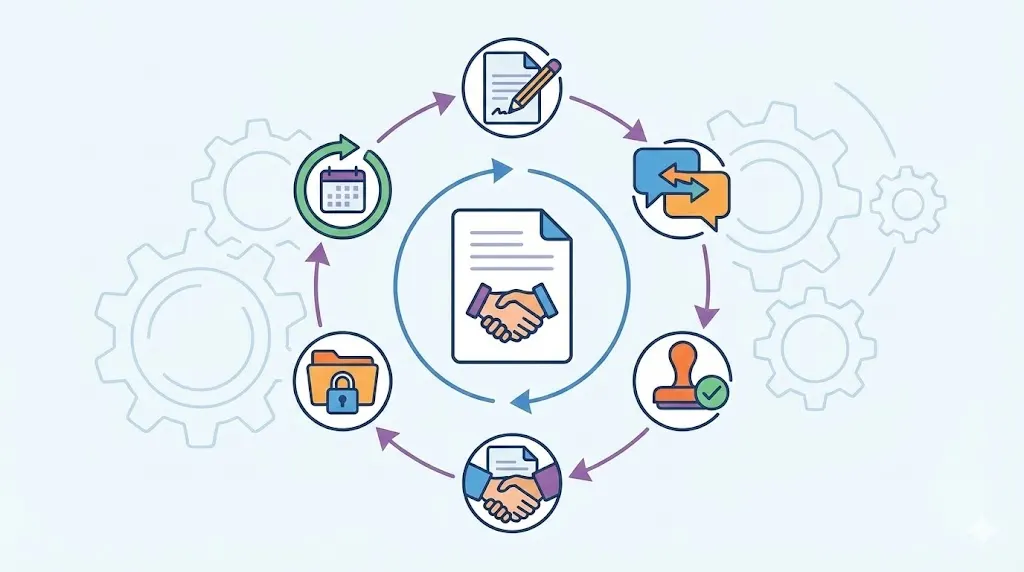
Use one lifecycle model for every region. Start with intake and request review. Then move through drafting, negotiation, approval, signing, storage, monitoring, renewal, amendment, and closure.
The model should show required actions at each stage. It should also name the person responsible for each action. This prevents work from sitting between departments.
A common lifecycle creates better reporting. Leaders can compare cycle times across countries. They can also find delays, repeat risks, and weak handoffs.
Local rules still belong inside the model. A country may require a special signature method. Another region may need a translated contract. These steps should appear as local controls, not separate processes.
Use the same stage names worldwide. Define terms such as draft, approved, signed, active, expired, and terminated. Shared plain language improves reports and reduces confusion during handoffs.
Align global and local authority
Global policies should cover core risks. These include signing authority, data access, required approvals, and record retention. They should also cover sanctions, privacy, and mandatory insurance terms.
Regional teams need room for valid local choices. They may select local counsel or approved language. They may also set local tax terms within clear limits.
Create an exception process for unusual needs. The process should record the reason, reviewer, decision, and expiry date. Temporary exceptions should not become permanent habits.
Approval rights should match risk and value. A low-risk purchase may need local approval only. A major partnership may need regional and global review.
This balance supports multinational contract management. It protects core standards without forcing every market into one rigid mold.
Related articles: Contract Management Software for Faster Legal Work
Build a Centralized Contract Repository
A global contract repository gives teams one trusted record. It replaces scattered files with controlled storage and better search. It also supports global contract compliance after agreements are signed.
Create one source of truth
Store final agreements in one secure, cloud-based repository. Include signed documents, approved amendments, exhibits, and related records. Do not rely on email accounts or personal drives.
Local systems may still hold working files. However, the approved record should remain in the central repository. This rule prevents conflicting versions across regions.
Access should follow job needs. Legal may see all contract records. A regional buyer may see only assigned supplier agreements. Business owners should see records linked to their work.
Use role-based access controls. These controls grant access by role, region, entity, or contract type. Review access when people change roles or leave.
The repository should keep version history. Users should see who changed a record and when. They should also find the final signed version quickly.
Paper archives need a clear migration plan. Scan key records first. Then review image quality, signatures, dates, and missing pages. Do not upload poor copies without checking them.
Organize contract data for retrieval
Use common metadata across every region. Metadata means structured details about each contract. It helps teams search, filter, report, and set alerts.
Capture the legal entity and operating region. Record the counterparty, contract type, owner, and governing law. Add effective dates, renewal dates, and termination notice dates.
Financial fields should include currency, contract value, payment terms, and price changes. Operational fields should include service levels, deliverables, and key milestones.
Use controlled values for common fields. For example, contract type should use approved categories. Free text creates spelling differences and weak reports.
Set naming rules for documents. Include the counterparty, contract type, region, and date. A clear name helps users find records without opening each file.
A minimum record should include document identity, entity, region, counterparty, and contract type. It should include owner, dates, renewal terms, and termination notice periods. Add obligations, financial terms, risk flags, governing law, and access permissions.
Related articles: Contract Versions: A Guide to Easily Tracking Each Update
Standardize Global Contracting Workflows
Standard legal workflows make cross-border contracts easier to manage. They reduce manual follow-up and create a consistent audit trail. They also let teams preserve approved local differences.
Use approved templates and clause libraries
Create templates for common agreement types. These may include supplier, customer, employment, partnership, and procurement contracts. Templates should reflect approved business and legal positions.
Clause libraries should contain standard wording. Each clause should include a short use note. The note should explain when teams can use it and when review is required.
Local clauses should have clear labels. Mark them by country, region, or legal need. This helps users select the right language without copying old contracts.
Set an owner for every template and clause. That owner should review content on a regular schedule. Outdated language can create hidden legal and commercial risk.
Templates should work with business intake forms. A user should answer key questions once. The system can then suggest the right template and required reviewers.
Automate intake, review, and approvals
Use a simple request form for new contract work. Ask for parties, value, region, contract type, timing, and business purpose. Requesters should also identify unusual terms early.
Route work by risk and contract type. A standard supplier agreement may follow a short path. A major partnership may need legal, finance, privacy, and executive review.
Set approval thresholds by value and risk. Currency rules should account for local markets. The workflow should apply approved exchange rate rules where needed.
Use reminders for pending reviews. Escalate overdue tasks to managers or backup owners. Time zone rules should send alerts during local working hours.
Connect workflows with business systems where useful. ERP systems can provide vendor and payment data. CRM systems can provide customer details and sales stage information.
Support secure collaboration
Teams need controlled collaboration during negotiation. Users should comment on the same working version. They should also see changes through tracked redlines.
External parties need limited access. Share only the required document and review stage. Remove access when negotiations end or the contract is signed.
Keep an audit trail for important actions. Record reviews, approvals, changes, signatures, and access events. This record supports disputes, audits, and internal reviews.
Use e-signature tools that connect with the contract record. The signed file should return to the repository automatically. Signature status should remain visible to approved users.
Remote teams need clear handoff rules. A regional team may finish its review before another time zone starts. Workflow status should show the next action and responsible person.
Govern deviations from standard terms
Nonstandard terms need early review. Flag unusual liability, payment, data, or termination language. Do not wait until final approval to identify these changes.
Route each exception to the right reviewer. Legal may review contractual liability language. Finance may review payment risk. Privacy teams may review data transfer terms.
Record the reason for every approved deviation. Add the reviewer, decision date, and related risk. This history helps teams learn from repeated exceptions.
Use fallback clauses where possible. A fallback clause offers a safer approved alternative. It can speed negotiation while protecting the organization’s position.
Keep speed and risk in balance. Not every change needs senior review. High-impact changes should never move through an informal email approval.
Related articles: Mastering Contract Clauses: Risk & Performance
Address Cross-Border Contract Management Challenges
Cross-border contracts carry risks beyond the written terms. Local rules, language, data, and timing can affect performance. A strong process identifies these risks before signature.
Navigate jurisdictional and regulatory differences
Choose governing law with care. It controls how courts may read and enforce the agreement. Regional counsel should review unfamiliar legal choices.
Dispute terms also need local review. Arbitration, court venue, and language can change cost and access. These terms should match the organization’s risk plan.
Some countries require special contract formalities. These may include local signatures, notarization, registration, or approved language. Confirm these needs before execution.
Sector rules can affect contract content. Financial, health, energy, and public sector agreements may require extra controls. Procurement teams should identify these rules during intake.
Sanctions and tax duties also need review. Parties, payments, and locations may create restrictions. Finance and compliance teams should confirm the right checks.
Global standards need local legal validation. A template that works in one region may fail elsewhere. Local review should identify the change and document its purpose.
Manage language, currency, and time zone complexity
Use approved translations for important agreements. Machine translation may help with early review. Final contracts may still need qualified human review.
Keep one controlling language where possible. State which version governs if translations differ. Store all approved language versions together.
Currency terms should be clear and complete. State the payment currency, conversion method, and tax treatment. Include rules for price changes and exchange rate shifts.
Date formats can cause errors. Use written month names or standard digital formats. State the time zone for deadlines and notice periods.
Public holidays may affect performance. A deadline can fall on a local non-working day. Contracts should define the next working day rule.
Regional teams also work different hours. Workflow tools should account for local schedules. They should avoid sending urgent tasks during known closure periods.
Maintain consistent data and document quality
Poor data weakens global reporting. Missing dates can hide renewals. Wrong owners can leave obligations without action.
Duplicate records create another problem. Teams may store one agreement under several entities. Set duplicate checks during migration and intake.
Incomplete signatures need prompt review. A document may look final but lack one required signatory. Store signing evidence with the agreement record.
Outdated templates can spread old terms. Lock approved templates and track their review dates. Remove retired versions from user search results.
Use a risk register for each region. Record the challenge, affected region, business impact, owner, mitigation, review date, and escalation status. Review high-risk entries during governance meetings.
Related articles: Contract Management Software for IT Companies: 5 Top Picks
Track Compliance, Risk, and Contract Obligations
Signing a contract starts the delivery phase. Teams must then track duties, deadlines, evidence, and changes. This work supports global contract compliance across the full term.
Monitor key dates and deliverables
Record every important date during contract setup. Include renewals, notice periods, milestones, and termination rights. Add insurance dates, reports, and service reviews.
Alerts should arrive early enough for action. A renewal alert on the due date may be useless. Set reminders based on review time and business risk.
Track supplier deliverables and customer commitments. Include service levels, implementation tasks, reports, and training duties. Link each item to the relevant contract.
Payment terms also need monitoring. Compare invoice dates with agreed terms. Check discounts, credits, price changes, and late payment rules.
Amendments can change key dates. Update the main record after every approved change. Keep the earlier version for history and audit needs.
Connect obligations to accountable owners
Assign each obligation to a named person or team. Avoid assigning duties to a broad department only. Clear ownership improves follow-through.
Add a backup owner for critical duties. This helps during leave, turnover, or regional closure. Backup owners should know where to find evidence and instructions.
Define escalation rules for missed actions. A low-risk delay may go to the team manager. A serious breach may require legal and executive review.
Capture evidence as work happens. Evidence may include reports, certificates, delivery records, or meeting notes. Store it with the obligation record.
Regional accountability needs local context. Owners should understand language, law, and operating conditions. Global teams should still receive common status reports.
An obligation dashboard should show status, due date, owner, region, and risk level. It should also show evidence, next action, and escalation status. Use clear status terms such as open, complete, overdue, and blocked.
Related articles: Top Contract Lifecycle Management Solutions for Insurance
Measure Contract Performance Across Operations
Global contract management should support better business results. Reports must connect contract terms with real performance. They should also help leaders act before problems grow.
Define meaningful contract KPIs
Choose measures that match each contract’s purpose. A supplier agreement may focus on cost, quality, and delivery. A customer agreement may focus on revenue, retention, and service levels.
Financial measures can include savings, revenue, margins, and payment accuracy. Operational measures can include delivery time, defects, uptime, and milestone completion.
Compliance measures can include missed duties, open exceptions, and review completion. Relationship measures can include disputes, response time, and stakeholder satisfaction.
Lifecycle measures can include cycle time, renewal rate, amendment volume, and approval delays. Use the same definitions across regions for fair comparison.
Do not track every possible measure. Too many measures hide the important ones. Select a small group tied to contract goals and business decisions.
Reconcile commercial and operational data
Contract data must connect with business records. Compare invoices with agreed prices and payment terms. Compare purchase orders with approved supplier contracts.
Review delivery records against service commitments. Check project milestones against payment triggers. Compare customer credits with documented service failures.
ERP and finance systems provide transaction data. Procurement systems provide supplier and purchase data. CRM systems provide customer and sales data.
Supply chain tools can show delivery events. Project tools can show milestone progress. E-signature tools an confirm execution status.
These connections reduce duplicate entry. They also improve report accuracy. Data owners should agree on which system controls each field.
Review performance with stakeholders
Hold regular contract performance. Include the contract owner, business team, finance, procurement, and legal. Invite suppliers or customers when suitable.
Use a standard agenda for every region. Review open obligations, performance results, risks, disputes, and upcoming decisions. Record actions, owners, and due dates.
Poor performance may require a recovery plan. Repeated failures may support renegotiation or termination. Strong performance may support renewal or expanded business.
Reviews should consider local conditions. Delivery problems may reflect customs delays or regional events. Teams should separate valid causes from weak contract control.
Improve contracts using performance evidence
Historical data can reveal repeated problems. Teams may find unclear service levels or weak remedy clauses. They may also find approval steps that slow urgent work.
Use these findings to improve templates. Strengthen vague wording and add useful evidence rules. Remove terms that create repeat disputes without adding value.
Share lessons across regions carefully. A solution from one market may need local changes. Still, common problems often reveal a wider process gap.
A KPI scorecard should group measures by financial, operational, compliance, relationship, and lifecycle performance. Each measure needs an owner, source, review date, and action rule. This turns reporting into practical contract management.
Related articles: Best Contract Management Software: Top 10 CLM Tools
Implement Sustainable Global Contract Management Practices
Long-term success depends on process discipline. Technology cannot fix missing records or unclear ownership alone. Start with the highest risks, then improve through measured adoption.
Start with an inventory and risk-based prioritization
Begin by finding active contracts across every region. Search shared drives, email stores, local tools, paper files, and team archives. Ask each business unit for its contract lists.
Prioritize critical counterparties and high-value agreements. Add contracts with near renewals or urgent compliance gaps. Include agreements that support key products, customers, or suppliers.
Do not migrate every file at once. Start with records that create the most business value. This allows teams to test data fields and workflows early.
Classify contracts by risk, value, region, and status. Mark records with missing signatures or unclear owners. Assign cleanup work before migration.
Set a clear definition of an active contract. Include current agreements, pending renewals, and live amendments. Exclude duplicates and expired records unless retention rules require them.
Build adoption through governance and training
Assign a global process owner. This person should maintain the model, rules, and reporting approach. Regional champions should support local questions and feedback.
Training should match each user’s role. Requesters need intake guidance. Reviewers need approval and exception guidance. Owners need obligation and renewal training.
Use short examples from real work. Show how a buyer starts a request. Show how legal reviews a clause. Show how finance checks a payment term.
Explain the reason behind each control. Users follow rules more often when the purpose is clear. They also report problems sooner when support feels practical.
Review adoption by region. Look at active users, incomplete records, overdue tasks, and repeated workarounds. Low use may signal a process or training problem.
Improve the system continuously
Review workflow data each month. Look for slow stages, missed alerts, and repeated exceptions. Compare results across regions with similar work.
Ask users what blocks progress. They may report poor search, unclear fields, or unnecessary approvals. Fix simple issues before adding new features.
Update templates and clauses when risks change. Review permissions after team changes. Remove unused fields that reduce data quality.
Test reports against source records. A dashboard is useful only when users trust it. Data owners should resolve errors and document major changes.
Continuous improvement should have clear owners. Assign each change a reason, priority, reviewer, and target date. Track results after release.
Use a phased implementation sequence. Start with discovery and contract inventory. Then design the taxonomy, configure workflows, migrate data, run a pilot, train users, roll out by region, and review improvements.
Related articles: Best Contract Management Software in 2026: Top 20 CLM Tools
Why Contract Management Software Matters
Contract management software gives global teams one structured working space. It connects intake, drafting, approvals, signatures, storage, and post-signature work. It can also support regional rules without losing global visibility.
A good CLM tool can centralize contracts and metadata. It can route approvals, protect access, and send renewal alerts. It can also create reports across entities, regions, and contract types.
Volody CLM Software supports global teams with AI Contract Review, AI Metadata Extraction, and Obligation Management. AI Contract Review can flag risky clauses and missing terms. AI Metadata Extraction can capture parties, dates, and payment terms. Obligation Management can track milestones, renewals, and commitments.
For example, a regional buyer can upload a signed supplier agreement. The system can find key dates, flag unusual clauses, and assign renewal tasks. The global team can then view status without replacing local ownership.
Centralize contracts, metadata, templates, approvals, signatures, and obligation records.
Improve visibility across regions, entities, owners, renewals, exceptions, and compliance events.
Support consistent workflows while preserving local permissions and regional requirements.
Want to see how contract management software can simplify your legal workflows? Check out Volody's CLM Software.
FAQ
What is global contract management?
Global contract management is the process of managing agreements across countries, entities, and business teams. It covers intake, drafting, negotiation, approval, signing, storage, monitoring, renewal, amendment, and closure. It also adds controls for local law, language, currency, privacy, access, and regional ownership.
How does international contract management differ from local contract management?
International contract management must handle more than one legal and business setting. Teams may need different clauses, signing rules, currencies, languages, and data controls. The best model uses common global processes while allowing approved regional changes where local conditions require them.
How should companies manage cross-border contracts?
Start with a shared lifecycle, central repository, and clear ownership model. Add local legal reviews for governing law, tax, privacy, sanctions, and signing rules. Track dates, obligations, and evidence through one system, while giving regional teams controlled access to local tasks.
What should a global contract repository contain?
A repository should contain final contracts, amendments, exhibits, and signing records. Each record should include the parties, entity, region, owner, contract type, dates, currency, obligations, and governing law. It should also include access rules, risk indicators, and renewal or termination details.
How do you choose the right CLM software?
Start by mapping contract volumes, regions, users, approval rules, and business systems. Check repository search, workflow controls, access settings, reporting, integrations, and regional support. Test the tool with real contracts before purchase, since migration and user adoption can create hidden problems.
Can AI replace global contract management software?
AI can review clauses, extract data, summarize terms, and identify risks. It cannot replace approval rules, access controls, audit trails, ownership, or obligation tracking. Teams should use AI as an assistant, then apply human review for legal, commercial, and regional decisions.
What happens after a global contract is signed?
The signed agreement should enter the central repository with complete metadata. Teams should assign obligations, monitor milestones, track payments, and set renewal alerts. They should also collect evidence, review performance, manage amendments, and escalate missed duties before they create larger problems.
How should teams manage data privacy across regions?
Teams should classify contract data and limit access by role, region, and business need. They should review data residency, retention, encryption, transfer rules, and approved integrations. Regular access reviews and audit logs help maintain control as people, systems, and laws change.
Which systems should connect with global contract management software?
Connect your CLM platform with ERP, CRM, finance, procurement, supply chain, project management, and e-signature tools to improve control across global operations.
About the Company

Volody AI CLM is an Agentic AI-powered Contract Lifecycle Management platform designed to eliminate manual contracting tasks, automate complex workflows, and deliver actionable insights. As a one-stop shop for all contract activities, it covers drafting, collaboration, negotiation, approvals, e-signature, compliance tracking, and renewals. Built with enterprise-grade security and no-code configuration, it meets the needs of the most complex global organizations. Volody AI CLM also includes AI-driven contract review and risk analysis, helping teams detect issues early and optimize terms. Trusted by Fortune 500 companies, high-growth startups, and government entities, it transforms contracts into strategic, data-driven business assets.





" height="216.72211px" id="FYO0bO80Y" transform="translate(3 6.105)" width="206.073px"/><path d="M 108.174 222 C 88.432 222 70.303 217.239 53.785 207.717 C 37.267 198.196 24.173 185.052 14.504 168.285 C 4.835 151.312 0 132.165 0 110.845 C 0 89.731 4.835 70.792 14.504 54.025 C 24.173 37.052 37.267 23.804 53.785 14.282 C 70.303 4.761 88.432 0 108.174 0 C 128.116 0 146.246 4.761 162.562 14.282 C 179.08 23.804 192.073 37.052 201.541 54.025 C 211.21 70.792 216.044 89.731 216.044 110.845 C 216.044 132.165 211.21 151.312 201.541 168.285 C 192.073 185.052 179.08 198.196 162.562 207.717 C 146.044 217.239 127.915 222 108.174 222 Z M 108.174 183.189 C 120.864 183.189 132.044 180.291 141.713 174.495 C 151.382 168.492 158.936 160.006 164.375 149.035 C 169.814 138.064 172.533 125.334 172.533 110.845 C 172.533 96.355 169.814 83.729 164.375 72.965 C 158.936 61.994 151.382 53.611 141.713 47.815 C 132.044 42.02 120.864 39.122 108.174 39.122 C 95.483 39.122 84.202 42.02 74.332 47.815 C 64.663 53.611 57.109 61.994 51.67 72.965 C 46.231 83.729 43.511 96.355 43.511 110.845 C 43.511 125.334 46.231 138.064 51.67 149.035 C 57.109 160.006 64.663 168.492 74.332 174.495 C 84.202 180.291 95.483 183.189 108.174 183.189 Z" fill="rgba(255, 255, 255, 0.12)" height="222px" id="aa1McFcE9" transform="translate(227.183 3)" width="216.04399999999998px"/><path d="M 42.302 182.257 L 111.799 182.257 L 111.799 216.722 L 0 216.722 L 0 0 L 42.302 0 Z" fill="rgba(255, 255, 255, 0.12)" height="216.72211px" id="yRq4AnrsX" transform="translate(477.721 6.105)" width="111.79899999999998px"/><path d="M 108.174 222 C 88.432 222 70.303 217.239 53.785 207.717 C 37.267 198.196 24.173 185.052 14.504 168.285 C 4.835 151.312 0 132.165 0 110.845 C 0 89.731 4.835 70.792 14.504 54.025 C 24.173 37.052 37.267 23.804 53.785 14.282 C 70.303 4.761 88.432 0 108.174 0 C 128.116 0 146.246 4.761 162.562 14.282 C 179.08 23.804 192.073 37.052 201.541 54.025 C 211.21 70.792 216.045 89.731 216.045 110.845 C 216.045 132.165 211.21 151.312 201.541 168.285 C 192.073 185.052 179.08 198.196 162.562 207.717 C 146.044 217.239 127.915 222 108.174 222 Z M 108.174 183.189 C 120.864 183.189 132.044 180.291 141.713 174.495 C 151.382 168.492 158.936 160.006 164.375 149.035 C 169.814 138.064 172.534 125.334 172.534 110.845 C 172.534 96.355 169.814 83.729 164.375 72.965 C 158.936 61.994 151.382 53.611 141.713 47.815 C 132.044 42.02 120.864 39.122 108.174 39.122 C 95.483 39.122 84.202 42.02 74.332 47.815 C 64.663 53.611 57.108 61.994 51.67 72.965 C 46.231 83.729 43.511 96.355 43.511 110.845 C 43.511 125.334 46.231 138.064 51.67 149.035 C 57.108 160.006 64.663 168.492 74.332 174.495 C 84.202 180.291 95.483 183.189 108.174 183.189 Z" fill="rgba(255, 255, 255, 0.12)" height="222px" id="mo8HQspQ0" transform="translate(609.155 3)" width="216.04500000000007px"/><path d="M 73.727 0 C 95.885 0 115.324 4.45 132.044 13.351 C 148.967 22.252 161.957 34.982 171.027 51.541 C 180.287 67.894 184.917 86.937 184.917 108.671 C 184.917 130.405 180.287 149.449 171.027 165.801 C 161.957 181.947 148.967 194.47 132.044 203.371 C 115.324 212.271 95.885 216.722 73.727 216.722 L 0 216.722 L 0 0 Z M 72.216 179.773 C 94.374 179.773 111.497 173.564 123.583 161.144 C 135.669 148.724 141.713 131.233 141.713 108.671 C 141.713 86.109 135.669 68.515 123.583 55.888 C 111.497 43.055 94.374 36.638 72.216 36.638 L 42.302 36.638 L 42.302 179.773 Z" fill="rgba(255, 255, 255, 0.12)" height="216.72211px" id="I3iXX5Hi_" transform="translate(859.693 6.105)" width="184.91699999999992px"/><path d="M 185.22 0 L 113.91 141.273 L 113.91 216.722 L 71.61 216.722 L 71.61 141.273 L 0 0 L 47.74 0 L 93.06 99.046 L 138.08 0 Z" fill="rgba(255, 255, 255, 0.12)" height="216.72211px" id="nzHyWC0_d" transform="translate(1061.78 6.105)" width="185.22000000000003px"/></svg>)