
Legal teams turning enterprise contract software to manage their contracting processes. Companies must accelerate to keep pace with sales, procurement, and changing market demands. A technology company may lose a major deal because one approval sits in an inbox for six days. Its legal team then faces pressure to move faster without weakening review quality.
TL;DR
When contract approvals move faster, legal teams can support revenue without loosening risk controls.
Additionally, intake forms, templates, workflows, and clause rules eliminate avoidable manual work.
A central contract record gives legal and business teams one trusted source of information.
It should connect directly with Word as well as the CRM, ERP, procurement, and electronic-signature systems already in use.
Effective management requires legal leaders to see cycle time, bottlenecks, risk exceptions, and missed obligations.
AI may accelerate drafting and review, but people retain ownership of policy and make the final decisions.
Why Contract Approvals Take Too Long
Legal teams often receive contract requests through email, chat, shared drives, and hallway conversations. Additionally, each channel can generate its own version of the request. Important facts may arrive late, such as deal value, governing law, renewal terms, or data use.
That missing context forces lawyers to ask basic questions before review begins. The business waits, and legal work moves back and forth. A short agreement can take longer than a complex deal because the request started without clear information.
Many teams also use templates that sit in personal folders. Those templates may contain old language, missing provisions, or terms that no longer match company policy. Lawyers then spend time comparing files instead of assessing the actual business risk.
Moreover, approval chains create another common delay. A contract may need review from legal, finance, security, privacy, procurement, and an executive. Without automated routing, one person may receive the document without knowing the required deadline.
Email also obscures important status information. A legal leader may know that a contract is delayed, but not why it is delayed. The cause could involve a pricing exception, a data transfer clause, a missing insurance term, or a slow approver.
Negotiation creates further friction. Business users may send redlines from different files. Furthermore, external counsel may comment on an earlier version. A lawyer then spends time reconstructing the document history before deciding which language applies.
Manual data entry adds more risk. Teams often copy party names, dates, payment terms, and renewal details into spreadsheets. Small errors can create missed notices, incorrect invoices, or poor reporting.
The problem grows after signature. After signature, many organizations store final contracts in shared drives without consistent naming or metadata. People may struggle to locate the signed agreement when a dispute, audit, renewal, or supplier review appears.
The Association of Corporate Counsel has repeatedly highlighted the growing role of legal operations. Its resources focus on process design, technology, metrics, and business alignment. That focus reflects a practical shift. Legal teams therefore need systems that preserve legal judgment while keeping the work moving.
The effects of these delays reach far beyond the legal function and can affect the business as a whole. Sales forecasts, for instance, may be finalized before the corresponding contract is approved. Procurement can consequently fall short of its savings targets when supplier agreements remain unsigned. At the same time, finance may not have dependable terms for billing and revenue planning.
Begin with a map of the contract's entire path, from the initial request through renewal. Therefore, document every handoff, system interaction, approval, and manual entry in that workflow. That review often exposes delays that have gradually come to be treated as normal.
In that review, ask questions such as:
At what point do contract requests originate?
What information does the requester need to provide?
Who decides whether legal review is necessary?
Which clauses call for additional approval?
How does the team track redlines and versions?
Where does it store signed agreements and obligations?
Which reports reveal the actual cause of delay?
The objective is not to eliminate every control. Instead, place each control at the point where it provides the most value. A clear process lets lawyers focus on unusual risk while routine work follows approved paths.
Related articles: How Legal and Finance Can Collaborate Better on Contracts
Why Faster Contract Review Matters to the Business
Contracts underpin nearly every major business activity. Additionally, their scope runs from sales, purchasing, partnerships, and hiring to technology use, financing, and customer support. When any one of these activities stalls, the effects may reach revenue, cost, service, or compliance.
Fast review does not mean rushed review. It means removing work that adds little legal value. A lawyer should spend time on a liability cap, not on finding the correct template or chasing a signature.
Consider a software provider with a new enterprise customer. The deal team needs a data processing addendum, security schedule, service terms, and order form. With guided intake, the team can submit all needed information at once.
Known rules can determine where the request goes. For a standard deal, the required path may consist of one legal review and a sales approval. Where data access is unusual, privacy and security reviewers may also need to weigh in. The workflow should make those routes visible.
A faster contract review process can improve the customer experience. Customers expect clear answers and predictable timelines. Repeated requests for missing information can make a supplier appear disorganized, even when its legal team works hard.
The business can also make better choices with reliable contract data. Leaders can see where negotiations slow down. They can identify clauses that cause repeated exceptions. This information lets them decide whether to change policy, improve templates, or train business teams.
Research from the World Commerce and Contracting organization examines how effective contracting creates value. Its findings link contract quality not only to financial performance but also to relationships and operational results. That connection matters: contract work shapes far more than legal risk.
Faster review also helps legal teams absorb growth. A company may add new products, regions, suppliers, or sales channels without adding lawyers at the same rate. Standard workflows and approved language help the team handle more demand.
Yet speed requires guardrails. A contract process should define which terms people may approve and which terms require escalation. It should also record the reason for each exception.
Useful guardrails include:
Approved templates for common agreement types
Fallback clauses for common negotiation points
Risk rules for liability, privacy, security, and termination
Approval levels based on value, geography, and risk
Role based access for sensitive contracts
Full audit records for edits, approvals, and signatures
A good process gives business users more independence for routine work. It does not give them unlimited freedom to change legal terms. Self service is most effective when users move through controlled choices defined by the workflow.
Legal leaders should also track quality, not only speed. A shorter cycle time means little if the team misses a renewal notice or approves a prohibited clause. Use several measures together to understand the process.
Track:
Average and median time from request to signature.
Waiting time at each approval stage.
Requests submitted using approved templates.
Negotiation rounds by agreement type.
Recorded policy exceptions and escalations.
Missed renewals, notices, milestones, and obligations.
Satisfaction among legal and business teams.
Together, these measures help leaders distinguish real improvement from false gains. For example, a team may reduce legal review time while business users wait longer for intake. Another team may sign contracts quickly but lose control of obligations afterward.
Related articles: 7 Contract Management Principles Every Legal Team Needs
What Legal Teams Should Automate First
Legal teams should begin with repeatable work that follows clear rules. Additionally, automation delivers the most value when people perform the same steps many times. It should support legal judgment, not replace it.
Start with contract intake. A request portal can ask for agreement type, counterparty, business owner, value, region, and desired completion date. To keep the form focused, conditional logic can display only the fields relevant to the request.
A cloud service agreement, for example, calls for questions about data. A lease, by contrast, calls for a question about the relevant real estate. The result is less clutter and more complete, reliable submissions.
Next, automate template selection. Based on the request details, it can recommend an approved template. It can add dynamic fields for names, dates, prices, services, and governing law.
A clause library can support consistent drafting. The library should cover approved language, fallback positions, owner information, and version history. Lawyers must understand which clause applies and when an alternative is appropriate.
With approved templates and structured facts in place, AI drafting can generate a first version. A lawyer should still review the result. Source language and changes should remain visible to the reviewer.
Review automation can identify unusual or missing terms. It may flag unlimited liability, broad indemnity, automatic renewal, unusual audit rights, or weak data protections. Moreover, the lawyer then decides whether the issue needs negotiation or approval.
AI review works best with clear playbooks. Each playbook should identify the preferred position, acceptable fallback, escalation point, and rationale for the rule. Absent that guidance, an AI tool may flag language without supplying useful business context.
The National Institute of Standards and Technology publishes the AI Risk Management Framework, which offers a basis for governance, testing, monitoring, and clear accountability. The framework sets out expectations for governing AI, validating its performance, monitoring its use, and assigning accountability. Those principles can guide legal teams as they assess AI features in contract software.
Approval routing should follow business rules. Standard terms generally warrant a short approval path. Higher-value agreements, unusual risks, or sensitive data should trigger review by more stakeholders.
Automated reminders reduce the need for manual follow up. If an approval runs past its target time, the system can escalate the matter to a manager. The interface should clearly identify both the current owner and the next action.
The negotiation workspace should keep all versions together. It should support side-by-side change comparison, comment assignment, and decision records. A clear history allows the team to explain how the final language evolved.
Electronic signatures should connect with the approved contract record. Furthermore, once execution is complete, the signed copy and key data should be stored. It should also start post signature tasks without another manual handoff.
Obligation tracking deserves early attention. Contracts often include payment dates, reports, service levels, insurance renewals, audit rights, and notice periods. A repository without alerts can still leave the company exposed.
For legacy contracts, bulk import and optical character recognition can reduce manual entry. Therefore, the system can convert scanned files into searchable records. AI extraction can identify parties, dates, terms, and obligations for human validation.
Automation should follow a clear rollout path:
Map the current process and record baseline measures.
Choose one high-volume agreement type.
Define the template, clause rules, and approval path.
Then test the workflow with lawyers and business users.
Use errors, exceptions, and user feedback to evaluate how well it works.
After the workflow proves stable, extend the model to other agreement types.
Designate owners for templates, rules, data, and reports.
Before automating, evaluate whether the process is ready. Technology can make a poor workflow faster, but it cannot decide whether the workflow makes sense. Fix unclear ownership and duplicate approvals before adding more automation.
Related articles: Top Legal Software Tools Lawyers Need in 2026
How to Choose Enterprise Contract Software
Enterprise contract software should fit the way your organization works. Additionally, a long feature list does not guarantee useful results. Leaders should assess the product against real contract types, users, controls, and systems.
Begin with the user experience. Business users should know where to request a contract and what information to provide. Lawyers should reach the document, related data, comments, and approval history without searching across applications.
Test a complete workflow during evaluation. Submit a request, generate a draft, edit the document, route approvals, negotiate changes, obtain signatures, and track an obligation. Moreover, a product demo should show this full path, not isolated screens.
Review template and clause controls. Administrators should update language, fields, and rules without waiting for custom development. Version history should show who changed a template and when.
Review AI features with care. Which signals does the product use to identify risky language, and what informs its recommendations? Confirm whether users can review AI outputs before they affect a contract.
Furthermore, aI should not hide important reasoning. Users need clear explanations for flagged terms, missing provisions, and suggested alternatives. They also need controls that limit AI access to authorized documents.
Microsoft Word integration may matter to legal teams. Many lawyers prefer to draft and negotiate inside Word. A useful integration can preserve familiar work while connecting the document to the central contract record.
System connections also affect adoption. Check support for customer relationship management, enterprise resource planning, procurement, human resources, and electronic signature tools. Good connections reduce duplicate entry and keep data consistent.
Security deserves a detailed review. Also, ask about encryption, authentication, backups, access controls, audit trails, data locations, and incident response. Ask how the vendor segregates customer data and manages administrative privileges.
Privacy teams should take a close look at how the product handles AI data. They should also establish whether customer content feeds any shared-model training. Confirm retention rules, deletion processes, subprocessors, and access logs. Therefore, pricing, intellectual property, personal data, and confidential strategy may all reside in contract data.
Scalability matters for global organizations. A product should support several entities, regions, currencies, languages, and approval policies. Therefore, it should also handle large repositories without making search slow.
Reporting should answer operational questions. Leaders may need to see open requests, approval aging, risk exceptions, renewal exposure, and contract volume by business unit. Reports should allow filtering by agreement type, owner, region, and status.
A practical evaluation checklist includes:
Intake forms with conditional fields
Approved templates and clause libraries
AI drafting, review, and summaries
Configurable approval workflows
Redline and version control
Electronic signature connections
Searchable repository with metadata
Obligation and renewal alerts
Word and enterprise system connections
Role based access and audit trails
Configurable dashboards
Bulk import and document extraction
Ask vendors for customer references with similar contract volume and risk. Consequently, speak with legal users, business requesters, administrators, and information security leaders. Each group sees different adoption barriers.
Plan ownership before purchase. Legal may own policy, legal operations may own workflows, information technology may own integrations, and procurement may manage the vendor relationship. Clear ownership prevents a system from becoming an abandoned project.
The Corporate Legal Operations Consortium provides a useful model for thinking about legal operations as a business discipline. Its work emphasizes measurement, process maturity, and service delivery. Those ideas can help teams define success before selecting software.
Set a limited first goal. One suitable initial objective is to reduce turnaround time for standard sales agreements while improving template use. This focused outcome provides evidence, builds user trust, and establishes a basis for expansion.
Related articles: Contract Management Software for Sales Teams | CLM Guide
How CLM Software Solves This
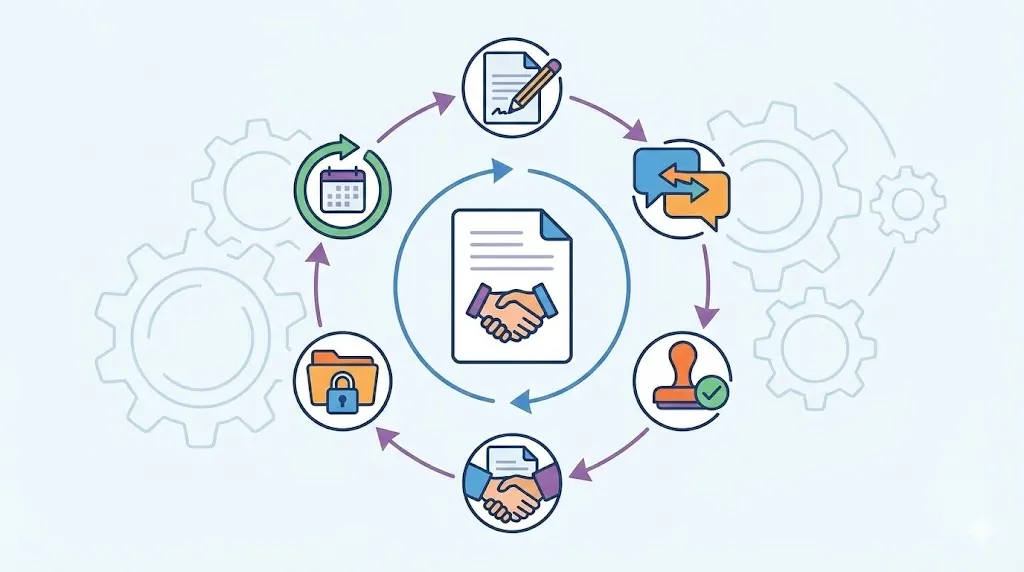
Contract lifecycle management software connects intake, drafting, review, approval, signature, storage, and obligation tracking. Additionally, it gives legal and business teams one process, one record, and clearer ownership. Volody adds AI drafting, review, clause recommendations, summaries, metadata extraction, automated approvals, Word integration, search, alerts, and dashboards to support faster work with stronger control.
Ready to make contract management more efficient? Learn more about Volody's CLM Software.
FAQ
What functions does software for enterprise contract management provide?
Additionally, the system covers the contract lifecycle from the initial request through renewal or termination. Its capabilities span drafting, review, negotiation, approval, signature, storage, reporting, and obligation tracking. It gives the team a shared record of contract activity.
How can contract software accelerate legal approvals?
The system gathers complete request details before legal review begins. The workflow handles choosing templates, routing approvals, sending reminders, and flagging exceptions. These controls, taken together, limit email follow up and reduce avoidable handoffs.
Does faster contract review increase legal risk?
Accelerating review need not compromise legal quality. Approved templates, clause rules, risk playbooks, and escalation paths help legal teams maintain standards. Lawyers should retain control over unusual terms and material exceptions.
What should legal teams automate first?
Start with high volume work that follows repeatable rules. Automating intake, selecting templates, routing approvals, sending reminders, and tracking signatures often provides early value. Choose one agreement type and measure results before expanding.
Can AI write and review contracts safely?
AI can create drafts, summarize terms, and identify unusual language. Moreover, people must verify its output and decide whether a clause creates acceptable risk. Teams should also review data controls, audit records, model behavior, and vendor security.
How can legal teams measure contract process improvement?
Track request to signature time, approval waiting time, template use, exception volume, and negotiation rounds. Also track missed obligations, user satisfaction, and contract data quality. Use several measures because one speed metric can hide new problems.
Should contract software replace Microsoft Word?
It can complement Word rather than replace it. Many teams prefer an integration that lets lawyers draft and edit in Word while the system controls data, versions, approvals, and records. This approach can improve adoption and reduce duplicate files.
How does a contract repository help after signature?
A central repository makes signed contracts easier to find and analyze. Searchable metadata can show owners, dates, terms, and obligations. Alerts can help teams manage renewals, notices, payments, service levels, and compliance duties.
What makes a contract management system enterprise ready?
It should support security controls, role based access, audit trails, integrations, reporting, and large contract volumes. It should also support different entities, regions, agreement types, and approval rules. Configuration options matter because enterprise processes change over time.
About the Company

Volody AI CLM is an Agentic AI-powered Contract Lifecycle Management platform designed to eliminate manual contracting tasks, automate complex workflows, and deliver actionable insights. As a one-stop shop for all contract activities, it covers drafting, collaboration, negotiation, approvals, e-signature, compliance tracking, and renewals. Built with enterprise-grade security and no-code configuration, it meets the needs of the most complex global organizations. Volody AI CLM also includes AI-driven contract review and risk analysis, helping teams detect issues early and optimize terms. Trusted by Fortune 500 companies, high-growth startups, and government entities, it transforms contracts into strategic, data-driven business assets.





" height="216.72211px" id="FYO0bO80Y" transform="translate(3 6.105)" width="206.073px"/><path d="M 108.174 222 C 88.432 222 70.303 217.239 53.785 207.717 C 37.267 198.196 24.173 185.052 14.504 168.285 C 4.835 151.312 0 132.165 0 110.845 C 0 89.731 4.835 70.792 14.504 54.025 C 24.173 37.052 37.267 23.804 53.785 14.282 C 70.303 4.761 88.432 0 108.174 0 C 128.116 0 146.246 4.761 162.562 14.282 C 179.08 23.804 192.073 37.052 201.541 54.025 C 211.21 70.792 216.044 89.731 216.044 110.845 C 216.044 132.165 211.21 151.312 201.541 168.285 C 192.073 185.052 179.08 198.196 162.562 207.717 C 146.044 217.239 127.915 222 108.174 222 Z M 108.174 183.189 C 120.864 183.189 132.044 180.291 141.713 174.495 C 151.382 168.492 158.936 160.006 164.375 149.035 C 169.814 138.064 172.533 125.334 172.533 110.845 C 172.533 96.355 169.814 83.729 164.375 72.965 C 158.936 61.994 151.382 53.611 141.713 47.815 C 132.044 42.02 120.864 39.122 108.174 39.122 C 95.483 39.122 84.202 42.02 74.332 47.815 C 64.663 53.611 57.109 61.994 51.67 72.965 C 46.231 83.729 43.511 96.355 43.511 110.845 C 43.511 125.334 46.231 138.064 51.67 149.035 C 57.109 160.006 64.663 168.492 74.332 174.495 C 84.202 180.291 95.483 183.189 108.174 183.189 Z" fill="rgba(255, 255, 255, 0.12)" height="222px" id="aa1McFcE9" transform="translate(227.183 3)" width="216.04399999999998px"/><path d="M 42.302 182.257 L 111.799 182.257 L 111.799 216.722 L 0 216.722 L 0 0 L 42.302 0 Z" fill="rgba(255, 255, 255, 0.12)" height="216.72211px" id="yRq4AnrsX" transform="translate(477.721 6.105)" width="111.79899999999998px"/><path d="M 108.174 222 C 88.432 222 70.303 217.239 53.785 207.717 C 37.267 198.196 24.173 185.052 14.504 168.285 C 4.835 151.312 0 132.165 0 110.845 C 0 89.731 4.835 70.792 14.504 54.025 C 24.173 37.052 37.267 23.804 53.785 14.282 C 70.303 4.761 88.432 0 108.174 0 C 128.116 0 146.246 4.761 162.562 14.282 C 179.08 23.804 192.073 37.052 201.541 54.025 C 211.21 70.792 216.045 89.731 216.045 110.845 C 216.045 132.165 211.21 151.312 201.541 168.285 C 192.073 185.052 179.08 198.196 162.562 207.717 C 146.044 217.239 127.915 222 108.174 222 Z M 108.174 183.189 C 120.864 183.189 132.044 180.291 141.713 174.495 C 151.382 168.492 158.936 160.006 164.375 149.035 C 169.814 138.064 172.534 125.334 172.534 110.845 C 172.534 96.355 169.814 83.729 164.375 72.965 C 158.936 61.994 151.382 53.611 141.713 47.815 C 132.044 42.02 120.864 39.122 108.174 39.122 C 95.483 39.122 84.202 42.02 74.332 47.815 C 64.663 53.611 57.108 61.994 51.67 72.965 C 46.231 83.729 43.511 96.355 43.511 110.845 C 43.511 125.334 46.231 138.064 51.67 149.035 C 57.108 160.006 64.663 168.492 74.332 174.495 C 84.202 180.291 95.483 183.189 108.174 183.189 Z" fill="rgba(255, 255, 255, 0.12)" height="222px" id="mo8HQspQ0" transform="translate(609.155 3)" width="216.04500000000007px"/><path d="M 73.727 0 C 95.885 0 115.324 4.45 132.044 13.351 C 148.967 22.252 161.957 34.982 171.027 51.541 C 180.287 67.894 184.917 86.937 184.917 108.671 C 184.917 130.405 180.287 149.449 171.027 165.801 C 161.957 181.947 148.967 194.47 132.044 203.371 C 115.324 212.271 95.885 216.722 73.727 216.722 L 0 216.722 L 0 0 Z M 72.216 179.773 C 94.374 179.773 111.497 173.564 123.583 161.144 C 135.669 148.724 141.713 131.233 141.713 108.671 C 141.713 86.109 135.669 68.515 123.583 55.888 C 111.497 43.055 94.374 36.638 72.216 36.638 L 42.302 36.638 L 42.302 179.773 Z" fill="rgba(255, 255, 255, 0.12)" height="216.72211px" id="I3iXX5Hi_" transform="translate(859.693 6.105)" width="184.91699999999992px"/><path d="M 185.22 0 L 113.91 141.273 L 113.91 216.722 L 71.61 216.722 L 71.61 141.273 L 0 0 L 47.74 0 L 93.06 99.046 L 138.08 0 Z" fill="rgba(255, 255, 255, 0.12)" height="216.72211px" id="nzHyWC0_d" transform="translate(1061.78 6.105)" width="185.22000000000003px"/></svg>)