

Enterprise contract risk demands consistent standards, clear accountability, and decisive action. A well-designed escalation framework aligns legal, finance, security, procurement, and business teams around a common method for identifying, assessing, mitigating, and resolving risk. This guide outlines how to build, operationalize, measure, and continuously improve that framework.
TL;DR
Set shared risk standards, categories, scores, approval limits, and contract risk thresholds.
Give each function clear ownership, decision rights, backup approvers, and escalation duties.
Create workflows for detection, review, remediation, monitoring, closure, and overdue action.
Fix common problems such as slow approvals, poor data, unclear ownership, and escalation fatigue.
Use CLM software to route reviews, track obligations, find risks, and preserve decision records.
Pilot the framework, measure results, collect feedback, and improve the rules before wider rollout.
Establish the Scope, Governance, and Risk Appetite
Start by defining what the framework must control. Link it to enterprise risk management, which coordinates risk decisions across the business.
The framework should support safe growth, faster approvals, and better contract visibility. It should also protect the business from avoidable legal, financial, privacy, and service failures.
Define the Framework’s Business Scope
Begin with the contract types that create the highest exposure. These may include supplier agreements, customer contracts, data processing terms, licenses, and outsourcing deals.
Set the first scope by business unit, country, contract value, and risk type. You can expand later after the process works well.
Include risks before signature and after signature. Pre-signature risks involve clauses, approvals, and negotiation positions. Post-signature risks include missed duties, renewal dates, service failures, and compliance changes.
Separate global rules from local rules. Global rules should cover core liability, privacy, security, and approval needs. Local teams can add rules for local laws, markets, and business practices.
Assign Governance Roles and Accountability
An executive sponsor should remove barriers and support the framework. Legal can own the contract risk standard, while each function owns risks within its expertise.
Procurement may lead supplier risks and sourcing controls. Finance may assess payment terms, credit exposure, and revenue effects.
Security and privacy teams should review data access, security duties, and breach terms. Business owners should explain the deal purpose and accept risks within their authority.
Use a RACI model to assign responsibility. RACI means responsible, accountable, consulted, and informed. This prevents repeated reviews and decisions without owners.
Create a review committee for material or disputed risks. Name backup approvers for urgent deals and planned absences.
Translate Risk Appetite into Operating Boundaries
Risk appetite states how much risk leadership will accept. Tolerance thresholds turn that statement into clear contract rules.
Acceptable positions fit approved clauses and delegated authority. Conditional positions need extra controls, specialist review, or senior approval. Prohibited positions cannot proceed without a formal exception.
Set boundaries for liability caps, indemnities, data use, payment exposure, termination rights, and service credits. Add rules for regulatory duties, audit rights, insurance, and subcontracting.
Review these boundaries with legal, finance, security, compliance, and business leaders. Record the approved version and its effective date. Train teams to apply the same rules during each contract review.
Related articles: How Tech Firms Can Use Contracts to Cut Risk in 2026
Build a Consistent Contract Risk Taxonomy and Scoring Model
A shared taxonomy gives teams one language for contract risk classification. It also makes reports, routing rules, and trend reviews more useful.
Score risk against business impact, not only clause changes. A small wording change can create high exposure in a sensitive deal. A large change may create little risk in another setting.
Assess both inherent and residual risk. Inherent risk exists before controls. Residual risk remains after controls, approvals, and mitigation.
Organize Risks into Actionable Categories
Use categories that lead to clear owners and actions. Common categories include financial, legal, regulatory, operational, security, privacy, commercial, reputational, and jurisdictional risk.
Each category should have plain definitions and examples. A privacy risk might involve broad data use rights. A financial risk might involve uncapped payment exposure.
Connect every category to a responsible function. This supports faster routing and avoids sending every issue to legal.
Use the taxonomy in intake forms, reports, playbooks, and review meetings. Update it when new risks appear or old categories become unclear.
Define Assessment Criteria and Thresholds
Use a simple scoring model that reviewers can apply consistently. Score severity, probability, exposure, urgency, detectability, and strategic importance.
Keep the scale short enough for daily use. For example, each factor can use low, medium, or high ratings. Document what each rating means with real contract examples.
The total score should trigger a defined action. Low scores may need standard review. Medium scores may require specialist review. High scores may require senior or executive approval Organizations should establish clear criteria for escalating risks when predefined thresholds are reached, following the principles outlined in the NIST definition of risk escalation.
Review scores together with contract value and business context. A sensitive customer relationship may need escalation despite a moderate score.
Criteria | Low range | Medium range | High range | Required action |
|---|---|---|---|---|
Legal exposure | Approved wording | Limited deviation | Uncapped or unusual exposure | Legal review for medium and high scores |
Financial exposure | Within budget | Material budget effect | Major or uncertain exposure | Finance review and approval |
Data sensitivity | No personal data | Limited personal data | Sensitive or regulated data | Security and privacy review |
Operational impact | Easy service recovery | Noticeable service effect | Business-critical dependency | Operations review and mitigation |
Approval level | Business owner | Functional lead | Executive authority | Escalate when the threshold is crossed |
Related articles: Contract Review Strategies for In-House Legal Teams
Design the Escalation Path and Decision Rights
A contract risk escalation process should show each step from discovery to closure. It should also show who can make each decision.
Start with detection and triage. Then move through review, mitigation, decision, monitoring, and closure.
Set response times for every escalation tier. An urgent risk needs a faster route than a routine clause question.
Map Escalation Tiers to Authority Levels
The first tier should handle routine risks within approved playbooks. Business owners can resolve low-risk issues when they have suitable training.
The second tier should include specialists. Legal, finance, security, privacy, compliance, or operations can assess risks in their areas.
Senior leaders should review material risks that exceed functional limits. Executive leaders may accept major residual risk when the business case supports it.
Board reporting may suit risks with serious strategic, regulatory, or reputational effects. The board should not review routine contract exceptions.
Each tier must define what it can accept, mitigate, transfer, reject, or escalate. Delegated authority should include value limits and risk limits.
Define Triggers, Routing Rules, and Service Levels
Triggers should use more than contract value. Include risk scores, unusual clauses, sensitive data, new jurisdictions, and regulatory concerns.
Add triggers for customer demands, time pressure, disputed advice, and missed review deadlines. These conditions often create hidden risk.
Routing rules should send each issue to the right function. They should also name backup approvers and fallback routes.
Set service levels for review and decision times. An overdue alert should go to the backup approver first. Further delay should create secondary escalation.
Document Escalation Decisions and Required Follow-Up
Every escalation record should explain the issue clearly. Include the affected clause, risk category, score, business purpose, and proposed fallback.
Add prior approvals, unresolved questions, and the decision authority. Record whether the risk was accepted, reduced, transferred, rejected, or escalated again.
Assign one owner for each follow-up action. Add a due date, evidence requirement, and review checkpoint.
The record should remain with the contract. This creates an audit trail and helps teams learn from repeated decisions.
Decision tier | Typical owner | Decision rights | Response time | Escalation condition |
|---|---|---|---|---|
Tier one | Business owner | Resolve approved low-risk exceptions | Two business days | Score or clause exceeds local limit |
Tier two | Functional specialist | Approve specialist controls or fallback terms | Three business days | Risk exceeds functional authority |
Tier three | Senior functional leader | Accept material functional exposure | Five business days | Cross-functional disagreement remains |
Tier four | Executive sponsor | Accept major residual business risk | Defined by urgency | Strategic or enterprise exposure remains |
Tier five | Board or committee | Review exceptional enterprise risk | Set by governance rules | Severe strategic or regulatory impact |
Related articles: Contract Governance: A Guide to Strategic Value
5 Key Challenges in Contract Risk Escalation
Enterprise frameworks often fail during daily work. Policy documents cannot solve unclear ownership, weak data, or slow decisions by themselves.
The following challenges affect deal speed, compliance, and risk visibility. Each one needs a practical control.
1. Inconsistent Risk Interpretation Across Teams
Different teams may judge the same clause in different ways. They may use separate playbooks, terms, or tolerance assumptions.
This creates uneven contract risk classification. It also causes repeated reviews and arguments during negotiation.
Use shared definitions, score examples, and approved fallback clauses. Run short calibration sessions with legal, procurement, finance, and business teams.
2. Unclear Ownership and Decision Authority
Escalations stall when no person owns the response. They also stall when an approver lacks authority to accept the risk.
Name a risk owner when the issue first appears. Give that owner a clear decision path and a backup approver.
Publish authority limits in the workflow. This keeps teams from sending routine questions to senior leaders.
3. Fragmented Contract Data and Manual Handoffs
Missing metadata makes triage slower and less reliable. Email approvals can also create version problems and lost decisions.
Disconnected systems hide the full contract history. Teams may miss renewal dates, related agreements, or earlier risk decisions.
Use one contract record with structured fields. Store the latest draft, score, approval record, and follow-up actions together.
4. Escalation Fatigue and Approval Bottlenecks
Sending every exception to senior leaders weakens the framework. It delays deals and reduces attention on serious risks.
Use risk-based routing and self-service guardrails. Give trained teams standard fallback language for routine issues.
Reserve senior review for material exposure, unusual terms, or unresolved disputes. Review escalation volume to find rules that create unnecessary work.
Challenge | Root cause | Operational impact | Recommended control |
|---|---|---|---|
Uneven interpretation | Separate playbooks and terms | Inconsistent decisions | Shared taxonomy and examples |
Unclear ownership | No named risk owner | Delayed response | Assigned owners and backups |
Fragmented data | Email and disconnected tools | Weak triage and reporting | Central contract record |
Approval bottlenecks | Excessive senior routing | Slow deals and fatigue | Tiered rules and service levels |
Poor follow-up | No closure standard | Open exposure after signature | Due dates, evidence, and monitoring |
Related articles: 4 Legal Issues in Retail: How to Mitigate Risks in Retailing
Create Remediation Workflows and Follow-Up Controls
Escalation should produce a controlled action, not just an approval email. The action must reduce exposure or explain why the business accepts it.
Some risks can be fixed through new wording. Others need insurance, technical controls, price changes, or stronger service plans.
Accepted risk still needs monitoring when exposure remains active. A signed contract does not remove the underlying risk.
Define Standard Response Options
Use accept when the risk fits approved tolerance and authority. Record the reason, owner, and review date.
Use mitigate when controls can lower probability or impact. Examples include tighter access rules, insurance, service credits, or added reporting.
Use transfer when another party or insurer can carry the exposure. Confirm that the transfer terms work in practice.
Use avoid when the business should not proceed. Use renegotiate when terms can change. Suspend or escalate further when facts remain unclear.
Each response needs supporting evidence. That evidence may include revised clauses, control plans, insurance records, or executive approval.
Implement Remediation and Closure Workflows
Assign one accountable owner for every action. Add a due date, dependencies, evidence needs, and validation steps.
Send reminders before the due date. Overdue actions should create a secondary legal risk escalation.
A reviewer should confirm that the action worked. Closure should require evidence, approval, and an updated residual risk score.
Keep monitoring when the risk remains active. Set a future review date for renewals, audits, service changes, or new regulations.
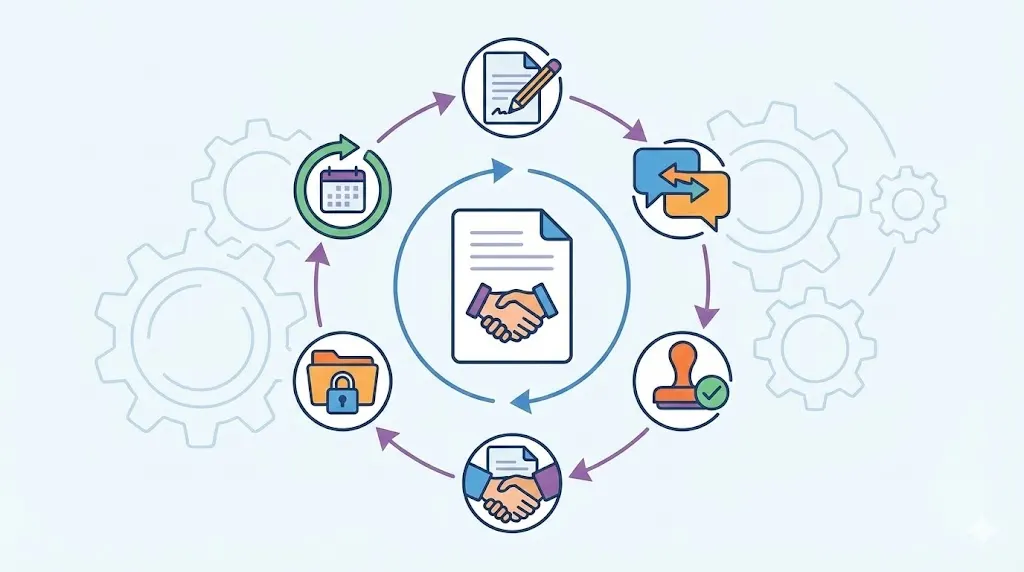
A useful remediation workflow follows this sequence:
Identify and record the risk.
Confirm the category, score, owner, and trigger.
Select a response and define the action.
Assign the owner, deadline, evidence, and dependencies.
Collect evidence and validate the completed control.
Update residual risk and monitor remaining exposure.
Close the record or start another escalation.
Related articles: Contract Risk Analysis Strengthened By AI In Legal Ops
Automate Risk Detection, Routing, and Reporting
Technology can make the framework faster and more consistent. It should support judgment, not replace experienced legal or business review.
A contract management platform can connect intake, review, approval, storage, and monitoring. It can also preserve the record of each decision.
Automate Intake and Initial Risk Assessment
Use templates and clause libraries to guide contract intake. Required metadata can include contract type, value, business unit, country, and counterparty.
AI tools can find unusual wording, missing provisions, and risky clauses. They can also extract parties, dates, payment terms, and renewal details.
Rules can flag contracts with sensitive data or high supplier dependence. They can also identify terms that fall outside approved language.
Human reviewers still need to assess context. A clause may look unusual but serve a valid business purpose.
Route Approvals Using Configured Decision Logic
Configure rules around risk scores, contract value, clause deviations, and business attributes. The system can then send each issue to the right reviewer.
Alerts should explain why a review is needed. Include the clause, risk category, score, and suggested fallback.
One-click escalation can reduce email handoffs. It should still require a complete record and clear decision authority.
Test routing rules with real examples. Review false positives and missed risks before wider use.
Monitor Open Risks, Obligations, and Management Trends
Dashboards should show open risks, overdue actions, renewals, and obligations. They should also show escalation volume and approval time.
Track recurring clause deviations across business units. Repeated issues may signal weak templates, poor training, or changing market terms.
Show management trends by category, owner, region, and contract type. This helps leaders address systemic risks rather than isolated events.
Dashboard metric | Owner | Reporting frequency | Escalation threshold |
|---|---|---|---|
Open high-risk contracts | Legal risk lead | Weekly | Any overdue high-risk review |
Average approval time | Contract operations | Monthly | Time exceeds service level |
Overdue remediation actions | Risk owners | Weekly | Action passes its due date |
Repeated clause deviations | Legal and procurement | Monthly | Same issue appears across teams |
Obligation failures | Business owner | Monthly | Critical duty is missed |
Risk by business unit | Executive sponsor | Quarterly | Unit exceeds approved tolerance |
Related articles: AI Advancements in Contract Management Tools by 2026
Pilot, Measure, and Improve the Framework
Do not launch the framework across every business unit at once. A focused pilot will reveal weak rules, missing data, and unclear ownership.
Choose a pilot with enough contract activity to show real patterns. Keep the boundary small enough for close support.
Select a Representative Pilot
Choose one business unit, contract type, or risk category first. The pilot should include different risk levels and several stakeholder groups.
Look for engaged leaders and usable contract data. Avoid a pilot with no executive support or poor records.
Keep unrelated contract types out of scope initially. Expand only after the core intake, review, approval, and follow-up process works.
Document the starting process before making changes. This gives the team a fair comparison after the pilot.
Test Scoring, Routing, and Decision Rights
Use sample contracts from recent work. Ask reviewers to score the same clauses independently.
Compare expected routes with actual routes. Check whether the correct specialist received each issue.
Test response times, backup routes, and overdue alerts. Review whether each approver had enough authority.
Check the final records for complete decisions. Missing reasons or owners can weaken the whole framework.
Measure Adoption and Operational Performance
Track review time, escalation accuracy, approval delays, and exception rates. Also track overdue actions and user adoption.
Separate process speed from decision quality. Fast approvals do not help if teams miss material risks.
Review whether residual risk falls after remediation. Check whether repeated issues decline over time.
Use feedback from lawyers, buyers, approvers, and business owners. Each group sees different parts of the process.
Govern Changes After Rollout
Set a formal owner for framework changes. That owner should control taxonomies, thresholds, playbooks, workflows, and training.
Use a continuous improvement cycle with these controls:
Collect feedback from reviewers and business users.
Review thresholds and trends each quarter.
Test key controls after major workflow changes.
Update playbooks when laws or markets change.
Maintain version records for rules and approvals.
Retrain users after material process changes.
Review the framework after disputes, audits, incidents, or strategy changes. Record why each change was made and when it takes effect.
Related articles: Enhancing Risk Mitigation and Payout Accuracy
Why Contract Management Software Matters
Contract management software gives teams one place for contract data and risk records. That shared foundation supports scoring, routing, approvals, obligation tracking, and audit reporting.
Configured workflows reduce manual handoffs without removing human judgment. Legal, finance, security, and business leaders can still review material decisions.
A central system can hold playbooks, approval limits, decisions, remediation tasks, and contract history. It also helps teams find repeated risks across the contract portfolio.
Volody's CLM Software supports AI Contract Review, AI Contract Summaries, and Approval Workflow Automation. It can flag unusual terms, highlight obligations and renewal dates, and route decisions through configured approval paths.
For example, a data processing agreement can trigger privacy review automatically. The system can then summarize key duties, route approval, and remind the owner about follow-up actions.
Central contract data: Store contracts, metadata, clauses, approvals, and risk records together.
This gives teams one reliable source during reviews and audits. It also reduces version confusion during active negotiations. Users can find prior decisions without searching through email.
Configured approval workflows: Route risks by score, value, business unit, or contract type.
Each reviewer receives the context needed for a quick decision. Backup routes can reduce delays when approvers are unavailable. The system can preserve each approval and escalation record.
Ongoing risk monitoring: Track obligations, renewals, remediation tasks, and unresolved exposure.
Alerts can remind owners before deadlines create new risk. Dashboards can show trends across teams and contract groups. Leaders can then improve rules based on actual contract activity.
Want to see how contract management software can simplify your legal workflows? Check out Volody's CLM Software.
FAQ
What is contract risk management?
Contract risk management is the process of finding, assessing, reducing, escalating, and monitoring contract risks. It covers legal, financial, privacy, security, compliance, and performance issues. An effective program assigns owners and defines approval limits. It also tracks obligations and residual risk after signature.
How should an enterprise define contract risk standards and tolerance thresholds?
An enterprise should start with its risk appetite, business goals, and legal duties. Leaders can define acceptable, conditional, and prohibited positions for liability, indemnity, data use, payment, and termination. Each boundary should connect to a score and approval level. The framework should also explain how teams request exceptions.
Which teams should own and assess contract risk?
Contract risk needs shared ownership across several functions. Legal may lead legal terms, while procurement, finance, security, privacy, compliance, operations, and business teams assess their areas. A named risk owner should coordinate each response. Senior leaders should accept risks that exceed delegated authority.
When should a contract risk be escalated?
Escalate risk when it exceeds a score, threshold, clause rule, or approval limit. Other triggers include sensitive data, unusual jurisdictions, regulatory exposure, and large financial commitments. Missed deadlines and unresolved stakeholder disagreements also need escalation. The route should reach an authority with suitable expertise.
How can businesses prevent contract risk escalation from slowing deals?
Use tiered approval rights and clear service levels for each risk level. Standard fallback clauses can help trained teams resolve routine exceptions. Automated routing can send only material issues to senior reviewers. Review approval times and escalation volume to find rules that create unnecessary delays.
How can organizations monitor contract risks after signature?
Maintain a risk and obligation record after signature. Include owners, deadlines, evidence, renewal dates, controls, and unresolved exposure. Dashboards can show missed duties, overdue remediation, and changing counterparty risk. Periodic reviews can confirm whether residual risk remains within tolerance.
How often should a contract risk escalation framework be reviewed?
Review the framework continuously through alerts, dashboards, and user feedback. Conduct a formal review each quarter or twice yearly, based on risk levels. Review it sooner after incidents, disputes, audits, or legal changes. Adopt the framework, measure its performance, and contact Volody to strengthen governance, accelerate approvals, and maintain control over contract risk at scale.
About the Company

Volody AI CLM is an Agentic AI-powered Contract Lifecycle Management platform designed to eliminate manual contracting tasks, automate complex workflows, and deliver actionable insights. As a one-stop shop for all contract activities, it covers drafting, collaboration, negotiation, approvals, e-signature, compliance tracking, and renewals. Built with enterprise-grade security and no-code configuration, it meets the needs of the most complex global organizations. Volody AI CLM also includes AI-driven contract review and risk analysis, helping teams detect issues early and optimize terms. Trusted by Fortune 500 companies, high-growth startups, and government entities, it transforms contracts into strategic, data-driven business assets.




" height="216.72211px" id="FYO0bO80Y" transform="translate(3 6.105)" width="206.073px"/><path d="M 108.174 222 C 88.432 222 70.303 217.239 53.785 207.717 C 37.267 198.196 24.173 185.052 14.504 168.285 C 4.835 151.312 0 132.165 0 110.845 C 0 89.731 4.835 70.792 14.504 54.025 C 24.173 37.052 37.267 23.804 53.785 14.282 C 70.303 4.761 88.432 0 108.174 0 C 128.116 0 146.246 4.761 162.562 14.282 C 179.08 23.804 192.073 37.052 201.541 54.025 C 211.21 70.792 216.044 89.731 216.044 110.845 C 216.044 132.165 211.21 151.312 201.541 168.285 C 192.073 185.052 179.08 198.196 162.562 207.717 C 146.044 217.239 127.915 222 108.174 222 Z M 108.174 183.189 C 120.864 183.189 132.044 180.291 141.713 174.495 C 151.382 168.492 158.936 160.006 164.375 149.035 C 169.814 138.064 172.533 125.334 172.533 110.845 C 172.533 96.355 169.814 83.729 164.375 72.965 C 158.936 61.994 151.382 53.611 141.713 47.815 C 132.044 42.02 120.864 39.122 108.174 39.122 C 95.483 39.122 84.202 42.02 74.332 47.815 C 64.663 53.611 57.109 61.994 51.67 72.965 C 46.231 83.729 43.511 96.355 43.511 110.845 C 43.511 125.334 46.231 138.064 51.67 149.035 C 57.109 160.006 64.663 168.492 74.332 174.495 C 84.202 180.291 95.483 183.189 108.174 183.189 Z" fill="rgba(255, 255, 255, 0.12)" height="222px" id="aa1McFcE9" transform="translate(227.183 3)" width="216.04399999999998px"/><path d="M 42.302 182.257 L 111.799 182.257 L 111.799 216.722 L 0 216.722 L 0 0 L 42.302 0 Z" fill="rgba(255, 255, 255, 0.12)" height="216.72211px" id="yRq4AnrsX" transform="translate(477.721 6.105)" width="111.79899999999998px"/><path d="M 108.174 222 C 88.432 222 70.303 217.239 53.785 207.717 C 37.267 198.196 24.173 185.052 14.504 168.285 C 4.835 151.312 0 132.165 0 110.845 C 0 89.731 4.835 70.792 14.504 54.025 C 24.173 37.052 37.267 23.804 53.785 14.282 C 70.303 4.761 88.432 0 108.174 0 C 128.116 0 146.246 4.761 162.562 14.282 C 179.08 23.804 192.073 37.052 201.541 54.025 C 211.21 70.792 216.045 89.731 216.045 110.845 C 216.045 132.165 211.21 151.312 201.541 168.285 C 192.073 185.052 179.08 198.196 162.562 207.717 C 146.044 217.239 127.915 222 108.174 222 Z M 108.174 183.189 C 120.864 183.189 132.044 180.291 141.713 174.495 C 151.382 168.492 158.936 160.006 164.375 149.035 C 169.814 138.064 172.534 125.334 172.534 110.845 C 172.534 96.355 169.814 83.729 164.375 72.965 C 158.936 61.994 151.382 53.611 141.713 47.815 C 132.044 42.02 120.864 39.122 108.174 39.122 C 95.483 39.122 84.202 42.02 74.332 47.815 C 64.663 53.611 57.108 61.994 51.67 72.965 C 46.231 83.729 43.511 96.355 43.511 110.845 C 43.511 125.334 46.231 138.064 51.67 149.035 C 57.108 160.006 64.663 168.492 74.332 174.495 C 84.202 180.291 95.483 183.189 108.174 183.189 Z" fill="rgba(255, 255, 255, 0.12)" height="222px" id="mo8HQspQ0" transform="translate(609.155 3)" width="216.04500000000007px"/><path d="M 73.727 0 C 95.885 0 115.324 4.45 132.044 13.351 C 148.967 22.252 161.957 34.982 171.027 51.541 C 180.287 67.894 184.917 86.937 184.917 108.671 C 184.917 130.405 180.287 149.449 171.027 165.801 C 161.957 181.947 148.967 194.47 132.044 203.371 C 115.324 212.271 95.885 216.722 73.727 216.722 L 0 216.722 L 0 0 Z M 72.216 179.773 C 94.374 179.773 111.497 173.564 123.583 161.144 C 135.669 148.724 141.713 131.233 141.713 108.671 C 141.713 86.109 135.669 68.515 123.583 55.888 C 111.497 43.055 94.374 36.638 72.216 36.638 L 42.302 36.638 L 42.302 179.773 Z" fill="rgba(255, 255, 255, 0.12)" height="216.72211px" id="I3iXX5Hi_" transform="translate(859.693 6.105)" width="184.91699999999992px"/><path d="M 185.22 0 L 113.91 141.273 L 113.91 216.722 L 71.61 216.722 L 71.61 141.273 L 0 0 L 47.74 0 L 93.06 99.046 L 138.08 0 Z" fill="rgba(255, 255, 255, 0.12)" height="216.72211px" id="nzHyWC0_d" transform="translate(1061.78 6.105)" width="185.22000000000003px"/></svg>)