

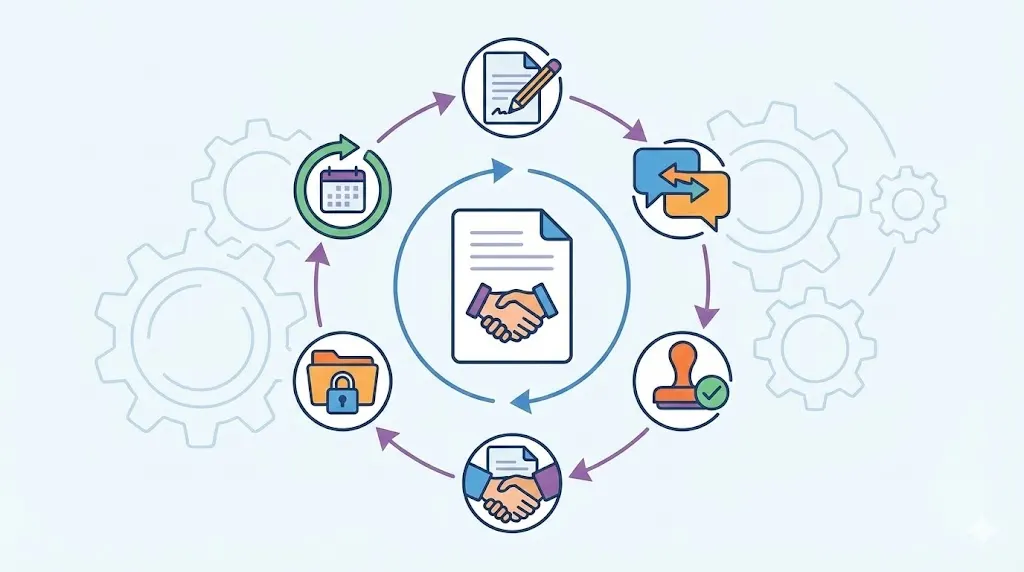
Enterprise contract management is a strategic operating discipline for controlling agreements across complex organizations. It aligns legal, procurement, sales, finance, IT, and business teams around consistent processes, accountable ownership, and reliable contract data. When implemented effectively, it reduces operational risk, accelerates execution, and gives leaders the visibility required to improve commercial performance. This guide outlines a practical framework for building and scaling that capability.
TL;DR
Assess contract workflows, systems, risks, delays, and ownership gaps before choosing processes or technology.
Set clear goals, assign owners, and track speed, compliance, savings, visibility, and renewal results.
Standardize intake, drafting, review, approval, signing, storage, and obligation tracking across business units.
Secure every contract record with access rules, version control, audit trails, retention, and backups.
Address fragmented data, uneven processes, user resistance, and complex integrations through focused improvements.
Start with a pilot, measure results, then expand using adoption data and contract analytics.
Assess the Current Contract Management Environment
A useful contract management strategy starts with facts. Teams need to understand how work happens today. They also need proof of where delays, risks, and costs appear.
Map the Existing Contract Lifecycle
Document each step from request intake through termination. Include drafting, review, approval, signature, storage, renewal, and closeout. Record who performs each task and which system they use.
Compare processes across regions and departments. Sales contracts may move quickly through one path. Supplier agreements may follow another path through procurement. These differences often remain hidden until teams map them.
Capture handoffs between legal, finance, security, and business owners. Note where work waits for email replies or missing information. Mark each step that creates duplicate entry or unclear ownership.
Identify Operational and Risk Gaps
Look for agreements stored in inboxes, shared drives, paper files, or local tools. Search for missing signatures, outdated templates, and unapproved clause changes. These issues weaken trust in the contract record.
Check whether teams can find active contracts and renewal dates. Review access rules for sensitive pricing, employee data, and supplier terms. Confirm whether approval evidence remains available after signing.
Review missed obligations and late renewals. A team may lose savings when a notice date passes. It may also renew poor service terms without enough time for negotiation.
Establish a Baseline for Improvement
Measure current cycle times for common contract types. Record volumes, review hours, approval delays, and signature waits. Track the number of contracts each team handles monthly.
Capture compliance exceptions and missed obligations. Record renewal outcomes, manual tasks, and search time. These measures create a starting point for contract process improvement.
Use the baseline during vendor selection and later reviews. A clear baseline helps leaders compare the pilot with normal work. It also supports a stronger business case for investment.
Current-state assessment checklist:
Review people, processes, systems, data, controls, and performance. Confirm contract owners, approval paths, storage points, metadata quality, access rules, and current measures. Include interviews with Legal, Procurement, Sales, Finance, IT, and business teams. Record both formal rules and common workarounds.
Related articles: Contract Management Software for Faster Legal Work
Align Strategy Goals, Governance, and Accountability
An enterprise CLM strategy needs more than software. It needs shared goals, clear decision rights, and steady oversight. Without these pieces, teams may buy a tool without changing weak habits.
Connect Contract Management to Enterprise Priorities
Link contract goals to results that leaders already track. Faster reviews can support sales growth and earlier revenue. Better supplier terms can support savings and supply continuity.
Compliance teams may need stronger evidence and fewer exceptions. Finance may need better visibility into payment terms and price changes. Operations may need reliable service levels and renewal alerts.
Choose a small set of business outcomes. Examples include shorter cycle times, fewer missed renewals, and better template use. Each goal should connect to an owner and a useful measure.
Define Ownership Across Functions
Legal should guide legal standards, clause rules, and high-risk reviews. Procurement should own supplier processes and commercial sourcing needs. Sales should help shape customer workflows and revenue goals.
Finance should support value data, payment terms, and savings measures. IT should manage integrations, identity access, and technical support. Security and compliance teams should define control and audit needs.
Business owners remain accountable for contract performance. Approvers must act within clear time limits. Contract administrators should maintain records, reminders, and routine data updates.
Responsibility matrix:
Map each lifecycle activity to one accountable owner. Name the required contributors and approval authority. Add an escalation contact for delayed work or disputed decisions. Review this matrix each quarter as teams, systems, and rules change.
Related articles: Contract Management for Small Business: A Complete Guide
Standardize the Contract Lifecycle and Core Controls
Standard processes make enterprise contract management easier to govern. They also make work easier for users. Teams can move faster when they know the right path for each agreement.
Create Consistent Intake and Triage
Use one intake form for each main contract request. Ask for parties, value, region, contract type, business need, and target date. Required fields reduce back-and-forth with legal teams.
Classify requests by type, value, risk, and urgency. Low-risk work can follow a standard route. High-risk work can receive deeper legal, security, or finance review.
Set routing rules before launch. A request involving personal data may need security review. A major supplier agreement may need procurement and executive approval.
Govern Templates and Clause Libraries
Create approved templates for common contract types. Store standard clauses in a controlled library. Add clear fallback language for common negotiation points.
Use playbooks to explain when teams may accept or change terms. Define approval rules for liability, data use, insurance, service levels, and termination. Make exceptions visible rather than informal.
Assign owners for template updates and clause reviews. Archive old versions so users cannot select them by mistake. Test revised language with the teams that use it most.
Build Structured Review and Approval Workflows
Use parallel reviews when several teams can work at once. Use sequential reviews when one decision depends on another. Set approval thresholds for value, risk, geography, and contract type.
Route unusual terms to the right legal or business expert. Add automatic reminders before deadlines. Keep comments, decisions, and changes with the contract record.
Require electronic signatures where policy allows. Store the signed copy as the final record. Make sure approval evidence remains linked to that copy.
Manage Post-Signature Obligations
Track deliverables, payment terms, price changes, and service levels. Record insurance certificates, audit rights, and reporting duties. Add notice dates for renewals and termination rights.
Assign each obligation to a named owner. Set reminders before deadlines, not after them. Escalate overdue tasks to a manager when needed.
Review performance during the contract term. A signed agreement still creates work and risk. Post-signature control turns contract data into useful business action.
Lifecycle control framework:
Define required inputs, decision points, records, approvals, and outputs. Cover intake, drafting, negotiation, approval, signature, storage, monitoring, renewal, and termination. Link every control to an owner and evidence source. Test the framework against common contracts before wider rollout.
Related articles: Mastering Contract Clauses: Risk & Performance
5 Key Challenges in Enterprise Contract Management
Large organizations face challenges that small teams may avoid. Volume, regional rules, and many systems increase the effort. A strong strategy addresses root causes instead of adding more manual checks.
1. Fragmented Contract Repositories
Contracts often sit across shared drives, inboxes, paper files, and business tools. Teams may not know which copy is current. Search then depends on personal memory and old email threads.
Fragmentation hides renewal dates and related documents. It also makes audits slower and less reliable. A central repository can create one trusted record for active agreements.
Migration still needs care. Teams should preserve signed copies, amendments, exhibits, and source history. They should also prioritize active, valuable, and high-risk contracts first.
2. Inconsistent Processes Across Business Units
Regions often use different forms, templates, and approval routes. Departments may create local workarounds for valid business reasons. Those differences can still create uneven controls and reporting gaps.
Inconsistent steps make turnaround times hard to predict. They also create duplicate work for legal and procurement. A shared operating model can allow local choices within clear limits.
Standardization does not mean every contract follows one rigid path. It means common risks receive common controls. Local teams can keep approved variations with proper governance.
3. Limited Data Quality and Visibility
Many contract records lack owners, dates, values, or contract types. Historical agreements may have no useful metadata. Teams then struggle to answer basic business questions.
Poor data weakens renewal forecasting and obligation tracking. It also limits analytics and risk review. Clean fields, naming rules, and ownership checks improve the quality of decisions.
Challenge diagnostic:
Link each issue to its business impact and risk exposure. Record the root cause, affected teams, and possible remedy. Add a priority, owner, target date, and success measure. Review the diagnostic during governance meetings and update it after each improvement.
Related articles: Healthcare Contract Management for Modern Organizations
Secure the Contract Record and Information Architecture
A contract repository should support control, access, and daily work. It should hold more than signed agreements. It should show the full record around each agreement.
Centralize Executed Agreements and Supporting Files
Store signed contracts with amendments, exhibits, and statements of work. Add certificates, notices, and key correspondence when policy permits. Link each file to the correct parent agreement.
Use metadata for parties, dates, value, region, owner, and contract type. Metadata means structured facts about a document. These facts make search, reporting, and alerts more reliable.
Keep drafts separate from executed records. Mark the final signed copy clearly. Preserve related documents without confusing them with the controlling agreement.
Apply Security, Versioning, and Retention Controls
Use role-based access for sensitive contract data. Give users only the access their work requires. Review access when people change roles or leave.
Keep version history for drafts and approvals. Protect executed copies from silent changes. Record who viewed, edited, approved, or downloaded each important file.
Use encryption, retention schedules, legal holds, and redundant backups. A legal hold stops normal deletion during a dispute or investigation. Test backup recovery instead of assuming it works.
Contract record standard:
Define mandatory metadata, naming rules, document links, access levels, retention periods, and audit needs. Include rules for amendments, renewals, and terminated agreements. Test the standard with legal, procurement, finance, security, and business users. Update it when laws or operating needs change.
Related articles: Contract Management Software for Finance: A Detailed Guide
Use Technology to Automate Work and Improve Visibility
Technology should support a clear operating model. It should not hide unclear ownership or weak process design. Select tools that reduce effort while preserving human judgment.
Automate Repetitive Lifecycle Activities
Automate intake, document creation, and clause selection for standard requests. Route approvals based on contract type, value, and risk. Send reminders for pending reviews, signatures, and renewals.
Use electronic signature routing to reduce manual follow-up. Track obligations with assigned owners and due dates. Alert managers when work passes its expected date.
AI can support drafting, review, and metadata extraction. It can flag unusual language or missing provisions. Legal teams should still approve material changes and high-risk decisions.
Integrate Contract Data With Enterprise Systems
Connect contract data with CRM systems for sales work. Link procurement and ERP tools for supplier and payment information. Connect identity tools for access management and user changes.
Integrate e-signature systems to preserve signing evidence. Send useful data to a warehouse for wider reporting. Connect compliance tools when contracts support specific control duties.
Plan integrations around real decisions. Do not move every field simply because a connection exists. Define the source of truth for parties, values, dates, and status.
Design Reporting Around Decisions
Build dashboards for cycle time, bottlenecks, and approval delays. Show contract value, risk exposure, renewal activity, and obligation status. Add policy measures such as template and clause use.
Give each role the view it needs. Executives may need value, risk, and trend data. Managers may need overdue work and team capacity.
Use alerts for action, not noise. A renewal alert should reach the owner early enough for a decision. A risk alert should explain the issue and suggest the next step.
Apply Analytics for Continuous Improvement
Structured data can reveal slow negotiation points and repeated exceptions. It can show which clauses cause the most review work. It can also reveal supplier performance patterns and savings opportunities.
Compare contract outcomes across regions and business units. Look for unusual terms, missed obligations, and recurring process failures. Use findings to update playbooks, templates, and training.
Analytics should answer a business question. A report that no team uses creates little value. Review dashboards during governance meetings and assign actions from the findings.
Automation and analytics priority matrix:
Rank each use case by business value, effort, data readiness, and control needs. Include the process owner and expected result. Start with high-value work that uses reliable data. Delay complex automation until its controls and source data are ready.
Related articles: Contract Management as a Growth Engine
Pilot, Implement, and Scale the Strategy
A phased rollout lowers risk and improves learning. It also gives leaders evidence before they fund wider change. The pilot should test process, technology, data, and user behavior together.
Select a Focused Pilot Scope
Choose a contract type with high volume and clear steps. Nondisclosure agreements, routine vendor agreements, and standard sales contracts often fit. Avoid starting with the most complex global agreements.
Select a willing business unit with visible leadership support. Confirm that the team can provide baseline data and user feedback. Define what the pilot will include and exclude.
Set success measures before configuration begins. Include cycle time, adoption, error rates, visibility, and approval delays. Add compliance and user satisfaction where they matter.
Prepare Users and Change Communications
Train users by role, not only by system screen. Requesters need clear intake guidance. Approvers need simple rules and timely alerts.
Give local teams process guides and support contacts. Explain why the change matters for daily work. Share expected behavior, launch dates, and escalation paths.
Ask leaders to reinforce the new process. Create feedback channels for defects and useful ideas. Track common questions and update training materials quickly.
Measure Pilot Results Before Expansion
Compare pilot results with the current baseline. Check whether work moved faster without raising risk. Review adoption, errors, approval delays, and contract visibility.
Interview users after the first work cycle. Ask where the process feels unclear or slow. Review system data alongside those comments.
Use findings to adjust workflows, fields, and training. Then decide whether to expand, pause, or change scope. A measured pilot creates a stronger foundation for enterprise CLM strategy growth.
Phased implementation roadmap:
Define pilot preparation, launch, evaluation, rollout waves, training, governance checks, and optimization. Assign owners and entry criteria for every phase. Set a decision gate after each wave. Expand only when results, controls, and support capacity meet the agreed standard.
Related articles: Why Contract Management Software Demand Is Skyrocketing Now
Why Contract Management Software Matters
Contract management software brings contracts, templates, metadata, approvals, signatures, and obligations together. It gives teams one controlled place for contract work. It also turns a contract management strategy into repeatable daily steps.
Centralized records: A secure repository keeps agreements and related files together. Users can search by party, owner, value, date, or contract type. Version history separates drafts from signed records. Better records support audits, renewals, and faster business decisions.
Automated workflows: Intake forms can route work to the right reviewers. Templates and clause libraries reduce repeated drafting effort. Reminders can support approvals, signatures, and obligations. Integrations can connect contract work with sales, procurement, finance, and identity systems.
Actionable insights: Dashboards show cycle time, bottlenecks, renewals, and policy gaps. Contract data can reveal unusual terms and missed savings. Risk teams can review exceptions with stronger evidence. Leaders can use these findings to guide contract process improvement.
Volody CLM Software supports enterprise contract management through AI Contract Review, Central Contract Repository, and Obligation Management. AI Contract Review can flag risky clauses and missing provisions. The repository supports controlled storage and search. Obligation Management tracks deliverables, renewals, and other commitments.
For example, a procurement team can review supplier terms, store the signed agreement, and receive renewal reminders from one system.
Want to see how contract management software can simplify your legal workflows? Check out Volody's CLM Software.
FAQ
What is enterprise contract management?
Enterprise contract management is a governed way to manage agreements across an organization. It covers creation, negotiation, approval, signing, storage, monitoring, renewal, and termination. The approach connects legal, procurement, sales, finance, IT, compliance, and business teams. It uses shared processes, controls, ownership rules, and contract data.
What are the building blocks of a strong enterprise contract management system?
Core building blocks include a central repository, standard templates, clause libraries, and approval workflows. Strong systems also support electronic signatures, obligation tracking, reporting, access controls, and audit trails. Integrations connect contract work with other business systems. AI can support drafting, review, data capture, risk checks, and analysis.
How should an enterprise assess, select, and implement contract management software?
Start by documenting current processes, contract volumes, risks, systems, and business goals. Compare tools for security, scale, integrations, workflow control, reporting, AI, usability, and support. Include total cost and data migration needs in the review. Use a governed pilot before expanding across teams and regions.
What metrics should enterprises use to measure contract management performance?
Useful measures include cycle time, approval duration, signature time, adoption, and template use. Track compliance exceptions, obligation completion, renewal results, savings, and revenue leakage. Also review risk exposure, user satisfaction, and system usage. Compare each measure with the baseline to show progress and guide action.
How can enterprises manage contracts that are stored in different systems?
Begin with an inventory of repositories, contract types, owners, dates, and business value. Prioritize active, high-value, high-risk, and frequently renewed agreements. Preserve source files and audit history during migration. Clean metadata, define repository rules, and use integrations when full consolidation must happen later.
How often should an enterprise review and improve its contract management strategy?
Establish a governed contract management program now to reduce risk, accelerate execution, and give every team reliable visibility into agreements and obligations. Use the framework above to assess your current environment, launch a focused pilot, measure results, and scale with confidence.
About the Company

Volody AI CLM is an Agentic AI-powered Contract Lifecycle Management platform designed to eliminate manual contracting tasks, automate complex workflows, and deliver actionable insights. As a one-stop shop for all contract activities, it covers drafting, collaboration, negotiation, approvals, e-signature, compliance tracking, and renewals. Built with enterprise-grade security and no-code configuration, it meets the needs of the most complex global organizations. Volody AI CLM also includes AI-driven contract review and risk analysis, helping teams detect issues early and optimize terms. Trusted by Fortune 500 companies, high-growth startups, and government entities, it transforms contracts into strategic, data-driven business assets.





" height="216.72211px" id="FYO0bO80Y" transform="translate(3 6.105)" width="206.073px"/><path d="M 108.174 222 C 88.432 222 70.303 217.239 53.785 207.717 C 37.267 198.196 24.173 185.052 14.504 168.285 C 4.835 151.312 0 132.165 0 110.845 C 0 89.731 4.835 70.792 14.504 54.025 C 24.173 37.052 37.267 23.804 53.785 14.282 C 70.303 4.761 88.432 0 108.174 0 C 128.116 0 146.246 4.761 162.562 14.282 C 179.08 23.804 192.073 37.052 201.541 54.025 C 211.21 70.792 216.044 89.731 216.044 110.845 C 216.044 132.165 211.21 151.312 201.541 168.285 C 192.073 185.052 179.08 198.196 162.562 207.717 C 146.044 217.239 127.915 222 108.174 222 Z M 108.174 183.189 C 120.864 183.189 132.044 180.291 141.713 174.495 C 151.382 168.492 158.936 160.006 164.375 149.035 C 169.814 138.064 172.533 125.334 172.533 110.845 C 172.533 96.355 169.814 83.729 164.375 72.965 C 158.936 61.994 151.382 53.611 141.713 47.815 C 132.044 42.02 120.864 39.122 108.174 39.122 C 95.483 39.122 84.202 42.02 74.332 47.815 C 64.663 53.611 57.109 61.994 51.67 72.965 C 46.231 83.729 43.511 96.355 43.511 110.845 C 43.511 125.334 46.231 138.064 51.67 149.035 C 57.109 160.006 64.663 168.492 74.332 174.495 C 84.202 180.291 95.483 183.189 108.174 183.189 Z" fill="rgba(255, 255, 255, 0.12)" height="222px" id="aa1McFcE9" transform="translate(227.183 3)" width="216.04399999999998px"/><path d="M 42.302 182.257 L 111.799 182.257 L 111.799 216.722 L 0 216.722 L 0 0 L 42.302 0 Z" fill="rgba(255, 255, 255, 0.12)" height="216.72211px" id="yRq4AnrsX" transform="translate(477.721 6.105)" width="111.79899999999998px"/><path d="M 108.174 222 C 88.432 222 70.303 217.239 53.785 207.717 C 37.267 198.196 24.173 185.052 14.504 168.285 C 4.835 151.312 0 132.165 0 110.845 C 0 89.731 4.835 70.792 14.504 54.025 C 24.173 37.052 37.267 23.804 53.785 14.282 C 70.303 4.761 88.432 0 108.174 0 C 128.116 0 146.246 4.761 162.562 14.282 C 179.08 23.804 192.073 37.052 201.541 54.025 C 211.21 70.792 216.045 89.731 216.045 110.845 C 216.045 132.165 211.21 151.312 201.541 168.285 C 192.073 185.052 179.08 198.196 162.562 207.717 C 146.044 217.239 127.915 222 108.174 222 Z M 108.174 183.189 C 120.864 183.189 132.044 180.291 141.713 174.495 C 151.382 168.492 158.936 160.006 164.375 149.035 C 169.814 138.064 172.534 125.334 172.534 110.845 C 172.534 96.355 169.814 83.729 164.375 72.965 C 158.936 61.994 151.382 53.611 141.713 47.815 C 132.044 42.02 120.864 39.122 108.174 39.122 C 95.483 39.122 84.202 42.02 74.332 47.815 C 64.663 53.611 57.108 61.994 51.67 72.965 C 46.231 83.729 43.511 96.355 43.511 110.845 C 43.511 125.334 46.231 138.064 51.67 149.035 C 57.108 160.006 64.663 168.492 74.332 174.495 C 84.202 180.291 95.483 183.189 108.174 183.189 Z" fill="rgba(255, 255, 255, 0.12)" height="222px" id="mo8HQspQ0" transform="translate(609.155 3)" width="216.04500000000007px"/><path d="M 73.727 0 C 95.885 0 115.324 4.45 132.044 13.351 C 148.967 22.252 161.957 34.982 171.027 51.541 C 180.287 67.894 184.917 86.937 184.917 108.671 C 184.917 130.405 180.287 149.449 171.027 165.801 C 161.957 181.947 148.967 194.47 132.044 203.371 C 115.324 212.271 95.885 216.722 73.727 216.722 L 0 216.722 L 0 0 Z M 72.216 179.773 C 94.374 179.773 111.497 173.564 123.583 161.144 C 135.669 148.724 141.713 131.233 141.713 108.671 C 141.713 86.109 135.669 68.515 123.583 55.888 C 111.497 43.055 94.374 36.638 72.216 36.638 L 42.302 36.638 L 42.302 179.773 Z" fill="rgba(255, 255, 255, 0.12)" height="216.72211px" id="I3iXX5Hi_" transform="translate(859.693 6.105)" width="184.91699999999992px"/><path d="M 185.22 0 L 113.91 141.273 L 113.91 216.722 L 71.61 216.722 L 71.61 141.273 L 0 0 L 47.74 0 L 93.06 99.046 L 138.08 0 Z" fill="rgba(255, 255, 255, 0.12)" height="216.72211px" id="nzHyWC0_d" transform="translate(1061.78 6.105)" width="185.22000000000003px"/></svg>)