

Mergers and acquisitions (M&A) can reshape industries and create massive value. But many deals stumble or fail because companies overlook one crucial factor: clean contract data. When contracts are messy, incomplete, or scattered, the risks multiply. Imagine buying a company only to find hidden obligations or missed deadlines buried in thousands of paper files or unsearchable PDFs. That’s why understanding why merger and acquisition success depends on clean contract data is vital for legal, operations, and tech leaders involved in these deals.
TL;DR
Poor contract data quality combined with decentralized access frequently leads to M&A deals failing or diminishing in value.
Ensuring the integrity of contract data is essential for achieving accuracy in due diligence and conducting comprehensive risk assessments during the M&A lifecycle.
The process of manually reviewing contracts not only prolongs transaction schedules but also raises the risk of overlooking key obligations.
Successful post-deal contract assignment depends on a thorough understanding of change-of-control and assignment clauses.
Contract management platforms powered by AI significantly shorten the time required to extract critical data and enhance the efficiency of contract analysis.
Centralized contract repositories reduce risk and support smoother post-merger integration.
Why Does Contract Data Matter So Much in M&A?
Contracts are the backbone of any business. Additionally, they define the detailed terms that regulate interactions with customers, suppliers, employees, and partners. When two companies merge or one acquires another, the contracts do not just disappear. They carry obligations, rights, and risks that must be understood and managed carefully.
Imagine you are acquiring a company with thousands of contracts spread across multiple departments, stored in different formats and locations. Some contracts may have clauses that restrict assignment without consent. Several others include renewal dates or penalty provisions that might influence the transaction’s valuation. If you cannot rapidly locate and evaluate these contracts, unexpected issues may arise following closing. Such issues often result in expensive disputes, regulatory non-compliance, or unforeseen liabilities.
According to a survey by Accenture, 78% of executives say their M&A deals fail to deliver expected value quickly. Moreover, problems stemming from poor integrity and disorganization within contract data constitute a major factor. Without clean, well-organized contract data, due diligence takes longer and becomes less reliable. This delays deal closure and increases costs.
Contracts also carry commercial and legal risks. Overlooking a critical clause or misinterpreting an obligation risks breaches or revenue losses. Consider a supplier agreement containing a clause that mandates notification of ownership changes. Failure to comply with this requirement could prompt the supplier to terminate the contract, thereby disrupting your supply chain.
In short, having precise and comprehensive contract details plays a decisive role in your ability to evaluate risks, negotiate terms, and successfully integrate businesses after a deal.
Related articles: Key Contract Process KPIs That Impact Business Success
What Makes Contract Data So Hard to Manage in M&A?
Many companies struggle with contract data because it is often:
Scattered across multiple systems and locations. Additionally, contracts can be stored in a variety of places such as email inboxes, file shares, physical filing cabinets, or legacy databases. This fragmentation makes it hard to get a full picture.
Stored in unstructured formats. Contracts are usually long documents with complex language. Extracting important details manually is slow and error-prone.
Outdated or incomplete. Some contracts may have missing signatures, outdated terms, or multiple versions floating around.
Lacking metadata or indexing. Without proper tagging or summaries, finding contracts by key attributes like parties, dates, or clauses is difficult.
Moreover, filled with complex legal language. Understanding change-of-control clauses, assignment restrictions, and other legal terms requires expertise and careful review.
This complexity means manual contract review during M&A is often a massive, costly task. Legal teams spend weeks or months digging through thousands of contracts to answer questions like:
Which contracts transfer to the new entity?
Are there contracts that require third-party consent prior to assignment, and what is the scope of such consent?
How should critical deadlines and contractual obligations be monitored to ensure compliance?
What hidden risks or liabilities might these agreements contain that could influence the outcome of the transaction?
When contract data lacks completeness and accuracy, delivering definitive answers to such questions becomes a formidable challenge.
Related articles: Understanding Exclusive Contracts: Key Insights and Tips
How Do Contract Issues Impact Deal Outcomes?
Poorly maintained contract information introduces multiple complications throughout the M&A process:
Delays in Due Diligence
Due diligence requires analyzing contracts to verify assets, liabilities, and risks. Additionally, when contracts are disorganized or incomplete, the process extends significantly. This slows deal timelines and frustrates stakeholders.
Increased Risk of Surprises Post-Closing
Hidden contract obligations or restrictions may surface after the deal closes. For example, a contract might require customer notification on ownership change. Missing this could trigger termination or penalties.
Higher Costs and Legal Exposure
Ambiguities within contracts often precipitate disputes, litigation, or regulatory penalties. Organizations may incur substantial unanticipated expenses to renegotiate terms or resolve contractual conflicts.
Impact on Deal Valuation and Negotiations
When contract information is fragmented or insufficient, buyers struggle to accurately assess the target’s value. This uncertainty frequently depresses purchase prices or prompts renegotiation efforts.
Complex Post-Merger Integration
Integrating contract portfolios into a unified system presents significant hurdles in the absence of reliable data. This deficiency can lead to overlooked renewals, compliance breaches, or operational setbacks.
Related articles: 10 Crucial Legal Issues Every SaaS Company Must Address
What Contract Questions Arise During M&A?
M&A teams must answer many contract-related questions, including:
Which contracts belong to the acquired business and which remain with the seller?
Additionally, identifying contracts that transfer automatically under law versus those requiring explicit consent poses a significant challenge.
Contracts containing change-of-control provisions often impose specific obligations that must be carefully identified.
It is essential to monitor critical dates such as renewals, expirations, and notice periods to avoid adverse consequences.
Detailed analysis is warranted for agreements tied to key customers, suppliers, or intellectual property assets.
Any contracts featuring unusual or high-risk clauses need to be flagged.
It is important to establish the most current, fully executed version of each contract.
How do contracts affect liabilities, warranties, or indemnities?
Answering these questions requires a clear, accurate view of all contracts and their terms.
Related articles: Buy Side and Sell Side Contracts: What You Need to Know
Why Manual Contract Review Falls Short
Many companies still rely on manual contract review during M&A. This approach has major drawbacks:
Time-consuming: Reviewing thousands of contracts manually can take months.
Error-prone: Important nuances and complex clauses often elude even experienced reviewers.
Costly: Legal teams allocate extensive hours to routine tasks that add limited strategic value.
Inconsistent: Different reviewers may interpret contracts differently.
Difficult to scale: Large deals or multiple transactions overwhelm manual processes.
Manual review also struggles with extracting key data points like parties, dates, clauses, and obligations. This slows down analysis and increases risk.
Related articles: Contract Management Strategies: Key Dos and Don'ts
How AI and Contract Management Software Help
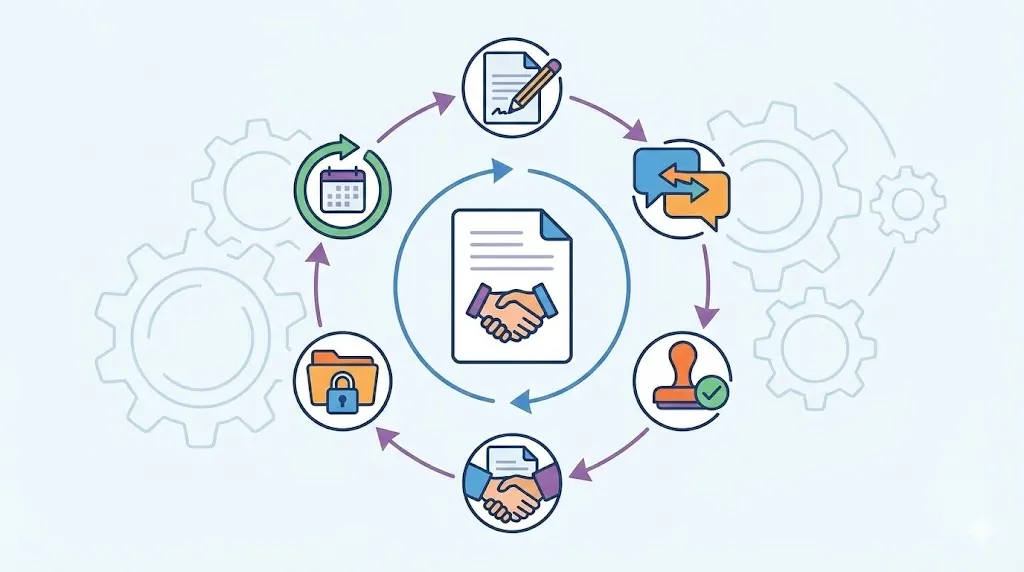
Contract lifecycle management (CLM) software combined with AI can transform contract review for M&A. These technologies offer:
Centralized Contract Repository
CLM software stores all contracts in one secure, searchable place. This eliminates scattered files and makes contracts easy to find.
Automated Metadata Extraction
AI tools scan contracts to extract key data like parties, dates, payment terms, and clauses. This saves time and improves accuracy.
Clause Identification and Risk Analysis
AI highlights important clauses such as change-of-control, assignment restrictions, and renewal terms. It flags risky or unusual language for review.
Contract Summaries
AI generates concise summaries of contract obligations, risks, and commercial terms. This helps stakeholders understand contracts quickly.
Version Control and Audit Trails
CLM systems track contract versions and changes with full audit history. This ensures the latest, fully executed contract is always accessible.
Workflow Automation
Approval workflows, notifications, and alerts keep contract review on track and prevent missed deadlines.
Integration with Enterprise Systems
CLM software connects with ERP, CRM, and other systems to provide a complete view of contract impact.
Faster Due Diligence and Integration
AI-powered contract analysis speeds up due diligence and post-merger contract assignment. This reduces deal cycle times and risks.
According to a report by MGI Research, companies without contract automation struggle to close deals because they cannot assess contract impact fully. AI and CLM tools help overcome this barrier.
Related articles: CLM Integration with CRM, CPQ, and ERP: A Complete Guide
What Happens After the Deal Closes?
Once the deal closes, contract management remains critical. The acquiring company must:
Ensure contracts are assigned to the appropriate legal entities in accordance with the deal terms.
Secure all required consents and finalize assignment agreements to officially effectuate the transfer.
Incorporate these contracts into existing management systems to maintain continuous and effective oversight.
Maintain ongoing tracking of obligations, renewal timelines, and compliance metrics throughout the expanded contract portfolio.
Address and mitigate risks and disputes that emerge from the newly acquired contractual commitments.
A lack of accurate contract data and centralized management tools can lead to disorder throughout this process. Such deficiencies often result in operational setbacks, overlooked deadlines, and breaches of compliance.
Related articles: What are Sign-In Wrap Agreements? Key Strategies For Success
Real-World Example of Contract Complexity in M&A
Consider a large company divesting a major business unit. The divestment involves:
Tens of thousands of contracts with customers, suppliers, and partners.
An extensive portfolio of intellectual property assets, including patents and trademarks, each requiring careful management.
Intricate assignment and consent protocols governing contract transfers.
A multidisciplinary team of hundreds of legal professionals managing the review and approval workflows.
A decade ago, this process required massive manual effort and custom repositories. Nowadays, the integration of AI with CLM software automates a significant portion of these tasks. AI technologies facilitate metadata extraction, clause identification, and systematic contract organization for efficient review. The impact is a substantial reduction in both time expenditure and operational costs associated with contract management.
For further insights, see: Contract Management Software for Sales Teams | CLM Guide
How to Prepare Your Contract Data for M&A
To enhance outcomes in M&A transactions, companies must prioritize centralizing contracts within a secure, fully searchable repository. Additionally, contracts require careful cleansing and restructuring to eliminate duplicates and outdated versions. Each contract demands precise application of metadata, including details such as parties involved, relevant dates, and classification categories. Extracting key clauses and generating accurate summaries of contractual obligations is facilitated by AI-driven tools. It is critical to conduct a thorough review of change-of-control and assignment provisions to uncover and address potential risks. Establishing clear workflows that outline responsibilities for contract review, approval processes, and assignment tracking is essential for organizational consistency. Targeted training programs are vital to elevate the expertise of legal and business personnel in managing contracts effectively. Integrating contract repositories with enterprise systems ensures unified operational insight across the organization.
These interventions work in concert to reduce risk exposure, streamline the due diligence phase, and support more efficient integration after mergers.
Related articles: Contract Audit Trails: Complete Guide & Best Practices 2026
Why Contract Management Software Matters
Contract management solutions serve as pivotal tools that convert complex contract data into structured, actionable insights. They provide:
A centralized repository for all contracts, which eliminates the inefficiencies caused by dispersed files.
Extraction of critical contract details through automation, significantly cutting down manual processing.
Analytical capabilities to detect and highlight potentially risky clauses and obligations.
Comprehensive dashboards and reports that offer real-time visibility into contract statuses and associated risks.
Automated workflows designed to ensure contract reviews proceed according to established timelines.
Robust access controls that safeguard sensitive contractual information.
Seamless interfacing with other enterprise systems, delivering an integrated operational perspective.
By implementing these systems, organizations enhance oversight of their contract portfolios, enabling accelerated and more assured decision-making in M&A contexts.
Related Article: How to Review M&A Agreements Without Missing Risks
How Volody’s Contract Management Software Supports M&A Success
Contract management software helps companies organize and analyze contracts efficiently during mergers and acquisitions. Additionally, volody incorporates AI-driven capabilities that extract essential contract data, pinpoint potential risks, and streamline workflow automation. This reduces manual review time and improves accuracy.
Volody’s platform features a centralized contract repository equipped with sophisticated search functions, comprehensive version control, and detailed obligation tracking. This empowers legal and operations teams to navigate complex contract portfolios with greater precision, supporting more informed decision-making. Integration with enterprise systems ensures that contract administration remains seamless throughout the post-merger phase.
Explore the advantages of Volody's CLM Software in transforming your contract management workflows.
FAQ
What defines reliable contract data within the M&A framework?
Additionally, well-maintained contract data guarantees that agreements are systematically organized, comprehensive, and stored to enable prompt retrieval and detailed analysis of critical information. It includes metadata like parties, dates, and clauses extracted accurately.
Why do insufficient contract records cause M&A deals to fail?
Insufficient documentation hides potential risks and liabilities that may emerge unexpectedly for buyers post-closing. They impede due diligence, triggering delays or renegotiations that diminish deal value or lead to collapse.
How does AI improve contract review during M&A?
Moreover, AI scans contracts to extract important data, identify risky clauses, and generate summaries. It speeds up review and reduces human errors in understanding complex contracts.
What are ownership transfer clauses and why do they matter?
Change-of-ownership clauses specify what happens to contracts if ownership changes. They may require consent or allow termination, impacting which contracts transfer in a deal.
How should companies prepare contract data before an M&A?
Furthermore, companies should centralize contracts, clean and tag data, extract key clauses with AI, and set up workflows for review and assignment. This preparation reduces risks and speeds the process.
What becomes of contracts after an acquisition closes?
Contracts must be assigned to the correct entity, consents obtained, and integrated into the acquirer’s systems. Ongoing management ensures obligations are met and risks controlled.
Can contract management software handle large volumes of contracts?
Also, yes, enterprise-grade software like Volody scales to manage tens of thousands of contracts, supporting complex deals and multiple business units.
Also, how does contract data affect deal valuation?
Complete agreements disclose risks and obligations that influence the price buyers are willing to pay. Missing or unclear contracts can lower valuation or cause disputes.
Is manual contract review still necessary?
Manual review may be needed for complex or high-risk contracts, but AI and software reduce the volume and speed up the process significantly.
What are common risks if contract data is not well managed in M&A?
Risks include missed deadlines, contract breaches, supply chain disruptions, compliance failures, and unexpected liabilities that can harm the business post-deal.
About the Company

Volody AI CLM is an Agentic AI-powered Contract Lifecycle Management platform designed to eliminate manual contracting tasks, automate complex workflows, and deliver actionable insights. As a one-stop shop for all contract activities, it covers drafting, collaboration, negotiation, approvals, e-signature, compliance tracking, and renewals. Built with enterprise-grade security and no-code configuration, it meets the needs of the most complex global organizations. Volody AI CLM also includes AI-driven contract review and risk analysis, helping teams detect issues early and optimize terms. Trusted by Fortune 500 companies, high-growth startups, and government entities, it transforms contracts into strategic, data-driven business assets.





" height="216.72211px" id="FYO0bO80Y" transform="translate(3 6.105)" width="206.073px"/><path d="M 108.174 222 C 88.432 222 70.303 217.239 53.785 207.717 C 37.267 198.196 24.173 185.052 14.504 168.285 C 4.835 151.312 0 132.165 0 110.845 C 0 89.731 4.835 70.792 14.504 54.025 C 24.173 37.052 37.267 23.804 53.785 14.282 C 70.303 4.761 88.432 0 108.174 0 C 128.116 0 146.246 4.761 162.562 14.282 C 179.08 23.804 192.073 37.052 201.541 54.025 C 211.21 70.792 216.044 89.731 216.044 110.845 C 216.044 132.165 211.21 151.312 201.541 168.285 C 192.073 185.052 179.08 198.196 162.562 207.717 C 146.044 217.239 127.915 222 108.174 222 Z M 108.174 183.189 C 120.864 183.189 132.044 180.291 141.713 174.495 C 151.382 168.492 158.936 160.006 164.375 149.035 C 169.814 138.064 172.533 125.334 172.533 110.845 C 172.533 96.355 169.814 83.729 164.375 72.965 C 158.936 61.994 151.382 53.611 141.713 47.815 C 132.044 42.02 120.864 39.122 108.174 39.122 C 95.483 39.122 84.202 42.02 74.332 47.815 C 64.663 53.611 57.109 61.994 51.67 72.965 C 46.231 83.729 43.511 96.355 43.511 110.845 C 43.511 125.334 46.231 138.064 51.67 149.035 C 57.109 160.006 64.663 168.492 74.332 174.495 C 84.202 180.291 95.483 183.189 108.174 183.189 Z" fill="rgba(255, 255, 255, 0.12)" height="222px" id="aa1McFcE9" transform="translate(227.183 3)" width="216.04399999999998px"/><path d="M 42.302 182.257 L 111.799 182.257 L 111.799 216.722 L 0 216.722 L 0 0 L 42.302 0 Z" fill="rgba(255, 255, 255, 0.12)" height="216.72211px" id="yRq4AnrsX" transform="translate(477.721 6.105)" width="111.79899999999998px"/><path d="M 108.174 222 C 88.432 222 70.303 217.239 53.785 207.717 C 37.267 198.196 24.173 185.052 14.504 168.285 C 4.835 151.312 0 132.165 0 110.845 C 0 89.731 4.835 70.792 14.504 54.025 C 24.173 37.052 37.267 23.804 53.785 14.282 C 70.303 4.761 88.432 0 108.174 0 C 128.116 0 146.246 4.761 162.562 14.282 C 179.08 23.804 192.073 37.052 201.541 54.025 C 211.21 70.792 216.045 89.731 216.045 110.845 C 216.045 132.165 211.21 151.312 201.541 168.285 C 192.073 185.052 179.08 198.196 162.562 207.717 C 146.044 217.239 127.915 222 108.174 222 Z M 108.174 183.189 C 120.864 183.189 132.044 180.291 141.713 174.495 C 151.382 168.492 158.936 160.006 164.375 149.035 C 169.814 138.064 172.534 125.334 172.534 110.845 C 172.534 96.355 169.814 83.729 164.375 72.965 C 158.936 61.994 151.382 53.611 141.713 47.815 C 132.044 42.02 120.864 39.122 108.174 39.122 C 95.483 39.122 84.202 42.02 74.332 47.815 C 64.663 53.611 57.108 61.994 51.67 72.965 C 46.231 83.729 43.511 96.355 43.511 110.845 C 43.511 125.334 46.231 138.064 51.67 149.035 C 57.108 160.006 64.663 168.492 74.332 174.495 C 84.202 180.291 95.483 183.189 108.174 183.189 Z" fill="rgba(255, 255, 255, 0.12)" height="222px" id="mo8HQspQ0" transform="translate(609.155 3)" width="216.04500000000007px"/><path d="M 73.727 0 C 95.885 0 115.324 4.45 132.044 13.351 C 148.967 22.252 161.957 34.982 171.027 51.541 C 180.287 67.894 184.917 86.937 184.917 108.671 C 184.917 130.405 180.287 149.449 171.027 165.801 C 161.957 181.947 148.967 194.47 132.044 203.371 C 115.324 212.271 95.885 216.722 73.727 216.722 L 0 216.722 L 0 0 Z M 72.216 179.773 C 94.374 179.773 111.497 173.564 123.583 161.144 C 135.669 148.724 141.713 131.233 141.713 108.671 C 141.713 86.109 135.669 68.515 123.583 55.888 C 111.497 43.055 94.374 36.638 72.216 36.638 L 42.302 36.638 L 42.302 179.773 Z" fill="rgba(255, 255, 255, 0.12)" height="216.72211px" id="I3iXX5Hi_" transform="translate(859.693 6.105)" width="184.91699999999992px"/><path d="M 185.22 0 L 113.91 141.273 L 113.91 216.722 L 71.61 216.722 L 71.61 141.273 L 0 0 L 47.74 0 L 93.06 99.046 L 138.08 0 Z" fill="rgba(255, 255, 255, 0.12)" height="216.72211px" id="nzHyWC0_d" transform="translate(1061.78 6.105)" width="185.22000000000003px"/></svg>)