

Key Highlights
Exclusive contracts grant one party the exclusive right to buy, sell, or deal with specific products or services, limiting competition. These agreements provide a competitive advantage by securing dedicated business relationships and market positions.
These agreements provide a competitive advantage by securing dedicated business relationships and market positions.
Key exclusivity clauses define the scope, duration, territory, and performance standards of the arrangement.
An exclusive agreement must be carefully drafted to avoid violating antitrust laws that prohibit anti-competitive practices.
Unlike non-exclusive deals, exclusive contracts create stronger commitments but reduce flexibility for both parties involved.
Termination provisions are crucial for outlining a clear exit strategy in case of breach or mutual agreement.
Introduction
In today's competitive landscape, businesses constantly seek ways to protect their interests and secure their market share. Exclusive contracts are powerful tools for achieving this, forming the foundation of many strategic business relationships. Whether you are a supplier, distributor, or buyer, understanding how these agreements work is vital. An exclusive arrangement can provide a significant competitive advantage, but it also comes with unique obligations and risks. This guide will walk you through the essentials of exclusive agreements to help you make informed decisions.
What is an Exclusive Contract?

Exclusive contracts are legally binding agreements where one or both parties commit to dealing only with each other for certain activities. This arrangement grants an exclusive right to one party, preventing them from engaging with competitors for a defined period.
The core function of these agreements is to restrict competition within the boundaries set by the contract terms. For example, a buyer might agree to purchase specific products solely from one seller. The scope of exclusivity can be limited to certain products, services, or geographical areas.
Meaning and Definition in Indian Legal Context
In the Indian legal context, exclusive contracts are primarily governed by the Competition Act of 2002. This Act aims to prevent practices that have an appreciable adverse effect on competition (AAEC) in India. Exclusive dealing agreements fall under scrutiny to ensure they do not stifle market competition unfairly.
The Competition Commission of India (CCI) evaluates exclusivity clauses to determine their impact. An agreement granting a sole right to a distributor or requiring a buyer to source only from one supplier is examined for its potential to create market barriers or foreclose competition. While not illegal outright, their legality depends on their effect on the market.
Essentially, if an exclusive dealing arrangement is found to harm competition significantly, the CCI has the power to intervene. Therefore, businesses must draft these agreements carefully to balance their commercial interests with the principles of fair competition outlined in Indian law.
How Exclusive Contracts Work in Business Relationships
In practice, exclusive contracts establish a focused and committed business relationship. When two parties enter an exclusive arrangement, they agree to specific limitations to protect their mutual business interests. The agreement grants one party an exclusive right, such as selling a product in a particular region, while restricting the other party from seeking similar deals with competitors.
A crucial element is the period of exclusivity, which defines the duration of the restriction. During this time, the parties are bound to the terms of the agreement. For instance, a "no-shop" clause can prevent a seller from entertaining other offers while negotiating a deal, giving the buyer the necessary time to conduct due diligence without distraction.
This structure provides stability and allows both parties to invest resources with confidence. The seller gets a guaranteed partner, and the buyer secures a unique product or service, creating a strong foundation for a strategic partnership.
Related Article: Types of Contracts Every Business Needs
Exclusive vs Non-Exclusive Contracts
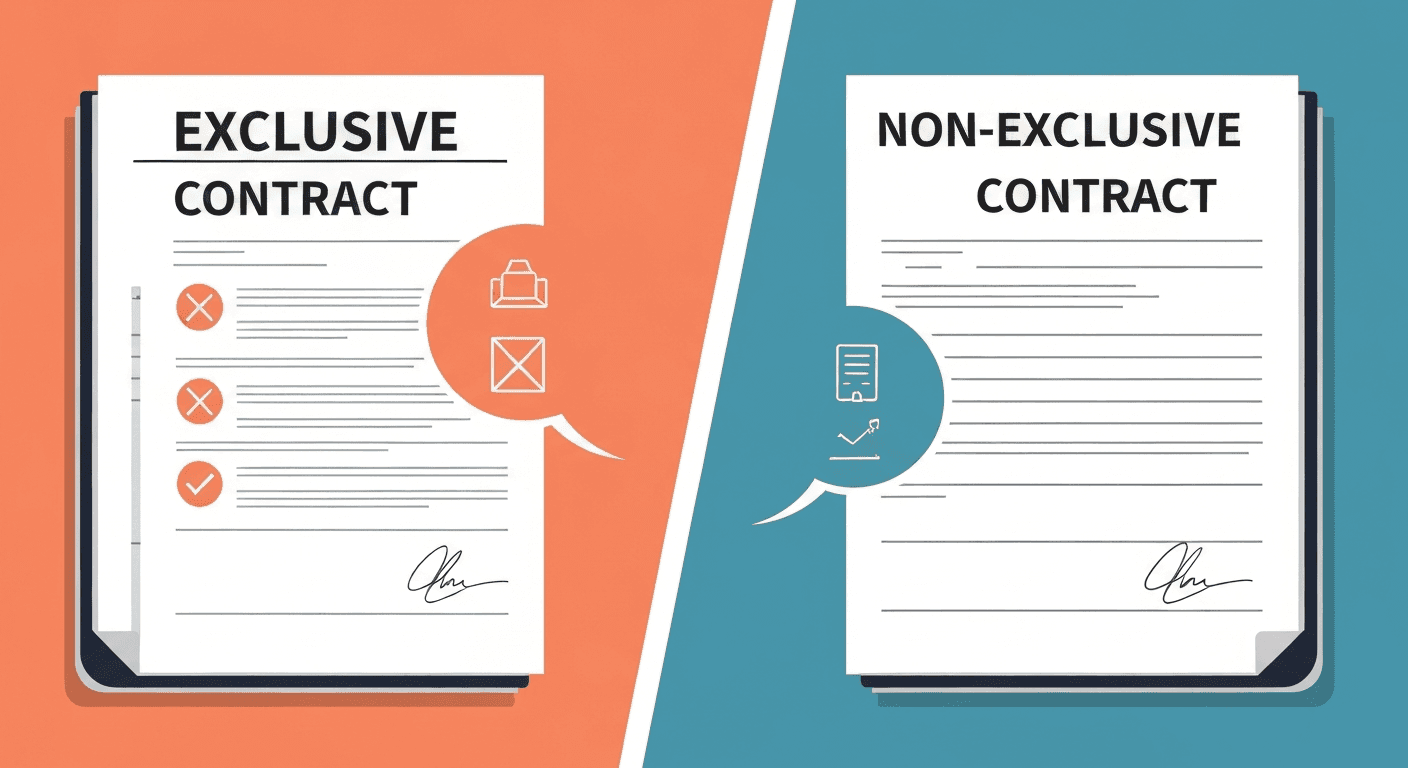
The primary difference between exclusive and non-exclusive contracts lies in the level of restriction. An exclusivity agreement provides one party with sole rights, creating a closed partnership that offers a strong competitive advantage. This means other competitors are barred from participating for a set duration.
In contrast, a non-exclusive contract allows a company to engage with multiple partners simultaneously for the same product or service. This approach offers greater flexibility but less security and market protection compared to an exclusive deal. The choice between them depends on your business goals and strategic priorities.
Key Differences in Rights and Obligations
The rights and obligations of parties differ significantly between exclusive and non-exclusive agreements. In an exclusive contract, one party is granted an exclusive right, giving them sole authority over a specific activity. This creates a high level of obligation, as that party is expected to perform and deliver results without competition from others engaged by the same partner.
Conversely, a non-exclusive agreement allows for multiple partners, meaning rights and obligations are shared and less stringent. There is no sole authority, and parties are free to work with others. The terms are often more flexible and can be adjusted by mutual consent without impacting other partnerships.
Here is a simple comparison of their rights and obligations:
Feature | Exclusive Contract | Non-Exclusive Agreement |
|---|---|---|
Partner Engagement | Restricts dealing with competitors. | Allows working with multiple partners simultaneously. |
Market Rights | Grants an exclusive right and sole authority in a defined area. | No exclusive rights; partners compete with each other. |
Commitment Level | High commitment required from both parties. | Lower commitment, offering more flexibility. |
Performance Pressure | Higher pressure to meet targets and standards. | Less pressure as risk is spread across multiple partners. |
Advantages and Drawbacks of Each Approach
Exclusive contracts offer a significant competitive advantage by securing a dedicated partner and market position. This focused relationship often leads to better quality control, cost efficiencies from volume commitments, and stronger brand loyalty. However, the main drawback is dependency; if your exclusive partner underperforms, your business can suffer. There are also potential additional costs if minimum fee triggers are included.
On the other hand, non-exclusive contracts provide greater flexibility. You can work with multiple suppliers or distributors, reducing reliance on a single source and hedging risks. This approach can also foster healthy competition among partners, potentially leading to better pricing and service.
Here are some key points to consider:
Exclusive Contracts: Offer market protection but create dependency.
Non-Exclusive Contracts: Provide flexibility but less commitment from partners.
Risk: Exclusivity concentrates risk, while non-exclusivity spreads it.
Investment: Exclusive deals often require a higher investment of time and resources from both sides.
Related Article: What are Contract Obligations and How to Manage Them
When Should a Business Use an Exclusive Agreement?

A business should consider using an exclusive agreement when its primary goal is to build deep, strategic partnerships and protect key business interests. These contracts are ideal when you need to secure a supply chain, protect sensitive product features, or establish a strong foothold in a new market without immediate competition.
An exclusive agreement is also beneficial during critical negotiations, such as mergers and acquisition or securing initial investors. By setting a clear exclusivity period, you can ensure that all parties remain focused on finalising the deal without being distracted by competing offers.
Common Scenarios for Implementing Exclusivity Clauses
Exclusivity clauses are implemented in various business scenarios to gain strategic advantages. One common situation is in distribution, where a manufacturer grants a distributor the exclusive right to sell products in a specific territory. This helps the distributor invest in marketing and building a market position without fear of competition from other distributors of the same brand.
Another key scenario is within the supply chain. A company might enter an exclusive purchasing agreement with a supplier to guarantee the quality and availability of essential materials. During mergers and acquisitions, an exclusivity period is often used to prevent the target company from seeking other buyers while due diligence is underway.
Here are a few common scenarios:
Investor Negotiations: A startup may grant an investor an exclusive period to finalise funding terms.
Distribution Deals: A brand gives a single distributor rights for a specific region.
Major Client Onboarding: A business provides a new client with exclusive access to a product during a pilot phase.
Supplier Agreements: A manufacturer agrees to source a specific component from only one supplier.
Related Article: What are Contract Obligations and How to Manage Them
Situations Where Non-Exclusivity Might Be Better
There are several situations where a non-exclusive agreement is the more strategic choice. If your business prioritises greater flexibility and wants to avoid being tied to a single partner, non-exclusivity is ideal. This approach allows you to work with multiple suppliers, which can lead to competitive pricing and a more resilient supply chain.
For businesses looking to scale quickly or test different markets, a non-exclusive agreement enables you to engage various distributors without long-term commitments. It is also beneficial when the supply of goods is readily available from many sources, as it lets you shop around for the best terms and a lower price.
Consider a non-exclusive agreement when:
You want to maintain a diverse network of suppliers or distributors.
The product or service is a commodity with many available providers.
Your business goal is rapid market penetration rather than deep market control.
Legal and Regulatory Risks of Exclusive Contracts

While exclusive contracts offer many benefits, they also come with significant legal risks, particularly concerning antitrust laws. If an agreement is seen as substantially limiting competition or creating a monopoly, it can face legal challenges. Courts and regulatory bodies may scrutinise contracts that give one party too much market power.
Another risk involves the handling of confidential information. During an exclusive partnership, parties often share sensitive business data. If this information is not properly protected through confidentiality clauses, it can lead to disputes and potential harm to your business.
Antitrust and Competition Law Considerations in India
In the Indian legal context, exclusive dealing contracts are carefully examined under antitrust laws, specifically the Competition Act of 2002. The primary concern is whether such agreements cause an appreciable adverse effect on competition (AAEC). The Competition Commission of India (CCI) does not view all exclusive contracts as illegal, but it does investigate their impact on the market.
The CCI considers several factors, such as the market share of the parties involved and whether the contract creates barriers for new entrants or drives existing competitors out of the market. If a company with a dominant market position uses exclusive dealing contracts to foreclose competition, it is likely to attract regulatory scrutiny.
Therefore, businesses in India must be mindful of these antitrust laws when structuring exclusive agreements. It is crucial to ensure that the restrictions are reasonable and do not unfairly limit competition, otherwise, you could face penalties and be forced to amend or terminate the contract.
Addressing Potential Disputes and Remedies
To minimise the impact of potential conflicts, exclusive contracts should include clear dispute resolution mechanisms. These clauses specify how disagreements will be handled, saving both parties time and money compared to lengthy court battles. Arbitration is a common method, where a neutral third party helps resolve the dispute outside of court.
The agreement should also outline the remedies available in case of a breach. These can include monetary damages to compensate the injured party for losses incurred. In some cases, the contract may specify liquidated damages, which are pre-agreed amounts payable for a breach. This provides certainty and avoids the need to calculate damages after a dispute arises.
Ultimately, acting in good faith is crucial for maintaining a healthy partnership. However, having well-defined dispute resolution pathways and remedies ensures that if disagreements do occur, they can be managed efficiently and fairly.
Industry-Specific Examples of Exclusive Agreements
Exclusive agreements are adapted to fit the needs of different industries, offering unique strategic advantages. In the technology sector, an exclusive license might grant a company the sole right to use a specific piece of intellectual property. In manufacturing, an exclusive supply agreement ensures a consistent source of materials.
These arrangements allow businesses to secure their supply chains, protect valuable assets, and achieve market control. By choosing an exclusive partner, a company can build a focused relationship designed to maximise its competitive edge in a particular market.
Exclusive Supply and Distribution Arrangements
Exclusive supply contracts are common in manufacturing, where a buyer agrees to purchase all its required goods from a single supplier. This arrangement helps streamline the supply chain and often comes with benefits like preferential pricing and guaranteed availability of materials. It fosters a close relationship between the buyer and supplier, aligning their business goals.
Similarly, an exclusive distribution agreement is frequently used in retail and consumer goods. In this setup, a manufacturer grants a distributor the sole right to sell its products within a specific geographic territory. This incentivises the distributor to invest heavily in marketing and sales efforts, as they will reap all the rewards in that area.
Both types of agreements are designed to create a dedicated partnership. They provide stability and predictability, allowing both parties to plan and invest with confidence, knowing their roles in the supply chain are secure.
Exclusive Purchasing Agreements and Their Benefits
An exclusive purchasing agreement, also known as an exclusive vendor agreement, is a contract where a buyer commits to sourcing specific goods or services from only one seller. This arrangement gives the buyer significant leverage and can be a powerful tool for securing favourable terms.
By committing their entire purchase volume to one vendor, the buyer gains considerable buyer power. This often translates into better pricing, higher service levels, and priority treatment. For the seller, the agreement guarantees a steady stream of revenue and a dedicated channel for their products, essentially securing one of their sales outlets.
This type of exclusivity benefits both parties by creating a stable and predictable business relationship. The buyer secures a reliable supply, while the seller gains a loyal customer, making it a mutually advantageous partnership.
Conclusion
In conclusion, understanding exclusive contracts is crucial for businesses aiming to navigate their relationships effectively while minimising legal risks. By grasping the nuances of exclusivity, organisations can leverage these agreements to secure competitive advantages and foster trust with partners. It’s essential to weigh the benefits against potential drawbacks, particularly concerning antitrust regulations and market dynamics. As you consider implementing exclusive agreements, reflect on the specific needs of your business and industry context. Take the time to draft clear, comprehensive contracts that protect your interests while adhering to legal standards. For further insights and tailored guidance, don't hesitate to reach out and get a free consultation.
About the Company

Volody AI CLM is an Agentic AI-powered Contract Lifecycle Management platform designed to eliminate manual contracting tasks, automate complex workflows, and deliver actionable insights. As a one-stop shop for all contract activities, it covers drafting, collaboration, negotiation, approvals, e-signature, compliance tracking, and renewals. Built with enterprise-grade security and no-code configuration, it meets the needs of the most complex global organizations. Volody AI CLM also includes AI-driven contract review and risk analysis, helping teams detect issues early and optimize terms. Trusted by Fortune 500 companies, high-growth startups, and government entities, it transforms contracts into strategic, data-driven business assets.







" height="216.72211px" id="FYO0bO80Y" transform="translate(3 6.105)" width="206.073px"/><path d="M 108.174 222 C 88.432 222 70.303 217.239 53.785 207.717 C 37.267 198.196 24.173 185.052 14.504 168.285 C 4.835 151.312 0 132.165 0 110.845 C 0 89.731 4.835 70.792 14.504 54.025 C 24.173 37.052 37.267 23.804 53.785 14.282 C 70.303 4.761 88.432 0 108.174 0 C 128.116 0 146.246 4.761 162.562 14.282 C 179.08 23.804 192.073 37.052 201.541 54.025 C 211.21 70.792 216.044 89.731 216.044 110.845 C 216.044 132.165 211.21 151.312 201.541 168.285 C 192.073 185.052 179.08 198.196 162.562 207.717 C 146.044 217.239 127.915 222 108.174 222 Z M 108.174 183.189 C 120.864 183.189 132.044 180.291 141.713 174.495 C 151.382 168.492 158.936 160.006 164.375 149.035 C 169.814 138.064 172.533 125.334 172.533 110.845 C 172.533 96.355 169.814 83.729 164.375 72.965 C 158.936 61.994 151.382 53.611 141.713 47.815 C 132.044 42.02 120.864 39.122 108.174 39.122 C 95.483 39.122 84.202 42.02 74.332 47.815 C 64.663 53.611 57.109 61.994 51.67 72.965 C 46.231 83.729 43.511 96.355 43.511 110.845 C 43.511 125.334 46.231 138.064 51.67 149.035 C 57.109 160.006 64.663 168.492 74.332 174.495 C 84.202 180.291 95.483 183.189 108.174 183.189 Z" fill="rgba(255, 255, 255, 0.12)" height="222px" id="aa1McFcE9" transform="translate(227.183 3)" width="216.04399999999998px"/><path d="M 42.302 182.257 L 111.799 182.257 L 111.799 216.722 L 0 216.722 L 0 0 L 42.302 0 Z" fill="rgba(255, 255, 255, 0.12)" height="216.72211px" id="yRq4AnrsX" transform="translate(477.721 6.105)" width="111.79899999999998px"/><path d="M 108.174 222 C 88.432 222 70.303 217.239 53.785 207.717 C 37.267 198.196 24.173 185.052 14.504 168.285 C 4.835 151.312 0 132.165 0 110.845 C 0 89.731 4.835 70.792 14.504 54.025 C 24.173 37.052 37.267 23.804 53.785 14.282 C 70.303 4.761 88.432 0 108.174 0 C 128.116 0 146.246 4.761 162.562 14.282 C 179.08 23.804 192.073 37.052 201.541 54.025 C 211.21 70.792 216.045 89.731 216.045 110.845 C 216.045 132.165 211.21 151.312 201.541 168.285 C 192.073 185.052 179.08 198.196 162.562 207.717 C 146.044 217.239 127.915 222 108.174 222 Z M 108.174 183.189 C 120.864 183.189 132.044 180.291 141.713 174.495 C 151.382 168.492 158.936 160.006 164.375 149.035 C 169.814 138.064 172.534 125.334 172.534 110.845 C 172.534 96.355 169.814 83.729 164.375 72.965 C 158.936 61.994 151.382 53.611 141.713 47.815 C 132.044 42.02 120.864 39.122 108.174 39.122 C 95.483 39.122 84.202 42.02 74.332 47.815 C 64.663 53.611 57.108 61.994 51.67 72.965 C 46.231 83.729 43.511 96.355 43.511 110.845 C 43.511 125.334 46.231 138.064 51.67 149.035 C 57.108 160.006 64.663 168.492 74.332 174.495 C 84.202 180.291 95.483 183.189 108.174 183.189 Z" fill="rgba(255, 255, 255, 0.12)" height="222px" id="mo8HQspQ0" transform="translate(609.155 3)" width="216.04500000000007px"/><path d="M 73.727 0 C 95.885 0 115.324 4.45 132.044 13.351 C 148.967 22.252 161.957 34.982 171.027 51.541 C 180.287 67.894 184.917 86.937 184.917 108.671 C 184.917 130.405 180.287 149.449 171.027 165.801 C 161.957 181.947 148.967 194.47 132.044 203.371 C 115.324 212.271 95.885 216.722 73.727 216.722 L 0 216.722 L 0 0 Z M 72.216 179.773 C 94.374 179.773 111.497 173.564 123.583 161.144 C 135.669 148.724 141.713 131.233 141.713 108.671 C 141.713 86.109 135.669 68.515 123.583 55.888 C 111.497 43.055 94.374 36.638 72.216 36.638 L 42.302 36.638 L 42.302 179.773 Z" fill="rgba(255, 255, 255, 0.12)" height="216.72211px" id="I3iXX5Hi_" transform="translate(859.693 6.105)" width="184.91699999999992px"/><path d="M 185.22 0 L 113.91 141.273 L 113.91 216.722 L 71.61 216.722 L 71.61 141.273 L 0 0 L 47.74 0 L 93.06 99.046 L 138.08 0 Z" fill="rgba(255, 255, 255, 0.12)" height="216.72211px" id="nzHyWC0_d" transform="translate(1061.78 6.105)" width="185.22000000000003px"/></svg>)