
The 15 leading legal AI software tools for 2026 enable legal teams to reduce review time, improve consistency, and surface contract data faster. A legal operations leader may face 600 agreements before quarter end. The team cannot add headcount for every spike. The right tool acts like a reliable second set of eyes, while lawyers retain control over judgment, advice, and risk.
TL;DR
Legal AI now supports research, drafting, review, workflow control, analytics, and contract obligations.
The strongest tools match a clear use case instead of trying to solve every legal problem.
Before buying, assess the platform's security and accuracy, its integrations and audit trails, and the controls for human oversight.
For legal analysis, use a research platform; contract intake and lifecycle control generally belong in a CLM tool.
Begin with a measured pilot, establishing success metrics in advance, limiting the data to approved sources, and documenting a clear review process.
Volody combines AI review, drafting, workflows, search, approvals, signatures, and obligation tracking.
What is legal AI software?
Legal AI software combines machine learning, language models, and legal data to support legal work. Additionally, it can review documents, identify patterns, summarize terms, propose language, and answer research questions. Because each product is designed around a particular workflow, buyers should not assume that all tools are interchangeable.
Research platforms are designed to search cases, statutes, regulations, and secondary sources. Contract tools, by contrast, compare language with a playbook. Workflow platforms handle operational processes by routing requests, collecting approvals, and tracking deadlines. Some products cover several tasks, but each tool still has a primary strength.
Legal AI does not replace legal judgment. A model may flag a missing limitation of liability clause. Whether that omission matters for the deal remains a question for the lawyer. Answering it requires weighing the business context, negotiation goals, and local law.
Reliable results depend on clear instructions and trusted source material. Teams should establish approved templates, review rules, escalation points, and user roles. Before permitting broad use, they should test the results against known documents.
The American Bar Association’s Formal Opinion 512 discusses duties that arise when lawyers use generative AI. Those duties include competence, confidentiality, supervision, communication, and reasonable fees. These duties should shape every legal AI buying decision.
Related articles: Why Legal Teams Must Embrace AI for Legal Research Now
How legal teams use AI software
Legal teams use AI across both legal advice and daily operations. Additionally, the strongest use cases tend to share three traits. They involve repeatable work, large document volumes, or information that teams often struggle to locate.
Common uses include:
Summarizing agreements for business leaders
Comparing clauses against approved positions
Finding cases and regulations
Drafting first versions from templates
Extracting dates, parties, fees, and obligations
Routing contract requests to the right team
Tracking renewals, notices, and deliverables
Finding unusual terms across a contract portfolio
Preparing reports for audits and management meetings
Consider a procurement team that sends legal 80 vendor agreements each month. A contract AI tool can extract key terms and flag deviations before a lawyer begins review. The lawyer then spends time on material risks rather than basic data collection.
A litigation group may use AI to group documents by issue, create summaries, and find references to key events. A research team may ask a platform to identify relevant authority across several jurisdictions. In each case, the tool reduces search time, but a qualified person still checks the result.
Adoption also creates new work. Teams must manage prompts, access rights, model updates, training, and quality checks. They need a process for reporting bad outputs. They also need rules for confidential data and client information.
A 2025 report from Thomson Reuters found growing use of generative AI across professional services. It also raises concerns about accuracy, privacy, and trust. Taken together, those findings reflect the opportunity—and the caution—shaping the current buying environment.
Related articles: New AI Regulations Every Legal Team Should Know
Main categories of legal AI tools
Legal AI products generally fall into several groups. Some products cross these groups, but the distinction helps buyers compare tools with similar jobs.
Legal research and case analysis
These tools search legal authorities and return related results. Several also summarize cases, set competing positions side by side, and tie their answers to the underlying authorities. What they deliver depends largely on the breadth of their source coverage, the reliability of their citations, and the jurisdictions they support.
Contract review and analysis
Contract comparison features measure agreements against playbooks and approved clause sets. Depending on the system, the findings can range from missing language and atypical phrasing to broader business risk. In stronger products, reviewers can follow each finding back to the relevant source text.
Contract drafting and negotiation
Using templates, clause libraries, and user inputs, drafting systems produce initial versions of agreements. As negotiations proceed, they track redlines and comments together with fallback language and approval status.
Workflow and document automation
Moreover, these products manage intake, forms, routing, approvals, and repeatable documents. By centralizing those steps, they can reduce email traffic and manual handoffs.
Legal analytics
With these tools, teams can examine matter data, outside counsel spend, contract terms, and case trends. They turn stored information into reports that support planning and risk decisions.
Contract lifecycle management
CLM platforms manage contracts from request through renewal. Typical capabilities include templates, review, signatures, repositories, alerts, search, and reporting. They are particularly useful when a team needs control across the full contract process.
For related reading, see AI in Law: Smart Contracts & Legal Automation Tools
Features to check before buying legal AI
A polished demonstration can obscure substantial gaps, so treat the product demonstration as only an initial indication of capability. Additionally, before selecting a product, conduct a structured review. Have vendors walk you through live workflows instead of showing only prepared examples.
Accuracy and source support
For each answer or finding, determine what evidence the product provides. In legal research, that means providing citations and links to the underlying sources. For example, a contract tool should point to the precise clause behind a warning.
Test the system with difficult documents. Include scanned files, poor formatting, amended agreements, schedules, and agreements from different jurisdictions. Record false positives and missed issues as well.
Data protection and access controls
Examine how the vendor stores, encrypts, and processes your information, including whether customer data is used to train public models. Examine retention rules, deletion methods, backups, and incident response.
Role-based access matters too. A procurement user may need supplier terms, but not privileged litigation files. Moreover, look for permissions by team, region, matter, entity, and document type.
The National Institute of Standards and Technology AI Risk Management Framework offers a useful structure for reviewing AI risks. Its approach covers governance, measurement, mapping, and risk management.
Workflow flexibility
Your process will change after launch. Choose a tool that lets administrators update forms, fields, rules, templates, and approval paths without constant coding work.
Exceptions deserve particular attention. An effective workflow routes unusual requests to a lawyer. Every contract should not be forced through a single rigid path.
Integrations
Legal work typically spans multiple applications. Check connections with Microsoft 365, Word, CRM, ERP, procurement, identity management, storage, and electronic signature systems.
An integration should reduce duplicate entry. Furthermore, it should also preserve records, permissions, and audit history. Have vendors demonstrate how data moves between systems.
Auditability and human review
The product should record who changed a document, approved a clause, or completed a task. It should preserve versions and show the history of important actions.
Human review should remain clear. Therefore, users need a simple way to accept, reject, edit, or explain an AI suggestion. The system should not hide uncertainty behind a confident answer.
Total cost
Look beyond the license fee. Include setup, data migration, training, integrations, support, internal administration, and future user growth.
Set a baseline before the pilot. During the pilot, track how long reviews take, how quickly requests receive responses, search time, missed deadlines, and user adoption. Its value should be measured by whether it improves a defined process—not by whether it adds another dashboard.
See also: AI Contract Review vs. Human Lawyers: Speed, Accuracy & ROI
Benefits of legal AI software
Legal AI can create value in several ways, but results depend on process design. Additionally, a new tool applied to a weak process usually just makes that process fail faster.
Faster first reviews
AI can identify key terms before a lawyer starts detailed analysis. This helps teams prioritize high-risk documents and move simple agreements through a shorter path.
More consistent analysis
A shared playbook gives reviewers common rules. It can bring greater consistency across teams, offices, and outside counsel. Reviewers can still adjust those rules when a matter calls for a different approach.
Better access to contract data
A searchable repository lets teams retrieve information on terms, renewals, and obligations. Instead of digging through inboxes and shared drives each time, staff can retrieve the answer directly.
Fewer missed dates
Alerts can also flag renewals, notice periods, deliverables, and payment events. These reminders help prevent avoidable costs and missed business rights.
Better use of legal expertise
Automation handles routine work. Lawyers can then focus on negotiation strategy, complex advice, dispute prevention, and business partnership.
The World Economic Forum Future of Jobs Report 2025 describes AI and information processing as major forces affecting work. Legal departments should plan for skill changes, not only tool purchases. Training, review standards, and role design will shape the final result.
Related articles: Can AI Replace Lawyers? Exploring the Future of Legal AI
Best all-around legal AI tools
The best general tool depends on your work, data, and required controls. Additionally, no product wins every category. The list below gives a practical starting point for evaluation.
Harvey: A broad platform for legal research, drafting, analysis, and matter support. Firms and enterprise legal teams that need custom workflows and rigorous professional review are likely to consider it a good fit.
Thomson Reuters CoCounsel: An AI assistant connected to Thomson Reuters legal content and workflow tools. Its core uses include research, document review, summarization, and drafting.
Lexis+ AI: The platform centers on research, with conversational search, summaries, and drafting support built in. Teams already working with Lexis legal content will find it a natural fit.
Westlaw Precision AI: Within Westlaw, it supports AI-assisted research questions, summaries, and source discovery. Its established case law coverage and linked citations make it well suited to firms with those requirements.
vLex Vincent AI: Drawing on vLex content, Vincent AI brings together legal research and analytical tools. It also lets users compare legal authorities and pursue questions across multiple jurisdictions.
Bloomberg Law AI: The platform brings a suite of AI capabilities into Bloomberg Law. Alongside legal and business information, it supports research and case analysis.
These products center primarily on research, analysis, and broader legal work. During evaluation, buyers should verify content coverage, jurisdiction support, confidentiality terms, and administrative controls.
Related articles: Choosing Legal AI Tools That Work: The 4 Cs Framework
Best legal AI tools for research
Research tools can save time, but source quality matters more than a smooth chat screen. Additionally, ask, too, whether the tool searches primary law, secondary materials, practical guidance, or all three.
Clio Duo: An AI assistant within the Clio ecosystem. Its capabilities vary by configuration, but may include drafting, summarization, and practice management.
vLex Vincent AI: For teams conducting cross-border research, this tool may merit a place on the shortlist. That usefulness, however, will turn on which jurisdictions and source types it covers.
Lexis+ AI: Researchers can use Lexis+ AI to pose questions in plain language. Even so, users should open each cited authority and verify it before relying on the answer.
Westlaw Precision AI: It can accelerate the initial research stage. Reviewers need to check each authority's complete holding, procedural history, and current status.
Use real questions from recent matters in the research pilot. The test set should include easy, narrow, and complex questions. Evaluate the pilot against citation accuracy, missing authorities, summary quality, and time saved.
The pilot should also test how the product handles uncertain questions. The system should distinguish a supported answer from a conclusion based on limited material. That distinction protects both quality and user trust.
Related articles: Top 9 Legal AI Tools in 2026: Elevate Your Legal Process
Best legal AI tools for contract review
Contract review tools work best when a team has clear policies. Additionally, before testing a product, define preferred language, fallback positions, approval thresholds, and prohibited terms.
Spellbook: An AI drafting and review tool that works with Microsoft Word. It helps users review clauses, draft language, and suggest edits inside a familiar document environment.
Luminance: Luminance supports contract review, classification, and portfolio insight, with capabilities that extend beyond individual agreements. This portfolio-level perspective suits teams handling large volumes of agreements.
Litera Kira: Users can use Litera Kira to extract information from contracts and review their provisions. It supports matters ranging from due diligence and lease review to other document-intensive work.
Lawgeex: Lawgeex automates contract review against defined policies. For repeatable agreements, it applies established legal rules consistently.
Evisort: Evisort brings contract management and analysis together, covering extraction, search, and lifecycle processes. It is designed for teams that need contract data beyond the scope of a single review.
Moreover, review tools differ in how they handle negotiated language. Some focus on risk detection. Others offer drafting suggestions, clause comparisons, or workflow routing. In testing, buyers should examine amendments, exhibits, nonstandard clauses, and contracts with inconsistent formatting.
Use the following test structure:
Begin with a sample of 20 to 30 completed agreements.
For each agreement, document the known issues and accepted exceptions.
Run the documents through every shortlisted tool.
Then compare each tool's output with the human review record.
Assess the results by time, accuracy, editing effort, and user confidence.
Once the vendor adjusts the playbook, repeat the exercise.
A high volume of findings is not, by itself, enough to judge a tool. Systems that flag every unusual phrase can burden lawyers with noise. The more meaningful question is whether the tool identifies material issues and explains each result.
Related reading: Best Word Add-Ins to Automate Legal Document Drafting
Best tools for legal automation
Automation tools address the work around legal analysis. Additionally, they also collect requests, create documents, route reviews, and keep stakeholders informed.
Contract and workflow products may include:
Guided intake forms
Approved templates
Dynamic fields
Clause libraries
Automated routing
Approval reminders
Electronic signatures
Version history
Contract repositories
Microsoft Word access
Obligation alerts
A legal intake portal can replace a shared mailbox. A requester answers structured questions, uploads relevant files, and selects a needed date. From there, the system assigns the request, applies a service level, and displays its status, reducing the need for repeated emails.
Microsoft 365 Copilot: Inside Microsoft applications, this general enterprise assistant supports drafting, summarization, and other information work. Permissions require careful configuration, and legal teams should not treat Copilot as a dedicated legal authority.
Automation needs clear ownership. Decide who maintains templates, who approves playbook changes, and who handles exceptions. Without ownership, automated workflows can preserve outdated rules at high speed.
The Office of the Comptroller of the Currency has highlighted broader technology and third-party risks in financial services. Legal teams in regulated sectors should connect automation reviews with existing vendor risk programs.
Related articles: Contract Risk Analysis Strengthened By AI In Legal Ops
Best tools for legal data and analytics
Analytics helps leaders answer questions that individual documents cannot answer. It can also show where delays, demand, exceptions, and missed reviews concentrate: which contract types take longest, which business units create the most requests, which suppliers receive frequent exceptions, and which agreements renew without review.
Clean data is the foundation for useful analytics. A dashboard cannot fix missing dates, inconsistent names, or contracts stored outside the main repository. Plan data standards before building reports.
Useful measures include:
Request volume by business unit
Average review time
Approval cycle time
Contracts by risk level
Renewal value and notice dates
Open obligations
Clause deviation frequency
Outside counsel spend
User adoption
AI finding acceptance rates
Analytics can also reveal process problems. A spike in approval time may point to one senior approver. A high rate of clause overrides may show that the playbook no longer fits business needs.
For legal leaders, metrics only become useful once they are read in context. A shorter cycle, for example, may simply reflect a lower mix of complex contracts. Likewise, high adoption may coexist with work of poor quality. Operational metrics should therefore be assessed alongside legal outcomes, risk findings, and stakeholder feedback.
For further reading, see AI Contract Review: Enhancing Legal Workflow Efficiency
How to evaluate legal AI software
Start with the business problem, not a product category. Additionally, add a sentence describing the current pain. For example, “Legal cannot identify renewal obligations across supplier contracts without manual review.”
Then define the target result. You might aim to reduce first review time by 30 percent, answer contract questions within five minutes, or route standard requests within one business day.
Evaluate the process in the following order:
Begin by mapping the current process.
Next, identify the points at which delays, rework, or manual entry arise.
Document the requirements for data, security, and access.
For testing, use representative documents and questions drawn from actual work.
Limit the pilot to a defined period.
Moreover, assess the pilot against accuracy, usability, controls, and integration effort.
Before deployment at scale, assign clear ownership.
Include legal, operations, security, procurement, finance, and business users. The risks differ across those groups. For security, data movement may be the central concern. Legal will likely prioritize confidentiality and accuracy. Furthermore, for business teams, the primary concerns are generally speed and ease of use.
Ask vendors the following questions:
Which model powers the feature?
Is customer data used to train shared models?
What sources or supporting evidence are visible to users in the product?
When confidence is low, how does the product respond?
Can an administrator modify rules without writing code?
Also, what record of user actions does the system retain for audit purposes?
If we stop using the product, can all of our data be exported?
What support do you provide for implementation and adoption?
Which integrations are included in the stated price?
What methodology do you use to measure accuracy?
A short pilot can expose problems that a sales demonstration will not. Include difficult documents and ordinary users. Test the process from intake through reporting, not only the AI feature.
Related articles: How to maintain ethically use AI in Legal Operations
How CLM software solves contract workflow problems
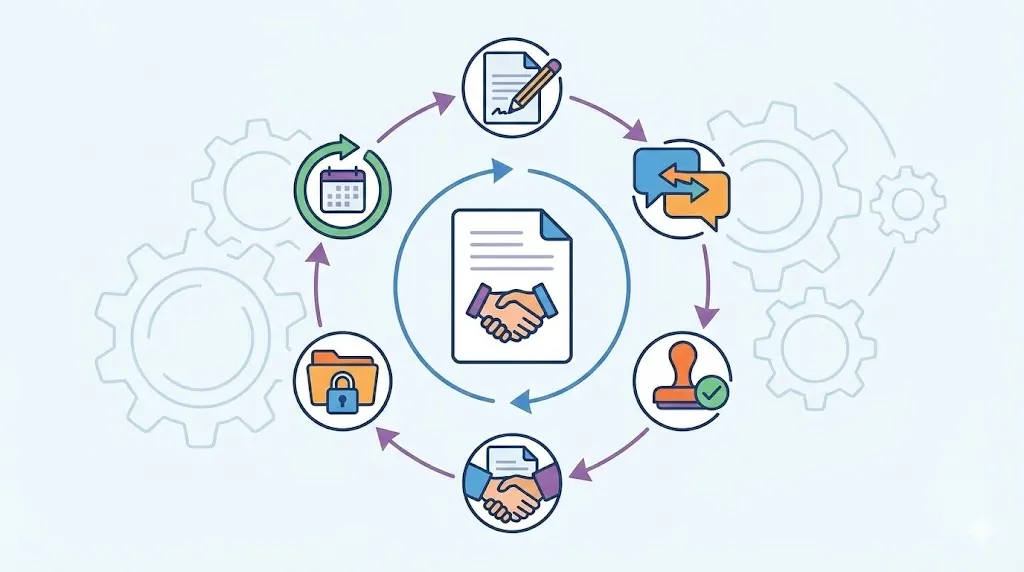
Generic CLM software gives legal teams one place to request, draft, review, approve, sign, store, and monitor contracts. Additionally, it can also combine AI review with templates, clause libraries, search, alerts, and audit trails. That shared process helps legal and business teams work from the same record.
Volody adds AI drafting, review, clause recommendations, summaries, metadata extraction, approval workflows, electronic signatures, repository search, obligation tracking, and dashboards. Teams can also use role based permissions, version control, Microsoft Word access, OCR, and no code configuration.
Ready to make contract management more efficient? Learn more about Volody's CLM Software.
FAQ
What is the best legal AI software for law firms?
Additionally, the right choice turns on the firm’s work, jurisdictions, and data needs. Research heavy firms may prefer a legal research platform, while transactional teams may need drafting, review, and workflow tools.
Can legal AI replace lawyers?
Legal AI can complete repeatable tasks, but it cannot replace professional judgment. Lawyers must review important outputs, advise clients, manage risk, and take responsibility for legal work.
Is legal AI safe for confidential information?
The relevant safeguards are the vendor’s controls and your configuration. Review encryption, retention, model training rules, access permissions, audit logs, and incident response before uploading confidential information.
How accurate are AI contract review tools?
Accuracy varies by document type, playbook quality, and system configuration. Test tools with known agreements, measure missed issues and false alerts, and keep human review for material decisions.
What metrics should a legal AI pilot track?
Assess time saved, finding accuracy, user adoption, review effort, workflow completion, and integration work, then track whether the tool reduces missed dates, rework, and unnecessary escalations.
Which should legal teams buy first: a research tool or a CLM platform?
Choose based on the largest operational problem. Buy research software for authority discovery and legal analysis. Buy CLM software when contract intake, approval, storage, and obligation tracking cause the greatest strain.
How long does legal AI implementation take?
A focused pilot may take several weeks. A full rollout takes longer because it includes data migration, workflow design, security review, user training, integrations, and governance.
What defines enterprise readiness for legal AI?
Enterprise readiness requires strong security, reliable permissions, audit trails, integrations, scalability, administrative controls, support, and clear data ownership. Evaluate platforms against these standards and select one that fits your legal team’s review process.
About the Company

Volody AI CLM is an Agentic AI-powered Contract Lifecycle Management platform designed to eliminate manual contracting tasks, automate complex workflows, and deliver actionable insights. As a one-stop shop for all contract activities, it covers drafting, collaboration, negotiation, approvals, e-signature, compliance tracking, and renewals. Built with enterprise-grade security and no-code configuration, it meets the needs of the most complex global organizations. Volody AI CLM also includes AI-driven contract review and risk analysis, helping teams detect issues early and optimize terms. Trusted by Fortune 500 companies, high-growth startups, and government entities, it transforms contracts into strategic, data-driven business assets.





" height="216.72211px" id="FYO0bO80Y" transform="translate(3 6.105)" width="206.073px"/><path d="M 108.174 222 C 88.432 222 70.303 217.239 53.785 207.717 C 37.267 198.196 24.173 185.052 14.504 168.285 C 4.835 151.312 0 132.165 0 110.845 C 0 89.731 4.835 70.792 14.504 54.025 C 24.173 37.052 37.267 23.804 53.785 14.282 C 70.303 4.761 88.432 0 108.174 0 C 128.116 0 146.246 4.761 162.562 14.282 C 179.08 23.804 192.073 37.052 201.541 54.025 C 211.21 70.792 216.044 89.731 216.044 110.845 C 216.044 132.165 211.21 151.312 201.541 168.285 C 192.073 185.052 179.08 198.196 162.562 207.717 C 146.044 217.239 127.915 222 108.174 222 Z M 108.174 183.189 C 120.864 183.189 132.044 180.291 141.713 174.495 C 151.382 168.492 158.936 160.006 164.375 149.035 C 169.814 138.064 172.533 125.334 172.533 110.845 C 172.533 96.355 169.814 83.729 164.375 72.965 C 158.936 61.994 151.382 53.611 141.713 47.815 C 132.044 42.02 120.864 39.122 108.174 39.122 C 95.483 39.122 84.202 42.02 74.332 47.815 C 64.663 53.611 57.109 61.994 51.67 72.965 C 46.231 83.729 43.511 96.355 43.511 110.845 C 43.511 125.334 46.231 138.064 51.67 149.035 C 57.109 160.006 64.663 168.492 74.332 174.495 C 84.202 180.291 95.483 183.189 108.174 183.189 Z" fill="rgba(255, 255, 255, 0.12)" height="222px" id="aa1McFcE9" transform="translate(227.183 3)" width="216.04399999999998px"/><path d="M 42.302 182.257 L 111.799 182.257 L 111.799 216.722 L 0 216.722 L 0 0 L 42.302 0 Z" fill="rgba(255, 255, 255, 0.12)" height="216.72211px" id="yRq4AnrsX" transform="translate(477.721 6.105)" width="111.79899999999998px"/><path d="M 108.174 222 C 88.432 222 70.303 217.239 53.785 207.717 C 37.267 198.196 24.173 185.052 14.504 168.285 C 4.835 151.312 0 132.165 0 110.845 C 0 89.731 4.835 70.792 14.504 54.025 C 24.173 37.052 37.267 23.804 53.785 14.282 C 70.303 4.761 88.432 0 108.174 0 C 128.116 0 146.246 4.761 162.562 14.282 C 179.08 23.804 192.073 37.052 201.541 54.025 C 211.21 70.792 216.045 89.731 216.045 110.845 C 216.045 132.165 211.21 151.312 201.541 168.285 C 192.073 185.052 179.08 198.196 162.562 207.717 C 146.044 217.239 127.915 222 108.174 222 Z M 108.174 183.189 C 120.864 183.189 132.044 180.291 141.713 174.495 C 151.382 168.492 158.936 160.006 164.375 149.035 C 169.814 138.064 172.534 125.334 172.534 110.845 C 172.534 96.355 169.814 83.729 164.375 72.965 C 158.936 61.994 151.382 53.611 141.713 47.815 C 132.044 42.02 120.864 39.122 108.174 39.122 C 95.483 39.122 84.202 42.02 74.332 47.815 C 64.663 53.611 57.108 61.994 51.67 72.965 C 46.231 83.729 43.511 96.355 43.511 110.845 C 43.511 125.334 46.231 138.064 51.67 149.035 C 57.108 160.006 64.663 168.492 74.332 174.495 C 84.202 180.291 95.483 183.189 108.174 183.189 Z" fill="rgba(255, 255, 255, 0.12)" height="222px" id="mo8HQspQ0" transform="translate(609.155 3)" width="216.04500000000007px"/><path d="M 73.727 0 C 95.885 0 115.324 4.45 132.044 13.351 C 148.967 22.252 161.957 34.982 171.027 51.541 C 180.287 67.894 184.917 86.937 184.917 108.671 C 184.917 130.405 180.287 149.449 171.027 165.801 C 161.957 181.947 148.967 194.47 132.044 203.371 C 115.324 212.271 95.885 216.722 73.727 216.722 L 0 216.722 L 0 0 Z M 72.216 179.773 C 94.374 179.773 111.497 173.564 123.583 161.144 C 135.669 148.724 141.713 131.233 141.713 108.671 C 141.713 86.109 135.669 68.515 123.583 55.888 C 111.497 43.055 94.374 36.638 72.216 36.638 L 42.302 36.638 L 42.302 179.773 Z" fill="rgba(255, 255, 255, 0.12)" height="216.72211px" id="I3iXX5Hi_" transform="translate(859.693 6.105)" width="184.91699999999992px"/><path d="M 185.22 0 L 113.91 141.273 L 113.91 216.722 L 71.61 216.722 L 71.61 141.273 L 0 0 L 47.74 0 L 93.06 99.046 L 138.08 0 Z" fill="rgba(255, 255, 255, 0.12)" height="216.72211px" id="nzHyWC0_d" transform="translate(1061.78 6.105)" width="185.22000000000003px"/></svg>)