

Legal approval problems slow down deals and frustrate teams. Imagine a sales team waiting days or weeks for contract sign-off while the legal department juggles unclear requests and endless back-and-forths. These delays can cost your company millions and damage business relationships. Legal approval bottlenecks happen when unclear rules, incomplete information, and rigid approval steps block progress. This article breaks down why these bottlenecks happen and how to fix them with smart processes and technology.
TL;DR
Legal approval confirms contracts meet risk standards but often gets stuck due to unclear routing and incomplete info.
Additionally, not every contract requires legal review; prioritizing high-risk transactions helps prevent bottlenecks within legal teams.
Clear roles and responsibilities prevent confusion and stalled approvals.
Parallel approval workflows speed up the process compared to strict sequential reviews.
Structured intake requests with complete details reduce rework and delays.
Contract lifecycle management (CLM) software, especially with AI, can automate routing and speed approvals.
What Exactly Is Legal Approval?
Legal approval means a qualified legal person formally agrees a contract meets your company’s risk and compliance standards. Additionally, this confirmation serves as the formal authorization required before a contract proceeds. This step confirms the organization understands and accepts the contract’s terms and risks.
People often confuse legal approval with related activities. Legal review is the detailed analysis of contract terms, spotting risks, and suggesting changes. Legal approval happens after this review, representing the decision to proceed.
Signature authority refers to the designated capacity to execute contracts on the company’s behalf. Moreover, it represents the power to sign contracts on behalf of the company. Legal approval usually precedes the exercise of signature authority. For instance, while the legal team grants approval for a contract, the actual signing is performed by a sales leader or executive.
Authorization can originate from other departments as well, such as finance approving budgets or procurement approving vendors. Legal approval specifically confirms legal risks are acceptable and that the contract complies with company policies. It also creates an auditable record showing legal oversight.
Related articles: Fix Broken Legal Budgets: CLM Solutions That Work
When Should Contracts Get Legal Approval?
Not every contract should go to legal. Additionally, routing every single agreement, even straightforward, standard NDAs, can overwhelm legal teams and introduce avoidable delays. According to the 2026 Contracting Benchmark Report, the average legal involvement rate across contracts is 32%. Companies that use automated routing and clear playbooks reduce this to 25%.
Legal approval should focus on contracts that carry real risk or complexity. Here are common triggers for legal review:
Contracts with non-standard or modified clauses that differ from approved templates.
Contracts that surpass a predefined monetary value.
Agreements involving the management of sensitive data or the imposition of privacy obligations.
Engagements initiated with counterparties lacking prior vetting.
Any contract that changes fundamental terms such as liability provisions, indemnification clauses, or intellectual property rights.
It is essential to record these triggers explicitly within an approval matrix or routing guidelines. When criteria are ambiguous or absent, legal teams risk being inundated with low-risk contracts while potentially overlooking those that warrant thorough examination.
Related articles: Contract Templates Standardization: Simplifying Legal Work
Who Handles Legal Approval? Roles and Responsibilities
Contracts pass through many hands before final approval. Additionally, clarifying roles is crucial to prevent confusion and delays stemming from ambiguous ownership. Here’s a typical breakdown:
Role | Responsibility |
|---|---|
Requester (Business) | Submits contract request with context, justification, and docs. |
Legal Reviewer | Analyzes terms, flags risks, redlines, and approves or rejects. |
Manages intake, routing, templates, and tracks turnaround. | |
Subject Matter Experts | Review specific clauses (e.g., InfoSec for data, Finance for payments). |
Final Approver | Holds authority to approve and bind the company (e.g., GC or department head). |
Clear delegation of authority policies are essential. They define who can approve contracts at different risk or value levels. Without this, contracts stall because people don’t know who has the final say.
Related articles: Mastering Contract Clauses: Risk & Performance
What Are the Steps in a Legal Approval Workflow?
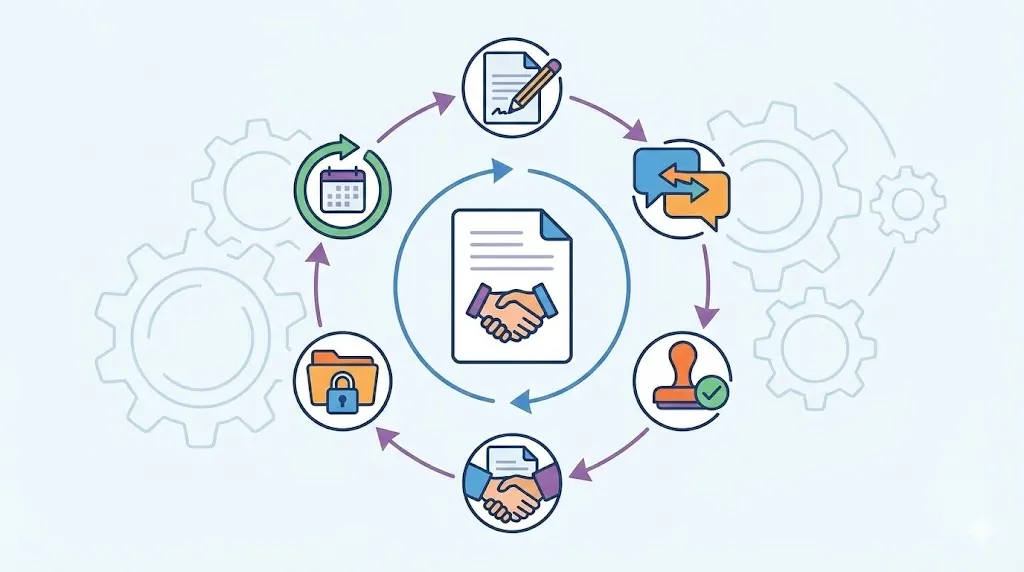
A typical legal approval workflow for contracts includes these stages:
Contract Request Submission: The business user submits a request with all necessary details and documents.
Intake Review: Legal operations or an intake team checks the request for completeness and routes it based on risk criteria.
Legal Review: The legal team analyzes contract terms, flags issues, and suggests changes.
Subject Matter Review: If needed, experts in areas like security or finance review specific clauses.
Approval Decision: The authorized legal approver signs off or rejects the contract.
Signature and Execution: The contract is signed by authorized signatories and stored securely.
Delays often arise when requests are incomplete, necessitating multiple rounds of clarification with the requester. Bottlenecks also emerge during sequential reviews, as each party must wait for the previous input before proceeding.
Related articles: Level Up Your Legal Operations: 6 Tips to Legal Efficiency
What Should a Legal Approval Request Include?
Incomplete requests are the biggest cause of delays. Every legal approval request should have:
Contract type and purpose clearly stated.
Counterparty details and relationship history.
Business context explaining why the contract is needed.
Summary of key changes or redlines if it’s a negotiation.
Timeline expectations and deadlines.
A detailed analysis of any potential risks or issues that could influence the approval decision.
Utilizing structured intake forms or portals establishes a robust framework to ensure all necessary information is captured.
Implementing these tools helps to clarify ambiguities, thereby accelerating the legal review process.
Explore further insights in our article: AI Contract Review vs. Human Lawyers: Speed, Accuracy & ROI
What Decision Points Cause Legal Approval Delays?
Several common decision points stall contracts:
Unclear Routing: Contracts sent to legal without clear criteria overload legal teams.
Incomplete Requests: Missing info causes rework and slows review.
Sequential Approvals: When each reviewer must wait for the previous one to finish, the process becomes a bottleneck, extending overall timelines.
Unclear Authority: Ambiguities in delegation policies generate uncertainty about who holds the approval power.
Competing Priorities: Balancing numerous demands often forces legal teams to postpone contracts deemed less urgent.
Fixing these issues requires process clarity and automation.
Related articles: How To Accelerate Contract Review Process? Effective Guide
How Can CLM and AI Reduce Legal Approval Cycle Time?
Contract Lifecycle Management (CLM) software automates and streamlines legal approval workflows. Additionally, cLM enhanced with artificial intelligence accelerates the review and routing processes.
Here’s how CLM and AI help:
Automated Routing: Rules-based routing sends only high-risk contracts to legal. Low-risk contracts bypass legal or get fast-tracked.
Structured Intake: CLM portals enforce complete, standardized contract requests.
Parallel Reviews: CLM workflows allow multiple reviewers to work simultaneously, cutting wait times.
AI Contract Review: AI scans contracts for risky clauses, missing terms, or unusual language, highlighting issues for legal.
Approval Tracking: Automated reminders and escalations keep approvals on schedule.
Audit Trails: Every action is logged, supporting compliance and reporting.
According to Gartner, organizations using AI in contract management reduce legal review time by up to 40%. This frees legal teams to focus on complex issues instead of routine checks.
Related articles: How Does AI Limitations Impacting Contract Management?
Why Contract Management Software Matters
Contract management platforms centralize and automate contract workflows. Additionally, they also enable legal teams to accelerate approvals while minimizing errors.
Key benefits include:
Consistent Routing: Software applies rules consistently, avoiding human error and bottlenecks.
Complete Requests: Intake portals enforce submission only after all required information is provided.
Parallel Workflows: When feasible, multiple reviewers can approve simultaneously.
AI Assistance: Risky clauses are flagged and fallback language suggested by AI, accelerating the review process.
Visibility: Dashboards provide consolidated, real-time insights into contract status and highlight workflow inefficiencies.
Auditability: Comprehensive logs of approvals and modifications support rigorous compliance monitoring.
Volody’s solution integrates these capabilities with sophisticated AI functionality. Moreover, it streamlines contract drafting, review, and approval processes. The platform also enables structured intake, flexible approval matrix setup, and seamless real-time collaboration. Legal teams gain control, speed, and consistency.
Managing complex legal workflows requires a centralized and intelligent solution. Interested in how Volody's platform can streamline your legal workflows?
FAQ
What is the difference between legal review and legal approval?
Legal review is the detailed examination of contract terms to identify risks and suggest changes. Legal approval is the formal decision that the contract meets the organization's risk standards and can proceed. Review comes before approval; one is analysis, the other is the final sign-off.
Furthermore, why do legal approval bottlenecks happen?
Bottlenecks arise from unclear routing rules, incomplete contract requests, sequential approvals that cause waiting, and vague delegation policies. These factors create delays and confusion, slowing down contract processing.
How can companies decide which contracts need legal approval?
Companies should set clear criteria based on risk factors like non-standard clauses, contract value, data/privacy obligations, new counterparties, and liability shifts. Only contracts meeting these triggers should go to legal, reducing unnecessary workload.
What role does legal operations play in approvals?
Legal operations oversee the intake workflow, enforce routing protocols, maintain templates and playbooks, and monitor performance metrics to ensure efficient processing.
Also, how do parallel approval workflows speed up contract approvals?
Also, parallel workflows let multiple reviewers approve a contract at the same time when their inputs don’t depend on each other. This avoids waiting for one person to finish before the next can start, reducing delays.
What information should a contract request include to avoid delays?
A complete request should include contract type, counterparty details, business context, redline summaries if applicable, timeline expectations, and any known risks. This helps legal review contracts quickly without back-and-forth.
Can AI really help reduce legal approval times?
Yes. AI can automatically flag risky clauses, suggest fallback language, extract key metadata, and summarize contracts. This reduces manual review time and highlights issues early, speeding approvals.
Therefore, what happens if delegation of authority is unclear?
Uncertainty about who holds approval authority at different levels leads to stalled negotiations, duplicated efforts, or unauthorized sign-offs. Clear delegation frameworks are essential to prevent these issues.
How does contract management software improve legal approval workflows?
It enforces routing rules, standardizes intake, enables parallel reviews, automates reminders, and provides audit trails. This reduces errors, accelerates approvals, and enhances transparency regarding contract progress.
What are common mistakes to avoid in legal approval processes?
Avoid routing every contract to legal, submitting incomplete requests, relying on strictly sequential approvals, and lacking clear delegation policies. These mistakes cause delays and inefficiencies.
This article outlines a detailed, practical roadmap to identify and resolve bottlenecks during the legal approval cycle. By clarifying roles, standardizing requests, applying smart routing, and leveraging contract management technology, legal teams can accelerate approvals and mitigate risk.
About the Company

Volody AI CLM is an Agentic AI-powered Contract Lifecycle Management platform designed to eliminate manual contracting tasks, automate complex workflows, and deliver actionable insights. As a one-stop shop for all contract activities, it covers drafting, collaboration, negotiation, approvals, e-signature, compliance tracking, and renewals. Built with enterprise-grade security and no-code configuration, it meets the needs of the most complex global organizations. Volody AI CLM also includes AI-driven contract review and risk analysis, helping teams detect issues early and optimize terms. Trusted by Fortune 500 companies, high-growth startups, and government entities, it transforms contracts into strategic, data-driven business assets.





" height="216.72211px" id="FYO0bO80Y" transform="translate(3 6.105)" width="206.073px"/><path d="M 108.174 222 C 88.432 222 70.303 217.239 53.785 207.717 C 37.267 198.196 24.173 185.052 14.504 168.285 C 4.835 151.312 0 132.165 0 110.845 C 0 89.731 4.835 70.792 14.504 54.025 C 24.173 37.052 37.267 23.804 53.785 14.282 C 70.303 4.761 88.432 0 108.174 0 C 128.116 0 146.246 4.761 162.562 14.282 C 179.08 23.804 192.073 37.052 201.541 54.025 C 211.21 70.792 216.044 89.731 216.044 110.845 C 216.044 132.165 211.21 151.312 201.541 168.285 C 192.073 185.052 179.08 198.196 162.562 207.717 C 146.044 217.239 127.915 222 108.174 222 Z M 108.174 183.189 C 120.864 183.189 132.044 180.291 141.713 174.495 C 151.382 168.492 158.936 160.006 164.375 149.035 C 169.814 138.064 172.533 125.334 172.533 110.845 C 172.533 96.355 169.814 83.729 164.375 72.965 C 158.936 61.994 151.382 53.611 141.713 47.815 C 132.044 42.02 120.864 39.122 108.174 39.122 C 95.483 39.122 84.202 42.02 74.332 47.815 C 64.663 53.611 57.109 61.994 51.67 72.965 C 46.231 83.729 43.511 96.355 43.511 110.845 C 43.511 125.334 46.231 138.064 51.67 149.035 C 57.109 160.006 64.663 168.492 74.332 174.495 C 84.202 180.291 95.483 183.189 108.174 183.189 Z" fill="rgba(255, 255, 255, 0.12)" height="222px" id="aa1McFcE9" transform="translate(227.183 3)" width="216.04399999999998px"/><path d="M 42.302 182.257 L 111.799 182.257 L 111.799 216.722 L 0 216.722 L 0 0 L 42.302 0 Z" fill="rgba(255, 255, 255, 0.12)" height="216.72211px" id="yRq4AnrsX" transform="translate(477.721 6.105)" width="111.79899999999998px"/><path d="M 108.174 222 C 88.432 222 70.303 217.239 53.785 207.717 C 37.267 198.196 24.173 185.052 14.504 168.285 C 4.835 151.312 0 132.165 0 110.845 C 0 89.731 4.835 70.792 14.504 54.025 C 24.173 37.052 37.267 23.804 53.785 14.282 C 70.303 4.761 88.432 0 108.174 0 C 128.116 0 146.246 4.761 162.562 14.282 C 179.08 23.804 192.073 37.052 201.541 54.025 C 211.21 70.792 216.045 89.731 216.045 110.845 C 216.045 132.165 211.21 151.312 201.541 168.285 C 192.073 185.052 179.08 198.196 162.562 207.717 C 146.044 217.239 127.915 222 108.174 222 Z M 108.174 183.189 C 120.864 183.189 132.044 180.291 141.713 174.495 C 151.382 168.492 158.936 160.006 164.375 149.035 C 169.814 138.064 172.534 125.334 172.534 110.845 C 172.534 96.355 169.814 83.729 164.375 72.965 C 158.936 61.994 151.382 53.611 141.713 47.815 C 132.044 42.02 120.864 39.122 108.174 39.122 C 95.483 39.122 84.202 42.02 74.332 47.815 C 64.663 53.611 57.108 61.994 51.67 72.965 C 46.231 83.729 43.511 96.355 43.511 110.845 C 43.511 125.334 46.231 138.064 51.67 149.035 C 57.108 160.006 64.663 168.492 74.332 174.495 C 84.202 180.291 95.483 183.189 108.174 183.189 Z" fill="rgba(255, 255, 255, 0.12)" height="222px" id="mo8HQspQ0" transform="translate(609.155 3)" width="216.04500000000007px"/><path d="M 73.727 0 C 95.885 0 115.324 4.45 132.044 13.351 C 148.967 22.252 161.957 34.982 171.027 51.541 C 180.287 67.894 184.917 86.937 184.917 108.671 C 184.917 130.405 180.287 149.449 171.027 165.801 C 161.957 181.947 148.967 194.47 132.044 203.371 C 115.324 212.271 95.885 216.722 73.727 216.722 L 0 216.722 L 0 0 Z M 72.216 179.773 C 94.374 179.773 111.497 173.564 123.583 161.144 C 135.669 148.724 141.713 131.233 141.713 108.671 C 141.713 86.109 135.669 68.515 123.583 55.888 C 111.497 43.055 94.374 36.638 72.216 36.638 L 42.302 36.638 L 42.302 179.773 Z" fill="rgba(255, 255, 255, 0.12)" height="216.72211px" id="I3iXX5Hi_" transform="translate(859.693 6.105)" width="184.91699999999992px"/><path d="M 185.22 0 L 113.91 141.273 L 113.91 216.722 L 71.61 216.722 L 71.61 141.273 L 0 0 L 47.74 0 L 93.06 99.046 L 138.08 0 Z" fill="rgba(255, 255, 255, 0.12)" height="216.72211px" id="nzHyWC0_d" transform="translate(1061.78 6.105)" width="185.22000000000003px"/></svg>)