
The 3 Biggest Challenges Procurement Professionals Faced in 2025 and How to Address Them in 2026 now shape every sourcing plan. A supplier misses a delivery, finance cuts the budget, and business leaders still expect savings. Procurement teams need better control over risk, contracts, data, and internal demand. They also need a clear plan that turns pressure into stronger business decisions.
TL;DR
With budgets tightening, costs rising, and service expectations increasing, procurement teams must demonstrate business value.
Global events can, with little warning, disrupt suppliers, prices, transport routes, and production plans.
AI can reduce manual work; however, teams still need clean data, clear rules, and rigorous human review.
Procurement can act before problems reach customers when intake improves and contract data and supplier insight are easier to use.
During 2026, a phased technology plan can strengthen speed, control, compliance, and stakeholder trust.
Why procurement teams faced more pressure in 2025
Procurement leaders entered 2025 with a difficult mandate. At the same time, they had to lower costs, protect supply, support growth, and manage risk. Additionally, many teams also had fewer people and less time to complete that work.
Business leaders often measure procurement through savings alone. That measure misses much of the team’s value. Procurement also protects revenue, supports compliance, improves supplier performance, and helps the business respond to change.
Procurement operates close to a wide range of business risks. Delayed shipments, for example, can disrupt production. A weak contract, meanwhile, may restrict the business’s recovery options. An overlooked renewal might leave the business with an unwanted expense. Each issue may start outside procurement, but the business still expects procurement to manage the result.
The first step for 2026 involves changing the conversation. Procurement should connect its work to business outcomes, not only purchase price.
Use a broader scorecard that tracks:
Total cost, including delivery, service, support, and switching costs
Supplier continuity and recovery time after a disruption
Contract cycle time and approval delays
Compliance with approved suppliers and purchasing policies
Value created through better terms, controls, and supplier performance
Internal satisfaction among finance, legal, operations, and business teams
According to the World Bank Logistics Performance Index, companies assess supply chains across factors such as customs, infrastructure, logistics services, and shipment timeliness. Procurement leaders can use similar measures inside their own organizations. They can show how supplier choices affect delivery, working capital, and operational stability.
Procurement needs closer working relationships with finance and operations. Those conversations should begin before annual targets are set. The focus should be on the business results that matter most. From there, procurement can map each project to the outcome it is meant to influence.
A software renewal project, for instance, may look like a straightforward pricing exercise. A closer review, however, may uncover unused licenses, poor usage data, and automatic renewal terms. In response, the team can reduce spend, eliminate unused access, and establish a stronger renewal process. That result matters more than a discount percentage alone.
How to prove procurement value
Start with a simple value map. Connect each activity to a measurable business result.
Identify the business goal, such as margin protection or faster delivery.
List the supplier or contract decisions that affect that goal.
Assign an owner and a clear measure.
Review progress alongside finance and the affected business team.
Report the result in plain language.
This approach helps procurement move from reactive service to active business leadership. It also makes budget discussions more productive. Leaders can see what the team protects, not only what it buys.
Related articles: How Tech Firms Can Use Contracts to Cut Risk in 2026
How can procurement teams manage supply chain risk?
Supply chain risk became harder to manage in 2025. Additionally, political conflict, trade restrictions, weather events, transport delays, and supplier failures all created new uncertainty. Procurement teams could not remove those risks, but they could improve their response.
Many businesses still rely on limited supplier information. They may know who supplies them directly while lacking visibility into key sub suppliers. Risk details may sit in emails, spreadsheets, or separate systems. When conditions change, that limited visibility can make timely action difficult.
Effective risk management begins with supplier segmentation. Suppliers should not all be managed in the same way. Group suppliers by business impact, replacement difficulty, data access, and financial exposure.
A practical supplier risk model can include:
Criticality: How much damage would a failure cause?
Replaceability: How quickly could the business secure another source?
Concentration: Does the business rely too heavily on one supplier, region, or country?
Financial health: Does the supplier have the financial capacity to support the required service over time?
Contract protection: Do the terms provide adequate protection against delays and quality failures, while covering recovery and termination?
Operational visibility: Does the team have a clear view of performance and warning signs?
The World Economic Forum Global Risks Report 2025 identifies conflict, geoeconomic confrontation, and environmental risks among major concerns for businesses. Procurement leaders should convert those broad risks into specific supplier questions. Which routes carry essential goods? Which contracts allow price changes? Which suppliers rely on a single port or production site?
Build a supply risk playbook
Teams can use a playbook as a shared framework for responding to emerging risks. Moreover, it should identify relevant triggers, assign owners, set out the required actions, and establish escalation points.
For example, a company may set a trigger for a supplier that misses two critical deliveries in one quarter. The response may include a supplier review, a recovery plan, a search for alternatives, and an executive update. The contract should also show the rights available to the business.
Concentration risk warrants review at least once each quarter. Look beyond supplier names. Check country exposure, transport routes, raw materials, production sites, and service dependencies. A business may use three suppliers and nevertheless remain exposed to a single region.
Contracts play a major role here. Strong terms cannot prevent every disruption, but they can improve the response. The procurement team should assess force majeure language, notice duties, service levels, audit rights, insurance, termination rights, and business continuity plans.
Supplier diversification also needs care. Adding a second supplier may raise unit cost. Also, it can still protect the business if the first supplier fails. Compare the cost of backup capacity with the expected cost of a shutdown, missed sale, or emergency purchase.
Do not rely on risk scores alone. Ask suppliers for evidence. Review delivery data, recovery plans, certifications, financial information, and performance trends. Then record those findings where procurement, legal, and operations can access them.
Use scenario planning
Scenario planning helps teams prepare without predicting the future. Choose a few events that could affect the category. Examples include a trade restriction, a port closure, a supplier insolvency, or a sudden price increase.
For each event, document:
The first sign of trouble
The supplier and business owners responsible
The decisions needed within one week
The contract rights available
The backup source or operating plan
The message for internal stakeholders
This process turns risk work into a repeatable business practice. It also reduces the time spent searching for information during a crisis.
Procurement Contract Risks That Could Sink Your Business
How should procurement use AI in 2026?
AI became a major topic for procurement in 2025. Additionally, teams also used it to review documents, summarize terms, analyze spend, and create reports. Yet many organizations still struggled to move from small trials to trusted daily use.
The problem did not come from a lack of interest. It came from poor data, unclear ownership, weak controls, and uncertainty about human review. Procurement cannot place sensitive supplier information into a tool without checking security, access, accuracy, and retention.
The most reliable applications are bounded, well-defined tasks. The best starting points are processes with repeatable steps and known inputs. This includes contract summaries, metadata extraction, clause checks, and intake classification.
According to the National Institute of Standards and Technology AI Risk Management Framework, organizations should manage AI risks through functions that include govern, map, measure, and manage. That structure gives procurement a practical way to govern each AI use case.
Choose practical procurement use cases
The best initial use case addresses a visible problem. Its value should come from time saved, while necessary judgment remains with the team.
Consider these examples:
Extract renewal dates and notice periods from supplier contracts.
Flag price-adjustment terms so a category manager can review them.
Compare a supplier's draft against the approved company position.
Use it to summarize service levels, payment terms, and liability limits.
Route requests according to category, value, risk, and business owner.
Moreover, surface contracts missing required insurance or data protection terms.
A review tool can identify unusual language. It should not decide whether the business accepts that language. A procurement professional or lawyer must review the finding, assess the context, and approve the next step.
Create rules before scaling AI
Before expanding adoption, establish an AI use policy. It should set out answers to a few basic questions.
Which tools may employees use?
What information may employees enter into those tools?
When does human approval become necessary?
What process will the team use to test accuracy?
Who ultimately owns accountability for the output?
What process will the team follow to report errors?
The organization should also define how changes to the tool will be tracked.
Data quality matters as much as the AI model. If contract names, dates, supplier records, and categories remain inconsistent, the output will contain gaps. Clean key fields before asking AI to analyze thousands of documents.
Furthermore, run a controlled pilot with a defined sample. Compare the tool’s output with expert review. Track false positives, missed issues, review time, and user feedback. Set a clear standard for moving from pilot to wider use.
The European Commission’s AI Act overview offers useful context for risk-based AI governance. Teams in procurement need to understand how their organization classifies AI tools and what controls apply. Those controls should be agreed jointly by legal, security, privacy, and procurement.
Keep people in the decision loop
AI can take on repetitive work, while accountability remains with people. A buyer needs to understand the supplier context before acting on an output. Legal must assess the resulting legal exposure. Finance must confirm the commercial impact.
Give users a simple way to accept, reject, or correct AI suggestions. Record those decisions where possible. Feedback can improve the process and show leaders whether the tool creates measurable value.
Related articles: What is Contract Renewal? Key Terms and Processes in 2026
How can procurement improve stakeholder engagement?
Procurement often becomes involved after a business team has chosen a supplier. Additionally, by then, the team may be facing a rushed negotiation, a missing budget, or a contract that does not match the business need.
This pattern creates tension. Business teams see procurement as a delay. Procurement sees business teams as bypassing controls. Legal receives incomplete information and must review the issue under time pressure.
Better engagement starts with a clear service model. Tell internal teams what procurement handles, what information it needs, and how long each step usually takes. Offer different paths for low, medium, and high risk requests.
For a low-value renewal, a short form and standard template may be sufficient. A strategic outsourcing deal, by contrast, calls for a planning meeting, security review, financial analysis, and legal negotiation. Moreover, applying the same treatment to both requests creates needless work.
Improve the request process
Replace the shared inbox with a structured intake form. The questions should give the team enough information to determine the appropriate path.
The form should capture:
Business owner and department
Supplier name and current relationship
Goods or services required
Estimated value and term
Target start date
Data, security, or regulatory concerns
Existing contract or renewal date
Required approvals
Reason for the purchase
Keep the form short enough for business users to complete. Use conditional questions so users only see fields linked to their request. Explain why each required field matters.
A request portal can route work based on value, category, risk, and geography. It can send reminders and show status to the requester. That visibility reduces follow up emails and helps procurement manage workload.
Set shared service measures
Measure the process from the stakeholder’s view. Furthermore, track time to first response, time to approval, time in negotiation, and total contract cycle time. Also track rework, incomplete requests, and requests that bypass procurement.
Do not use speed as the only goal. A fast contract with weak terms can create larger costs later. Pair cycle time with risk checks, savings, supplier performance, and user satisfaction.
Meet monthly with key business groups. Use those sessions to review delays, repeated questions, urgent requests, and policy exceptions. Change the process when the data identifies a genuine problem.
Procurement should also explain its decisions. If a team rejects a supplier or requests a contract change, give a short reason. Plain explanations build trust and reduce repeated challenges.
Related articles: Why Procurement Professionals Face Burnout and How to Fix It
How can procurement build a stronger operating model?
Technology cannot fix unclear ownership. Additionally, procurement teams also need a practical operating model that defines who requests, reviews, approves, signs, and manages each contract.
Start by mapping the full process. Include the steps before procurement receives a request and after a contract gets signed. Many risks sit outside the formal procurement workflow. A business user may promise a term to a supplier before legal sees the document. An owner may also miss a renewal because no system records it.
A useful process map should show:
The request entry point
The information required for review
The risk and value thresholds
The roles for procurement, legal, finance, security, and the business
The approval path
The signing process
The storage location
The post signature owner
The renewal and obligation process
This map exposes duplicate work and missing controls. It also helps teams decide where automation can add value.
Create clear decision rights
Use a responsibility matrix for major contract and supplier activities. Define the matrix by specifying who performs each activity, who has approval authority, which stakeholders advise, and who must be kept informed.
For example, procurement may own commercial negotiation, with legal accountable for the associated legal risk. Security may lead the technology review; finance, meanwhile, may approve the budget. The business owner, in turn, may accept operational risk and confirm that the service meets business needs.
Write these roles into the workflow as well. Do not rely on informal knowledge held by one employee. People change roles and teams reorganize; urgent work can then slip past processes that exist only in someone's memory.
Standardize templates and clauses
Teams can start with an approved template instead of drafting from scratch. During negotiations, negotiators can draw on clause libraries for appropriate fallback language. Each asset requires an accountable owner, version control, and scheduled review dates.
A single template should not cover every situation. Develop a manageable set instead, organized around common categories and risk levels. Guidance should indicate when users should apply each template.
Templates should be reviewed whenever material legal, regulatory, or business changes occur. Remove superseded versions from the active workflow. Keep historical versions for audit purposes, but prevent users from selecting them by mistake.
Track obligations after signature
A signed contract does not end procurement’s work. The team must track pricing, delivery, service levels, reporting, insurance, audits, renewals, and termination notices.
Assign every obligation to an owner, set a due date, and create a reminder. Record evidence when the owner completes the task. Overdue items should be escalated according to business impact.
According to the U.S. Government Accountability Office, federal contract management reviews often focus on performance, oversight, and accountability. Private organizations face similar needs. A contract repository without ownership does not create control.
Related articles: 10 Key Contract Clauses Every Business Should Know in 2026
How can leaders create a 2026 action plan?
Procurement leaders do not need to fix every process at once. Additionally, a focused plan can produce results within one quarter and support wider work later.
Begin with a short diagnostic. The diagnostic should draw on interviews with procurement, legal, finance, operations, security, and frequent business requesters. Include, too, a sample of recent contracts and supplier events. Review these materials to identify recurring delays, missing data, ambiguous approvals, and unfulfilled obligations.
Use those findings to rank problems by business impact and implementation effort. A simple scoring model can make triage more consistent:
Prioritize high-impact items that require little effort.
Moreover, reserve major workstreams for high-impact issues that demand substantial effort.
Address lower-impact items requiring little effort when capacity permits.
Unless circumstances change, leave low-impact work that demands substantial effort out of scope.
A phased plan for procurement teams
First 30 days
Assign an executive sponsor and a process owner.
Map how requests, contracts, and renewals move through the current process.
Begin with critical suppliers and high value contracts.
Capture key renewal dates and notice periods.
Furthermore, select one process problem for a controlled pilot.
Days 31 to 60
Create intake forms for common request types.
Set approval thresholds according to value and risk.
Bring consistency to the format of core templates and fallback clauses.
Specify supplier risk triggers and assign ownership for escalation.
Test a single AI use case under expert review.
Days 61 to 90
Launch dashboards for cycle time, volume, risk, and renewals.
Also, assess supplier concentration against the adequacy of backup plans.
Prepare business users to follow the new request process.
Measure pilot results against the starting position.
Give senior leaders an update on progress and next steps.
Establish baseline data before changing the process. An 18-day average review time, for example, should be recorded as the starting point. Where renewal notices have been missed, quantify those events. Therefore, these baselines give leaders a defensible way to determine whether the work is generating value.
The plan should not hinge on perfect data. Improve the most important fields first. Parties, value, start date, end date, renewal date, owner, supplier, and risk level usually offer a strong starting point.
Communicate progress in business terms. Say that the new process reduced approval delays, improved renewal control, or protected a critical supply route. Avoid reporting only the number of forms, meetings, or automated tasks.
Related articles: 20 Key Contract Clauses Every Business Should Know in 2026
How can contract management software support procurement?
Contract management software gives procurement one place to request, draft, review, approve, sign, store, and monitor contracts. Additionally, it also connects contract work with supplier risk, business ownership, and renewal planning. That shared record helps procurement act earlier and answer questions faster.
For example, AI can extract payment terms, obligations, dates, jurisdictions, and renewal rules from existing contracts. Automated workflows can route approvals and send reminders. Search and dashboards can help teams find exposure across suppliers and business units.
Volody supports these needs through AI drafting, AI review, clause recommendations, metadata extraction, obligation tracking, approval workflows, repository search, audit trails, and enterprise integrations. Teams can use approved templates, compare versions, track redlines, and monitor renewals from one controlled system.
Explore a simpler way to create, review, approve, and track contracts with Volody's CLM Software.
FAQ
What were the main procurement challenges in 2025?
Additionally, the main challenges included pressure to deliver more value with fewer resources, supply chain uncertainty, and slow AI adoption. They also had to contend with weak data, unclear ownership, and rising stakeholder expectations.
When reducing supply chain risk, which approaches can procurement use?
A useful starting point is to segment suppliers according to business impact, replaceability, concentration, financial health, and contract protection. Build response plans for major events, review supplier dependencies, and maintain backup options for critical categories.
What should procurement automate first?
Start with repeatable work that has clear inputs and measurable results. Contract summaries, metadata extraction, renewal alerts, intake routing, and clause checks often provide useful starting points.
Does AI replace procurement professionals?
By reducing the burden of manual review, AI can make relevant information more accessible. Commercial judgment, supplier relationships, risk decisions, and accountability remain with procurement professionals. Important outputs must still undergo human review before the business acts on them.
Moreover, how can procurement strengthen its relationships with business teams?
Establish a straightforward intake process, publish service expectations, and make request status visible. Workflows should reflect the level of risk involved, from low to medium to high. Explain decisions in plain language, and review delays with stakeholders.
Why does contract data matter to procurement?
Contract data shows obligations, prices, renewal dates, service levels, liabilities, and rights. Accurate data helps procurement find savings, prevent missed notices, manage supplier performance, and respond to risk.
What should a 2026 procurement plan include?
Include supplier risk, contract control, data quality, AI governance, stakeholder service, and measurable business outcomes. Start with a short diagnostic, then deliver improvements in phases with clear owners.
How does contract management software help procurement teams?
It centralizes contract information, standardizes requests, automates approvals, and tracks obligations. It also gives procurement better search, reporting, renewal visibility, and control over contract versions.
About the Company
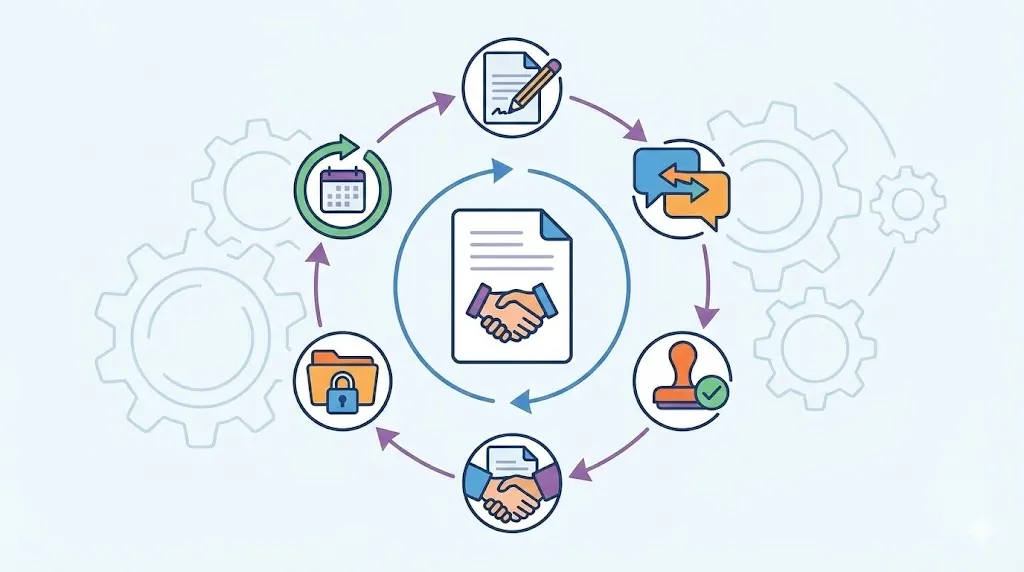
Volody AI CLM is an Agentic AI-powered Contract Lifecycle Management platform designed to eliminate manual contracting tasks, automate complex workflows, and deliver actionable insights. As a one-stop shop for all contract activities, it covers drafting, collaboration, negotiation, approvals, e-signature, compliance tracking, and renewals. Built with enterprise-grade security and no-code configuration, it meets the needs of the most complex global organizations. Volody AI CLM also includes AI-driven contract review and risk analysis, helping teams detect issues early and optimize terms. Trusted by Fortune 500 companies, high-growth startups, and government entities, it transforms contracts into strategic, data-driven business assets.



" height="216.72211px" id="FYO0bO80Y" transform="translate(3 6.105)" width="206.073px"/><path d="M 108.174 222 C 88.432 222 70.303 217.239 53.785 207.717 C 37.267 198.196 24.173 185.052 14.504 168.285 C 4.835 151.312 0 132.165 0 110.845 C 0 89.731 4.835 70.792 14.504 54.025 C 24.173 37.052 37.267 23.804 53.785 14.282 C 70.303 4.761 88.432 0 108.174 0 C 128.116 0 146.246 4.761 162.562 14.282 C 179.08 23.804 192.073 37.052 201.541 54.025 C 211.21 70.792 216.044 89.731 216.044 110.845 C 216.044 132.165 211.21 151.312 201.541 168.285 C 192.073 185.052 179.08 198.196 162.562 207.717 C 146.044 217.239 127.915 222 108.174 222 Z M 108.174 183.189 C 120.864 183.189 132.044 180.291 141.713 174.495 C 151.382 168.492 158.936 160.006 164.375 149.035 C 169.814 138.064 172.533 125.334 172.533 110.845 C 172.533 96.355 169.814 83.729 164.375 72.965 C 158.936 61.994 151.382 53.611 141.713 47.815 C 132.044 42.02 120.864 39.122 108.174 39.122 C 95.483 39.122 84.202 42.02 74.332 47.815 C 64.663 53.611 57.109 61.994 51.67 72.965 C 46.231 83.729 43.511 96.355 43.511 110.845 C 43.511 125.334 46.231 138.064 51.67 149.035 C 57.109 160.006 64.663 168.492 74.332 174.495 C 84.202 180.291 95.483 183.189 108.174 183.189 Z" fill="rgba(255, 255, 255, 0.12)" height="222px" id="aa1McFcE9" transform="translate(227.183 3)" width="216.04399999999998px"/><path d="M 42.302 182.257 L 111.799 182.257 L 111.799 216.722 L 0 216.722 L 0 0 L 42.302 0 Z" fill="rgba(255, 255, 255, 0.12)" height="216.72211px" id="yRq4AnrsX" transform="translate(477.721 6.105)" width="111.79899999999998px"/><path d="M 108.174 222 C 88.432 222 70.303 217.239 53.785 207.717 C 37.267 198.196 24.173 185.052 14.504 168.285 C 4.835 151.312 0 132.165 0 110.845 C 0 89.731 4.835 70.792 14.504 54.025 C 24.173 37.052 37.267 23.804 53.785 14.282 C 70.303 4.761 88.432 0 108.174 0 C 128.116 0 146.246 4.761 162.562 14.282 C 179.08 23.804 192.073 37.052 201.541 54.025 C 211.21 70.792 216.045 89.731 216.045 110.845 C 216.045 132.165 211.21 151.312 201.541 168.285 C 192.073 185.052 179.08 198.196 162.562 207.717 C 146.044 217.239 127.915 222 108.174 222 Z M 108.174 183.189 C 120.864 183.189 132.044 180.291 141.713 174.495 C 151.382 168.492 158.936 160.006 164.375 149.035 C 169.814 138.064 172.534 125.334 172.534 110.845 C 172.534 96.355 169.814 83.729 164.375 72.965 C 158.936 61.994 151.382 53.611 141.713 47.815 C 132.044 42.02 120.864 39.122 108.174 39.122 C 95.483 39.122 84.202 42.02 74.332 47.815 C 64.663 53.611 57.108 61.994 51.67 72.965 C 46.231 83.729 43.511 96.355 43.511 110.845 C 43.511 125.334 46.231 138.064 51.67 149.035 C 57.108 160.006 64.663 168.492 74.332 174.495 C 84.202 180.291 95.483 183.189 108.174 183.189 Z" fill="rgba(255, 255, 255, 0.12)" height="222px" id="mo8HQspQ0" transform="translate(609.155 3)" width="216.04500000000007px"/><path d="M 73.727 0 C 95.885 0 115.324 4.45 132.044 13.351 C 148.967 22.252 161.957 34.982 171.027 51.541 C 180.287 67.894 184.917 86.937 184.917 108.671 C 184.917 130.405 180.287 149.449 171.027 165.801 C 161.957 181.947 148.967 194.47 132.044 203.371 C 115.324 212.271 95.885 216.722 73.727 216.722 L 0 216.722 L 0 0 Z M 72.216 179.773 C 94.374 179.773 111.497 173.564 123.583 161.144 C 135.669 148.724 141.713 131.233 141.713 108.671 C 141.713 86.109 135.669 68.515 123.583 55.888 C 111.497 43.055 94.374 36.638 72.216 36.638 L 42.302 36.638 L 42.302 179.773 Z" fill="rgba(255, 255, 255, 0.12)" height="216.72211px" id="I3iXX5Hi_" transform="translate(859.693 6.105)" width="184.91699999999992px"/><path d="M 185.22 0 L 113.91 141.273 L 113.91 216.722 L 71.61 216.722 L 71.61 141.273 L 0 0 L 47.74 0 L 93.06 99.046 L 138.08 0 Z" fill="rgba(255, 255, 255, 0.12)" height="216.72211px" id="nzHyWC0_d" transform="translate(1061.78 6.105)" width="185.22000000000003px"/></svg>)