

The Great Resignation has shaken many industries, and contract management teams are no exception. When experienced contract professionals leave, they take vital knowledge with them. Building contracting processes that can survive this churn is no longer optional. Imagine a legal operations team scrambling to close deals while key contract experts walk out the door. This article explores how to design contract workflows that keep business moving, even when turnover spikes.
TL;DR
Mid-career contract professionals frequently leave roles, disrupting deal continuity and threatening the preservation of institutional knowledge.
The prevalence of manual, paper-based, or siloed contract workflows intensifies risks, especially during periods of staff turnover.
Clear documentation paired with standardized workflows reduces dependency on any single subject matter expert.
Centralized contract management software improves transparency, enhances search functionality, and fosters collaboration.
Automation tools streamline the onboarding process for new hires and help prevent bottlenecks in contract negotiations.
Investing thoughtfully in contract technology is essential for supporting talent retention and strengthening overall business resilience.
Why Contract Teams Are Vulnerable in the Great Resignation
The Great Resignation refers to the wave of employees leaving their jobs in large numbers since early 2021. Additionally, in August 2021 alone, more than 4.3 million Americans quit their jobs, accounting for nearly 3% of the workforce within that single month (U.S. Bureau of Labor Statistics). What makes this trend especially challenging for contracting teams is who is leaving. Unlike past waves where younger, less experienced workers moved on, this time mid-career professionals aged 30 to 45 are resigning at high rates.
These mid-career contract managers possess intricate knowledge of how their companies negotiate, draft, and execute contracts. They have a detailed grasp of internal policies, the parameters of risk tolerance, and the nuances of long-standing client relationships. Their departure results in a significant loss of this critical expertise. Contracting teams often rely on institutional knowledge rather than documented procedures. This makes it difficult for new hires to pick up where their predecessors left off.
Contract management involves specialized skills and attention to detail. Many organizations still rely on manual processes, spreadsheets, and scattered email threads to manage contracts. This lack of standardization creates bottlenecks. When experienced staff depart, newcomers face steep learning curves and limited visibility into ongoing deals. This can cause delays, errors, and even lost business opportunities.
Contract teams must recognize their vulnerability. They need to ask: Are our contract processes documented and repeatable? Can a new employee quickly understand and manage active contracts? Without answers to these questions, companies risk operational disruption and increased legal exposure.
Related articles: Cut Contract Cycle Time: Proven Steps to Speed Up Deals
How Manual Contract Processes Increase Risk
Many contracting teams operate with outdated methods. Some still manage contracts using email folders, shared drives, or local desktops. Additionally, others depend on manual checklists and spreadsheets to monitor contract progress. These approaches create several problems:
Knowledge silos: Critical information lives in individual inboxes or on personal computers. When staff leave, their knowledge leaves too.
Poor visibility: Without a central repository, it is hard to find contracts or understand their current status. This slows approvals and renewals.
Inconsistent workflows: Variations in procedural adherence among team members introduce errors and elevate compliance risks.
Long onboarding: New hires face extended periods reconstructing contract histories and assimilating unwritten operational norms.
Deal delays: Changes in contract management during negotiations can cause interruptions or regressions as successors revisit prior agreements.
These challenges become more acute during periods of high turnover. The Great Resignation exposes the fragility of manual contract management. It highlights the need for processes that do not depend on any single person’s memory or habits.
Related articles: How to Improve HR Contract Management with CLM
What Makes Contracting Processes Resilient?
Resilient contracting processes reduce dependence on individual expertise by systematically capturing knowledge within well-documented, transparent workflows. Here is what to focus on:
Document Every Step
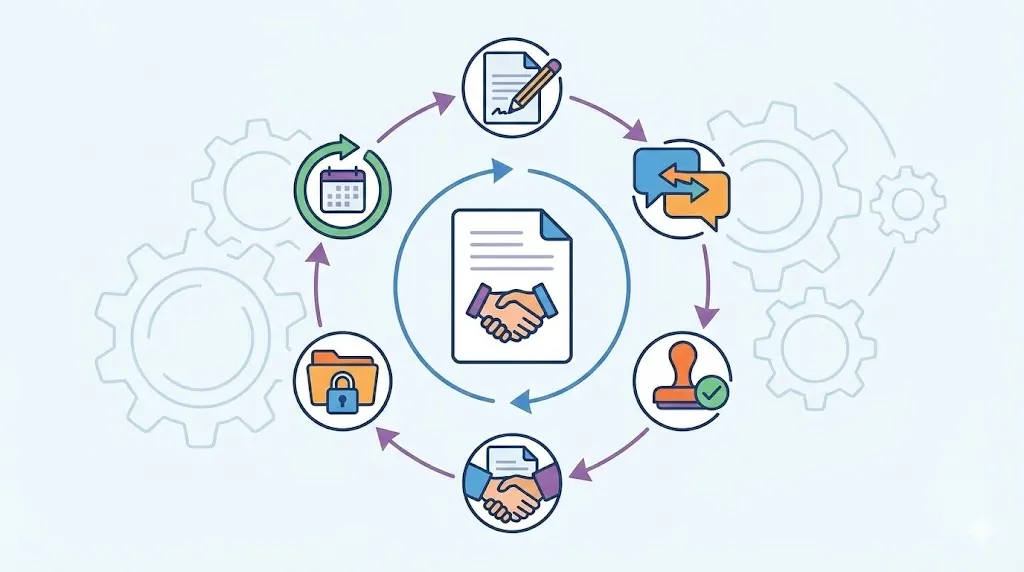
Document the pathways through which contracts progress within your organization. Begin by mapping each stage, from the initial request to final execution. Identify the personnel responsible for reviewing, approving, and signing contracts. Record typical negotiation strategies and acceptable risk levels. This record serves as an essential resource for onboarding new employees and facilitating training.
Use Standard Templates and Clauses
Establish a repository of approved contract templates in conjunction with a detailed clause library. Moreover, use standardized language to reduce drafting time and limit legal risks. Keep these resources readily accessible and update them regularly. This consistency enables new team members to draft and evaluate contracts with confidence.
Centralize Contract Storage
Store all contracts in a single, secure location. Avoid scattered files on desktops or email. Choose a repository equipped with advanced search functions enhanced by metadata tagging to accelerate contract retrieval. Furthermore, centralized storage provides better oversight and minimizes the chances of losing important documents.
Build Repeatable Workflows
Construct workflows designed to progress contracts through each phase automatically, minimizing manual input. Utilize checklists, automated reminders, and approval routing to keep deals moving efficiently. Implement automated notifications for contract renewals and obligations. These streamlined processes help reduce errors and speed up contract turnaround times.
Train Continuously
Also, offer ongoing training to contract teams on processes, tools, and policies. Encourage knowledge sharing and collaboration. Also, this builds a culture where contract management is understood and valued.
Plan for Turnover
Accept that turnover will happen. Equip your organization by cross-training personnel and thoroughly documenting essential knowledge. Prevent operational bottlenecks caused by dependency on a single individual for critical functions. Teams that distribute expertise and provide mutual support foster resilience.
Related articles: What is Lack of Notice in Contracts? An Effective Guide
How Technology Strengthens Contracting Processes
Contract management software enhances the robustness of contracting workflows. Additionally, by consolidating contracts, templates, and workflows into a single interface, a unified contract lifecycle management (CLM) platform streamlines operational complexity. Users gain access to automation functions for routine operations and tools that extract essential contract data efficiently. Here are some ways CLM software helps:
Central Repository with Search
CLM platforms store all contracts and related documents in one place. Metadata tagging combined with full-text indexing accelerates the retrieval of contracts. This process prevents unnecessary time spent searching for files and minimizes the risk of lost contracts.
Automated Workflows and Approvals
The software automates routing contracts through review and approval stages. Moreover, notifications and escalations are sent proactively to keep deals advancing. This approach also curtails delays typically caused by manual handoffs or overlooked tasks.
Template and Clause Libraries
CLM systems maintain approved templates and clauses with version control. Contract managers can draft agreements faster and with consistent language. This reduces drafting errors and legal risks.
Visibility into Contract Status
Dashboards provide real-time visualization of contract progression within the workflow. Furthermore, managers can identify process bottlenecks and balance workload distribution. Insights generated enable better resource allocation and enhance overall operational efficiency.
Onboarding and Knowledge Transfer
New employees benefit from immediate access to contract playbooks, templates, and historical agreements. Access to these resources accelerates onboarding and reduces dependence on individual subject matter experts. CLM software acts as a knowledge hub.
Risk and Compliance Controls
CLM tools detect potentially risky contract terms or absent approvals. These systems enforce adherence to company policies and regulatory standards. As a result, legal exposure is mitigated and audit readiness improved.
Real-World Example: Avoiding Deal Stalls During Turnover
Consider a mid-sized company negotiating a complex vendor contract. Additionally, their lead contract manager unexpectedly resigns in the middle of negotiations. Without documented processes or a central contract repository, the new hire struggles to understand prior discussions. The vendor grows frustrated as the contract stalls. Negotiations restart from scratch, delaying the project launch by weeks.
If the company had a CLM platform with a centralized contract history and automated workflows, the new manager could quickly review prior versions and approvals. The vendor would see consistent progress, and the deal would close on time. This example shows how resilient contracting processes protect business continuity.
Related articles: How to Scale Contract Organization for Growing Enterprises
How to Start Building Resilient Contracting Processes Today
Improving contract management processes takes time but starts with clear steps:
Map your current process: Document how contracts move through your organization today, noting pain points and knowledge gaps.
Centralize contract storage: Move contracts from email and desktops into a single repository.
Create standard templates: Work with legal and business teams to develop approved templates and clauses.
Define approval workflows: Set clear rules for who approves contracts and when. Automate these steps if possible.
Train your team: Share process documentation and provide hands-on training.
Evaluate contract software: Research CLM platforms that fit your needs and budget.
Plan for turnover: Cross-train staff and document critical knowledge.
Measure and improve: Use metrics like contract cycle time and approval delays to track progress.
Start small and build momentum. Even basic improvements can reduce risk and speed up contracts.
Related articles: Mastering Contract Clauses: Risk & Performance
Why Contract Management Software Matters
Contract management software builds durable frameworks that remain effective despite changes in personnel. Additionally, it consolidates contracts and workflows into a unified repository. This comprehensive oversight minimizes interruptions linked to personnel transitions. Automation streamlines repetitive tasks and mitigates errors. Utilizing standard templates alongside clause libraries ensures contractual uniformity.
Software also supports onboarding new hires by giving them instant access to contract history and playbooks. This shortens ramp-up time and reduces mistakes. Contract risk scoring and compliance checks help teams avoid costly errors.
The emerging cohort of contract professionals demands tools that align with the intuitive interfaces found in consumer applications. Organizations adopting advanced contract technologies tend to see higher employee engagement and retention rates. Beyond that, these solutions reinforce operational continuity despite staff changes.
Discover further expertise in: Contract Management Strategies: Expert Dos & Don'ts
How Contract Management Software Solves This
Contract lifecycle management platforms centralize contracts and automate workflows. Additionally, they eliminate dependence on personal recall and unstructured procedures. Contract teams gain instant access to templates, clause libraries, and contract playbooks. This accelerates the drafting and review phases.
Automated approval routing combined with notification systems ensures deals progress without delay. Dashboards provide visibility into bottlenecks and uneven workload distribution. AI-powered tools can extract key contract data and flag risks automatically. This reduces manual work and legal exposure.
Moreover, when contract managers leave, new hires can quickly get up to speed by reviewing contract histories and templates in the system. This ensures continuity and avoids deal stalls. The software also enhances talent acquisition and retention by delivering an intuitive, contemporary user interface.
Volody’s platform integrates AI-assisted drafting, review, and metadata extraction capabilities. It provides centralized storage, automated approval workflows, and obligation tracking. Collectively, these functionalities enable contract teams to establish repeatable, transparent processes resilient to personnel changes.
> Interested in discovering how this CLM solution can streamline your legal workflows? Explore the details at Volody's CLM Software.
FAQ
What is the Great Resignation and why does it impact contract teams?
Additionally, the "Great Resignation" describes the significant surge in employee departures that began in 2021. Contract teams confront difficulties as numerous seasoned mid-career professionals leave, taking essential institutional knowledge with them. Such turnover jeopardizes deal continuity and the overall quality of contract management.
Why are manual contract processes risky during high turnover?
Manual contract procedures rely extensively on individual expertise and scattered documentation throughout the organization. When employees leave, they take their specialized knowledge and records along. This results in workflow interruptions, inaccuracies, and misplaced agreements. Manual systems also create obstacles to the seamless onboarding of new personnel.
Moreover, how does documenting contract processes help?
Documenting processes provides a comprehensive and detailed blueprint for contract workflows. It reduces dependence on any single person. New hires can learn faster and follow consistent steps. Documentation also supports training and continuous improvement.
What features should I look for in contract management software?
Look for centralized contract storage, automated approval workflows, template and clause libraries, contract status dashboards, and risk analysis tools. AI features that extract contract data and flag risks add extra value.
Furthermore, how can contract software improve employee retention?
Modern contract platforms reduce repetitive manual tasks and speed up contract turnaround times. This empowers staff to concentrate on more strategic responsibilities. Streamlined access to templates and historical contracts lowers workplace frustration and contributes to a more engaging professional environment that helps retain personnel.
Can contract software help with compliance?
Yes. Contract management platforms can enforce approval rules, flag risky clauses, and track obligations. They provide audit trails and reports that support regulatory compliance and internal policies.
What are the first steps to improve contracting processes?
Also, start with a thorough analysis of current workflows to identify gaps. Consolidate contract repositories and develop uniform templates. Then define clear approval hierarchies and apply automation where appropriate. Provide thorough training for your team and assess various contract management solutions.
How long does it take to implement contract management software?
The timeline for implementation varies depending on organizational size and system complexity. Initial rollouts might take a few weeks, while more elaborate configurations involving integrations can extend over several months. Effective planning and active stakeholder engagement promote smoother and faster adoption.
Is contract management software expensive?
Therefore, pricing depends on features and scale. Many vendors offer flexible pricing structures. When evaluating ROI, take into account the time saved, risk mitigation, and accelerated deal cycles.
How do I ensure knowledge transfer when contract managers leave?
Cross-train team members regularly. Document key processes and contract histories. Use contract software to centralize knowledge. Encourage collaboration and open communication within the team.
This article explained how to build contracting processes that survive the Great Resignation. By documenting workflows, standardizing templates, centralizing contracts, and using contract management software, teams can reduce risks and keep deals moving. Investing in these practices protects your business from the disruption of staff turnover and supports a stronger legal operations function.
About the Company

Volody AI CLM is an Agentic AI-powered Contract Lifecycle Management platform designed to eliminate manual contracting tasks, automate complex workflows, and deliver actionable insights. As a one-stop shop for all contract activities, it covers drafting, collaboration, negotiation, approvals, e-signature, compliance tracking, and renewals. Built with enterprise-grade security and no-code configuration, it meets the needs of the most complex global organizations. Volody AI CLM also includes AI-driven contract review and risk analysis, helping teams detect issues early and optimize terms. Trusted by Fortune 500 companies, high-growth startups, and government entities, it transforms contracts into strategic, data-driven business assets.





" height="216.72211px" id="FYO0bO80Y" transform="translate(3 6.105)" width="206.073px"/><path d="M 108.174 222 C 88.432 222 70.303 217.239 53.785 207.717 C 37.267 198.196 24.173 185.052 14.504 168.285 C 4.835 151.312 0 132.165 0 110.845 C 0 89.731 4.835 70.792 14.504 54.025 C 24.173 37.052 37.267 23.804 53.785 14.282 C 70.303 4.761 88.432 0 108.174 0 C 128.116 0 146.246 4.761 162.562 14.282 C 179.08 23.804 192.073 37.052 201.541 54.025 C 211.21 70.792 216.044 89.731 216.044 110.845 C 216.044 132.165 211.21 151.312 201.541 168.285 C 192.073 185.052 179.08 198.196 162.562 207.717 C 146.044 217.239 127.915 222 108.174 222 Z M 108.174 183.189 C 120.864 183.189 132.044 180.291 141.713 174.495 C 151.382 168.492 158.936 160.006 164.375 149.035 C 169.814 138.064 172.533 125.334 172.533 110.845 C 172.533 96.355 169.814 83.729 164.375 72.965 C 158.936 61.994 151.382 53.611 141.713 47.815 C 132.044 42.02 120.864 39.122 108.174 39.122 C 95.483 39.122 84.202 42.02 74.332 47.815 C 64.663 53.611 57.109 61.994 51.67 72.965 C 46.231 83.729 43.511 96.355 43.511 110.845 C 43.511 125.334 46.231 138.064 51.67 149.035 C 57.109 160.006 64.663 168.492 74.332 174.495 C 84.202 180.291 95.483 183.189 108.174 183.189 Z" fill="rgba(255, 255, 255, 0.12)" height="222px" id="aa1McFcE9" transform="translate(227.183 3)" width="216.04399999999998px"/><path d="M 42.302 182.257 L 111.799 182.257 L 111.799 216.722 L 0 216.722 L 0 0 L 42.302 0 Z" fill="rgba(255, 255, 255, 0.12)" height="216.72211px" id="yRq4AnrsX" transform="translate(477.721 6.105)" width="111.79899999999998px"/><path d="M 108.174 222 C 88.432 222 70.303 217.239 53.785 207.717 C 37.267 198.196 24.173 185.052 14.504 168.285 C 4.835 151.312 0 132.165 0 110.845 C 0 89.731 4.835 70.792 14.504 54.025 C 24.173 37.052 37.267 23.804 53.785 14.282 C 70.303 4.761 88.432 0 108.174 0 C 128.116 0 146.246 4.761 162.562 14.282 C 179.08 23.804 192.073 37.052 201.541 54.025 C 211.21 70.792 216.045 89.731 216.045 110.845 C 216.045 132.165 211.21 151.312 201.541 168.285 C 192.073 185.052 179.08 198.196 162.562 207.717 C 146.044 217.239 127.915 222 108.174 222 Z M 108.174 183.189 C 120.864 183.189 132.044 180.291 141.713 174.495 C 151.382 168.492 158.936 160.006 164.375 149.035 C 169.814 138.064 172.534 125.334 172.534 110.845 C 172.534 96.355 169.814 83.729 164.375 72.965 C 158.936 61.994 151.382 53.611 141.713 47.815 C 132.044 42.02 120.864 39.122 108.174 39.122 C 95.483 39.122 84.202 42.02 74.332 47.815 C 64.663 53.611 57.108 61.994 51.67 72.965 C 46.231 83.729 43.511 96.355 43.511 110.845 C 43.511 125.334 46.231 138.064 51.67 149.035 C 57.108 160.006 64.663 168.492 74.332 174.495 C 84.202 180.291 95.483 183.189 108.174 183.189 Z" fill="rgba(255, 255, 255, 0.12)" height="222px" id="mo8HQspQ0" transform="translate(609.155 3)" width="216.04500000000007px"/><path d="M 73.727 0 C 95.885 0 115.324 4.45 132.044 13.351 C 148.967 22.252 161.957 34.982 171.027 51.541 C 180.287 67.894 184.917 86.937 184.917 108.671 C 184.917 130.405 180.287 149.449 171.027 165.801 C 161.957 181.947 148.967 194.47 132.044 203.371 C 115.324 212.271 95.885 216.722 73.727 216.722 L 0 216.722 L 0 0 Z M 72.216 179.773 C 94.374 179.773 111.497 173.564 123.583 161.144 C 135.669 148.724 141.713 131.233 141.713 108.671 C 141.713 86.109 135.669 68.515 123.583 55.888 C 111.497 43.055 94.374 36.638 72.216 36.638 L 42.302 36.638 L 42.302 179.773 Z" fill="rgba(255, 255, 255, 0.12)" height="216.72211px" id="I3iXX5Hi_" transform="translate(859.693 6.105)" width="184.91699999999992px"/><path d="M 185.22 0 L 113.91 141.273 L 113.91 216.722 L 71.61 216.722 L 71.61 141.273 L 0 0 L 47.74 0 L 93.06 99.046 L 138.08 0 Z" fill="rgba(255, 255, 255, 0.12)" height="216.72211px" id="nzHyWC0_d" transform="translate(1061.78 6.105)" width="185.22000000000003px"/></svg>)