

Contract cycle time can make or break business momentum. Imagine a sales team closing a deal but waiting weeks for contracts to clear legal and get signed. Every day lost means delayed revenue and frustrated partners. This article explains how to slash contract cycle time, helping your teams move contracts faster without raising risk. You will learn how to measure delays, identify bottlenecks, and apply practical fixes that save days or even weeks.
Related Article: Why Procurement Professionals Face Burnout and How to Fix It
TL;DR
Contract cycle time encompasses the entire span from when a contract is requested until the final signature is obtained, explicitly accounting for waiting periods.
Additionally, delays frequently stem from factors such as ambiguous intake procedures, disorganized template management, sluggish approval workflows, and inefficient negotiation strategies.
To quantify cycle time accurately, decompose the contract process into distinct phases and measure intervals of inactivity versus periods of active engagement.
Employing standardized forms, leveraging pre-approved templates, and utilizing negotiation playbooks can substantially reduce delays encountered during drafting.
Streamlining approval workflows through automation and embedding eSignature technology effectively alleviates bottlenecks caused by manual handoffs.
Align legal, sales, procurement, and finance with shared goals on contract turnaround times.
What Exactly Is Contract Cycle Time?
Contract cycle time counts all the days it takes for a contract to move from the first request to the final signature. This measurement encompasses every interval of inactivity, not solely the periods when legal professionals are engaged in drafting or reviewing. A contract may require only a few hours of legal effort, yet if it remains idle in inboxes or awaits approvals for several weeks, the total cycle time extends to encompass those weeks.
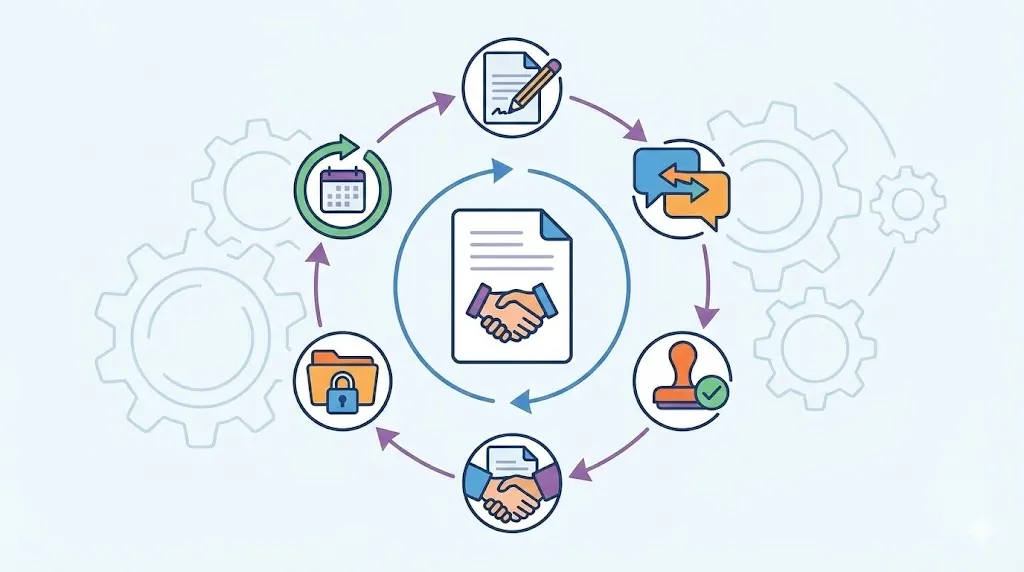
Contracts travel through several key stages:
Intake: Someone submits a contract request, often with details about the deal.
Drafting: The legal team prepares the initial draft of the contract, often building upon established templates to ensure consistency and compliance.
Internal Review: Departments such as legal and finance conduct thorough assessments of the draft, identifying necessary changes and ensuring alignment with organizational policies.
Negotiation: Stakeholders exchange redlines and comments, working collaboratively to reach terms that satisfy all involved parties.
Approval: Authorized personnel within the organization provide the final authorization.
Execution: The contract is formally executed upon signatures from all parties.
Time accumulates at each phase, with the majority of delays occurring during transitions rather than active tasks. A contract prepared for review might remain pending for several days simply because the responsible party is unaware that action is required.
Understanding this full timeline is crucial. It helps you see where contracts stall and how to fix those hold-ups.
Related articles: How To Accelerate Contract Review Process? Effective Guide
Why Does Contract Cycle Time Matter So Much?
Contract cycle time is not just a legal team issue. Additionally, it impacts the entire business. Slow contracts delay revenue, disrupt forecasting, and strain relationships with partners and vendors.
Revenue Delays: Every extra day contracts take to sign delays revenue recognition. Sales teams lose momentum, and quarterly targets slip. According to a 2023 survey by the Association of Corporate Counsel, 54% of sales professionals say contract delays hurt their revenue.
Forecasting Challenges: When contracts take unpredictable amounts of time, finance teams cannot accurately forecast cash flow or budget. This uncertainty makes planning difficult.
Damaged Relationships: Vendors and partners notice slow contract processes. Moreover, in some cases, they may prefer competitors who move faster, risking lost business.
Hidden Risks: Longer cycle times increase exposure to changing regulations, market shifts, or personnel changes. Contracts left unsigned can become outdated or riskier.
Legal Reputation: If contracts drag, legal teams get blamed as bottlenecks, even when delays come from other departments. This hurts trust between legal and business teams.
Fast, predictable contract cycle times build trust and support business growth. They keep deals moving and reduce risks.
Related articles: Streamlining Contract Summaries for Business Teams
What Causes Long Contract Cycle Times?
Most contract delays do not come from complex legal work. Instead, inefficient processes, missing information, and disconnected tools are often to blame.
Here are common causes:
Unstructured Intake: Requests arrive by email or chat, often missing key details. Legal must chase down information before drafting. This can add days.
No Standard Templates: Without approved templates, legal starts from scratch or hunts for the latest version. This wastes time and risks errors.
Lack of Negotiation Playbooks: Without clear rules on which contract terms can change, negotiation drags as teams debate every clause.
Slow Approval Routing: If no one knows who must approve next, contracts sit idle. Multiple approvers multiply delays.
Fragmented Tools: Contract data spread across emails, spreadsheets, and multiple systems causes confusion and manual work.
Manual Signature Processes: Printing, scanning, or emailing contracts for signature adds unnecessary wait time.
According to a 2024 Gartner report, organizations use an average of 24 different systems to manage contract data, creating silos that slow workflows.
Related articles: Contract Abstraction: Extract Key Data Efficiently
Who Should Own Contract Cycle Time?
Contract cycle time is a shared responsibility. Additionally, legal teams frequently take the lead given their role in drafting and reviewing contracts. Meanwhile, departments such as sales, procurement, finance, and operations each exert significant influence over the overall cycle time.
Legal: Responsible for drafting contracts, conducting risk assessments, managing reviews, and overseeing approval workflows.
Sales: Responsible for initiating contracts and steering negotiations to establish final terms with customers.
Procurement: Handles vendor contracts alongside the complexities of required approval procedures.
Finance: Focuses on assessing budgets and closely examining payment terms stipulated in contracts.
Operations: Manages the execution phase and ensures continuous compliance throughout contract lifecycles.
Bringing these groups into alignment on their goals and workflows is essential for producing consistent results. Shared service-level agreements (SLAs) that define target cycle times per contract type help create accountability. For example, simple sales contracts might have a 3-day turnaround goal, while complex vendor agreements allow more time.
Leadership should monitor cycle time metrics across teams to identify bottlenecks and improve collaboration.
Related articles: How to Manage a Contract Post Execution? Best Practices
How to Measure Contract Cycle Time Accurately
Measuring contract cycle time well is the first step to cutting it. Additionally, to gain better insights, track total days and dissect the process into discrete stages to pinpoint actual delays.
Define Contract Stages: Intake, drafting, internal review, negotiation, approval, execution.
Track Active Work vs. Wait Time: Separate time spent actively working on contracts from time waiting for input or approval.
Record exact timestamps marking when contracts enter and exit each phase.
Calculate the duration of each stage to identify which ones contribute most significantly to the total delay.
Analyze recurring bottlenecks by examining patterns related to contract types, responsible teams, or requesters.
For example, drafting may require only 2 days, whereas approvals can extend to 10 days, highlighting critical areas for improvement.
Automated contract lifecycle management (CLM) tools can capture these metrics in real time. Without automation, manual tracking often misses hidden wait times.
Related articles: How to Simplify Contract Approvals? A Comprehensive Guide
5 Practical Ways to Cut Contract Cycle Time Without Adding Risk
Cutting contract cycle time requires tackling root causes while ensuring contracts remain compliant and intact.
1. Standardize Intake with Self-Service Forms: Use carefully designed forms that gather all necessary information right from the start.
2. Maintain a Library of Approved Templates: Update templates regularly and organize them for easy access. Draft contracts faster and more consistently.
3. Create Negotiation Playbooks: Define which terms negotiators can change and which are fixed. This curtails protracted discussions over minor points.
4. Automate Approval Workflows: Route contracts automatically based on type and value. Enable parallel reviews to speed approvals.
5. Integrate eSignature Tools: Allow contracts to be signed electronically within the CLM platform to avoid printing or emailing delays.
By using this approach, you can significantly reduce back-and-forth communications required to clarify deal specifics. Implementing these adjustments minimizes inefficiencies and facilitates continuous contract progression. Moreover, applying established standards consistently enhances compliance and decreases the likelihood of errors.
Related articles: How to Reduce Contract Redlining: Embrace Contract Templates
4 Challenges in Maintaining Fast Contract Cycle Times
Even after improvements, some challenges persist:
Changing Business Needs: New products, markets, or regulations require contract updates that slow processes.
User Adoption: Resistance to adopting new tools or workflows often results in process inefficiencies and the implementation of workaround solutions.
Complex Negotiations: High-stakes deals often involve protracted discussions and demand an exhaustive examination of terms.
Cross-Department Coordination: Delays in handoffs become unavoidable when priorities diverge or accountability lacks clarity.
It is critical to mitigate these issues through ongoing process audits, comprehensive user training, and recalibrating SLAs to align with operational realities.
Related articles: Crypto Exchange Giant Revolutionizes Contract Management
Why Contract Management Software Matters
Contract management software serves to centralize contracts, streamline workflows through automation, and deliver clear insights into cycle times. It helps teams:
Track contract progress throughout each stage with real-time status updates.
Utilize templates, clause libraries, and playbooks to speed up drafting and negotiation.
Facilitate approvals through rules-based workflows paired with automated reminders.
Incorporate electronic signatures to expedite contract finalization.
Analyze cycle time data to identify bottlenecks and optimize workflows.
Such solutions lessen manual effort and minimize errors, thereby enhancing speed and accuracy.
Managing complex contract workflows requires a centralized system equipped with sophisticated intelligence. Volody’s contract management platform includes AI-enhanced drafting, review, and negotiation capabilities. Moreover, it also automates approval workflows and integrates eSignatures to avoid delays. Volody features dashboards that monitor cycle times and contract statuses live.
Interested in how contract management tools can optimize your legal workflows? Explore Volody's CLM Software.
Related Article: Understanding Contract Duration: Key Elements and Tips
FAQ
What differentiates contract cycle time from turnaround time?
Contract cycle time encompasses the entire duration from contract initiation to final signature, including all waiting periods. Turnaround time instead measures the actual effort expended during discrete contract phases. While cycle time highlights total latency, turnaround time focuses solely on active processing time.
Furthermore, how can legal teams shorten the contract lifecycle without compromising compliance?
Legal teams accomplish this by standardizing templates, utilizing negotiation playbooks, and automating approval sequences. These tactics curtail avoidable delays while preserving compliance and contract integrity. It remains vital to ensure that reviews are thorough to maintain effective risk management.
What role does automation play in accelerating contract cycles?
Automation directs contracts to the correct approvers, sends timely follow-up notifications, and supports parallel reviews. It also integrates eSignatures, eliminating manual handoffs. Together, these features cut wait times and reduce human errors that often cause delays.
Also, how do negotiation playbooks help contract speed?
Playbooks set predefined rules on allowable contract term modifications, preventing drawn-out negotiations over minor points and hastening agreement closure. They also ensure consistent risk controls across agreements.
What metrics should organizations track to improve contract cycle efficiency?
Organizations should measure total cycle length and segment it by key stages such as intake, drafting, review, negotiation, approval, and execution. Separating periods of inactivity from active work is essential. Examining averages by contract category and responsible teams delivers further granularity.
It is essential to differentiate between waiting intervals and periods of active work. Therefore, tracking averages by contract type and accountable teams provides additional clarity.
Why do contracts frequently experience delays during the approval phase?
Approval delays often result from unclear accountability or overburdened approvers. Without automated workflows combined with notification alerts, contracts risk stagnating in inboxes. The involvement of multiple approvers can further complicate timely progression.
Can sales teams influence contract timelines?
Yes. Sales teams affect cycle time by submitting complete contract requests and following approved templates. They also enhance negotiation efficiency and work closely with legal and finance functions.
Consequently, how do postponements in contract finalization impact revenue recognition?
Finalization holdups delay revenue recognition because deals remain open. This affects the accuracy of financial reporting and cash flow forecasting, complicating strategic business planning.
What are the consequences of overlooking contract duration metrics?
Ignoring cycle time data can lead to lost business opportunities, strained vendor relationships, outdated contract provisions, and missed compliance deadlines. It also diminishes legal’s role as a strategic business partner.
How frequently should organizations evaluate their contract lifecycle processes?
Quarterly or more frequent reviews help detect emerging bottlenecks and refine service level agreements. Continuous improvement ensures contract management aligns with changing business demands and technological progress.
About the Company

Volody AI CLM is an Agentic AI-powered Contract Lifecycle Management platform designed to eliminate manual contracting tasks, automate complex workflows, and deliver actionable insights. As a one-stop shop for all contract activities, it covers drafting, collaboration, negotiation, approvals, e-signature, compliance tracking, and renewals. Built with enterprise-grade security and no-code configuration, it meets the needs of the most complex global organizations. Volody AI CLM also includes AI-driven contract review and risk analysis, helping teams detect issues early and optimize terms. Trusted by Fortune 500 companies, high-growth startups, and government entities, it transforms contracts into strategic, data-driven business assets.




" height="216.72211px" id="FYO0bO80Y" transform="translate(3 6.105)" width="206.073px"/><path d="M 108.174 222 C 88.432 222 70.303 217.239 53.785 207.717 C 37.267 198.196 24.173 185.052 14.504 168.285 C 4.835 151.312 0 132.165 0 110.845 C 0 89.731 4.835 70.792 14.504 54.025 C 24.173 37.052 37.267 23.804 53.785 14.282 C 70.303 4.761 88.432 0 108.174 0 C 128.116 0 146.246 4.761 162.562 14.282 C 179.08 23.804 192.073 37.052 201.541 54.025 C 211.21 70.792 216.044 89.731 216.044 110.845 C 216.044 132.165 211.21 151.312 201.541 168.285 C 192.073 185.052 179.08 198.196 162.562 207.717 C 146.044 217.239 127.915 222 108.174 222 Z M 108.174 183.189 C 120.864 183.189 132.044 180.291 141.713 174.495 C 151.382 168.492 158.936 160.006 164.375 149.035 C 169.814 138.064 172.533 125.334 172.533 110.845 C 172.533 96.355 169.814 83.729 164.375 72.965 C 158.936 61.994 151.382 53.611 141.713 47.815 C 132.044 42.02 120.864 39.122 108.174 39.122 C 95.483 39.122 84.202 42.02 74.332 47.815 C 64.663 53.611 57.109 61.994 51.67 72.965 C 46.231 83.729 43.511 96.355 43.511 110.845 C 43.511 125.334 46.231 138.064 51.67 149.035 C 57.109 160.006 64.663 168.492 74.332 174.495 C 84.202 180.291 95.483 183.189 108.174 183.189 Z" fill="rgba(255, 255, 255, 0.12)" height="222px" id="aa1McFcE9" transform="translate(227.183 3)" width="216.04399999999998px"/><path d="M 42.302 182.257 L 111.799 182.257 L 111.799 216.722 L 0 216.722 L 0 0 L 42.302 0 Z" fill="rgba(255, 255, 255, 0.12)" height="216.72211px" id="yRq4AnrsX" transform="translate(477.721 6.105)" width="111.79899999999998px"/><path d="M 108.174 222 C 88.432 222 70.303 217.239 53.785 207.717 C 37.267 198.196 24.173 185.052 14.504 168.285 C 4.835 151.312 0 132.165 0 110.845 C 0 89.731 4.835 70.792 14.504 54.025 C 24.173 37.052 37.267 23.804 53.785 14.282 C 70.303 4.761 88.432 0 108.174 0 C 128.116 0 146.246 4.761 162.562 14.282 C 179.08 23.804 192.073 37.052 201.541 54.025 C 211.21 70.792 216.045 89.731 216.045 110.845 C 216.045 132.165 211.21 151.312 201.541 168.285 C 192.073 185.052 179.08 198.196 162.562 207.717 C 146.044 217.239 127.915 222 108.174 222 Z M 108.174 183.189 C 120.864 183.189 132.044 180.291 141.713 174.495 C 151.382 168.492 158.936 160.006 164.375 149.035 C 169.814 138.064 172.534 125.334 172.534 110.845 C 172.534 96.355 169.814 83.729 164.375 72.965 C 158.936 61.994 151.382 53.611 141.713 47.815 C 132.044 42.02 120.864 39.122 108.174 39.122 C 95.483 39.122 84.202 42.02 74.332 47.815 C 64.663 53.611 57.108 61.994 51.67 72.965 C 46.231 83.729 43.511 96.355 43.511 110.845 C 43.511 125.334 46.231 138.064 51.67 149.035 C 57.108 160.006 64.663 168.492 74.332 174.495 C 84.202 180.291 95.483 183.189 108.174 183.189 Z" fill="rgba(255, 255, 255, 0.12)" height="222px" id="mo8HQspQ0" transform="translate(609.155 3)" width="216.04500000000007px"/><path d="M 73.727 0 C 95.885 0 115.324 4.45 132.044 13.351 C 148.967 22.252 161.957 34.982 171.027 51.541 C 180.287 67.894 184.917 86.937 184.917 108.671 C 184.917 130.405 180.287 149.449 171.027 165.801 C 161.957 181.947 148.967 194.47 132.044 203.371 C 115.324 212.271 95.885 216.722 73.727 216.722 L 0 216.722 L 0 0 Z M 72.216 179.773 C 94.374 179.773 111.497 173.564 123.583 161.144 C 135.669 148.724 141.713 131.233 141.713 108.671 C 141.713 86.109 135.669 68.515 123.583 55.888 C 111.497 43.055 94.374 36.638 72.216 36.638 L 42.302 36.638 L 42.302 179.773 Z" fill="rgba(255, 255, 255, 0.12)" height="216.72211px" id="I3iXX5Hi_" transform="translate(859.693 6.105)" width="184.91699999999992px"/><path d="M 185.22 0 L 113.91 141.273 L 113.91 216.722 L 71.61 216.722 L 71.61 141.273 L 0 0 L 47.74 0 L 93.06 99.046 L 138.08 0 Z" fill="rgba(255, 255, 255, 0.12)" height="216.72211px" id="nzHyWC0_d" transform="translate(1061.78 6.105)" width="185.22000000000003px"/></svg>)