

Managing contracts feels like juggling a dozen balls at once. As your business grows, so does the number of agreements, deadlines, and obligations. Without a clear system, contracts can become lost, outdated, or overlooked. This creates risks in compliance, missed revenue opportunities, and operational slowdowns. Understanding how to scale contract organization is essential to keep your legal, procurement, and finance teams aligned and efficient.
Imagine a procurement team scrambling to find a vendor contract before a renewal deadline. Or a legal department hunting through multiple drives to confirm the latest signed version during an audit. These scenarios are common when contract management is scattered and unstructured. Scaling contract organization means building a reliable, scalable system that keeps contracts accessible, accurate, and actionable across your entire company.
TL;DR
Centralizing contracts into a single, secure repository addresses the vulnerabilities introduced by fragmented file storage and misplacement.
Applying metadata tags—covering elements like counterparty, effective dates, and contract classification—enables precise indexing that enhances document retrieval and ongoing contract monitoring.
Implementing automated notifications for contract renewals, obligations, and approval requirements is critical for avoiding missed deadlines and reducing associated risks.
Initiate the process by focusing on one contract category with an assigned owner, then broaden the scope once measurable improvements have been demonstrated.
When contracts are disorganized, it leads to version control issues, overlooked renewals, and protracted audits, all of which negatively affect revenue and risk management.
Utilizing contract management software enables the optimization of workflows, increases transparency, and minimizes reliance on manual processes.
Related Article: Why Poor Organizational Design Is Costing Your Business
What Does Scaling Contract Organization Really Mean?
Establishing an adaptable framework for organizing contracts is essential to accommodate your business’s increasing contract volume and complexity. Additionally, it is not just about storing files. It involves structuring contracts so teams can quickly find, understand, and act on agreements no matter how many contracts exist or how many people need access.
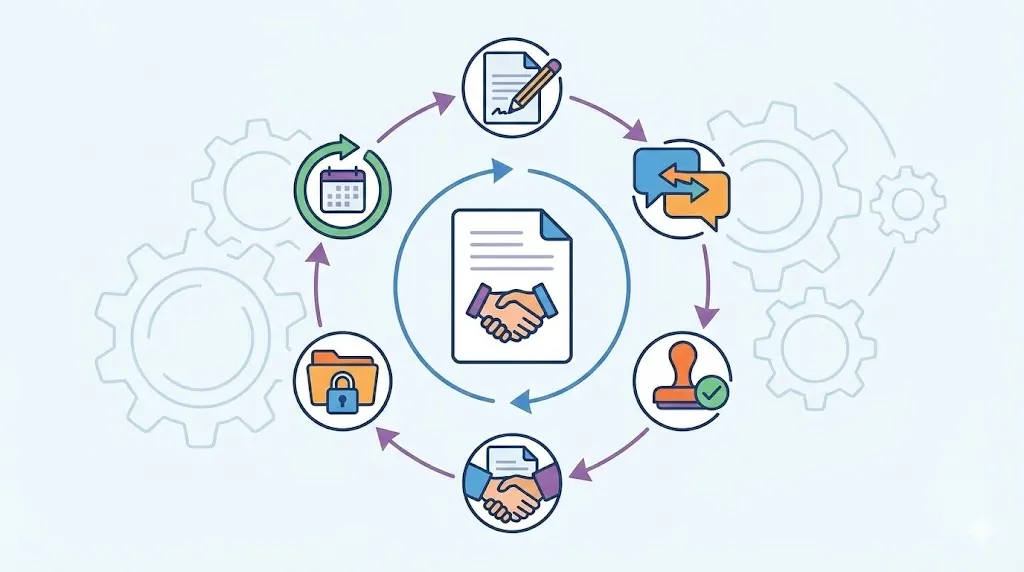
At its core, contract organization covers where contracts live, how they are categorized, who can access them, and how ongoing obligations are tracked. Proper implementation enhances every phase of the contract lifecycle—drafting through to renewal—by streamlining workflows and improving visibility.
Without a scalable infrastructure for managing contract records, companies find themselves overwhelmed as the number of contracts grows exponentially. Teams waste time searching for documents, risk using outdated templates, and miss important deadlines. This leads to legal exposure, financial loss, and operational bottlenecks.
A well-structured contract management architecture underpins effective contract lifecycle management (CLM) tools and processes. It ensures that as your contract portfolio grows, your ability to manage it does not break down. It turns contract management from a reactive chore into a strategic asset.
Related articles: Scaling Your Business with the Right CLM Software
Why Is Contract Organization Critical for Legal, Procurement, and Finance?
Contracts touch many parts of a business. When contract organization fails, it affects multiple teams:
Legal teams struggle to find signed agreements during audits or due diligence. This increases risk and delays decisions. They may also lose control over contract templates, leading to inconsistent or risky language slipping in.
Procurement teams lose sight of vendor obligations and renewal dates. This causes missed opt-outs, duplicate contracts, and uncontrolled spending. Without clear contract visibility, procurement cannot negotiate effectively or manage supplier relationships.
Finance teams depend on contract terms for revenue forecasting and expense tracking. Moreover, poor contract access results in inaccurate financial projections and overlooked escalations or auto-renewals, which gradually erode profit margins.
According to a report by The Contracting Benchmark, organizations lose between 5% and 9% of annual revenue due to poor contract management practices. This revenue leakage happens quietly but adds up fast.
Good contract organization shifts legal and procurement from bottlenecks to trusted business partners. It enables faster responses, better risk control, and smarter financial planning. This alignment is vital for companies aiming to scale efficiently and reduce operational risks.
Related articles: Vendor Contract Management Logistics: Best Practices
What Common Problems Arise from Poor Contract Organization?
Disorganized contracts create many everyday challenges. These issues are not rare exceptions but frequent pain points in companies without a scalable system:
Version sprawl: Multiple contract drafts float across emails, desktops, and cloud drives. Teams cannot confirm which version was signed, leading to confusion and disputes.
Shadow repositories: Different departments keep their own contract folders. This causes duplicate or conflicting records that no one reconciles. On average, companies use 24 different systems to store contract data, fragmenting visibility.
Missed renewals: Without automated alerts, contracts renew silently on unfavorable terms or expire when still needed. This results in lost leverage or service gaps.
Stale templates: Relying on outdated templates often causes teams to embed clauses that may be non-compliant or expose the organization to unnecessary risk.
Slow audits: Complying with regulatory requests often demands extensive searches across disparate systems, delaying the generation of comprehensive reports.
Studies show 71% of businesses cannot locate at least 10% of their contracts during audits.
No reporting baseline: Finance or procurement leaders cannot confidently answer how many active contracts exist or their key terms. This lack of data hinders strategic decisions.
These problems grow exponentially as contract volume expands, complicating management further. Most companies do not plan for this complexity upfront. Instead, contract chaos builds quietly until it causes serious operational or financial damage.
Related articles: Contract Storage Tips: How to Organise Contracts Easily
How to Organize Contracts at Scale: Best Practices
Organizing contracts at scale requires a clear strategy and disciplined execution. Here are detailed best practices to build a scalable contract organization system:
1. Centralize Contracts in One Secure Repository
Start by gathering all contracts into a single, secure digital repository. Avoid scattered storage across emails, shared drives, or personal folders. Centralization provides a single source of truth for all agreements.
The repository should support:
Secure access controls by role or department
Full-text search and metadata filtering
Version control with audit history
Easy upload and bulk import capabilities
Centralization reduces time spent hunting for contracts and prevents lost or duplicated files.
2. Define and Apply Consistent Metadata Fields
Metadata turns a contract repository from a filing cabinet into a searchable database. Tag every contract with essential fields such as:
Counterparty name
Contract type (e.g., NDA, purchase agreement)
Effective date and expiration date
Renewal terms and notice periods
Department or business unit owner
Contract value or spend amount
This structure enables quick filtering and reporting. For example, procurement can pull all vendor contracts expiring in the next 90 days. Moreover, finance teams, in turn, monitor contracts that exceed specific monetary thresholds.
3. Automate Alerts and Tracking
Manual tracking of contract deadlines and obligations leads to errors and missed opportunities. Automate alerts for:
Renewal and termination notice deadlines
Payment schedules and milestones
Service level agreement (SLA) commitments
Contract status changes (draft, negotiation, executed)
Automated dashboards should show contracts needing attention. This proactive approach prevents silent renewals and compliance failures.
4. Build Workflows Around High-Volume Contract Types
Start scaling by focusing on one high-volume contract type, such as NDAs or vendor agreements. Assign a dedicated owner to develop templates, metadata, and approval workflows for that contract category.
Track key metrics like:
Contract cycle time from request to execution
Renewal capture rate
User adoption and compliance rates
Use these insights to prove value and refine processes before expanding to other contract types or departments.
5. Establish Clear Ownership and Access Policies
Assign contract ownership to specific teams or individuals. Owners are responsible for maintaining contract templates, metadata accuracy, and compliance.
Set access permissions based on roles and departments. This protects sensitive information while ensuring stakeholders can find and act on contracts relevant to them.
6. Regularly Audit and Clean Your Contract Repository
Scheduled audits uncover duplicates, outdated files, and incomplete contracts that need remediation. Also, during these reviews, remove stale templates and archive agreements that have reached expiration. This ongoing maintenance keeps the repository dependable and current.
7. Train Teams and Promote Adoption
Scaling contract organization depends on securing commitment from legal, procurement, finance, and business units alike. Provide comprehensive training on repository usage, metadata application, and workflow procedures.
Communicate the benefits clearly: faster contract turnaround, fewer risks, and better visibility. Monitor adoption and address resistance early.
Related articles: How to Organize Contracts: 7 Best Practices in 2026
What to Look for in Contract Organization Software
Software can make or break your ability to scale contract organization. Choose a solution that offers:
Centralized contract repository: Secure storage with full-text search, metadata tagging, and version control.
Metadata and tagging flexibility: Ability to customize fields and categories to match your business needs.
Automated alerts and notifications: Reminders for renewals, obligations, and approvals.
Workflow automation: Support for contract requests, approvals, and collaboration.
Reporting and dashboards: Tools that provide detailed analysis of contract volume, cycle times, risk factors, and compliance status.
Integration capabilities: Seamless connections with your existing ERP, CRM, and document management platforms.
Security and compliance: Features such as role-based access controls, data encryption, audit trails, and adherence to compliance standards.
Scalability: Capable of managing portfolios across multiple entities, departments, and international jurisdictions.
Avoid software that only stores contracts without workflow or alert features, as these lack critical functionality for proactive management. Also, beware of solutions that require heavy IT involvement for configuration or lack user-friendly interfaces.
Related articles: Contract Management for Small Business in 2026
How to Roll Out Contract Organization Across Your Business
Rolling out a contract organization system at scale is a multi-step process:
Assess current contract landscape: Identify where contracts live, volume by type, and pain points.
Define goals and success metrics: These might involve cutting contract cycle times by a fifth or ensuring no renewals are overlooked.
Select a pilot contract type: Focus on a category that combines significant volume with strategic relevance to maximize impact.
Assign a contract owner: Designate an individual responsible for developing templates, configuring metadata, and designing workflows.
Implement software and migrate contracts: Transfer existing agreements into the platform, ensuring each is meticulously tagged with the correct metadata.
Train users and communicate benefits: Engage legal, procurement, and finance teams early to support adoption and underscore the system’s advantages.
Monitor performance and gather feedback: Track metrics including user adoption, contract processing times, and error rates.
Iterate and expand: Continuously refine processes and gradually bring additional contract types or departments into the fold.
Change management is key. Address resistance by demonstrating early successes and illustrating how adopting this system alleviates everyday frustrations.
Related articles: How to Improve Vendor Contract Management in Logistics
5 Challenges in Maintaining Contract Organization at Scale
Scaling contract organization is not without obstacles. Common challenges include:
Data quality issues: Metadata inconsistencies and absent fields often undermine both the precision of search functions and the reliability of generated reports.
User adoption: Teams entrenched in existing workflows frequently exhibit resistance to adopting new tools or processes, particularly when these are perceived to introduce additional complexity.
Legacy contracts: Migrating legacy agreements frequently involves painstaking efforts to rectify formatting irregularities and supplement missing information.
Integration gaps: The absence of native interoperability between ERP, CRM, and e-signature systems compels organizations to rely heavily on manual processes and maintain disjointed data silos.
Security concerns: Ensuring comprehensive protection of sensitive contracts while granting appropriate access requires implementing meticulously designed and enforceable control policies.
Addressing these obstacles effectively requires establishing clear governance frameworks, providing ongoing training, and selecting adaptable software solutions tailored to your operational environment.
Related articles: Contract Governance: A Guide to Strategic Value
How Contract Management Software Solves This
Contract management solutions provide a centralized platform to organize, track, and automate contract processes. It eliminates the chaos of scattered files and manual tracking by offering:
A secure, searchable repository with version control
Custom metadata fields and tagging for easy filtering
Automated alerts for renewals, milestones, and approvals
Workflow automation for contract requests, reviews, and e-signatures
Dashboards and reports to monitor contract health and performance
Solutions like Volody combine AI-powered drafting and review with strong metadata extraction and obligation management. Features such as template libraries, approval workflows, and role-based access controls help teams maintain consistency and compliance as contract volume grows.
Volody supports multi-entity and global teams, making it suitable for enterprises scaling their contract organization. Its integration with Microsoft Word and various enterprise applications allows legal teams to work efficiently within familiar tools.
See how Volody's CLM Software helps legal teams manage contracts faster and with greater control.
FAQ
What distinguishes contract organization from contract lifecycle management?
Moreover, contract organization concerns the methods used for storing, labeling, and accessing contracts. It ensures contracts are easy to find and up to date. The management of contracts throughout their entire lifespan—from initial drafting to renewal—falls under contract lifecycle management.
How can metadata improve contract management?
Metadata tags key contract details like parties, dates, and contract type. This makes contracts searchable and enables automated alerts. Furthermore, metadata also supports reporting, helping teams track contract status and risks without manual review.
What are the risks of poor contract organization?
Poor organization leads to lost contracts, version confusion, missed renewals, and compliance failures. These problems also increase legal risk, cause revenue leakage, and slow down business operations.
What steps facilitate scaling contract organization within a company?
Start by focusing on a single high-volume contract category and designate a responsible owner. Also, develop templates, metadata schemas, and workflows tailored to that category. Measure key performance indicators to demonstrate impact, then progressively expand to other contract types and departments.
What features should I look for in contract organization software?
Look for centralized storage, metadata customization, automated alerts, workflow automation, reporting dashboards, integration options, and strong security controls.
How do automated renewal alerts help contract management?
Also, renewal alerts notify teams before contracts expire or auto-renew. This prevents unwanted renewals or lapses, allowing teams to renegotiate or cancel contracts on time.
Therefore, can contract management platforms integrate with other enterprise systems?
Indeed, effective contract management software interfaces seamlessly with ERP, CRM, procurement, and e-signature platforms. Such integration minimizes manual data entry and ensures data consistency across organizational tools.
What role do contract owners play in scaling organization?
Contract owners maintain templates, ensure metadata accuracy, and oversee compliance. They act as points of contact for contract questions and help enforce processes.
How should legacy contracts be handled when scaling?
Consequently, conduct a bulk import and metadata extraction process. Clean and tag contracts as you migrate them into the new system. Move outdated or inactive agreements into archives to declutter the active repository.
What strategies encourage user adoption of contract organization tools?
Provide bespoke training tailored to each team’s workflows. Highlight the benefits in efficiency and risk reduction. Share case studies and monitor adoption metrics to proactively address resistance.
This methodical approach to expanding contract organization helps companies reduce risk, improve efficiency, and support growth. By centralizing contracts, applying consistent metadata, automating alerts, and using smart software, teams gain control over their contract portfolios and unlock real business value.
About the Company

Volody AI CLM is an Agentic AI-powered Contract Lifecycle Management platform designed to eliminate manual contracting tasks, automate complex workflows, and deliver actionable insights. As a one-stop shop for all contract activities, it covers drafting, collaboration, negotiation, approvals, e-signature, compliance tracking, and renewals. Built with enterprise-grade security and no-code configuration, it meets the needs of the most complex global organizations. Volody AI CLM also includes AI-driven contract review and risk analysis, helping teams detect issues early and optimize terms. Trusted by Fortune 500 companies, high-growth startups, and government entities, it transforms contracts into strategic, data-driven business assets.




" height="216.72211px" id="FYO0bO80Y" transform="translate(3 6.105)" width="206.073px"/><path d="M 108.174 222 C 88.432 222 70.303 217.239 53.785 207.717 C 37.267 198.196 24.173 185.052 14.504 168.285 C 4.835 151.312 0 132.165 0 110.845 C 0 89.731 4.835 70.792 14.504 54.025 C 24.173 37.052 37.267 23.804 53.785 14.282 C 70.303 4.761 88.432 0 108.174 0 C 128.116 0 146.246 4.761 162.562 14.282 C 179.08 23.804 192.073 37.052 201.541 54.025 C 211.21 70.792 216.044 89.731 216.044 110.845 C 216.044 132.165 211.21 151.312 201.541 168.285 C 192.073 185.052 179.08 198.196 162.562 207.717 C 146.044 217.239 127.915 222 108.174 222 Z M 108.174 183.189 C 120.864 183.189 132.044 180.291 141.713 174.495 C 151.382 168.492 158.936 160.006 164.375 149.035 C 169.814 138.064 172.533 125.334 172.533 110.845 C 172.533 96.355 169.814 83.729 164.375 72.965 C 158.936 61.994 151.382 53.611 141.713 47.815 C 132.044 42.02 120.864 39.122 108.174 39.122 C 95.483 39.122 84.202 42.02 74.332 47.815 C 64.663 53.611 57.109 61.994 51.67 72.965 C 46.231 83.729 43.511 96.355 43.511 110.845 C 43.511 125.334 46.231 138.064 51.67 149.035 C 57.109 160.006 64.663 168.492 74.332 174.495 C 84.202 180.291 95.483 183.189 108.174 183.189 Z" fill="rgba(255, 255, 255, 0.12)" height="222px" id="aa1McFcE9" transform="translate(227.183 3)" width="216.04399999999998px"/><path d="M 42.302 182.257 L 111.799 182.257 L 111.799 216.722 L 0 216.722 L 0 0 L 42.302 0 Z" fill="rgba(255, 255, 255, 0.12)" height="216.72211px" id="yRq4AnrsX" transform="translate(477.721 6.105)" width="111.79899999999998px"/><path d="M 108.174 222 C 88.432 222 70.303 217.239 53.785 207.717 C 37.267 198.196 24.173 185.052 14.504 168.285 C 4.835 151.312 0 132.165 0 110.845 C 0 89.731 4.835 70.792 14.504 54.025 C 24.173 37.052 37.267 23.804 53.785 14.282 C 70.303 4.761 88.432 0 108.174 0 C 128.116 0 146.246 4.761 162.562 14.282 C 179.08 23.804 192.073 37.052 201.541 54.025 C 211.21 70.792 216.045 89.731 216.045 110.845 C 216.045 132.165 211.21 151.312 201.541 168.285 C 192.073 185.052 179.08 198.196 162.562 207.717 C 146.044 217.239 127.915 222 108.174 222 Z M 108.174 183.189 C 120.864 183.189 132.044 180.291 141.713 174.495 C 151.382 168.492 158.936 160.006 164.375 149.035 C 169.814 138.064 172.534 125.334 172.534 110.845 C 172.534 96.355 169.814 83.729 164.375 72.965 C 158.936 61.994 151.382 53.611 141.713 47.815 C 132.044 42.02 120.864 39.122 108.174 39.122 C 95.483 39.122 84.202 42.02 74.332 47.815 C 64.663 53.611 57.108 61.994 51.67 72.965 C 46.231 83.729 43.511 96.355 43.511 110.845 C 43.511 125.334 46.231 138.064 51.67 149.035 C 57.108 160.006 64.663 168.492 74.332 174.495 C 84.202 180.291 95.483 183.189 108.174 183.189 Z" fill="rgba(255, 255, 255, 0.12)" height="222px" id="mo8HQspQ0" transform="translate(609.155 3)" width="216.04500000000007px"/><path d="M 73.727 0 C 95.885 0 115.324 4.45 132.044 13.351 C 148.967 22.252 161.957 34.982 171.027 51.541 C 180.287 67.894 184.917 86.937 184.917 108.671 C 184.917 130.405 180.287 149.449 171.027 165.801 C 161.957 181.947 148.967 194.47 132.044 203.371 C 115.324 212.271 95.885 216.722 73.727 216.722 L 0 216.722 L 0 0 Z M 72.216 179.773 C 94.374 179.773 111.497 173.564 123.583 161.144 C 135.669 148.724 141.713 131.233 141.713 108.671 C 141.713 86.109 135.669 68.515 123.583 55.888 C 111.497 43.055 94.374 36.638 72.216 36.638 L 42.302 36.638 L 42.302 179.773 Z" fill="rgba(255, 255, 255, 0.12)" height="216.72211px" id="I3iXX5Hi_" transform="translate(859.693 6.105)" width="184.91699999999992px"/><path d="M 185.22 0 L 113.91 141.273 L 113.91 216.722 L 71.61 216.722 L 71.61 141.273 L 0 0 L 47.74 0 L 93.06 99.046 L 138.08 0 Z" fill="rgba(255, 255, 255, 0.12)" height="216.72211px" id="nzHyWC0_d" transform="translate(1061.78 6.105)" width="185.22000000000003px"/></svg>)