
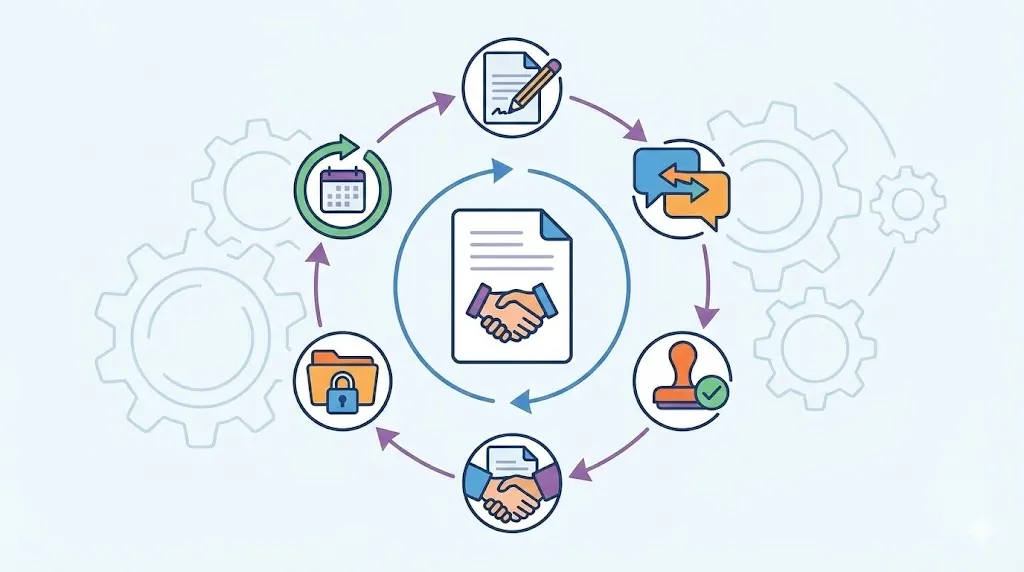
Contract lifecycle management (CLM) can feel like navigating a maze. Legal teams face tight deadlines, complex negotiations, and endless contract details. Our customer-centric teams are dedicated to hearing your feedback and partnering with you to deliver Contract Lifecycle solutions that truly fit your needs. By listening closely and working together, we help you turn contract challenges into smooth, manageable processes.
TL;DR
Gathering feedback centered on customer requirements is essential for customizing contract lifecycle management solutions effectively.
Additionally, in-depth interaction with users reveals critical insights that refine contract workflows and enhance software adoption rates.
The success of contract management is largely contingent upon robust collaborations established between service providers and their clients.
Specialized conferences and professional groups serve as vital platforms where contract experts exchange knowledge.
Leadership recognition and the encouragement of innovation in contract management are underscored by the dissemination of achievement narratives.
By automating workflows, mitigating potential risks, and accelerating approval cycles, contract management software greatly enhances operational efficiency.
Why Listening to Customers Matters in Contract Lifecycle Management
The management of contracts throughout their entire lifecycle encompasses numerous complex components. Additionally, from drafting and negotiation through execution and renewal, each phase demands meticulous attention and transparency. When software developers actively engage with their customers, they create solutions tailored to actual workflow requirements, minimizing obstacles and speeding up user adoption.
Customer insights expose underlying difficulties that might remain hidden without direct input. For instance, legal teams often encounter challenges in monitoring contract commitments or coordinating approval processes across various departments. Gathering such detailed feedback enables developers to pinpoint these problems and implement precise features aimed at addressing them.
Listening also builds trust. Customers who feel their perspectives are valued tend to participate more actively. They contribute innovative ideas, highlight issues, and recommend enhancements. This ongoing exchange cultivates a dynamic feedback loop advantageous to all stakeholders. As a result, product refinement occurs, delivering functionalities that align closely with user demands.
Moreover, consider a legal operations leader overwhelmed by disorganized contract renewals. They communicate concerns about overlooked deadlines and cumbersome manual tracking. In response, engineers integrate automated notifications alongside a unified dashboard interface. This approach significantly reduces renewal oversights and alleviates procedural burdens.
Customer-centric teams act like partners, not just vendors. These teams recognize that managing contracts from initiation through fulfillment requires collaborative engagement. By maintaining close cooperation with clients, they facilitate continuous adaptation of solutions to meet evolving business requirements.
Related articles: Contract Management Software for Sales Teams | CLM Guide
How Partnerships Enhance Contract Management Success
Strong partnerships between contract management providers and customers go beyond software delivery. Additionally, they encompass continuous collaboration, ongoing education, and comprehensive support. This partnership mindset helps organizations realize the full value of their contract lifecycle management investments.
Providers often assign dedicated teams to customer success. These teams guide clients through onboarding, training, and optimization. They ensure users understand how to use the system and get the most from it.
Maintaining open communication channels requires regular check-ins and structured feedback sessions. Customers are encouraged to express their concerns and suggest improvements. Providers share early insights into upcoming product developments and circulate best practices aimed at optimizing the user experience. Moreover, such transparency is crucial for building trust and deepening customer loyalty.
Partnerships also often foster active involvement in customer communities. These groups bring together contract professionals from various organizations, facilitating the exchange of insights and experiences. Events like webinars, roundtables, and user conferences create valuable networking opportunities.
For example, a procurement manager might learn how peers automate contract approvals or manage compliance better. This peer learning accelerates adoption and innovation.
Providers who invest in partnerships often see higher customer satisfaction and retention. Customers feel supported and empowered to succeed. They become advocates who share their positive experiences, attracting new users.
Related articles: How Machine Learning Transforms Contract Management Today
How Customer Communities Drive Continuous Improvement
Customer communities significantly influence the evolution of contract lifecycle management. Additionally, they serve as hubs for users to pose questions, share strategies, and debate challenges. This collective knowledge benefits everyone.
Online forums and digital groups allow users to connect anytime. They can post questions about contract templates, negotiation tactics, or software features. Other members, including product experts, respond with advice.
Communities also host live events. Webinars might cover topics like contract risk management or AI in contract review. Roundtables bring together experts and customers to brainstorm solutions.
These interactions generate new ideas. Moreover, providers routinely analyze community discussions to identify emerging trends and persistent pain points. They use this input to prioritize product updates and training materials.
Participation in communities also boosts user confidence. They see they are not alone in facing contract management hurdles. They gain practical knowledge that improves their daily work.
For example, a legal counsel struggling with clause standardization might discover a peer’s approach shared in a community webinar. They apply the idea and reduce drafting time.
Providers can encourage community engagement by assigning customer marketing teams. These teams organize events, publish success stories, and facilitate connections among users with similar roles or industries.
Related articles: 5 Tips for Effective Contract Collaboration: A Short Guide
How Sharing Customer Success Stories Builds Leadership
Highlighting customer success stories benefits both providers and clients. It showcases how contract lifecycle management solutions solve real problems and create value. It also positions customers as leaders in their fields.
Success stories often feature measurable results. For example, a company may reduce contract turnaround time by 30% or cut compliance risks significantly. Sharing these outcomes demonstrates the impact of effective contract management.
Providers can spotlight innovative use cases. Maybe a customer uses AI to automate contract reviews or integrates CLM with procurement systems. These stories inspire others and promote best practices.
Customers gain recognition within their organizations and industries. Being featured as a case study or speaking at events elevates their professional profile. It can open doors to awards, promotions, or new opportunities.
For instance, a contract manager who leads a successful CLM rollout might be invited to present at a legal technology conference. Such exposure significantly bolsters their professional standing and opens avenues for advancement.
Providers benefit from cultivating a diverse portfolio of validated solutions, which serves as tangible proof of their expertise.
A well-documented portfolio draws in potential clients looking for similar results while simultaneously strengthening confidence among existing customers through concrete examples of success.
Shared success stories naturally strengthen the bond between provider and client, fostering a partnership characterized by greater engagement and collaboration.
Related articles: IT Teams Choosing a CLM Platform: An In-Depth Guide
What Customer-Centric Teams Look Like in Practice
Customer-centric teams prioritize core values such as fairness, openness, respect, teamwork, and execution in their operational ethos.
Additionally, these foundational principles fundamentally influence every interaction with clients.
Fairness means consistently upholding honesty and respect in dealings with all customers.
It also demands clear and transparent communication regarding what the product can and cannot do.
Openness fosters an environment where ideas circulate freely and feedback flows without obstruction.
Team members practice active listening and respond promptly to input and concerns.
When criticism arises, it is viewed as a chance to enhance both processes and solutions.
Respect requires a profound appreciation for the individual challenges and objectives each customer faces.
Teams dedicate resources to developing customized solutions instead of relying on generic, one-size-fits-all approaches.
Teamwork emerges through cooperative initiatives both within the provider’s organization and alongside customers.
Moreover, cross-functional teams bring together expertise from product, support, and marketing departments to improve client service.
Execution focuses on delivering results. Teams follow through on commitments and measure success. They track key performance indicators like adoption rates and customer satisfaction.
For example, a customer support team might work closely with product developers to fix a bug reported by users. They keep customers informed throughout the process, showing accountability.
Leadership also plays a role. Executives promote an environment where customer success is paramount. They invest in training and resources that empower teams to listen and act effectively.
Related articles: CLM Integration with CRM, CPQ, and ERP: A Complete Guide
How Contract Management Software Solves This
[Contract lifecycle management relies heavily on robust software solutions. Additionally, it streamlines routine processes, consolidates data, and enhances transparency throughout each phase of contract handling.
Good software captures customer feedback to refine features. It adapts to evolving workflows and compliance requirements.
Key capabilities include:
Central Repository: Stores all contracts securely with easy search and retrieval.
Automated Workflows: Facilitates contract routing for review and approval, accompanied by timely reminders.
AI-Powered Review: Identifies risky clauses while recommending compliant alternatives.
Obligation Tracking: Keeps track of essential deadlines, upcoming contract renewals, and key deliverables to prevent critical oversights.
Collaboration Tools: Provides stakeholders with real-time commenting capabilities and maintains detailed version histories for comprehensive audit trails.
Moreover, these features help reduce errors, speed up approval processes, and strengthen adherence to regulatory standards. This shift enables legal teams to focus their skills on higher-value, strategic work.
Volody’s platform enhances these capabilities through AI-driven drafting, review, and metadata extraction. Its no-code configuration allows teams to customize workflows without relying on IT support. Integration with Microsoft Word and enterprise systems facilitates smooth functionality within established user environments.
Volody further provides advanced dashboards and analytics designed to monitor contract performance metrics and assess risk exposure comprehensively. Role-based access controls safeguard sensitive information while facilitating effective collaboration.
> See how modern contract management can streamline every stage of your contract lifecycle with Volody's CLM Software.
FAQ
What does customer-centric mean within the scope of managing contracts throughout their lifecycle?
Additionally, customer-centricity means placing the customer’s needs at the forefront and integrating their feedback directly into product development and support workflows. It entails actively engaging with users to co-create solutions that align with actual workflows.
How does customer feedback improve CLM software?
Feedback highlights pain points and feature requests. Providers use this input to fix issues, add capabilities, and make the software easier to use. This leads to better adoption and more value.
Why are customer communities important for contract professionals?
Moreover, communities offer a valuable forum for exchanging knowledge, posing questions, and building professional networks. They enable users to adopt best practices and resolve challenges more efficiently through peer collaboration.
How can sharing success stories benefit my career?
Being featured as a success story raises your professional profile. It can lead to recognition, awards, and speaking opportunities that showcase your expertise and leadership.
What core principles guide teams focused on customer-centricity?
Such teams prioritize fairness and transparency while demonstrating respect for customer perspectives. Furthermore, they emphasize collaboration and uphold accountability to build lasting trust and effective partnerships.
How does contract lifecycle software reduce legal risk?
It automates clause review, tracks obligations, and enforces compliance rules. This minimizes errors, missed deadlines, and exposure to unfavorable terms.
Can contract lifecycle software integrate with other business systems?
Yes. Modern CLM solutions connect with ERP, CRM, procurement, and e-signature platforms. This integration streamlines workflows and keeps data consistent.
Also, what role does AI play in managing contracts through their lifecycle?
AI assists in drafting contracts, reviewing clauses, extracting metadata, and summarizing essential terms. It accelerates processes while enhancing precision.
How do dedicated customer success teams support CLM users?
They guide onboarding, provide training, troubleshoot issues, and gather feedback. Their goal is to ensure users get value and meet their contract management goals.
What should I look for in a contract management solution?
Look for ease of use, automation features, integration capabilities, security, and strong customer support. The solution should meet your organization’s needs and scale alongside your growth.
About the Company
Volody AI CLM is an Agentic AI-powered Contract Lifecycle Management platform designed to eliminate manual contracting tasks, automate complex workflows, and deliver actionable insights. As a one-stop shop for all contract activities, it covers drafting, collaboration, negotiation, approvals, e-signature, compliance tracking, and renewals. Built with enterprise-grade security and no-code configuration, it meets the needs of the most complex global organizations. Volody AI CLM also includes AI-driven contract review and risk analysis, helping teams detect issues early and optimize terms. Trusted by Fortune 500 companies, high-growth startups, and government entities, it transforms contracts into strategic, data-driven business assets.



" height="216.72211px" id="FYO0bO80Y" transform="translate(3 6.105)" width="206.073px"/><path d="M 108.174 222 C 88.432 222 70.303 217.239 53.785 207.717 C 37.267 198.196 24.173 185.052 14.504 168.285 C 4.835 151.312 0 132.165 0 110.845 C 0 89.731 4.835 70.792 14.504 54.025 C 24.173 37.052 37.267 23.804 53.785 14.282 C 70.303 4.761 88.432 0 108.174 0 C 128.116 0 146.246 4.761 162.562 14.282 C 179.08 23.804 192.073 37.052 201.541 54.025 C 211.21 70.792 216.044 89.731 216.044 110.845 C 216.044 132.165 211.21 151.312 201.541 168.285 C 192.073 185.052 179.08 198.196 162.562 207.717 C 146.044 217.239 127.915 222 108.174 222 Z M 108.174 183.189 C 120.864 183.189 132.044 180.291 141.713 174.495 C 151.382 168.492 158.936 160.006 164.375 149.035 C 169.814 138.064 172.533 125.334 172.533 110.845 C 172.533 96.355 169.814 83.729 164.375 72.965 C 158.936 61.994 151.382 53.611 141.713 47.815 C 132.044 42.02 120.864 39.122 108.174 39.122 C 95.483 39.122 84.202 42.02 74.332 47.815 C 64.663 53.611 57.109 61.994 51.67 72.965 C 46.231 83.729 43.511 96.355 43.511 110.845 C 43.511 125.334 46.231 138.064 51.67 149.035 C 57.109 160.006 64.663 168.492 74.332 174.495 C 84.202 180.291 95.483 183.189 108.174 183.189 Z" fill="rgba(255, 255, 255, 0.12)" height="222px" id="aa1McFcE9" transform="translate(227.183 3)" width="216.04399999999998px"/><path d="M 42.302 182.257 L 111.799 182.257 L 111.799 216.722 L 0 216.722 L 0 0 L 42.302 0 Z" fill="rgba(255, 255, 255, 0.12)" height="216.72211px" id="yRq4AnrsX" transform="translate(477.721 6.105)" width="111.79899999999998px"/><path d="M 108.174 222 C 88.432 222 70.303 217.239 53.785 207.717 C 37.267 198.196 24.173 185.052 14.504 168.285 C 4.835 151.312 0 132.165 0 110.845 C 0 89.731 4.835 70.792 14.504 54.025 C 24.173 37.052 37.267 23.804 53.785 14.282 C 70.303 4.761 88.432 0 108.174 0 C 128.116 0 146.246 4.761 162.562 14.282 C 179.08 23.804 192.073 37.052 201.541 54.025 C 211.21 70.792 216.045 89.731 216.045 110.845 C 216.045 132.165 211.21 151.312 201.541 168.285 C 192.073 185.052 179.08 198.196 162.562 207.717 C 146.044 217.239 127.915 222 108.174 222 Z M 108.174 183.189 C 120.864 183.189 132.044 180.291 141.713 174.495 C 151.382 168.492 158.936 160.006 164.375 149.035 C 169.814 138.064 172.534 125.334 172.534 110.845 C 172.534 96.355 169.814 83.729 164.375 72.965 C 158.936 61.994 151.382 53.611 141.713 47.815 C 132.044 42.02 120.864 39.122 108.174 39.122 C 95.483 39.122 84.202 42.02 74.332 47.815 C 64.663 53.611 57.108 61.994 51.67 72.965 C 46.231 83.729 43.511 96.355 43.511 110.845 C 43.511 125.334 46.231 138.064 51.67 149.035 C 57.108 160.006 64.663 168.492 74.332 174.495 C 84.202 180.291 95.483 183.189 108.174 183.189 Z" fill="rgba(255, 255, 255, 0.12)" height="222px" id="mo8HQspQ0" transform="translate(609.155 3)" width="216.04500000000007px"/><path d="M 73.727 0 C 95.885 0 115.324 4.45 132.044 13.351 C 148.967 22.252 161.957 34.982 171.027 51.541 C 180.287 67.894 184.917 86.937 184.917 108.671 C 184.917 130.405 180.287 149.449 171.027 165.801 C 161.957 181.947 148.967 194.47 132.044 203.371 C 115.324 212.271 95.885 216.722 73.727 216.722 L 0 216.722 L 0 0 Z M 72.216 179.773 C 94.374 179.773 111.497 173.564 123.583 161.144 C 135.669 148.724 141.713 131.233 141.713 108.671 C 141.713 86.109 135.669 68.515 123.583 55.888 C 111.497 43.055 94.374 36.638 72.216 36.638 L 42.302 36.638 L 42.302 179.773 Z" fill="rgba(255, 255, 255, 0.12)" height="216.72211px" id="I3iXX5Hi_" transform="translate(859.693 6.105)" width="184.91699999999992px"/><path d="M 185.22 0 L 113.91 141.273 L 113.91 216.722 L 71.61 216.722 L 71.61 141.273 L 0 0 L 47.74 0 L 93.06 99.046 L 138.08 0 Z" fill="rgba(255, 255, 255, 0.12)" height="216.72211px" id="nzHyWC0_d" transform="translate(1061.78 6.105)" width="185.22000000000003px"/></svg>)