

Regulatory compliance reviews can feel like walking a tightrope over a pit of shifting rules and costly penalties. Legal teams face a flood of new laws, dense documents, and constant updates. Missing a single detail can lead to fines, lawsuits, or damaged reputations. How can AI help with regulatory compliance review? It offers a way to manage complexity, speed up reviews, and reduce human error. Imagine turning endless manual checks into clear, actionable insights that keep your business safe and efficient.
TL;DR
Legal teams leverage AI to efficiently navigate and analyze extensive collections of contracts and regulatory documents.
Additionally, by pinpointing clauses that introduce risk, the technology offers alternative language to enhance compliance and reduce legal liabilities.
Advanced natural language processing techniques transform complex regulatory frameworks into precise, actionable insights tailored for legal application.
Evaluating contracts involves aligning document content with evolving regulatory standards and internal policy requirements.
The adoption of AI by regulators to identify violations underscores its expanding influence in enforcing compliance.
Integrating AI capabilities into contract management solutions significantly advances operational efficiency and governance within compliance processes.
Related Article: How Machine Learning Transforms Contract Management Today
What Does Regulatory Compliance Mean for Legal Teams?
Regulatory compliance requires organizations to meet all relevant laws and regulations that impact their business operations. Additionally, these mandates derive from multiple entities, including government agencies, industry regulators, and international institutions. By ensuring adherence to these requirements, companies mitigate risks related to fines, lawsuits, and reputational harm.
Legal professionals play an indispensable role throughout this process. Their responsibilities encompass establishing frameworks that satisfy statutory obligations, identifying potential vulnerabilities in regulatory adherence, overseeing continuous compliance efforts and performing audits, and providing counsel on regulatory developments and amendments.
Examples of regulatory compliance include:
Privacy statutes such as the General Data Protection Regulation (GDPR) or California Consumer Privacy Act (CCPA) that safeguard personal data.
Laws that secure intellectual property rights to protect proprietary innovations.
Environmental regulations addressing emissions control and waste disposal.
Trade rules covering tariffs, customs procedures, and border enforcement.
Failing to comply exposes organizations to substantial financial penalties and may even result in mandated business closures. For example, violations of privacy regulations can result in substantial monetary penalties and trigger class-action litigation. Legal professionals need to stay abreast of regulatory evolutions and ensure that contractual agreements and organizational policies reflect current legal standards.
Related articles: Why Legal Teams Must Embrace AI for Legal Research Now
How AI Eases the Burden of Compliance Monitoring
AI demonstrates particular strength in handling tasks that are both repetitive and demand meticulous attention to detail—areas where legal teams often encounter significant strain. Its capabilities include:
The automation of audit processes combined with ongoing compliance verification.
Identifying emerging risks early to prevent expensive legal issues.
Enhancing operational workflows by minimizing human errors and conserving critical time.
AI tools analyze contracts and policies to ensure they meet regulatory standards. They flag missing or risky clauses and suggest improvements. This allows lawyers to concentrate their efforts on high-level strategic decisions rather than being bogged down by exhaustive reviews.
For instance, AI systems can rapidly scrutinize thousands of contracts to identify clauses that fail to comply with regulations. Beyond this, these systems continuously track regulatory developments and immediately notify legal teams when such changes impact existing agreements. Such a forward-looking approach greatly reduces the risk of unforeseen complications during audits or enforcement actions.
Related articles: Can AI Replace Lawyers? Exploring the Future of Legal AI
How AI Analyzes Contracts to Spot Risks
Contracts contain complex language that can hide compliance risks. AI uses pattern recognition to analyze contract text and identify:
Missing clauses required by law or company policy.
Language that could expose the company to liability.
Inconsistencies or deviations from standard terms.
AI tools can suggest alternative clauses that comply with current regulations. They also allow legal teams to create custom review criteria tailored to their industry or company rules. This flexibility ensures contracts meet specific compliance needs.
For example, if a contract lacks a required data protection clause, AI can highlight the gap and recommend wording that aligns with GDPR. Lawyers can then quickly update the contract instead of drafting from scratch.
AI-powered contract analysis reduces the risk of human oversight. It also speeds up reviews by focusing attention on the most critical issues.
Related articles: Contract Risk Analysis Strengthened By AI In Legal Ops
How Natural Language Processing Simplifies Complex Regulations
Regulatory texts can be dense and hard to interpret quickly. AI uses natural language processing (NLP) to:
Summarize lengthy regulations into key points.
Translate legal jargon into plain language.
Extract actionable requirements for compliance teams.
This helps legal professionals understand new rules without reading pages of legalese. They can map these requirements directly to company policies or contract terms.
For example, when a new data privacy law is introduced, NLP can highlight the main obligations like consent requirements, data subject rights, and breach notification timelines. Legal teams then adjust contracts and processes accordingly.
NLP reduces the time spent deciphering complex regulations and improves accuracy by focusing on relevant details.
Related articles: How Contract AI Archives Transform Legal Workflows
How AI Benchmarks Contracts Against Standards
AI compares contracts to current industry standards and internal policies to ensure compliance. It can:
Highlight deviations from legal or company benchmarks.
Integrate compliance checklists into automated reviews.
Create custom benchmarks for recurring contract types.
This benchmarking helps maintain consistency across contracts and reduces risk. Legal teams can quickly identify contracts that need revision before signing.
For example, a company may require all vendor contracts to include specific indemnity clauses. AI can flag contracts missing these clauses and prompt updates.
Benchmarking also supports audit readiness by providing clear evidence that contracts meet required standards.
Related articles: AI Contract Review: Enhancing Legal Workflow Efficiency
How Regulators Use AI to Enforce Compliance
Regulatory agencies increasingly use AI to detect violations. Additionally, this shows AI’s growing importance in compliance enforcement.
Examples include:
The U.S. Securities and Exchange Commission (SEC) employs sophisticated analytics to scrutinize trading data, revealing insider trading and market manipulation by pinpointing irregular transaction patterns.
Machine learning algorithms at the Federal Trade Commission (FTC) play a crucial role in identifying deceptive advertising practices, with a specialized emphasis on claims related to AI technologies.
Through AI-driven evaluation of clinical trial protocols, the Food and Drug Administration (FDA) seeks to detect latent safety concerns that might escape conventional review processes.
The Department of Health and Human Services (HHS) employs AI tools to monitor healthcare compliance and detect instances of fraud.
These cases demonstrate that AI extends beyond a mere support tool for legal teams, representing a fundamental component of modern regulatory surveillance. Companies that adopt AI to manage compliance can better anticipate enforcement trends and reduce risk.
Related articles: How AI Automates Legal Workflows
Why Contract Management Software Matters for Compliance
Contract lifecycle management (CLM) software is indispensable for ensuring adherence to regulatory requirements. Additionally, it also consolidates contract storage and streamlines essential workflows, thereby simplifying compliance oversight.
CLM systems with AI features help legal teams by:
Conducting automatic reviews of contracts to identify compliance risks.
Suggesting compliant clauses along with alternative fallback options.
Summarizing contract obligations and key terms succinctly.
Extracting critical metadata such as parties involved, pertinent dates, and payment schedules.
Monitoring approval workflows and maintaining detailed audit logs to enhance governance.
Integrating effectively with core enterprise systems like ERP and CRM platforms.
These functionalities minimize manual intervention and enhance precision. They also provide real-time insights into compliance status across the contract portfolio.
For example, a CLM system can send alerts when contracts approach renewal dates or when obligations require action. This helps prevent missed deadlines that could lead to non-compliance.
Related articles: Customized AI Powers End-to-End CLM for Legal Teams
How Volody’s Contract Management Software Supports Compliance
Contract management software helps legal teams stay organized and compliant. Additionally, it automates contract drafting, review, and approval using advanced AI-powered tools. Volody’s platform offers features such as AI contract review, clause recommendations, and risk analysis.
Volody extracts key contract data automatically, reducing manual entry. Its approval workflows and audit trails improve governance and transparency. Integration with Microsoft Word allows lawyers to work in familiar environments while benefiting from AI assistance.
See how Volody's CLM Software helps your team move contracts forward with confidence.
FAQ
What regulatory frameworks are typically addressed through AI-assisted compliance reviews?
Additionally, AI facilitates adherence to various regulatory frameworks, including data privacy laws, environmental mandates, intellectual property protections, trade compliance requirements, and industry-specific standards.
Does AI replace legal expertise in compliance?
No. AI supports legal professionals by automating routine tasks and highlighting risks. Lawyers still make final decisions and provide strategic advice based on AI insights.
How does AI identify risky contract clauses?
By examining contractual language and benchmarking it against applicable statutes and internal policies, AI detects unusual or missing provisions and suggests compliant alternatives.
Moreover, can AI keep up with changing regulations?
Yes. AI systems can be updated with new regulatory data and compliance checklists. They alert users when changes affect existing contracts or policies.
Is AI used by regulators themselves?
Yes. Agencies like the SEC, FTC, FDA, and HHS use AI to monitor compliance, detect fraud, and enforce regulations. This trend is increasing.
Furthermore, in what ways do contract lifecycle management solutions enhance compliance processes?
Such platforms centralize contract libraries, streamline review procedures, track approval workflows, and maintain detailed audit logs. Embedded AI functionalities expedite risk identification and confirm contract conformity with governing laws.
What is natural language processing (NLP) within AI-driven compliance platforms?
NLP enables AI to interpret and distill complex legal documents, rendering intricate regulations into concise summaries to facilitate thorough analysis and informed decision-making.
Are AI-enabled compliance technologies suitable for all industries?
Also, AI tools can be customized for various industries, such as healthcare, finance, manufacturing, and retail. Also, custom benchmarks and playbooks tailor reviews to specific needs.
How secure are solutions that integrate AI into contract management?
Leading platforms use enterprise-grade encryption, access controls, and audit logs to protect sensitive contract data and ensure compliance with security standards.
Can AI help with contract renewals and obligation tracking?
AI offers continuous surveillance of critical deadlines, milestones, and contract terms, providing timely notifications that prevent overlooked renewals or compliance failures.
This detailed overview shows how AI transforms regulatory compliance reviews from a daunting task into a manageable process. By integrating AI-driven solutions and sophisticated contract platforms, legal teams enhance precision, reduce exposure to risk, and optimize operational efficiency.
About the Company
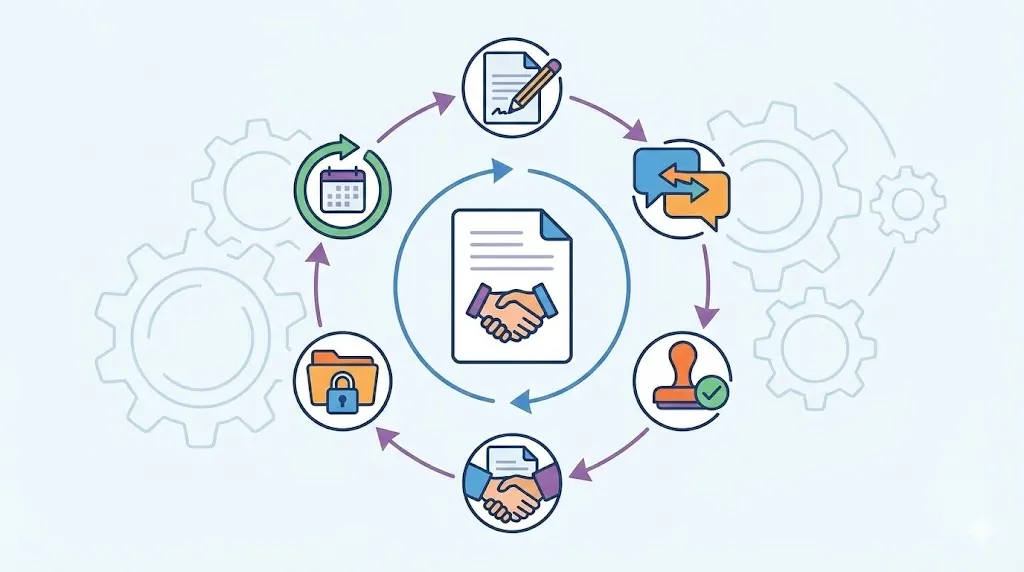
Volody AI CLM is an Agentic AI-powered Contract Lifecycle Management platform designed to eliminate manual contracting tasks, automate complex workflows, and deliver actionable insights. As a one-stop shop for all contract activities, it covers drafting, collaboration, negotiation, approvals, e-signature, compliance tracking, and renewals. Built with enterprise-grade security and no-code configuration, it meets the needs of the most complex global organizations. Volody AI CLM also includes AI-driven contract review and risk analysis, helping teams detect issues early and optimize terms. Trusted by Fortune 500 companies, high-growth startups, and government entities, it transforms contracts into strategic, data-driven business assets.




" height="216.72211px" id="FYO0bO80Y" transform="translate(3 6.105)" width="206.073px"/><path d="M 108.174 222 C 88.432 222 70.303 217.239 53.785 207.717 C 37.267 198.196 24.173 185.052 14.504 168.285 C 4.835 151.312 0 132.165 0 110.845 C 0 89.731 4.835 70.792 14.504 54.025 C 24.173 37.052 37.267 23.804 53.785 14.282 C 70.303 4.761 88.432 0 108.174 0 C 128.116 0 146.246 4.761 162.562 14.282 C 179.08 23.804 192.073 37.052 201.541 54.025 C 211.21 70.792 216.044 89.731 216.044 110.845 C 216.044 132.165 211.21 151.312 201.541 168.285 C 192.073 185.052 179.08 198.196 162.562 207.717 C 146.044 217.239 127.915 222 108.174 222 Z M 108.174 183.189 C 120.864 183.189 132.044 180.291 141.713 174.495 C 151.382 168.492 158.936 160.006 164.375 149.035 C 169.814 138.064 172.533 125.334 172.533 110.845 C 172.533 96.355 169.814 83.729 164.375 72.965 C 158.936 61.994 151.382 53.611 141.713 47.815 C 132.044 42.02 120.864 39.122 108.174 39.122 C 95.483 39.122 84.202 42.02 74.332 47.815 C 64.663 53.611 57.109 61.994 51.67 72.965 C 46.231 83.729 43.511 96.355 43.511 110.845 C 43.511 125.334 46.231 138.064 51.67 149.035 C 57.109 160.006 64.663 168.492 74.332 174.495 C 84.202 180.291 95.483 183.189 108.174 183.189 Z" fill="rgba(255, 255, 255, 0.12)" height="222px" id="aa1McFcE9" transform="translate(227.183 3)" width="216.04399999999998px"/><path d="M 42.302 182.257 L 111.799 182.257 L 111.799 216.722 L 0 216.722 L 0 0 L 42.302 0 Z" fill="rgba(255, 255, 255, 0.12)" height="216.72211px" id="yRq4AnrsX" transform="translate(477.721 6.105)" width="111.79899999999998px"/><path d="M 108.174 222 C 88.432 222 70.303 217.239 53.785 207.717 C 37.267 198.196 24.173 185.052 14.504 168.285 C 4.835 151.312 0 132.165 0 110.845 C 0 89.731 4.835 70.792 14.504 54.025 C 24.173 37.052 37.267 23.804 53.785 14.282 C 70.303 4.761 88.432 0 108.174 0 C 128.116 0 146.246 4.761 162.562 14.282 C 179.08 23.804 192.073 37.052 201.541 54.025 C 211.21 70.792 216.045 89.731 216.045 110.845 C 216.045 132.165 211.21 151.312 201.541 168.285 C 192.073 185.052 179.08 198.196 162.562 207.717 C 146.044 217.239 127.915 222 108.174 222 Z M 108.174 183.189 C 120.864 183.189 132.044 180.291 141.713 174.495 C 151.382 168.492 158.936 160.006 164.375 149.035 C 169.814 138.064 172.534 125.334 172.534 110.845 C 172.534 96.355 169.814 83.729 164.375 72.965 C 158.936 61.994 151.382 53.611 141.713 47.815 C 132.044 42.02 120.864 39.122 108.174 39.122 C 95.483 39.122 84.202 42.02 74.332 47.815 C 64.663 53.611 57.108 61.994 51.67 72.965 C 46.231 83.729 43.511 96.355 43.511 110.845 C 43.511 125.334 46.231 138.064 51.67 149.035 C 57.108 160.006 64.663 168.492 74.332 174.495 C 84.202 180.291 95.483 183.189 108.174 183.189 Z" fill="rgba(255, 255, 255, 0.12)" height="222px" id="mo8HQspQ0" transform="translate(609.155 3)" width="216.04500000000007px"/><path d="M 73.727 0 C 95.885 0 115.324 4.45 132.044 13.351 C 148.967 22.252 161.957 34.982 171.027 51.541 C 180.287 67.894 184.917 86.937 184.917 108.671 C 184.917 130.405 180.287 149.449 171.027 165.801 C 161.957 181.947 148.967 194.47 132.044 203.371 C 115.324 212.271 95.885 216.722 73.727 216.722 L 0 216.722 L 0 0 Z M 72.216 179.773 C 94.374 179.773 111.497 173.564 123.583 161.144 C 135.669 148.724 141.713 131.233 141.713 108.671 C 141.713 86.109 135.669 68.515 123.583 55.888 C 111.497 43.055 94.374 36.638 72.216 36.638 L 42.302 36.638 L 42.302 179.773 Z" fill="rgba(255, 255, 255, 0.12)" height="216.72211px" id="I3iXX5Hi_" transform="translate(859.693 6.105)" width="184.91699999999992px"/><path d="M 185.22 0 L 113.91 141.273 L 113.91 216.722 L 71.61 216.722 L 71.61 141.273 L 0 0 L 47.74 0 L 93.06 99.046 L 138.08 0 Z" fill="rgba(255, 255, 255, 0.12)" height="216.72211px" id="nzHyWC0_d" transform="translate(1061.78 6.105)" width="185.22000000000003px"/></svg>)