

Introduction
Imagine your organization as a high-performance engine designed for speed and power. In this analogy, contracts are the fuel lines that supply the necessary energy to every moving part. When these lines are clean and direct, the engine roars. However, when those lines become clogged with friction, leaks, or hidden blockages, performance stalls. You might not see the clog immediately, but you feel the loss of power. This is the reality for many enterprises today. They possess powerful market potential, yet they are throttled by inefficient contract processes.
For General Counsels and procurement leaders, the challenge lies in proving the value of fixing these lines. We often view Return on Investment (ROI) as a strict math problem. We look for a singular equation to prove that a specific dollar amount spent yields a specific dollar amount returned. However, in the complex world of legal operations, this narrow view fails to capture the true picture.
ROI in contract management is not merely about cutting costs. It is about value preservation, risk mitigation, and revenue acceleration. It is about shifting the legal department from a perceived cost center to a strategic business partner. When you remove friction from the contracting cycle, you do not just save administrative hours. You accelerate the time to revenue. You secure vendor relationships. You ensure that the enterprise operates within a safety zone of compliance.
This guide will move beyond simple arithmetic. We will explore how to articulate and calculate the return on your contract management efforts through a qualitative lens. We will examine the tangible impact of modernizing your legal operations. By understanding the strategic levers at your disposal, you can build a compelling business case for transformation. This is your roadmap to measuring success in the modern legal landscape.
The Problem Landscape: identifying the Silent Value Killers

Before we can discuss returns, we must fully understand the investment of time and risk currently plaguing manual systems. Many legal teams operate in a reactive state, fighting fires rather than preventing them. This section analyzes the heavy, often invisible burdens that justify the need for Enterprise CLM Software.
Workflow Breakdown
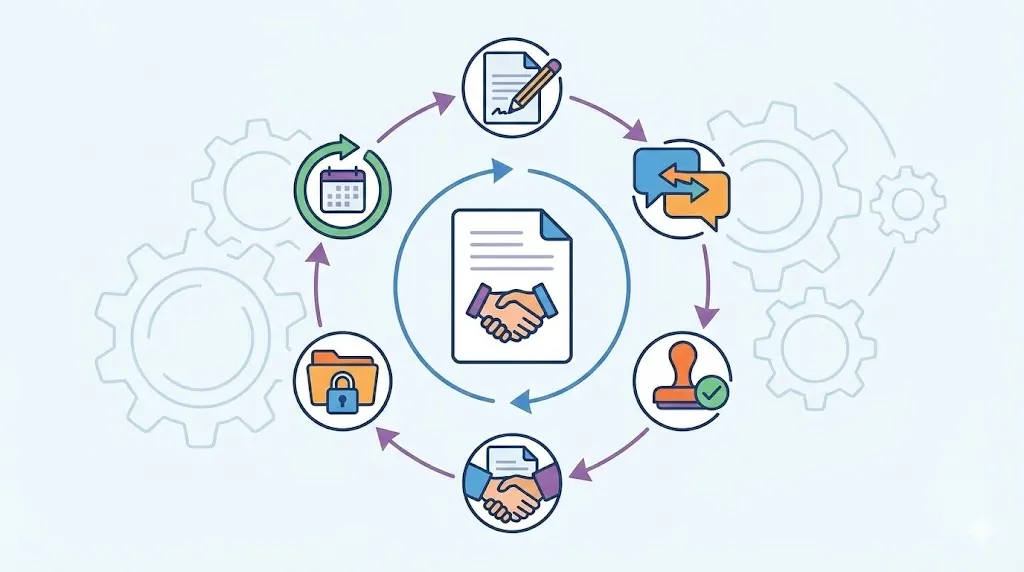
The most obvious drain on ROI is the sheer volume of manual administration. Consider the lifecycle of a standard Non-Disclosure Agreement (NDA). In a manual environment, this involves drafting, emailing, redlining, re-emailing, printing, signing, scanning, and filing.
This process is rife with friction. Highly paid legal counsel often spend valuable hours acting as administrative assistants. They chase signatures and manage version control in email chains. This is a misallocation of high-value human capital. When your best legal minds focus on formatting documents rather than strategic advisory, the business loses money. The opportunity cost is immense. Every hour spent on low-level clerical work is an hour lost on high-stakes negotiation or strategic risk assessment.
The Visibility Void
You cannot manage what you cannot see. In decentralized systems, contracts live in scattered silos. They reside on local hard drives, in personal email inboxes, or in physical filing cabinets. This fragmentation creates a "visibility void."
When a stakeholder asks about the status of a renewal, the answer often requires a forensic search. This delay is more than an annoyance; it is a business operational failure. Without a clear line of sight into obligations and milestones, opportunities slip away. Auto-renewals for unwanted services trigger quietly, draining budget. Conversely, revenue-generating renewals are missed, severing income streams. This lack of visibility makes it impossible to provide accurate answers to leadership, eroding trust in the legal function.
The Risk of Variation
In manual processes, standardization is nearly impossible to enforce. A sales representative might use an outdated template from three years ago. A procurement manager might accept a vendor's terms without proper legal review to "speed things up."
This introduces massive, unquantifiable risk. Non-standard clauses sneak into final agreements. Liability caps vary wildly across similar vendor relationships. Compliance obligations are agreed to but never tracked. The cost of this risk does not appear on a monthly spreadsheet. It appears later, as a sudden lawsuit, a failed audit, or a regulatory fine. The ROI of preventing these disasters is infinite, yet often overlooked until it is too late.
The Speed-to-Revenue Bottleneck
Perhaps the most critical "cost" is the delay in recognized revenue. A contract is the gateway to a sale. If that gate takes weeks to open due to internal approval lag, the company suffers. Deals go cold. Competitors with faster processes swoop in.
In a competitive market, deal velocity is a competitive advantage. A slow contracting process acts as a brake on sales momentum. The friction caused by manual routing and unclear approval hierarchies directly impacts the bottom line. Reducing this friction does not just save time; it captures revenue that might otherwise be lost. This is the operational reality we must change.
Strategic Solution Framework: Building the Modern Legal Ops Architecture
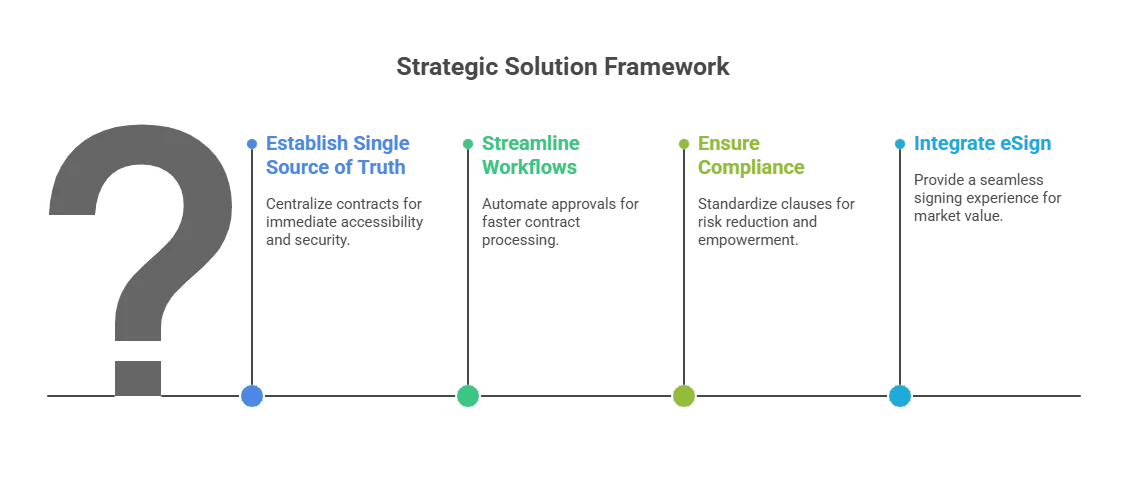
To reverse the losses described above, we must implement a strategic framework. This framework relies on technology, process, and people working in unison. The ROI here comes from replacing chaos with structured, automated efficiency.
Establishing the Single Source of Truth
The foundation of any high-ROI legal strategy is centralization. You must eliminate the silos. This begins with the implementation of a Centralized Contract Repository.
Think of this repository as the brain of your contract ecosystem. It is not just a storage folder; it is an intelligent vault. By migrating legacy contracts and active agreements into one secure location, you gain immediate control. The value realization here is instant accessibility.
Searchability: Finding a specific clause across thousands of documents becomes a matter of seconds, not days.
Security: Access is controlled, tracked, and audited, reducing the risk of data leaks.
Continuity: Institutional knowledge is preserved, regardless of staff turnover.
When the legal team trusts that the repository contains the definitive, current version of every agreement, confidence rises. The time previously spent hunting for files is instantly repurposed toward productive work. This is a massive qualitative win for the department.
Streamlining the Flow of Work
Once the data is centralized, the next step is to make the process flow. Bottlenecks usually occur during the approval and negotiation phases. Documents sit in inboxes, waiting for a stakeholder who is on vacation or simply unaware they are next in line.
The solution lies in No-Code Approval Workflows. These automated sequences act as the traffic control system for your contracts. You define the rules once, and the system enforces them every time.
Automated Routing: If a contract value exceeds a certain threshold, it automatically routes to the CFO.
Parallel Approvals: Legal, Finance, and Sales can review a document simultaneously rather than sequentially.
Escalation Triggers: If an approver takes too long, the system nudges them or escalates to a manager.
The ROI here is defined by velocity. The contract moves through the system without manual intervention. There is no need for a legal operations manager to manually forward emails. The system handles the logistics. This ensures that the contracting lifecycle shrinks dramatically. Faster approvals mean faster deal closures.
Ensuring Compliance Through Standardization
We discussed the risk of variation earlier. The strategic solution is the enforcement of pre-approved language. By utilizing a library of standard clauses and templates within your Enterprise CLM Software, you ensure consistency.
Self-service contracting becomes a reality. Sales teams can generate standard NDAs or Order Forms using compliant contract templates without engaging legal counsel. This "low-risk, high-volume" work is offloaded from the legal team entirely. The legal department maintains control over the content (the templates) but steps out of the process (the generation).
Risk Reduction: Every contract generated uses the latest legal language.
Empowerment: Business units feel empowered to move fast without waiting on legal.
Focus: Lawyers are reserved for high-value, bespoke negotiations.
This shift represents a massive cultural ROI. The legal team sheds the reputation of being the "Department of No" and becomes the "Department of How."
The Integrated Closing Experience
The final mile of the contract journey is the signature. In the past, this involved printing, signing, scanning, and mailing. Even early digital solutions often required downloading a document, uploading it to a signature tool, and then downloading it again to save it.
Modern ROI demands a seamless experience. This is achieved through Integrated eSign (Electronic Signature) capabilities. The transition from "Approved" to "Signed" should be instantaneous. The document is sent for signature directly from the platform. The status is tracked in real-time. Once signed, the document is automatically stored in the repository.
This seamless integration eliminates the "drop-off" risk where approved contracts linger unsigned. It provides a professional, modern experience for the counterparty. It signals that your organization is easy to do business with. That reputation carries significant market value.
Operationalizing the Strategy: From Concept to Execution
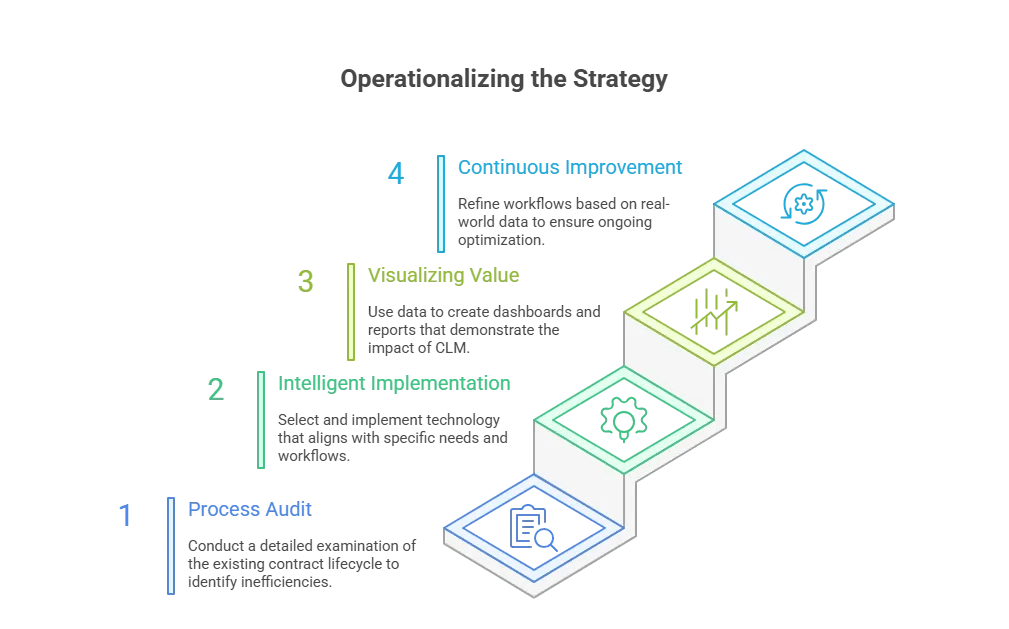
Having a framework is essential, but execution is where the ROI is realized. How do you take these concepts and apply them to your daily operations? This section outlines the practical steps to modernize your approach and how to visualize your success.
Step 1: The Process Audit
You cannot improve what you do not understand. Begin by mapping your current contract lifecycle. Identify every touchpoint. Who touches the document? How long does it sit with them? Where does the process break down?
Talk to your stakeholders in Sales and Procurement.
Ask them where they feel the most frustration.
Identify the recurring bottlenecks.
This qualitative data serves as your baseline. It is the "Before" picture in your ROI narrative. It highlights the pain points that your new strategy will resolve.
Step 2: Intelligent Implementation
Select the technology that aligns with your specific needs. Do not just buy software; buy a solution that fits your workflow. When implementing Enterprise CLM Software, focus on adoption. The best tool in the world offers zero ROI if no one uses it.
Start with a pilot group (e.g., Sales NDAs).
Get a quick win to demonstrate value.
Train your users on the benefits, not just the features.
Show the sales team how the software helps them close deals faster. Show the finance team how it gives them visibility into obligations. When users see the personal ROI, less admin work for them adoption follows naturally.
Step 3: Visualizing Value with Data
This is the most critical step for proving ROI to leadership. You must move away from anecdotal evidence ("I think we are faster") to data-driven proof. This is where Real-time Dashboards and Reporting become your most powerful ally.
A robust CLM platform captures data at every step. It tracks cycle times, approval durations, and contract volumes. You must harness this data to tell a story.
Identify Bottlenecks: Your dashboard might reveal that contracts stall specifically during the "Finance Review" stage. This allows you to address that specific resource gap.
Track Workload: Visualize the volume of contracts handled by each attorney. This helps justify headcount or resource allocation.
Monitor Expirations: create a visual alert system for upcoming renewals.
This visual data transforms the legal department into a transparent operation. You can walk into a board meeting and show a graph depicting the reduction in contract cycle time. You can show a chart illustrating the compliance rate of utilizing standard templates. This is "calculated" ROI in its most persuasive form, visual, irrefutable evidence of operational excellence.
Step 4: Continuous Improvement Loop
Operationalizing the strategy is not a one-time event. It is a cycle. Use your reports to identify new areas for improvement.
Are certain clause deviations causing long negotiation cycles?
Is one specific workflow step consistently rejected?
Are there new document types that should be templated?
By constantly refining your No-Code Approval Workflows based on real-world data, you ensure that the system evolves. The ROI compounds over time. The efficiency you gain in Year 1 serves as the foundation for even greater optimization in Year 2.
The Future of ROI: AI and Predictive Value

As we look toward the horizon, the definition of contract management ROI is expanding. We are moving from a focus on efficiency (doing things faster) to intelligence (doing things smarter). The future belongs to AI-driven insights.
In the coming years, Enterprise CLM Software will do more than route documents. It will read them. AI will analyze legacy contracts to identify revenue leakage ,money you are owed but haven't collected. It will predict which clauses are most likely to be rejected by a specific counterparty, suggesting alternative language before the negotiation even begins.
We will see a shift toward "Self-Driving Contracts" for low-risk agreements. The software will negotiate standard terms within pre-set parameters without human intervention. The ROI here is exponential scalability. Your legal team remains the same size, but your capacity to handle business volume grows without limit.
Furthermore, risk assessment will become predictive. Instead of realizing a contract is risky after it is signed, the system will score the risk level during the drafting phase. It will alert you to deviations from standard market terms. This proactive stance protects the company’s valuation and reputation.
Ultimately, the future ROI of contract management will be measured in strategic agility. The companies that can adapt their contracting terms instantly to meet new regulatory or market conditions will win. Those stuck in manual processes will be left behind.
Conclusion
Calculating the ROI of your contract management is not about plugging numbers into a spreadsheet. It is about constructing a narrative of transformation. It is about proving that by removing friction, you have accelerated the business. It is about demonstrating that by centralizing data, you have reduced risk. It is about showing that by automating the mundane, you have elevated your team to strategic advisors.
The transition from a manual, opaque process to a streamlined, digital ecosystem delivers value that is felt across the entire enterprise. From the Centralized Contract Repository that secures your data to the Integrated eSign that closes your deals, every feature is a building block of value.
Do not let your legal operations be the bottleneck that holds your company back. It is time to turn your contract lifecycle into a competitive advantage.
Ready to accelerate your legal operations? Book a demo with Volody today to experience how our comprehensive CLM platform can redefine your ROI and drive your business forward.
About the Company

Volody AI CLM is an Agentic AI-powered Contract Lifecycle Management platform designed to eliminate manual contracting tasks, automate complex workflows, and deliver actionable insights. As a one-stop shop for all contract activities, it covers drafting, collaboration, negotiation, approvals, e-signature, compliance tracking, and renewals. Built with enterprise-grade security and no-code configuration, it meets the needs of the most complex global organizations. Volody AI CLM also includes AI-driven contract review and risk analysis, helping teams detect issues early and optimize terms. Trusted by Fortune 500 companies, high-growth startups, and government entities, it transforms contracts into strategic, data-driven business assets.





" height="216.72211px" id="FYO0bO80Y" transform="translate(3 6.105)" width="206.073px"/><path d="M 108.174 222 C 88.432 222 70.303 217.239 53.785 207.717 C 37.267 198.196 24.173 185.052 14.504 168.285 C 4.835 151.312 0 132.165 0 110.845 C 0 89.731 4.835 70.792 14.504 54.025 C 24.173 37.052 37.267 23.804 53.785 14.282 C 70.303 4.761 88.432 0 108.174 0 C 128.116 0 146.246 4.761 162.562 14.282 C 179.08 23.804 192.073 37.052 201.541 54.025 C 211.21 70.792 216.044 89.731 216.044 110.845 C 216.044 132.165 211.21 151.312 201.541 168.285 C 192.073 185.052 179.08 198.196 162.562 207.717 C 146.044 217.239 127.915 222 108.174 222 Z M 108.174 183.189 C 120.864 183.189 132.044 180.291 141.713 174.495 C 151.382 168.492 158.936 160.006 164.375 149.035 C 169.814 138.064 172.533 125.334 172.533 110.845 C 172.533 96.355 169.814 83.729 164.375 72.965 C 158.936 61.994 151.382 53.611 141.713 47.815 C 132.044 42.02 120.864 39.122 108.174 39.122 C 95.483 39.122 84.202 42.02 74.332 47.815 C 64.663 53.611 57.109 61.994 51.67 72.965 C 46.231 83.729 43.511 96.355 43.511 110.845 C 43.511 125.334 46.231 138.064 51.67 149.035 C 57.109 160.006 64.663 168.492 74.332 174.495 C 84.202 180.291 95.483 183.189 108.174 183.189 Z" fill="rgba(255, 255, 255, 0.12)" height="222px" id="aa1McFcE9" transform="translate(227.183 3)" width="216.04399999999998px"/><path d="M 42.302 182.257 L 111.799 182.257 L 111.799 216.722 L 0 216.722 L 0 0 L 42.302 0 Z" fill="rgba(255, 255, 255, 0.12)" height="216.72211px" id="yRq4AnrsX" transform="translate(477.721 6.105)" width="111.79899999999998px"/><path d="M 108.174 222 C 88.432 222 70.303 217.239 53.785 207.717 C 37.267 198.196 24.173 185.052 14.504 168.285 C 4.835 151.312 0 132.165 0 110.845 C 0 89.731 4.835 70.792 14.504 54.025 C 24.173 37.052 37.267 23.804 53.785 14.282 C 70.303 4.761 88.432 0 108.174 0 C 128.116 0 146.246 4.761 162.562 14.282 C 179.08 23.804 192.073 37.052 201.541 54.025 C 211.21 70.792 216.045 89.731 216.045 110.845 C 216.045 132.165 211.21 151.312 201.541 168.285 C 192.073 185.052 179.08 198.196 162.562 207.717 C 146.044 217.239 127.915 222 108.174 222 Z M 108.174 183.189 C 120.864 183.189 132.044 180.291 141.713 174.495 C 151.382 168.492 158.936 160.006 164.375 149.035 C 169.814 138.064 172.534 125.334 172.534 110.845 C 172.534 96.355 169.814 83.729 164.375 72.965 C 158.936 61.994 151.382 53.611 141.713 47.815 C 132.044 42.02 120.864 39.122 108.174 39.122 C 95.483 39.122 84.202 42.02 74.332 47.815 C 64.663 53.611 57.108 61.994 51.67 72.965 C 46.231 83.729 43.511 96.355 43.511 110.845 C 43.511 125.334 46.231 138.064 51.67 149.035 C 57.108 160.006 64.663 168.492 74.332 174.495 C 84.202 180.291 95.483 183.189 108.174 183.189 Z" fill="rgba(255, 255, 255, 0.12)" height="222px" id="mo8HQspQ0" transform="translate(609.155 3)" width="216.04500000000007px"/><path d="M 73.727 0 C 95.885 0 115.324 4.45 132.044 13.351 C 148.967 22.252 161.957 34.982 171.027 51.541 C 180.287 67.894 184.917 86.937 184.917 108.671 C 184.917 130.405 180.287 149.449 171.027 165.801 C 161.957 181.947 148.967 194.47 132.044 203.371 C 115.324 212.271 95.885 216.722 73.727 216.722 L 0 216.722 L 0 0 Z M 72.216 179.773 C 94.374 179.773 111.497 173.564 123.583 161.144 C 135.669 148.724 141.713 131.233 141.713 108.671 C 141.713 86.109 135.669 68.515 123.583 55.888 C 111.497 43.055 94.374 36.638 72.216 36.638 L 42.302 36.638 L 42.302 179.773 Z" fill="rgba(255, 255, 255, 0.12)" height="216.72211px" id="I3iXX5Hi_" transform="translate(859.693 6.105)" width="184.91699999999992px"/><path d="M 185.22 0 L 113.91 141.273 L 113.91 216.722 L 71.61 216.722 L 71.61 141.273 L 0 0 L 47.74 0 L 93.06 99.046 L 138.08 0 Z" fill="rgba(255, 255, 255, 0.12)" height="216.72211px" id="nzHyWC0_d" transform="translate(1061.78 6.105)" width="185.22000000000003px"/></svg>)