

Contracts are the backbone of business deals, but managing them well remains a challenge for many organizations. The 2026 Contracting Benchmark Report sheds light on how companies handle contract processes today. It reveals surprising shifts in cycle times, negotiation patterns, and legal team involvement. If your legal or operations team feels stuck in slow contract workflows or lacks clear data on performance, this report offers a clear view of where the market stands and what to expect next.
TL;DR
The duration of contract cycles shows significant variation across industries, often extended in sectors where governance structures introduce additional complexity.
The proportion of contracts reviewed directly by legal teams has decreased to roughly 32%, a trend driven by the adoption of automation and self-service platforms.
Organizations are increasingly connecting contract management with CRM and ERP systems to improve visibility and optimize operational workflows.
Implementation timelines tend to lengthen as companies focus on developing contract management infrastructures that are both resilient and scalable.
There is a broad spectrum of contract lifecycle maturity, with numerous organizations still navigating the initial phases of digital transformation.
By benchmarking contract KPIs against industry norms, organizations can identify performance gaps and set pragmatic goals for improvement.
What Contracting Benchmarks Reveal About Industry Performance
Contracting benchmarks provide a way to measure how well organizations manage their contracts compared to peers. Key performance indicators (KPIs) such as the duration from contract initiation to signature, negotiation success rates, and legal team involvement yield valuable insights into operational efficiency and risk management.
Contract Cycle Times and Their Impact
Contract cycle time quantifies the total elapsed period required to finalize a contract, from initial request through to signature. The 2026 data shows cycle times vary significantly across industries. For instance, sectors with heavy regulatory oversight like healthcare and finance generally experience extended timelines, a consequence of rigorous compliance reviews and multiple approval hierarchies. Companies operating in technology and retail sectors tend to expedite contract closure by leveraging process optimization and automation technologies.
Longer cycle times frequently result in postponed revenue recognition, introduce complexities into procurement scheduling, and increase operational costs. By closely tracking these durations and implementing timely interventions, organizations often realize more efficient workflows and improved agility.
Related Article: How to Achieve Full Contract Visibility by 2026
Negotiation Rates and Contract Outcomes
Negotiation rate refers to the percentage of contracts that undergo back-and-forth revisions before finalization. Sectors with complex commercial arrangements or heightened risk exposure typically record higher frequencies of negotiation. The 2026 report highlights that negotiation rates are stabilizing or declining in many sectors, partly due to better upfront contract templates and clause libraries.
Lower negotiation rates frequently correlate with accelerated contract completion and reduced demands on legal teams. Nevertheless, an excessively low negotiation frequency could signal inadequate risk evaluation or the use of inflexible contract frameworks.
Legal Involvement Trends
Legal teams are involved in fewer contract reviews than before, with the average dropping to about 32%. This shift reflects the rise of contract lifecycle management (CLM) software and AI tools that automate routine reviews and flag key risks. Business users now handle more contracts independently, escalating only complex cases to legal.
Reducing legal involvement can free up lawyers for strategic tasks, but it requires strong governance and clear policies to avoid risk exposure.
Related articles: Best Contract Management Software in 2026: Top 20 CLM Tools
How Contract Lifecycle Management Maturity Shapes Results
Contract lifecycle management maturity denotes how developed an organization’s contract processes and technology infrastructure have become. Additionally, maturity progresses along a continuum, beginning with manual, paper-based systems and advancing toward fully automated, AI-enabled platforms.
Early-Stage Maturity Challenges
In the early phases, organizations rely heavily on email communication, spreadsheets, and manual tracking methods. Such fragmented approaches expose operations to risks including lost contracts, missed deadlines, and inconsistent terms. The absence of a centralized repository or automated workflows frequently leads to contract bottlenecks.
Mid-Level Maturity Gains
Companies that adopt CLM software see improvements in contract visibility, collaboration, and cycle time. Automation of approvals and e-signatures reduces delays. Integrating contract management with systems across sales, procurement, and finance creates a more cohesive and streamlined process.
Advanced Maturity Benefits
Organizations with advanced maturity incorporate AI-driven contract analysis alongside risk scoring and predictive insights. They continuously refine contract templates and workflows using data-driven feedback loops. These enhancements accelerate negotiations, strengthen compliance, and deliver superior business outcomes.
According to a Gartner report, mature CLM users reduce contract cycle times by up to 40% and cut legal review hours by 30%.
Related articles: Cut Contract Cycle Time: Proven Steps to Speed Up Deals
Why Longer Implementation Timelines Are Becoming Standard
The 2026 report notes that companies now accept longer timelines to implement contract management systems. This trend contrasts with past expectations of quick software rollouts.
Building Sustainable Systems
Longer implementations allow teams to design processes that fit their unique needs rather than forcing quick fixes. A key part of this approach involves deep integration of CLM with essential enterprise platforms such as Salesforce, ERP, and procurement systems. By doing so, organizations establish a unified repository for contract information, significantly diminishing the incidence of errors stemming from manual data entry.
Change Management and User Adoption
Extended timelines give organizations time to train users, refine workflows, and embed governance policies. This approach increases adoption rates and reduces resistance. Rushed implementations often fail because users lack confidence or find the system cumbersome.
Realistic Expectations
Contract management involves many stakeholders and complex workflows. Accepting longer timelines helps set realistic goals and avoids costly rework. It also allows for phased rollouts, starting with high-impact contract types before expanding.
Related articles: Leading CLM Software in Boston for 2026
How Industry Governance Levels Affect Contract Metrics
Governance refers to the rules, policies, and controls that guide contract creation, review, and approval. The report highlights that industries with weaker governance see contract performance metrics decline under market pressures.
Impact of Weak Governance
Without clear policies, contracts may lack consistent terms, increasing legal risk. Approval delays and missed renewals become common. Inadequate governance also undermines the reliability of contract data, which hampers efforts to benchmark performance or implement improvements.
Examples of Governance Challenges
In sectors such as manufacturing or small-scale retail, governance frameworks generally exhibit lower maturity levels. These sectors often struggle with contract version control and obligation tracking. As a result, they face higher risks of non-compliance and financial leakage.
Strengthening Governance
Companies can improve governance by standardizing contract templates, defining approval workflows, and using audit trails. Training business users on contract policies also helps. Deploying sophisticated software solutions that integrate automated controls and real-time notifications enhances governance enforcement.
Related articles: The Ultimate Guide to Contract Review Tools for 2025
What Contracting Leaders Can Learn from Peer Benchmarks
Benchmarking against peers provides legal and operations leaders with a comparative perspective to uncover both strengths and vulnerabilities within their contract processes. Additionally, it serves as a foundational element for strategic planning and informs decisions on how best to allocate resources.
Identifying Gaps and Opportunities
Comparative analysis of KPIs such as cycle time, negotiation frequencies, and the extent of legal involvement offers insight into your organization's performance relative to others. For example, if your contract cycle time exceeds peer averages by 30%, it warrants a detailed examination of potential bottlenecks or deficiencies in technology.
Setting Realistic Goals
Benchmarks create a basis for establishing attainable objectives that mirror both industry standards and the achievements of leading organizations. Setting such informed targets helps prevent the frustration and disengagement that stem from overly ambitious goals.
Driving Continuous Improvement
Engaging in benchmarking on a regular schedule promotes ongoing scrutiny of operational procedures alongside the adoption of new technologies. This process further substantiates the business case for investing in contract management software or expanding legal department staffing.
Example Benchmarking Approach
Moreover, begin by collecting internal contract data for key KPIs.
Compare with industry benchmarks from reports or peer groups.
Analyze root causes of performance gaps.
Formulate specific initiatives aimed at enhancing workflows, governance structures, or technological tools.
Monitor improvements methodically and recalibrate strategies based on empirical results.
Further reading: What to Track in Legal Operations Dashboards
How Contract Management Software Solves These Challenges
Contract management software centralizes contracts and automates key steps in the contract lifecycle. Additionally, it also accelerates cycle times, enhances compliance adherence, and alleviates the legal department’s operational burden.
Key Benefits of Contract Management Software
Centralized repository equipped with sophisticated search functions and robust version control mechanisms.
Optimized workflows that facilitate efficient handling of approvals and contract renewals.
AI-driven tools that assist in contract drafting, thorough review procedures, and comprehensive risk analysis.
Integration capabilities that connect contract management seamlessly with CRM, ERP, and procurement systems.
Dynamic dashboards coupled with in-depth analytics for continuous performance evaluation.
Introducing Volody’s Contract Management Solution
Volody offers a contract management platform designed to simplify contract workflows and increase control. It includes AI features such as automated contract authoring, comprehensive review functions, and metadata extraction. Automated approval routing and electronic signatures speed execution. The platform supports obligation tracking and compliance monitoring to prevent missed deadlines.
Volody’s solution connects with existing business tools, enabling seamless data flow and better contract visibility across teams.
> See how Volody's CLM Software helps legal teams manage contracts faster and with greater control.
FAQ
What is the average contract cycle time across industries?
Additionally, contract cycle times differ significantly across sectors. Regulated industries may take several weeks to months due to compliance checks. Less regulated sectors often close contracts within days or a few weeks. The average depends on contract complexity and governance maturity.
Why has legal involvement in contract review decreased?
Routine contracts increasingly fall under the purview of business users empowered by automation and self-service platforms. Moreover, AI systems assist by identifying risks and flagging absent provisions, substantially lowering the volume of contracts requiring legal scrutiny. This shift enables legal teams to dedicate greater attention to contracts that carry higher risk or strategic value.
How does integrating contract management with CRM or ERP help?
Bringing contract management systems together with sales, finance, and procurement platforms ensures data synchronization. This reduces manual data entry, improves accuracy, and gives a unified view of contract status and obligations.
What does maturity in contract lifecycle processes indicate?
Furthermore, in essence, it reflects the sophistication of an organization’s contract processes and technology. Higher maturity means more automation, better governance, and data-driven insights.
Why are longer implementation timelines becoming common?
Companies want to build sustainable, integrated systems that fit their workflows. Longer timelines allow for better change management and reduce rollout risks.
How can benchmarking improve contract management?
Also, benchmarking reveals performance gaps and helps set realistic improvement goals. Also, it promotes continuous process refinement and technology adoption.
What risks arise from poor contract governance?
Inconsistent terms, missed approvals, and overlooked obligations increase legal and financial risks. Poor governance also limits data accuracy and process efficiency.
Can AI really improve contract negotiation?
Advanced AI applications can generate alternative clause suggestions, detect potentially problematic language, and extract critical contractual elements efficiently. Therefore, these capabilities accelerate negotiation cycles and alleviate legal department workloads, although expert human evaluation remains indispensable.
What features should I look for in contract management software?
Essential features encompass AI-assisted drafting and review tools, robust workflow automation, integration capabilities with existing enterprise systems, detailed obligation management, and rigorous security measures.
How do I start improving contract management in my organization?
An effective starting point involves compiling comprehensive contract data, conducting benchmark analyses to assess current performance, and identifying specific process inefficiencies. Afterward, organizations should prioritize standardizing contract templates, optimizing workflows through automation, and selecting suitable solutions for managing contract lifecycles.
This report on contracting benchmarks for 2026 highlights key trends that are transforming contract management methodologies. Legal and operations leaders can leverage these findings to enhance strategic planning, boost operational efficiency, and mitigate risks. Success in the coming years will depend heavily on adopting appropriate technologies and governance frameworks.
About the Company
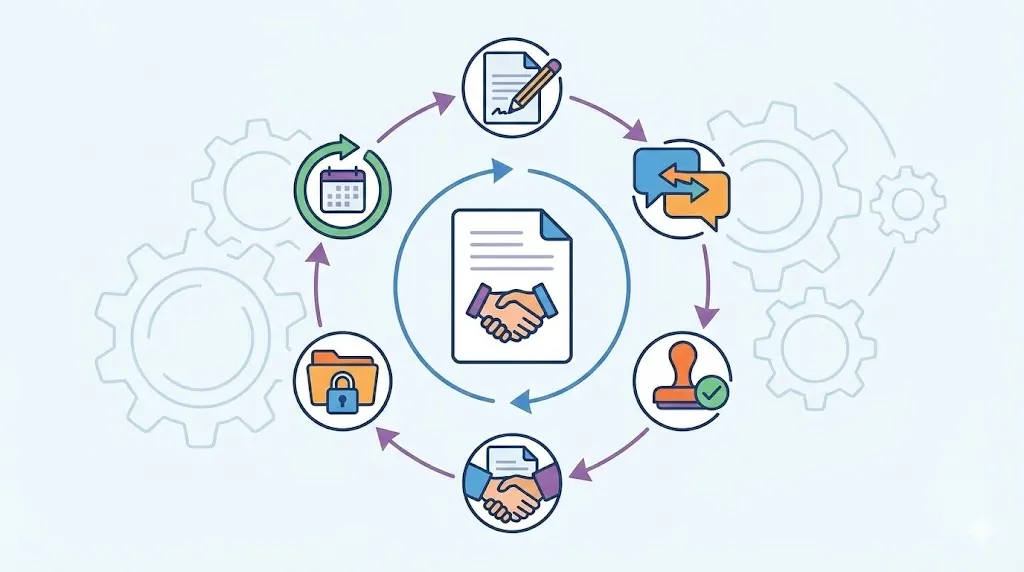
Volody AI CLM is an Agentic AI-powered Contract Lifecycle Management platform designed to eliminate manual contracting tasks, automate complex workflows, and deliver actionable insights. As a one-stop shop for all contract activities, it covers drafting, collaboration, negotiation, approvals, e-signature, compliance tracking, and renewals. Built with enterprise-grade security and no-code configuration, it meets the needs of the most complex global organizations. Volody AI CLM also includes AI-driven contract review and risk analysis, helping teams detect issues early and optimize terms. Trusted by Fortune 500 companies, high-growth startups, and government entities, it transforms contracts into strategic, data-driven business assets.




" height="216.72211px" id="FYO0bO80Y" transform="translate(3 6.105)" width="206.073px"/><path d="M 108.174 222 C 88.432 222 70.303 217.239 53.785 207.717 C 37.267 198.196 24.173 185.052 14.504 168.285 C 4.835 151.312 0 132.165 0 110.845 C 0 89.731 4.835 70.792 14.504 54.025 C 24.173 37.052 37.267 23.804 53.785 14.282 C 70.303 4.761 88.432 0 108.174 0 C 128.116 0 146.246 4.761 162.562 14.282 C 179.08 23.804 192.073 37.052 201.541 54.025 C 211.21 70.792 216.044 89.731 216.044 110.845 C 216.044 132.165 211.21 151.312 201.541 168.285 C 192.073 185.052 179.08 198.196 162.562 207.717 C 146.044 217.239 127.915 222 108.174 222 Z M 108.174 183.189 C 120.864 183.189 132.044 180.291 141.713 174.495 C 151.382 168.492 158.936 160.006 164.375 149.035 C 169.814 138.064 172.533 125.334 172.533 110.845 C 172.533 96.355 169.814 83.729 164.375 72.965 C 158.936 61.994 151.382 53.611 141.713 47.815 C 132.044 42.02 120.864 39.122 108.174 39.122 C 95.483 39.122 84.202 42.02 74.332 47.815 C 64.663 53.611 57.109 61.994 51.67 72.965 C 46.231 83.729 43.511 96.355 43.511 110.845 C 43.511 125.334 46.231 138.064 51.67 149.035 C 57.109 160.006 64.663 168.492 74.332 174.495 C 84.202 180.291 95.483 183.189 108.174 183.189 Z" fill="rgba(255, 255, 255, 0.12)" height="222px" id="aa1McFcE9" transform="translate(227.183 3)" width="216.04399999999998px"/><path d="M 42.302 182.257 L 111.799 182.257 L 111.799 216.722 L 0 216.722 L 0 0 L 42.302 0 Z" fill="rgba(255, 255, 255, 0.12)" height="216.72211px" id="yRq4AnrsX" transform="translate(477.721 6.105)" width="111.79899999999998px"/><path d="M 108.174 222 C 88.432 222 70.303 217.239 53.785 207.717 C 37.267 198.196 24.173 185.052 14.504 168.285 C 4.835 151.312 0 132.165 0 110.845 C 0 89.731 4.835 70.792 14.504 54.025 C 24.173 37.052 37.267 23.804 53.785 14.282 C 70.303 4.761 88.432 0 108.174 0 C 128.116 0 146.246 4.761 162.562 14.282 C 179.08 23.804 192.073 37.052 201.541 54.025 C 211.21 70.792 216.045 89.731 216.045 110.845 C 216.045 132.165 211.21 151.312 201.541 168.285 C 192.073 185.052 179.08 198.196 162.562 207.717 C 146.044 217.239 127.915 222 108.174 222 Z M 108.174 183.189 C 120.864 183.189 132.044 180.291 141.713 174.495 C 151.382 168.492 158.936 160.006 164.375 149.035 C 169.814 138.064 172.534 125.334 172.534 110.845 C 172.534 96.355 169.814 83.729 164.375 72.965 C 158.936 61.994 151.382 53.611 141.713 47.815 C 132.044 42.02 120.864 39.122 108.174 39.122 C 95.483 39.122 84.202 42.02 74.332 47.815 C 64.663 53.611 57.108 61.994 51.67 72.965 C 46.231 83.729 43.511 96.355 43.511 110.845 C 43.511 125.334 46.231 138.064 51.67 149.035 C 57.108 160.006 64.663 168.492 74.332 174.495 C 84.202 180.291 95.483 183.189 108.174 183.189 Z" fill="rgba(255, 255, 255, 0.12)" height="222px" id="mo8HQspQ0" transform="translate(609.155 3)" width="216.04500000000007px"/><path d="M 73.727 0 C 95.885 0 115.324 4.45 132.044 13.351 C 148.967 22.252 161.957 34.982 171.027 51.541 C 180.287 67.894 184.917 86.937 184.917 108.671 C 184.917 130.405 180.287 149.449 171.027 165.801 C 161.957 181.947 148.967 194.47 132.044 203.371 C 115.324 212.271 95.885 216.722 73.727 216.722 L 0 216.722 L 0 0 Z M 72.216 179.773 C 94.374 179.773 111.497 173.564 123.583 161.144 C 135.669 148.724 141.713 131.233 141.713 108.671 C 141.713 86.109 135.669 68.515 123.583 55.888 C 111.497 43.055 94.374 36.638 72.216 36.638 L 42.302 36.638 L 42.302 179.773 Z" fill="rgba(255, 255, 255, 0.12)" height="216.72211px" id="I3iXX5Hi_" transform="translate(859.693 6.105)" width="184.91699999999992px"/><path d="M 185.22 0 L 113.91 141.273 L 113.91 216.722 L 71.61 216.722 L 71.61 141.273 L 0 0 L 47.74 0 L 93.06 99.046 L 138.08 0 Z" fill="rgba(255, 255, 255, 0.12)" height="216.72211px" id="nzHyWC0_d" transform="translate(1061.78 6.105)" width="185.22000000000003px"/></svg>)