
Legal teams face rising contract volumes and tighter deadlines. The reality of AI agents in legal operations today is more complex than buzz suggests. These smart tools do more than answer questions or suggest text. They can independently handle multi-step contract tasks, saving time and reducing errors. But not every legal workflow suits AI agents, and risks remain. Understanding where AI agents fit, how to govern them, and how to measure success is critical for legal leaders aiming to modernize operations without losing control.
Imagine a legal operations team drowning in routine contract reviews. An AI agent could take over the first pass, flagging only unusual clauses for lawyers. This frees lawyers to focus on complex deals, cutting turnaround from days to hours. Yet, deploying AI agents requires careful planning, clear guardrails, and realistic expectations. This article breaks down what AI agents do, where they shine, what risks to watch, and how to adopt them wisely.
TL;DR
AI agents operate with autonomy to execute complex, multi-step contract tasks, minimizing the need for continuous human intervention.
These systems prove particularly effective in managing high-volume, routine workflows such as NDA reviews, contract drafting, and intake routing.
The deployment of AI carries inherent risks, including challenges related to data privacy, potential errors in contract interpretation, and opacity in decision-making processes absent rigorous governance frameworks.
Ensuring effective implementation requires layered human oversight complemented by comprehensive audit trails documenting each AI-driven action.
Measure AI impact by contract turnaround time, review touches, and legal team capacity, not just tech metrics.
Contract management software with built-in AI features helps automate and control legal workflows efficiently.
Related Article: How AI Drives the 5 Key Steps of Procurement Transformation
What Are AI Agents in Legal Operations?
AI agents are software programs designed to perform tasks independently by breaking down goals into steps and completing them without constant human input. They differ from simple AI tools that execute single commands or generate text suggestions because they orchestrate a series of interconnected actions. They use external data sources, remember context, and adjust their work as they go.
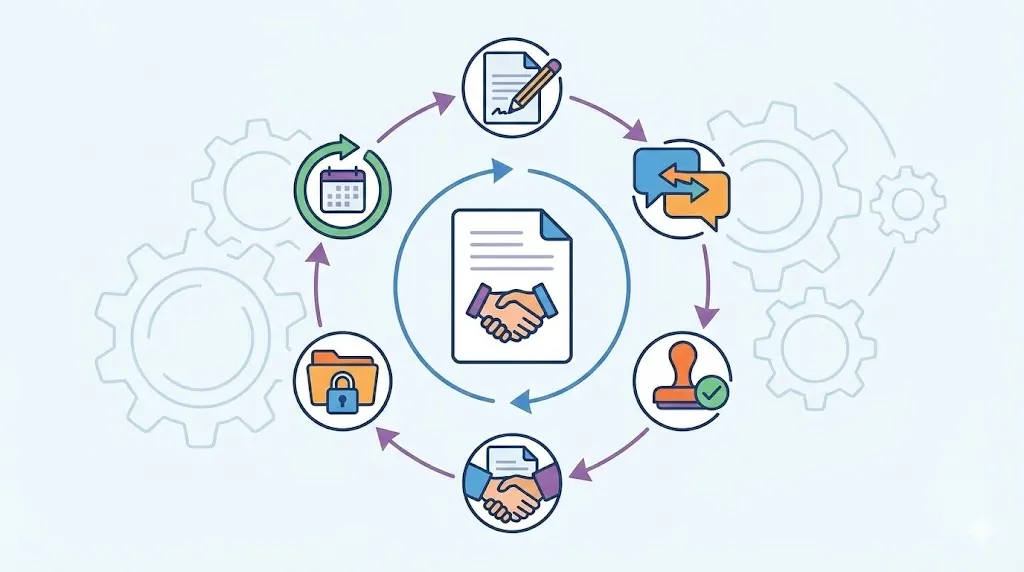
For example, a legal AI agent might receive a task like “Review this NDA against our standards.” It will then:
Retrieve the relevant contract clauses from your approved library.
Analyze the incoming document in detail, evaluating each clause against the standards.
Detect inconsistencies, deviations, or omissions that warrant further review.
Produce a redlined draft that integrates the suggested amendments.
This process unfolds seamlessly, without the user needing to intervene at every step. The agent “remembers” its prior findings and leverages that knowledge to guide subsequent decisions.
Three features define AI agents in legal work:
Autonomy: They act across multiple steps without waiting for new commands.
Tool Integration: They connect to contract repositories, clause libraries, or CRM systems to gather data.
Contextual Memory: They keep track of previous steps to maintain consistency and accuracy.
Most legal teams do not deploy standalone AI agents. Instead, they use contract management platforms with agent-like features embedded in workflows. These platforms handle tasks like routing contract requests, comparing clauses, and tracking obligations automatically.
A Deloitte survey found that 73% of legal leaders believe contracts and commercial work have the highest potential for AI transformation. This shows strong interest but also highlights the need to balance risk tolerance and process maturity before adopting AI agents.
Related articles: How to maintain ethically use AI in Legal Operations
Which Legal Workflows Benefit Most from AI Agents?
AI agents work best in workflows that are repetitive, predictable, and involve multiple systems. Additionally, these characteristics enable significant time savings and error reduction through the automation of routine tasks.
Contract Review and Redlining
Contract review is the leading use case for AI agents. The 2025 State of Artificial Intelligence Report highlights that 28% of legal professionals consider contract review their primary application of intelligent automation. Such agents can:
Compare incoming contracts against your approved clause library,
Identify missing or non-standard clauses flagged by severity, and
Produce suggested redlines prepared for lawyer assessment.
This cuts down hours of manual side-by-side reading to minutes. Lawyers still make final decisions but start from a clearer, more accurate draft.
Contract Drafting and Playbook Compliance
Moreover, drafting contracts is another area where AI agents add value. A survey by the Association of Corporate Counsel (ACC) revealed that 82% of in-house counsel anticipate the majority of efficiency gains from automation in drafting. These systems can:
Select the appropriate template based on deal type and value,
Automatically populate contracts with data sourced from CRM or intake forms, and
Verify that every clause adheres to the latest playbook standards before approval.
This lets sales or procurement teams generate compliant first drafts without legal involvement. Legal experts focus on contracts that need judgment calls.
Legal Intake and Request Routing
Contract requests can be managed by these systems through classification and proper routing. Instead of manual email triage, they:
Identify contract types (NDA, MSA, amendment),
Assess risk levels based on predefined criteria, and
Route requests to the appropriate legal queue or self-service workflow.
Embedding this intelligence in contract management platforms maintains intake organization and accelerates response times.
Obligation Tracking and Renewals
After contracts are signed, these tools assist with tracking critical dates and obligations. They:
Extract renewal windows, opt-out deadlines, payment milestones from contracts,
Set automated alerts ahead of deadlines, and
Reduce manual calendar reminders by interpreting contract language directly.
This is vital for teams managing large vendor portfolios where missing a renewal or notice could cause financial or legal harm.
Other Potential Workflows
Additional applications include:
Contract negotiation tracking through monitoring redlines and comments,
Risk and compliance analysis by flagging deviations from policy, and
Metadata extraction to automate data entry and migration.
The key is to start with workflows that have clear rules and high volume to prove AI value before expanding.
Related articles: Contract Risk Analysis Strengthened By AI in Legal Operations
What Risks and Governance Controls Matter for AI Agents?
AI agents bring efficiency but also new risks. Additionally, it is essential to establish governance frameworks that safeguard sensitive information and uphold operational control.
Data Privacy and Security
Contracts contain confidential information. AI agents often connect to cloud-based AI models, raising concerns about data exposure. Recommended controls include choosing AI providers that implement strict zero-retention policies, enforcing encryption of data both in transit and at rest, limiting AI access strictly to relevant contractual data, and deploying role-based access controls to manage who can view the outputs generated by the AI.
Accuracy and Interpretation Errors
AI agents can misinterpret clauses or miss subtle risks. This can lead to incorrect redlines or missed obligations. To mitigate these issues, implement a tiered human oversight model where agents autonomously process routine cases but escalate exceptions to legal professionals. Additionally, training datasets should be regularly refreshed to include the latest contracts and their corresponding playbooks. Moreover, prior to widescale deployment, AI outputs must undergo rigorous validation against predefined performance benchmarks to ensure reliability.
Transparency and Auditability
Legal teams must grasp the decision-making processes of AI agents. This entails maintaining immutable audit trails that document every AI action and decision, providing comprehensive documentation of the AI’s underlying logic and the playbooks employed, and ensuring the capability to review and override AI-generated results whenever necessary.
Compliance and Ethical Use
Ensure AI use complies with regulations and ethical standards. This involves actively mitigating bias within training datasets, preserving human responsibility for ultimate decision-making, and adhering to recognized industry standards for AI governance.
Change Management and User Adoption
AI agents change workflows and roles. To facilitate adoption, organizations need to deliver training on AI functionalities and limitations, establish clear and achievable expectations regarding AI capabilities, and systematically gather user feedback to refine AI performance and increase acceptance.
Related articles: AI Contract Review vs. Human Lawyers: Speed, Accuracy & ROI
How Do Legal Teams Deploy AI Agents in Contract Workflows?
Rolling out AI agents requires a clear strategy and phased approach.
Start with Low-Risk, High-Volume Workflows
Additionally, begin by focusing on contract types such as standard NDAs where rules are well-defined and risks remain minimal. This allows teams to measure time savings and build confidence. For example:
Automate initial NDA review against a defined playbook.
Track how much time lawyers save and how many contracts agents handle autonomously.
Implement Tiered Human Oversight
Set up workflows where AI agents handle routine tasks but escalate flagged issues to lawyers. This balances efficiency with risk control. For instance:
The agent performs contract reviews to detect clauses that deviate from standard terms and warrant attorney review.
Lawyers then assess these highlighted areas and implement any necessary revisions prior to finalizing the contract.
Define Governance Policies Early
Establish comprehensive policies addressing data security, privacy, and audit requirements from the outset. This includes specifying:
Who is authorized to access AI-generated outputs through defined access control measures.
How AI-driven decisions are recorded and subject to systematic review.
Procedures designed to address errors or disputes resulting from AI involvement.
Measure Business-Focused Metrics
Track metrics that show real impact on legal operations, such as:
Contract turnaround time reduction.
Moreover, the number of touches per contract before approval.
Percentage of contracts handled without lawyer intervention.
Legal team capacity gains.
Avoid focusing only on technical metrics like AI accuracy scores, which may not reflect business value.
Integrate AI Agents into Existing Platforms
Use contract lifecycle management (CLM) software that embeds AI agents within workflows. This avoids tool fragmentation and improves user experience.
Communicate and Train
Keep stakeholders informed about AI goals and progress. Train legal and business users on how to work with AI agents effectively.
Iterate and Expand
Use initial deployments as pilots. Gather comprehensive data and stakeholder feedback to enhance AI models and governance frameworks. Progressively extend AI agent applications to encompass more complex contracts and workflows.
Related articles: How Contract AI Archives Transform Legal Workflows
Why Contract Management Software Matters
Contract management solutions play a critical role in embedding AI agents into legal workflows, ensuring both practicality and security in their application. Additionally, these platforms create a centralized environment where AI features operate within clearly defined and tightly controlled workflows.
Key benefits include:
Centralized Clause Libraries and Templates: By maintaining a single source of approved language and established playbooks, AI agents consistently apply standardized clauses.
Automated Routing and Approval Workflows: AI agents can trigger notifications and route contracts based on risk and type.
Audit Trails and Version Control: Every AI action and contract change is logged for compliance.
Role-Based Access Controls: Protect sensitive contract data and AI outputs.
Obligation Tracking and Alerts: AI agents monitor deadlines and trigger reminders automatically.
Integration with Enterprise Systems: Connects with CRM, ERP, and e-signature tools for seamless data flow.
Modern platforms for contract management frequently incorporate AI-powered drafting, review, clause recommendations, and metadata extraction. These features reduce manual work and improve contract quality.
Managing complex legal workflows requires a centralized and intelligent solution. Volody offers a platform designed to help legal teams automate contract creation, review, and tracking with built-in AI capabilities. Its features include AI contract drafting, clause comparison, risk analysis, and obligation management, all within a secure and scalable platform.
> See how Volody's CLM Software helps your team move contracts forward with confidence.
FAQ
What exactly defines an AI agent within legal operations?
Additionally, such software is capable of completing multi-step legal tasks independently. It uses data from contract libraries and remembers context to review, draft, or route contracts without constant human input.
How do AI agents differ from chatbots or AI copilot tools?
Chatbots answer one question at a time, and copilots suggest text while you type. These systems execute a series of actions autonomously, connecting to external systems and carrying context through the process.
Which contract workflows should I automate first with AI agents?
Start with high-volume, low-risk workflows like standard NDA reviews. Moreover, these have clear rules and measurable time savings, making them ideal for initial AI deployment.
What are the main risks of using AI agents in legal work?
Risks include data privacy issues, AI misinterpretation of contract language, lack of transparency in AI decisions, and potential compliance gaps. Strong governance and human oversight reduce these risks.
How can legal teams maintain control over AI agent decisions?
Use tiered oversight where AI handles routine tasks but flags exceptions for lawyers. Maintain audit trails for every AI action and ensure easy review and override of AI outputs.
Furthermore, what metrics indicate whether AI agents are delivering value to legal operations?
Measure contract turnaround time, number of review touches per contract, percentage of contracts handled autonomously, and improvements in legal team capacity.
Can AI agents handle complex contracts with many variables?
At present, these tools are most effective on predictable, rule-based contracts. Complex deals requiring nuanced judgment still need human lawyers, though AI can assist with initial reviews or data extraction.
How does contract management software support AI agent use?
CLM software centralizes templates, clauses, and workflows, allowing AI agents to operate within controlled environments. Also, it provides security, audit trails, and integration with other business systems.
Also, what should legal teams do before deploying AI agents?
Define clear goals, select suitable workflows, establish governance policies, train users, and plan phased rollouts with human oversight to ensure safe and effective adoption.
Are AI agents replacing lawyers?
No. AI agents automate routine, repetitive tasks to free lawyers for higher-value work. They assist but do not replace legal judgment or decision-making.
This comprehensive overview explains how AI agents operate within legal frameworks, where they add the most value, what risks to manage, and how to adopt them effectively. Legal leaders can use this insight to modernize contract workflows while maintaining control and compliance.
About the Company

Volody AI CLM is an Agentic AI-powered Contract Lifecycle Management platform designed to eliminate manual contracting tasks, automate complex workflows, and deliver actionable insights. As a one-stop shop for all contract activities, it covers drafting, collaboration, negotiation, approvals, e-signature, compliance tracking, and renewals. Built with enterprise-grade security and no-code configuration, it meets the needs of the most complex global organizations. Volody AI CLM also includes AI-driven contract review and risk analysis, helping teams detect issues early and optimize terms. Trusted by Fortune 500 companies, high-growth startups, and government entities, it transforms contracts into strategic, data-driven business assets.





" height="216.72211px" id="FYO0bO80Y" transform="translate(3 6.105)" width="206.073px"/><path d="M 108.174 222 C 88.432 222 70.303 217.239 53.785 207.717 C 37.267 198.196 24.173 185.052 14.504 168.285 C 4.835 151.312 0 132.165 0 110.845 C 0 89.731 4.835 70.792 14.504 54.025 C 24.173 37.052 37.267 23.804 53.785 14.282 C 70.303 4.761 88.432 0 108.174 0 C 128.116 0 146.246 4.761 162.562 14.282 C 179.08 23.804 192.073 37.052 201.541 54.025 C 211.21 70.792 216.044 89.731 216.044 110.845 C 216.044 132.165 211.21 151.312 201.541 168.285 C 192.073 185.052 179.08 198.196 162.562 207.717 C 146.044 217.239 127.915 222 108.174 222 Z M 108.174 183.189 C 120.864 183.189 132.044 180.291 141.713 174.495 C 151.382 168.492 158.936 160.006 164.375 149.035 C 169.814 138.064 172.533 125.334 172.533 110.845 C 172.533 96.355 169.814 83.729 164.375 72.965 C 158.936 61.994 151.382 53.611 141.713 47.815 C 132.044 42.02 120.864 39.122 108.174 39.122 C 95.483 39.122 84.202 42.02 74.332 47.815 C 64.663 53.611 57.109 61.994 51.67 72.965 C 46.231 83.729 43.511 96.355 43.511 110.845 C 43.511 125.334 46.231 138.064 51.67 149.035 C 57.109 160.006 64.663 168.492 74.332 174.495 C 84.202 180.291 95.483 183.189 108.174 183.189 Z" fill="rgba(255, 255, 255, 0.12)" height="222px" id="aa1McFcE9" transform="translate(227.183 3)" width="216.04399999999998px"/><path d="M 42.302 182.257 L 111.799 182.257 L 111.799 216.722 L 0 216.722 L 0 0 L 42.302 0 Z" fill="rgba(255, 255, 255, 0.12)" height="216.72211px" id="yRq4AnrsX" transform="translate(477.721 6.105)" width="111.79899999999998px"/><path d="M 108.174 222 C 88.432 222 70.303 217.239 53.785 207.717 C 37.267 198.196 24.173 185.052 14.504 168.285 C 4.835 151.312 0 132.165 0 110.845 C 0 89.731 4.835 70.792 14.504 54.025 C 24.173 37.052 37.267 23.804 53.785 14.282 C 70.303 4.761 88.432 0 108.174 0 C 128.116 0 146.246 4.761 162.562 14.282 C 179.08 23.804 192.073 37.052 201.541 54.025 C 211.21 70.792 216.045 89.731 216.045 110.845 C 216.045 132.165 211.21 151.312 201.541 168.285 C 192.073 185.052 179.08 198.196 162.562 207.717 C 146.044 217.239 127.915 222 108.174 222 Z M 108.174 183.189 C 120.864 183.189 132.044 180.291 141.713 174.495 C 151.382 168.492 158.936 160.006 164.375 149.035 C 169.814 138.064 172.534 125.334 172.534 110.845 C 172.534 96.355 169.814 83.729 164.375 72.965 C 158.936 61.994 151.382 53.611 141.713 47.815 C 132.044 42.02 120.864 39.122 108.174 39.122 C 95.483 39.122 84.202 42.02 74.332 47.815 C 64.663 53.611 57.108 61.994 51.67 72.965 C 46.231 83.729 43.511 96.355 43.511 110.845 C 43.511 125.334 46.231 138.064 51.67 149.035 C 57.108 160.006 64.663 168.492 74.332 174.495 C 84.202 180.291 95.483 183.189 108.174 183.189 Z" fill="rgba(255, 255, 255, 0.12)" height="222px" id="mo8HQspQ0" transform="translate(609.155 3)" width="216.04500000000007px"/><path d="M 73.727 0 C 95.885 0 115.324 4.45 132.044 13.351 C 148.967 22.252 161.957 34.982 171.027 51.541 C 180.287 67.894 184.917 86.937 184.917 108.671 C 184.917 130.405 180.287 149.449 171.027 165.801 C 161.957 181.947 148.967 194.47 132.044 203.371 C 115.324 212.271 95.885 216.722 73.727 216.722 L 0 216.722 L 0 0 Z M 72.216 179.773 C 94.374 179.773 111.497 173.564 123.583 161.144 C 135.669 148.724 141.713 131.233 141.713 108.671 C 141.713 86.109 135.669 68.515 123.583 55.888 C 111.497 43.055 94.374 36.638 72.216 36.638 L 42.302 36.638 L 42.302 179.773 Z" fill="rgba(255, 255, 255, 0.12)" height="216.72211px" id="I3iXX5Hi_" transform="translate(859.693 6.105)" width="184.91699999999992px"/><path d="M 185.22 0 L 113.91 141.273 L 113.91 216.722 L 71.61 216.722 L 71.61 141.273 L 0 0 L 47.74 0 L 93.06 99.046 L 138.08 0 Z" fill="rgba(255, 255, 255, 0.12)" height="216.72211px" id="nzHyWC0_d" transform="translate(1061.78 6.105)" width="185.22000000000003px"/></svg>)