
Many companies lose millions every year without realizing it. The organizational design problem costing your business millions is often hidden in how teams handle contracts after signing. Imagine a relay race where runners drop the baton during handoffs. That’s what happens when contracts pass between departments with unclear roles and disconnected systems. This leak in contract value quietly drains profits, risks compliance, and wastes effort. Fixing it requires understanding where contracts fail and how to build stronger, smarter processes that protect value throughout the contract’s life.
TL;DR
Contract value leaks when unclear roles cause missed obligations and poor handoffs between teams.
Additionally, rigid contract templates combined with defensive clauses exacerbate operational risks while constraining adaptability.
Outdated systems fragment contract data, blocking visibility and slowing decision-making.
Leakage occurs throughout various stages of the contract lifecycle, extending beyond just signing or renewal phases.
Addressing these deficiencies requires procurement teams to champion comprehensive contract lifecycle management solutions.
Leveraging advanced contract management platforms enables the consolidation of data, the automation of workflows, and rigorous obligation enforcement.
What Is the Organizational Design Problem Costing Your Business Millions?
The organizational design problem refers to how companies structure teams, processes, and systems to manage contracts. Many businesses focus heavily on contract negotiation and signing but fail to design clear ownership and workflows for what happens next. This gap causes contract value to leak away unnoticed.
According to World Commerce & Contracting (WorldCC), companies lose an average of 11% of contract value due to poor contract management. This loss occurs when obligations are not clearly managed, performance remains unmonitored, and contracts are not adapted to evolving conditions. Contracts become static documents instead of active tools that govern relationships and deliver benefits.
Think of a contract like a blueprint for a building. If the construction team never reads the blueprint or ignores key details, the building will have flaws. Similarly, when operational personnel fail to comprehend or track contract terms, the organization misses out on savings, penalties, or growth opportunities.
This problem is not just a procurement issue. It spans legal, operations, sales, and finance teams. Each group may assume another owns contract execution, leaving critical tasks undone. Fixing this requires rethinking organizational design to assign clear roles, improve communication, and use better technology.
Related articles: Contract Management for Procurement: Elevate Your Strategy
Where Does Contract Value Leakage Happen?
Contract leakage arises not from a single point of failure but from a cascade of breakdowns occurring throughout the contract lifecycle. Additionally, these persistent issues accumulate, resulting in substantial financial losses.
1. Unclear Roles and Poor Handoffs
When teams do not have clear responsibilities, contract obligations go unmanaged. Procurement may negotiate a great deal, but once signed, the contract often moves to other teams for execution. These teams may never receive a proper briefing or tools to track commitments.
For instance, operations can remain unaware of specific entitlements such as innovation clauses or discounts tied to purchase volumes. Sales teams might overlook critical renewal deadlines, while finance departments may fail to monitor penalty provisions. Without clear ownership, obligations slip through the cracks.
Tom Mills, a procurement expert, explains that many procurement teams stop working once the contract is signed. They hand off the contract and assume the business will manage it. This approach treats contracts as static documents rather than live governance frameworks that need ongoing attention.
Unmanaged obligations cause these common types of leakage:
Missed savings from discounts based on purchase volumes or gain-share agreements (1-2%).
Charges incurred from unchecked scope creep, which often go unapproved (2-3%).
Disputes and penalties arising when compliance requirements or contract commitments are overlooked (1-2%).
Failure to track pricing adjustments can lead to excess payments (1-2%).
The cumulative effect of even small percentage losses translates into millions of dollars in large organizations. This pattern is primarily driven by unclear accountability and ineffective communication across teams.
2. Inflexible Contract and Organizational Structures
Many companies rely on standard contract templates that do not adapt to changing business models or market conditions. Instead of making contracts flexible, they add more risk-shifting clauses to protect themselves.
This defensive approach often backfires. Risk transfer provisions can:
Prolong negotiations and increase supplier prices.
Fail to create real risk management mechanisms.
Lead to contracts that are hard to enforce or govern.
Risk shifting does not eliminate risk. In the absence of coordinated oversight and continuous monitoring, vulnerabilities persist throughout the organization. Poor supplier performance continues to impact business outcomes despite contractual language.
Contracts become legal shields rather than tools for collaboration. This leaves operational teams without clear guidance on managing risks or performance. Customers ultimately suffer from service gaps or higher costs.
3. Outdated and Fragmented Systems
Technology plays a big role in contract management. Most legacy procurement or legal systems were designed for static contracts and rigid controls. They do not support today’s dynamic, fast-moving environment.
Contract data is frequently scattered across various platforms, including email, file shares, ERP, CRM, and spreadsheets. This fragmentation severely restricts visibility and complicates efforts to quickly evaluate contract performance or detect risks.
The lack of centralized, searchable contract repositories forces teams to spend disproportionate time searching for documents or specific contractual terms. Reliance on manual workflows further raises the risk of errors and delays in addressing critical obligations or approaching renewals.
According to a Deloitte report, 70% of companies face challenges due to contract data fragmentation, which contributes to operational delays and missed business opportunities. Modern contract management solutions must integrate data and automate workflows to overcome these issues.
Related articles: How Sales and Legal Collaboration Achieves Business Success
Why Does This Problem Exist?
The organizational design problem is deeply rooted in how companies think about contracts and team responsibilities.
Contracts as Documents, Not Processes: Many view contracts as one-time legal documents to sign, not ongoing frameworks to manage. This mindset limits investment in lifecycle management.
Siloed Teams: Procurement, legal, operations, and finance frequently operate in distinct silos without integrated workflows.
Lack of Ownership: There is often an absence of accountability for managing contract performance across its entire lifecycle.
Rigid Structures: Organizations rely on fixed templates and rules that do not fit complex, evolving supplier relationships.
Technology Gaps: Legacy systems do not support collaboration, automation, or real-time data sharing.
Fixing this requires a cultural and structural shift. Teams must treat contracts as living assets that require ongoing attention and collaboration. Clear roles, flexible processes, and modern tools are essential.
Related articles: Fix Broken Legal Budgets: CLM Solutions That Work
How Can Procurement Lead the Charge to Fix This?
Procurement teams sit at the center of contract creation and supplier relationships. Additionally, their role inherently enables them to influence and implement meaningful improvements.
Expand Procurement’s Role: Procurement should own contract lifecycle management, not just negotiation and signing. This means tracking obligations, performance, and renewals actively.
Define Clear Responsibilities: Assign accountability for contract execution across teams. Use RACI charts or similar tools to clarify who is Responsible, Accountable, Consulted, and Informed for each contract stage.
Improve Cross-Functional Collaboration: Create regular touchpoints between procurement, legal, operations, and finance. Share contract summaries and key metrics widely.
Adopt Flexible Contract Models: Work with legal and suppliers to build adaptable contracts that accommodate change without excessive risk-shifting.
Invest in Training: Educate all stakeholders on contract terms, risks, and performance metrics. Enable teams to spot and report issues early.
Use Data to Prioritize: Analyze contract data to identify high-risk or high-value contracts. Focus resources where leakage is most costly.
Procurement can become the hub that connects contract strategy with operational execution. This approach reduces leakage and protects business value.
Related articles: Streamlining Contract Summaries for Business Teams
5 Challenges in Maintaining Contract Value Post-Signing
Safeguarding contract value after execution requires navigating a complex set of challenges. Additionally, below are five issues that commonly impede effective contract management.
1. Lack of Visibility Into Contract Terms
Many teams face difficulties in obtaining a full view of contract details. Often, contracts are scattered across email threads, shared drives, or physical files, which complicates the retrieval process. Without a centralized repository, identifying relevant clauses or tracking critical deadlines becomes a cumbersome task.
This lack of visibility leads to missed renewals, overlooked obligations, and unmanaged risks. For example, a sales team might miss a volume discount clause because it was buried in a contract folder.
2. Poor Communication Between Departments
Contracts touch many functions: procurement, legal, sales, operations, and finance. Communication regarding contract terms or amendments is often inadequate among these groups.
When handoffs lack clarity, operational teams often remain unaware of their responsibilities. Legal departments may not receive necessary feedback on supplier performance, and finance teams can fail to monitor payment terms with sufficient rigor.
3. Manual and Fragmented Processes
Many companies rely on manual tracking of contract milestones, obligations, and approvals. Spreadsheets, emails, and calendars are frequently employed as tools.
Manual processes increase errors and delays. They also make it difficult to generate reports or audit contract compliance.
4. Overly Complex or Risk-Averse Contracts
Contracts loaded with risk-shifting clauses slow negotiations and increase supplier costs. They also create confusion about who manages what risks.
Complex contracts present significant management and enforcement challenges. Teams may avoid using innovation or flexibility clauses because they fear legal exposure.
5. Inadequate Technology Support
Legacy contract management systems do not support end-to-end lifecycle management. They lack automation, collaboration tools, and real-time analytics.
Without modern software, teams cannot track obligations, monitor risks, or generate actionable insights efficiently.
Related articles: Contract Management Software for Sales Teams | CLM Guide
What Are the Consequences of Ignoring This Problem?
Ignoring organizational design flaws in contract management leads to serious consequences:
Financial Losses: Millions in lost savings, penalties, or revenue due to unmanaged obligations and scope creep.
Increased Risk: Compliance failures, disputes, and damaged supplier relationships.
Operational Inefficiency: Significant time is lost searching for contracts, combined with reliance on manual tracking processes and redundant tasks.
Missed Opportunities: Failure to leverage innovation clauses or volume discounts undermines the organization’s competitive advantage.
Legal Exposure: Weaknesses in contract governance increase the likelihood of litigation and regulatory penalties.
Collectively, these challenges weigh heavily on overall business effectiveness. Implementing solutions to these fundamental issues is essential for achieving enduring organizational benefits.
Delve deeper into contract governance with our comprehensive guide: Contract Governance: A Guide to Strategic Value
How to Identify Contract Leakage in Your Organization
Start by assessing your current contract management practices and organizational design.
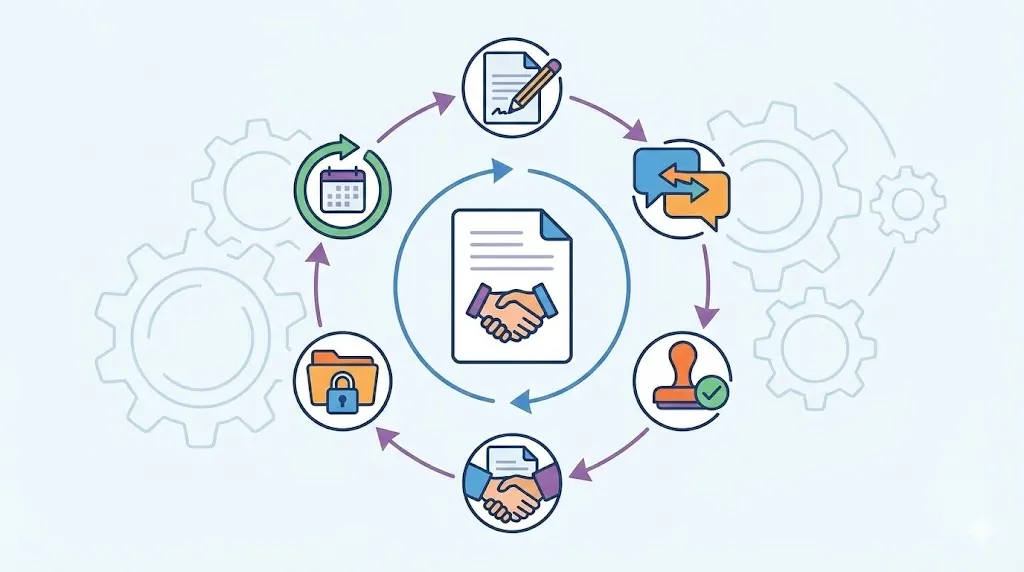
Map Contract Lifecycle Processes: Document who does what at each stage from request to renewal. Identify gaps or unclear handoffs.
Analyze Contract Data: Investigate occurrences of missed deadlines alongside instances of overpayments and penalties to uncover systemic issues.
Survey Stakeholders: Consult with teams to understand the specific obstacles they encounter in managing contracts. Identify pain points and communication breakdowns.
Review Technology Use: Assess whether current systems support collaboration, automation, and reporting.
Calculate Potential Losses: Estimate financial impact based on leakage rates reported by industry groups like WorldCC.
This diagnostic helps prioritize interventions and build a business case for change.
Related articles: Missed a Contract Deadline? Here’s What You Should Do Next!
Why Contract Lifecycle Management Software Matters
Contract lifecycle management (CLM) software offers a centralized repository for contracts while streamlining workflow automation. Additionally, it also addresses the critical gaps responsible for value leakage within organizations.
CLM software provides:
A unified repository serving as the definitive reference for all contracts, equipped with advanced search capabilities.
Automated alerts for renewals, obligations, and approvals.
Access controls tailored by role, ensuring that each team interacts only with contracts pertinent to their responsibilities.
Tools that enable seamless cooperation and communication among legal, procurement, and business teams.
Comprehensive analytics dashboards designed to assess contract performance and identify potential risks.
By integrating people, processes, and data, CLM software transforms contracts from static documents into dynamic assets that support ongoing lifecycle management rather than one-time signing.
Related articles: Legal and Procurement: Strategies for Smooth Collaboration
How CLM Software Solves This
End-to-end contract management helps organizations overcome design challenges by integrating processes and reinforcing accountability mechanisms.
Additionally, ownership for each contract stage is explicitly assigned through customizable workflows.
Teams receive automated reminders about critical obligations and upcoming deadlines.
A centralized repository of contract data enhances transparency and diminishes the likelihood of errors.
Advanced features like AI contract review highlight risky clauses and missing terms. Metadata extraction pulls out key dates and parties automatically. Integration with ERP and procurement systems connects contracts to operations.
Moreover, volody’s platform delivers these functionalities along with AI-powered drafting, review, and obligation tracking. It also enables collaboration across legal, procurement, sales, and operations teams. This reduces leakage and protects contract value.
See how Volody's CLM Software empowers your team to advance contracts with confidence.
Related Article: How Contract Audit Trails Strengthen Compliance
FAQ
What does the term 'value leakage' signify in the context of contracts?
Contractual value leakage refers to the financial detriment or diminished advantages that organizations experience due to inefficiencies in managing their contracts.
Furthermore, this includes missed discounts, unauthorized charges, penalties, or untracked obligations.
It often results from unclear roles and disconnected processes.
Why do unclear roles cause contract leakage?
When no one owns contract execution, obligations fall through the cracks. Teams may not know their responsibilities or fail to communicate key contract terms. This leads to missed deadlines, unmanaged risks, and financial losses.
Also, how do rigid contracts increase risk?
Contracts that focus on shifting risk to suppliers create negotiation delays and higher costs. They frequently lack processes to jointly identify and mitigate risks.
Moreover, this leaves the business exposed despite legal protections.
What role should procurement play in managing contracts?
Procurement’s responsibility should extend beyond negotiation to encompass ownership of the entire contract lifecycle management. This means tracking performance, managing obligations, and coordinating with other teams to protect value.
Therefore, how does technology help reduce contract leakage?
Modern contract lifecycle tools centralize contracts, automate alerts, and facilitate collaboration. It improves visibility into obligations and risks, reducing errors and missed opportunities.
Therefore, can contract leakage be measured?
Yes. Industry research, such as from WorldCC, estimates average leakage around 11%. Organizations can analyze their contract data to identify specific leakage points and quantify losses.
What are common signs of contract leakage?
Consequently, signs include missed renewal dates, untracked price changes, scope creep without approval, penalties from non-compliance, and lack of clarity on obligations.
How can organizations improve communication around contracts?
Establish regular cross-functional meetings, share contract summaries, and use centralized systems accessible to all stakeholders. Clear handoffs and clearly defined roles are essential.
Why do many companies treat contracts as static documents?
Historically, contracts were viewed primarily as legal paperwork to sign and file.
This mindset ignores the ongoing management required to capture contract value and control associated risks.
What features should a good CLM system have?
Key features include a central contract repository, automated alerts, collaboration tools, AI-powered review, obligation tracking, and integration with business systems. These help manage contracts from creation to renewal effectively.
About the Company

Volody AI CLM is an Agentic AI-powered Contract Lifecycle Management platform designed to eliminate manual contracting tasks, automate complex workflows, and deliver actionable insights. As a one-stop shop for all contract activities, it covers drafting, collaboration, negotiation, approvals, e-signature, compliance tracking, and renewals. Built with enterprise-grade security and no-code configuration, it meets the needs of the most complex global organizations. Volody AI CLM also includes AI-driven contract review and risk analysis, helping teams detect issues early and optimize terms. Trusted by Fortune 500 companies, high-growth startups, and government entities, it transforms contracts into strategic, data-driven business assets.




" height="216.72211px" id="FYO0bO80Y" transform="translate(3 6.105)" width="206.073px"/><path d="M 108.174 222 C 88.432 222 70.303 217.239 53.785 207.717 C 37.267 198.196 24.173 185.052 14.504 168.285 C 4.835 151.312 0 132.165 0 110.845 C 0 89.731 4.835 70.792 14.504 54.025 C 24.173 37.052 37.267 23.804 53.785 14.282 C 70.303 4.761 88.432 0 108.174 0 C 128.116 0 146.246 4.761 162.562 14.282 C 179.08 23.804 192.073 37.052 201.541 54.025 C 211.21 70.792 216.044 89.731 216.044 110.845 C 216.044 132.165 211.21 151.312 201.541 168.285 C 192.073 185.052 179.08 198.196 162.562 207.717 C 146.044 217.239 127.915 222 108.174 222 Z M 108.174 183.189 C 120.864 183.189 132.044 180.291 141.713 174.495 C 151.382 168.492 158.936 160.006 164.375 149.035 C 169.814 138.064 172.533 125.334 172.533 110.845 C 172.533 96.355 169.814 83.729 164.375 72.965 C 158.936 61.994 151.382 53.611 141.713 47.815 C 132.044 42.02 120.864 39.122 108.174 39.122 C 95.483 39.122 84.202 42.02 74.332 47.815 C 64.663 53.611 57.109 61.994 51.67 72.965 C 46.231 83.729 43.511 96.355 43.511 110.845 C 43.511 125.334 46.231 138.064 51.67 149.035 C 57.109 160.006 64.663 168.492 74.332 174.495 C 84.202 180.291 95.483 183.189 108.174 183.189 Z" fill="rgba(255, 255, 255, 0.12)" height="222px" id="aa1McFcE9" transform="translate(227.183 3)" width="216.04399999999998px"/><path d="M 42.302 182.257 L 111.799 182.257 L 111.799 216.722 L 0 216.722 L 0 0 L 42.302 0 Z" fill="rgba(255, 255, 255, 0.12)" height="216.72211px" id="yRq4AnrsX" transform="translate(477.721 6.105)" width="111.79899999999998px"/><path d="M 108.174 222 C 88.432 222 70.303 217.239 53.785 207.717 C 37.267 198.196 24.173 185.052 14.504 168.285 C 4.835 151.312 0 132.165 0 110.845 C 0 89.731 4.835 70.792 14.504 54.025 C 24.173 37.052 37.267 23.804 53.785 14.282 C 70.303 4.761 88.432 0 108.174 0 C 128.116 0 146.246 4.761 162.562 14.282 C 179.08 23.804 192.073 37.052 201.541 54.025 C 211.21 70.792 216.045 89.731 216.045 110.845 C 216.045 132.165 211.21 151.312 201.541 168.285 C 192.073 185.052 179.08 198.196 162.562 207.717 C 146.044 217.239 127.915 222 108.174 222 Z M 108.174 183.189 C 120.864 183.189 132.044 180.291 141.713 174.495 C 151.382 168.492 158.936 160.006 164.375 149.035 C 169.814 138.064 172.534 125.334 172.534 110.845 C 172.534 96.355 169.814 83.729 164.375 72.965 C 158.936 61.994 151.382 53.611 141.713 47.815 C 132.044 42.02 120.864 39.122 108.174 39.122 C 95.483 39.122 84.202 42.02 74.332 47.815 C 64.663 53.611 57.108 61.994 51.67 72.965 C 46.231 83.729 43.511 96.355 43.511 110.845 C 43.511 125.334 46.231 138.064 51.67 149.035 C 57.108 160.006 64.663 168.492 74.332 174.495 C 84.202 180.291 95.483 183.189 108.174 183.189 Z" fill="rgba(255, 255, 255, 0.12)" height="222px" id="mo8HQspQ0" transform="translate(609.155 3)" width="216.04500000000007px"/><path d="M 73.727 0 C 95.885 0 115.324 4.45 132.044 13.351 C 148.967 22.252 161.957 34.982 171.027 51.541 C 180.287 67.894 184.917 86.937 184.917 108.671 C 184.917 130.405 180.287 149.449 171.027 165.801 C 161.957 181.947 148.967 194.47 132.044 203.371 C 115.324 212.271 95.885 216.722 73.727 216.722 L 0 216.722 L 0 0 Z M 72.216 179.773 C 94.374 179.773 111.497 173.564 123.583 161.144 C 135.669 148.724 141.713 131.233 141.713 108.671 C 141.713 86.109 135.669 68.515 123.583 55.888 C 111.497 43.055 94.374 36.638 72.216 36.638 L 42.302 36.638 L 42.302 179.773 Z" fill="rgba(255, 255, 255, 0.12)" height="216.72211px" id="I3iXX5Hi_" transform="translate(859.693 6.105)" width="184.91699999999992px"/><path d="M 185.22 0 L 113.91 141.273 L 113.91 216.722 L 71.61 216.722 L 71.61 141.273 L 0 0 L 47.74 0 L 93.06 99.046 L 138.08 0 Z" fill="rgba(255, 255, 255, 0.12)" height="216.72211px" id="nzHyWC0_d" transform="translate(1061.78 6.105)" width="185.22000000000003px"/></svg>)