
Sharvi Sawant

MedTech companies face rising costs, shifting regulations, and new ways buyers want to pay. These changes force companies to rethink how they create and manage contracts. Commercial models are redefining contracting strategies in MedTech by moving away from simple purchases to more complex, outcome-based agreements. This shift demands smarter contracts that can adapt over time and reflect shared risks and rewards. Without modern contract tools, companies risk losing money or missing key obligations.
TL;DR
The landscape of MedTech contracting has evolved to include extended durations, adaptable pricing strategies, and models that distribute risk.
Additionally, traditional purchase contracts are increasingly replaced by arrangements such as leases, subscriptions, and agreements guaranteeing specific outcomes.
It is imperative that contracts incorporate innovative payment mechanisms directly tied to patient outcomes and the nuances of care environments.
Manual management of these contracts heightens the probability of errors and overlooked revenue opportunities.
Contract lifecycle management software serves to monitor, interpret, and enforce the intricacies of these sophisticated contract terms.
Employing AI-driven contract solutions enhances regulatory adherence, accelerates negotiation processes, and safeguards profit margins.
What Commercial Models Are Driving Change in MedTech?
MedTech companies historically sold devices and equipment through straightforward purchases. Buyers paid upfront, and ownership transferred immediately. This model suited a time when hospitals and clinics bought devices to use indefinitely. Now, commercial models are evolving to meet new financial and clinical realities.
One major trend is the rise of Device-as-a-Service (DaaS). Instead of buying equipment outright, healthcare providers lease devices and pay ongoing fees. This model shifts capital expenses to operational expenses. It also creates opportunities for MedTech companies to build longer-term relationships with buyers.
Another shift involves value-based care. Regulators and payers increasingly tie payments to patient outcomes rather than volume of procedures. MedTech companies now share risk with buyers. Gain-sharing agreements, for instance, enable manufacturers to receive financial incentives tied directly to enhanced health outcomes achieved through their devices. In contrast, outcome guarantees impose financial liabilities such as refunds or discounts if predefined clinical targets are not met.
The move from inpatient to outpatient care has introduced new complexities in contracting structures. Since outpatient procedures typically receive lower reimbursement rates compared to inpatient settings, this trend exerts downward pressure on MedTech pricing strategies. As a result, companies must carefully revise contract terms to accommodate these reimbursement shifts while safeguarding their profit margins.
These commercial models require contracts that incorporate provisions extending beyond fixed prices and delivery schedules. Effective agreements must integrate dynamic pricing mechanisms, establish rigorous performance metrics, and allow for adaptable terms that respond to evolving clinical and financial conditions over time. This complexity challenges traditional contract drafting and management.
Related articles: Healthcare Payer Contract Management
How Are Contracting Strategies Adapting to New MedTech Models?
MedTech contracts have expanded well beyond the mere delivery of products. Additionally, their scope now includes service level agreements, equipment maintenance, staff training, and guarantees linked to clinical outcomes. This shift has led to contracts becoming more comprehensive, intricately detailed, and frequently involving multiple stakeholders.
Longer contract durations help stabilize revenue streams, especially under subscription or leasing models. In addition, these agreements allow for scheduled price adjustments based on actual usage data or patient outcomes. For instance, agreements might stipulate a fixed base fee supplemented by performance incentives correlated with patient recovery rates.
Dynamic pricing clauses facilitate necessary adjustments in light of changing regulatory frameworks or market conditions. This feature mitigates risks associated with unexpected market or regulatory shifts, ensuring equitable terms for all parties involved. Contracts may also incorporate provisions addressing rebates, penalties, or mechanisms for sharing savings.
The range of stakeholders involved in these contracts is expanding. Beyond the MedTech manufacturer and healthcare providers, participants such as group purchasing organizations (GPOs), pharmacy benefit managers (PBMs), insurers, and regulatory bodies play integral roles in negotiation and compliance. Each stakeholder introduces additional layers of complexity during contract formulation and execution.
Addressing this multifaceted environment requires a fundamental reassessment of contracting workflows. Organizations must implement platforms that facilitate seamless collaboration across internal teams and external partners. Continuous monitoring mechanisms are also essential to track contract performance in real time.
Related articles: How can Pharmaceutical Industry Benefit from CLM Software
What Risks Do MedTech Companies Face Without Modern Contract Management?
Manual contract processes create critical weak points that can jeopardize both profitability and adherence to regulatory standards. Additionally, when contracts increase in complexity, the probability of errors and overlooked obligations escalates.
A major hazard lies in setting unfavorable contract terms from the beginning. Without leveraging data-driven insights, organizations might consent to disadvantageous pricing structures or ambiguous performance criteria, potentially inciting revenue losses or contractual disputes down the line.
Another risk is failing to track contract execution. For example, if rebates or penalties are due but not applied, companies lose money. If delivery or service commitments are missed, customer satisfaction suffers.
Companies also struggle to measure the true profitability of deals. Agreements that combine diverse pricing schemes with intricate performance metrics require detailed and nuanced financial analysis. Without seamless integration of contract data, finance teams cannot achieve the accuracy needed for precise profit margin assessments.
Regulatory compliance imposes strict mandates on healthcare contracts, including pricing transparency, anti-kickback regulations, and comprehensive reporting requirements. Missing a compliance deadline or failing to meet a contractual obligation can lead to significant fines and tarnish the organization's reputation.
In markets characterized by fierce competition and minimal profit margins, these weaknesses expose companies to considerable financial threats. To mitigate these risks, MedTech organizations must adopt advanced contract management platforms that minimize errors and deliver comprehensive, real-time visibility into contract status and performance.
Related articles: Leading Solutions for Pharma Contract Management in 2026
How Does Contract Intelligence Support MedTech Contracting?
Contract intelligence employs sophisticated digital solutions to extract, interpret, and operationalize contract data while minimizing human involvement. Additionally, it also converts paper-based or PDF contracts into structured data formats that integrate smoothly with existing business systems.
By embedding contract terms within operational workflows, contract intelligence guarantees that contractual obligations are fulfilled and associated risks are proactively controlled. For example, if a contract includes a rebate based on sales volume, contract intelligence can trigger automated calculations and payments.
This technology also helps companies stay compliant by flagging risky clauses or missing approvals. It provides dashboards that show contract performance, renewal dates, and potential risks.
Contract intelligence supports dynamic pricing by enabling contracts to update terms based on external data like market indexes or regulatory changes. It also helps manage multi-party agreements by tracking roles and responsibilities clearly.
MedTech companies can use contract intelligence to:
Automate contract review and approval workflows.
Extract key terms like payment schedules, obligations, and penalties.
Monitor contract performance against agreed outcomes.
Facilitate integration of contract data with CRM, ERP, and finance systems.
Enable generation of alerts for renewals, expirations, or compliance deadlines.
This approach significantly reduces manual processing, accelerates the contracting cycle, and enhances strategic decision-making.
Related articles: How Machine Learning Transforms Contract Management Today
What Are Practical Examples of New MedTech Contract Models?
Several commercial models illustrate how MedTech contracting is evolving.
Device-as-a-Service (DaaS):
A hospital leases imaging equipment with a monthly fee covering usage, maintenance, and software updates. Uptime guarantees are established, with penalties triggered if service levels decline. Pricing adjusts annually based on usage data.
Gain-Sharing Agreements:
A MedTech company partners with a healthcare system to supply cardiac devices. Bonuses are awarded if patient readmission rates fall below a target. Both parties share data to track outcomes.
Outcome Guarantees:
A manufacturer offers a refund if an orthopedic implant fails within two years. Moreover, testing protocols and warranty terms are clearly defined within the agreement. Pricing includes a premium for this risk-sharing.
Bundled Payments:
Contracts bundle device costs with related services like surgery and rehab. Payments are fixed per patient episode, encouraging efficiency. Contracts detail responsibilities and cost-sharing among providers.
Each model requires contracts that clearly define metrics, data sharing, pricing formulas, and risk allocation. These contracts often involve multiple amendments as conditions change.
Related articles: Mastering Contract Clauses: Risk & Performance
How Are Regulations Influencing MedTech Contracting?
Healthcare regulations shape how MedTech companies can price and promote products. Additionally, laws also serve to prevent fraud, enhance transparency, and safeguard patient safety.
Value-based care policies encourage contracts tied to outcomes. The Centers for Medicare & Medicaid Services (CMS) promote alternative payment models that reward quality over volume. This dynamic compels MedTech companies to align their contractual arrangements with these evolving priorities.
Anti-kickback statutes impose limitations on payments that might unduly influence clinical decision-making. Contracts must explicitly exclude improper incentives or concealed rebates. Transparency regulations further require detailed disclosure of pricing structures and discount arrangements.
Data privacy laws like HIPAA influence the parameters for sharing contract data, particularly patient outcomes. As a result, contractual documents must include precise provisions to ensure data security and regulatory adherence.
Companies must continuously update contracts to reflect changes in the regulatory landscape. Failure to comply carries substantial legal risks and may jeopardize business prospects.
Related articles: Mastering Contract Clauses: Risk & Performance
What Challenges Do MedTech Teams Face Managing Complex Contracts?
Legal, procurement, and sales teams often struggle with contract complexity. Challenges include:
Fragmented contract data: Contracts stored in multiple systems or formats make it hard to get a full picture.
Manual processes: The reliance on email and spreadsheets for drafting, reviewing, and approving contracts introduces delays and a higher likelihood of errors.
Lack of visibility: Real-time insights into contract status, obligations, and risks are frequently unavailable to teams.
Collaboration difficulties: Achieving consensus is complicated when stakeholders prioritize conflicting objectives.
Scaling issues: As contract volumes increase, manual methods become progressively unsustainable and demand more resources.
These challenges contribute to slower deal closures, heightened compliance vulnerabilities, and diminished profitability.
Explore the case study detailing how Volody's AI-driven CLM revolutionized contract management for a global conglomerate.
How Can Contract Management Software Help MedTech Companies?
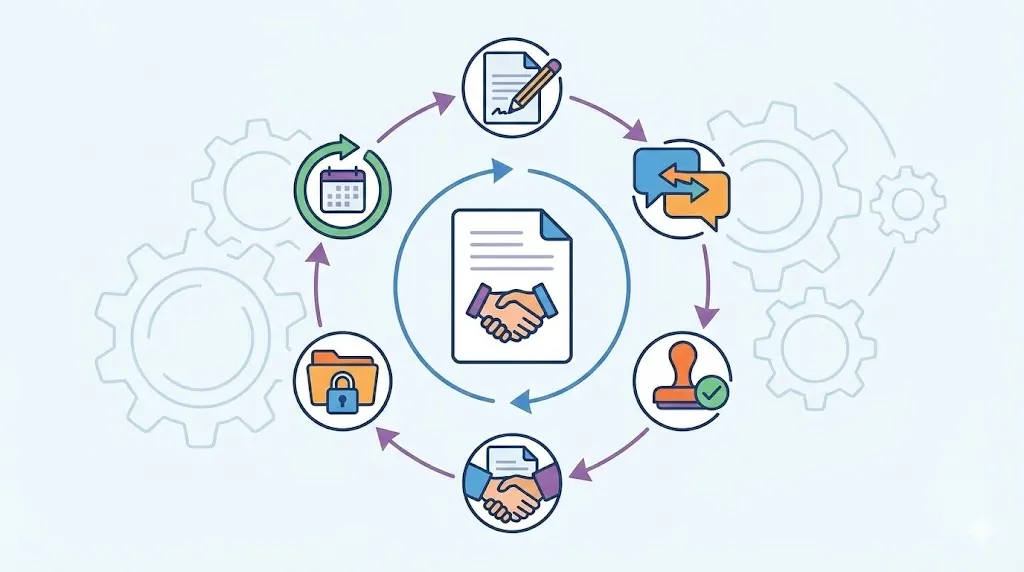
Contract management software centralizes contracts in one secure place. Additionally, by applying AI-driven analysis, it detects essential clauses and flags potential risks embedded in agreements. This empowers teams with sophisticated tools to efficiently draft, negotiate, approve, and oversee contracts at every stage of their lifecycle.
Key benefits include:
Accelerated contract generation facilitated through standardized templates paired with extensive clause libraries.
Proactive identification of risks and compliance issues via automated validation processes.
Interactive dashboards that provide up-to-date insights into contract status and key obligations.
Timely notifications for upcoming renewals, expirations, and compliance requirements.
Integration capabilities with CRM, ERP, and financial systems to maintain consistent and accurate data flow.
Robust collaboration features enabling multiple stakeholders to review and annotate documents concurrently.
By minimizing errors and expediting contract workflows, this software significantly enhances the enforcement and management of contractual agreements.
Why Contract Management Software Matters
Managing complex MedTech contracts requires a system that keeps pace with evolving commercial models. Contract management solutions provide the structure and intelligence needed to handle dynamic pricing, outcome-based terms, and multi-party agreements.
It helps companies maintain control over contract terms and ensures that commitments translate into actual business results. This reduces financial risks and supports compliance with healthcare regulations.
With these tools, MedTech teams can focus on strategic tasks instead of administrative work. They gain insights that improve negotiations and decision-making.
Related articles: Leading Solutions for Contract Management in Fashion by 2026
How CLM Software Solves This
Contract lifecycle management (CLM) software helps MedTech companies handle the growing complexity of contracts. Additionally, it also converts unstructured contract text into actionable data. This data links directly to business processes like billing, compliance, and supply chain.
CLM software automates routine tasks such as contract creation, review, and approval. It tracks obligations and triggers alerts for key dates. AI-powered features identify risky clauses and suggest improvements.
By extracting essential elements such as payment terms, renewal dates, and outcome metrics directly from contract documents, CLM systems provide critical insights for operational efficiency. Integration with ERP systems further ensures precise management of pricing adjustments and rebate applications.
The CLM solution from Volody applies advanced AI techniques to improve contract drafting, offering intelligent clause recommendations alongside thorough risk evaluation. It supports collaboration with approval workflows and electronic signatures. Its central repository and advanced search make contract data easy to find and manage.
> Want to see how contract management software can simplify your legal workflows? Explore Volody’s CLM Software.
FAQ
What are the main commercial models changing MedTech contracting?
Additionally, leasing or Device-as-a-Service, gain-sharing agreements, outcome guarantees, and bundled payments represent significant shifts from traditional purchasing models.
They prioritize contracts that link compensation to actual utilization and clinical results rather than upfront sales.
Why do MedTech contracts need to be longer and more detailed now?
The emergence of these models obliges contracts to encompass service scopes, dynamic pricing mechanisms, performance indicators, and the involvement of multiple stakeholders.
Such intricacy necessitates agreements that are both extended in duration and adaptable in structure.
How does contract intelligence improve contract management?
Moreover, contract intelligence automates the extraction of key clauses and data from agreements, enabling detailed analysis to monitor obligations, identify risks, and integrate data effectively with enterprise platforms.
What risks do manual contract processes pose?
Manual methods increase errors, missed obligations, poor pricing, and compliance failures. These risks can cause lost revenue and legal penalties.
How do regulations affect MedTech contracts?
Current regulatory environments place strong emphasis on transparency, data privacy compliance, and the shift toward value-based care models.
Furthermore, contracts must be aligned with these requirements to mitigate the risk of penalties and protect organizational reputation.
Which functionalities are critical for effective contract lifecycle management in MedTech?
Key elements include AI-driven drafting tools, thorough risk assessment capabilities, precise obligation tracking, optimized approval pipelines, and robust interoperability with CRM and ERP systems.
Can advanced contract platforms assist in managing agreements involving multiple parties?
Yes. They maintain clear delineation of roles, responsibilities, and obligations across all stakeholders, enhancing coordination and regulatory adherence.
Also, how does dynamic pricing work in MedTech contracts?
Contract provisions permit price adjustments triggered by utilization levels, clinical outcomes, or fluctuations in market conditions. Software solutions automate these modifications efficiently.
Also, what is the benefit of linking contract data to operational systems?
It ensures contract terms are reflected in billing, rebates, and compliance processes. This alignment protects margins and reduces errors.
How can MedTech companies measure contract profitability?
By using contract intelligence to analyze pricing, rebates, penalties, and outcomes over time. This requires integrated data and advanced analytics.
About the Company

Volody AI CLM is an Agentic AI-powered Contract Lifecycle Management platform designed to eliminate manual contracting tasks, automate complex workflows, and deliver actionable insights. As a one-stop shop for all contract activities, it covers drafting, collaboration, negotiation, approvals, e-signature, compliance tracking, and renewals. Built with enterprise-grade security and no-code configuration, it meets the needs of the most complex global organizations. Volody AI CLM also includes AI-driven contract review and risk analysis, helping teams detect issues early and optimize terms. Trusted by Fortune 500 companies, high-growth startups, and government entities, it transforms contracts into strategic, data-driven business assets.




" height="216.72211px" id="FYO0bO80Y" transform="translate(3 6.105)" width="206.073px"/><path d="M 108.174 222 C 88.432 222 70.303 217.239 53.785 207.717 C 37.267 198.196 24.173 185.052 14.504 168.285 C 4.835 151.312 0 132.165 0 110.845 C 0 89.731 4.835 70.792 14.504 54.025 C 24.173 37.052 37.267 23.804 53.785 14.282 C 70.303 4.761 88.432 0 108.174 0 C 128.116 0 146.246 4.761 162.562 14.282 C 179.08 23.804 192.073 37.052 201.541 54.025 C 211.21 70.792 216.044 89.731 216.044 110.845 C 216.044 132.165 211.21 151.312 201.541 168.285 C 192.073 185.052 179.08 198.196 162.562 207.717 C 146.044 217.239 127.915 222 108.174 222 Z M 108.174 183.189 C 120.864 183.189 132.044 180.291 141.713 174.495 C 151.382 168.492 158.936 160.006 164.375 149.035 C 169.814 138.064 172.533 125.334 172.533 110.845 C 172.533 96.355 169.814 83.729 164.375 72.965 C 158.936 61.994 151.382 53.611 141.713 47.815 C 132.044 42.02 120.864 39.122 108.174 39.122 C 95.483 39.122 84.202 42.02 74.332 47.815 C 64.663 53.611 57.109 61.994 51.67 72.965 C 46.231 83.729 43.511 96.355 43.511 110.845 C 43.511 125.334 46.231 138.064 51.67 149.035 C 57.109 160.006 64.663 168.492 74.332 174.495 C 84.202 180.291 95.483 183.189 108.174 183.189 Z" fill="rgba(255, 255, 255, 0.12)" height="222px" id="aa1McFcE9" transform="translate(227.183 3)" width="216.04399999999998px"/><path d="M 42.302 182.257 L 111.799 182.257 L 111.799 216.722 L 0 216.722 L 0 0 L 42.302 0 Z" fill="rgba(255, 255, 255, 0.12)" height="216.72211px" id="yRq4AnrsX" transform="translate(477.721 6.105)" width="111.79899999999998px"/><path d="M 108.174 222 C 88.432 222 70.303 217.239 53.785 207.717 C 37.267 198.196 24.173 185.052 14.504 168.285 C 4.835 151.312 0 132.165 0 110.845 C 0 89.731 4.835 70.792 14.504 54.025 C 24.173 37.052 37.267 23.804 53.785 14.282 C 70.303 4.761 88.432 0 108.174 0 C 128.116 0 146.246 4.761 162.562 14.282 C 179.08 23.804 192.073 37.052 201.541 54.025 C 211.21 70.792 216.045 89.731 216.045 110.845 C 216.045 132.165 211.21 151.312 201.541 168.285 C 192.073 185.052 179.08 198.196 162.562 207.717 C 146.044 217.239 127.915 222 108.174 222 Z M 108.174 183.189 C 120.864 183.189 132.044 180.291 141.713 174.495 C 151.382 168.492 158.936 160.006 164.375 149.035 C 169.814 138.064 172.534 125.334 172.534 110.845 C 172.534 96.355 169.814 83.729 164.375 72.965 C 158.936 61.994 151.382 53.611 141.713 47.815 C 132.044 42.02 120.864 39.122 108.174 39.122 C 95.483 39.122 84.202 42.02 74.332 47.815 C 64.663 53.611 57.108 61.994 51.67 72.965 C 46.231 83.729 43.511 96.355 43.511 110.845 C 43.511 125.334 46.231 138.064 51.67 149.035 C 57.108 160.006 64.663 168.492 74.332 174.495 C 84.202 180.291 95.483 183.189 108.174 183.189 Z" fill="rgba(255, 255, 255, 0.12)" height="222px" id="mo8HQspQ0" transform="translate(609.155 3)" width="216.04500000000007px"/><path d="M 73.727 0 C 95.885 0 115.324 4.45 132.044 13.351 C 148.967 22.252 161.957 34.982 171.027 51.541 C 180.287 67.894 184.917 86.937 184.917 108.671 C 184.917 130.405 180.287 149.449 171.027 165.801 C 161.957 181.947 148.967 194.47 132.044 203.371 C 115.324 212.271 95.885 216.722 73.727 216.722 L 0 216.722 L 0 0 Z M 72.216 179.773 C 94.374 179.773 111.497 173.564 123.583 161.144 C 135.669 148.724 141.713 131.233 141.713 108.671 C 141.713 86.109 135.669 68.515 123.583 55.888 C 111.497 43.055 94.374 36.638 72.216 36.638 L 42.302 36.638 L 42.302 179.773 Z" fill="rgba(255, 255, 255, 0.12)" height="216.72211px" id="I3iXX5Hi_" transform="translate(859.693 6.105)" width="184.91699999999992px"/><path d="M 185.22 0 L 113.91 141.273 L 113.91 216.722 L 71.61 216.722 L 71.61 141.273 L 0 0 L 47.74 0 L 93.06 99.046 L 138.08 0 Z" fill="rgba(255, 255, 255, 0.12)" height="216.72211px" id="nzHyWC0_d" transform="translate(1061.78 6.105)" width="185.22000000000003px"/></svg>)