

The 2026 AI in Contracting Report highlights a sharp rise in interest and investment in AI for contract management. Organizations show 56% more enthusiasm compared to last year. Yet, many still struggle to turn this interest into real results. AI is no longer a concept for the future—it is now part of everyday contract and commercial operations. But the biggest obstacle isn’t the technology itself. It is how companies organize and use AI that determines success.
TL;DR
AI in contracting has shifted from testing to actual use across many businesses in 2026.
Executive demands for accelerated, more intelligent contract decision-making are intensifying.
Many organizations struggle with inadequate data infrastructure and governance frameworks that limit their ability to leverage AI’s full potential.
The role of contract management has expanded, becoming a pivotal element in unlocking enterprise-wide AI benefits.
Rather than merely focusing on cost reduction, top companies are prioritizing enhancements in operational efficiency alongside the creation of strategic business value.
Success hinges on assembling adaptable, specialized teams capable of translating AI capabilities into tangible, measurable outcomes.
How Are Businesses Using AI in Contracting Today?
AI’s role in contracting has evolved quickly. By 2026, numerous organizations had advanced well beyond initial pilot phases. Organizations increasingly leverage AI technologies to accelerate drafting, reviewing, and negotiating contracts. These tools are capable of analyzing thousands of contracts, identifying potential risks, and recommending enhancements. This enables legal and commercial teams to arrive at more informed decisions with greater efficiency.
For example, a procurement team might deploy AI-driven analytics to pinpoint clauses that fail to comply with internal standards. This cuts review time from days to hours. Sales teams can draft contracts using AI templates tailored to deal specifics. AI also helps spot unusual terms that could cause future problems.
Despite these advances, adoption varies widely. The extent of implementation frequently reflects how seamlessly AI is embedded into everyday workflows and decision processes.
Executives predict that AI adoption will lead to shorter contract cycle times and improvements in the quality of outcomes.
Among their priorities are minimizing errors, ensuring stronger compliance measures, and enhancing overall risk management.
But many organizations still struggle with the basics. They lack clean, accessible contract data and clear rules for using AI outputs. Without these foundations, AI tools cannot reach their full potential.
Related articles: AI Contract Review vs. Human Lawyers: Speed, Accuracy & ROI
Why Is Contract and Commercial Management Central to AI Success?
Contracting functions overlap with numerous departments across an organization, including legal, sales, procurement, finance, and operations. Contracts encapsulate critical information on obligations, risk exposure, and projected revenue streams. Enhancing contract workflows has a profound impact on elevating overall business performance.
The 2026 report highlights that contract management is emerging as a focal point for AI-driven advancements. Improvements in contract workflows powered by AI extend their benefits well beyond the legal department. Accelerated contract approvals contribute to shortening sales cycles, while enhanced risk detection mechanisms mitigate the likelihood of expensive disputes. Furthermore, automated compliance verifications serve to diminish regulatory exposure.
This central role also means contract teams must work closely with IT, data, and business units. They need to build systems that collect and organize contract data. They must set rules for AI use that balance automation with human judgment. Organizations that succeed in this become leaders in enterprise AI.
Related articles: How to maintain ethically use AI in Legal Operations
What Challenges Do Organizations Face When Using AI in Contracting?
Many companies hit roadblocks when scaling AI in contracting. The biggest challenges include:
Data Quality and Access: Contracts are often stored in multiple places and formats. Extracting consistent data is hard. Poor data limits AI accuracy and usefulness.
Lack of Operating Models: Few organizations have established clear protocols detailing how AI integrates into contract workflows, which limits the utilization of AI tools.
Governance and Compliance: It is imperative that AI outputs adhere to legal and regulatory standards.
Maintaining transparency and ensuring auditability in AI-driven decisions continue to be significant hurdles for many organizations.
Change Management: Contract teams frequently encounter obstacles when adapting to AI technologies, as ingrained workflows and established habits can be difficult to modify.
Widespread apprehension about job displacement and doubts about the reliability of AI-generated insights significantly fuel this resistance.
Moreover, addressing these challenges demands focused training programs coupled with transparent and consistent communication strategies.
Integration with Existing Systems: Often, AI solutions function in isolation from contract management or ERP platforms, resulting in operational discontinuities and increased manual intervention.
Measuring Impact: Companies find it hard to track AI’s real business benefits. Without clear metrics, they cannot justify further investment.
Addressing these challenges requires a multifaceted strategy that integrates technological innovation, process refinement, and the development of human expertise.
Organizations must allocate resources for data cleansing, establish detailed AI operational workflows, and invest in comprehensive staff training.
Robust governance frameworks are also essential to ensure the reliability and compliance of AI-generated decisions.
Related articles: How Does AI Limitations Impacting Contract Management?
How Are Executive Expectations Shaping AI Use in Contracting?
Executives demand that AI produces quantifiable business outcomes. Additionally, they emphasize results such as accelerated contract cycles, enhanced compliance, and strengthened risk management. This shift redefines AI projects, positioning them as integral to overarching business strategies rather than mere technical trials.
Executives also expect contract teams to engage in close collaboration with other business units. AI in contracting should support sales, procurement, finance, and legal goals. For example, AI can help sales teams close deals faster by automating contract drafting. Procurement can use AI to spot unfavorable terms before signing.
This push from the top creates urgency. Contract teams must show quick wins and clear value. They need to communicate AI benefits in business terms, not just technical features. This helps secure ongoing support and funding.
The report notes that executives increasingly prioritize productivity gains and business impact over just cutting costs. Their expectation is that AI enables teams to enhance efficiency without merely downsizing. This mindset encourages investment in training and process improvements alongside technology.
Related articles: Effectively use AI in Contract Drafting
What Practical Steps Can Organizations Take to Build AI Execution Capability?
Building AI execution capability means more than buying tools. It requires a systematic approach:
Assess Current Contract Processes: Identify bottlenecks and pain points where AI can help. Map out workflows and data flows.
Clean and Structure Contract Data: Invest in data extraction and normalization. Use contract metadata and clause tagging to improve AI accuracy.
Define Clear AI Use Cases: Focus on high-impact areas like contract review, risk detection, or compliance checks. Avoid trying to automate everything at once.
Develop Governance Policies: Create comprehensive guidelines that govern AI deployment, monitoring, and validation procedures.
Ensure legal and compliance teams sign off on AI outputs.
Train Teams and Manage Change: Provide specialized training programs aligned with distinct team roles, while encouraging frank discussions to resolve any concerns about AI adoption.
Proactively engage with employees to clarify how AI will augment their responsibilities rather than replace them.
Integrate AI with Existing Systems: Establish seamless interoperability between AI platforms and core systems such as contract repositories, CRM, and ERP to streamline workflows and enhance data consistency.
Measure and Report Results: Track metrics like contract cycle time, error rates, and user satisfaction. Use data to refine AI use and build executive support.
Scale Gradually: Start with pilot projects, then expand successful AI applications. Learn from early experiences to improve processes.
By methodically implementing these strategies, organizations can bridge the gap between theoretical AI potential and tangible business outcomes. Developing robust execution capabilities distinguishes superficial AI adoption from genuine transformational impact.
Related articles: 10 Key Contract Clauses Every Business Should Know in 2026
Why Are Leading Organizations Focusing on Productivity and Outcomes Over Cost-Cutting?
Many companies initially viewed AI as a way to reduce legal expenses and streamline contract management processes. However, the 2026 report shows a shift. Leading organizations focus on improving productivity and business outcomes.
This means using AI to help teams work faster and smarter, not just cheaper. For example, AI can automate routine contract reviews, freeing lawyers to focus on complex issues. It can also provide insights that improve negotiation strategies and reduce risks.
Focusing on outcomes encourages investment in training, governance, and process redesign. It also supports collaboration across departments. This approach creates sustainable value rather than short-term savings.
In practice, companies that prioritize outcomes see benefits such as:
Shorter contract approval times
Fewer contract errors and disputes
Better compliance with regulations
Increased revenue through faster deal cycles
Improved team morale and engagement
This approach aligns AI use with broader business goals. It helps legal professionals and contract management teams become trusted partners in growth and risk management.
Related articles: Leading Contract Management Solutions for Pharma in 2026
How Legal AI Software Solves These Contracting Challenges
Legal AI platforms address numerous obstacles that organizations encounter in contract management. Additionally, it streamlines repetitive tasks such as contract drafting and review processes. The technology extracts essential clauses and obligations from extensive contract datasets. In addition, it provides risk assessments alongside compliance verifications.
Modern AI tools establish direct connections to enterprise systems and contract repositories. This connectivity enables efficient workflows by reducing manual data entry and lowering the likelihood of errors. They provide comprehensive dashboards and reporting tools to monitor contract progress and evaluate AI effectiveness.
One example is an AI platform that uses autonomous agents to manage contract workflows. These agents can draft contracts based on templates, review clauses against company policies, and flag risks for human review. This reduces time spent on routine tasks and improves consistency.
Moreover, AI solutions promote collaboration by allowing legal, sales, and procurement personnel to work within a shared environment. They capture institutional knowledge through AI playbooks and workflow frameworks, thereby extending expertise across teams.
Lawxy is a comprehensive legal assistant powered by AI, designed to streamline and accelerate contract and legal workflows. It integrates contract drafting, review, research, and document intelligence within a single platform. Lawxy employs AI agents to orchestrate complex workflows while ensuring human oversight of critical decisions. Moreover, this approach allows legal teams to minimize manual effort, enhance precision, and accelerate contract processing.
Want to see how AI can simplify legal work? Explore Lawxy Legal AI Software.
Related articles: Contract Automation: Embracing Legal Transformation
FAQ
What does the 2026 AI in Contracting Report say about AI adoption trends?
The report reveals a 56% rise in organizational enthusiasm for AI applications within contracting compared to the previous year. AI has shifted from experimental pilots to practical use in many companies. However, adoption varies widely, with some organizations still facing challenges in execution and data readiness.
Why is contract management critical for enterprise AI success?
Contracts contain vital business information about obligations, risks, and revenue. Optimizing contract workflows through AI delivers value across legal, sales, procurement, and finance functions. Contract management serves as a pivotal point where AI can deliver tangible business benefits.
What are the main challenges companies face when implementing AI in contracting?
Common challenges include poor contract data quality, lack of clear AI workflows, governance and compliance concerns, resistance to change, system integration issues, and difficulty measuring AI impact. Overcoming these obstacles requires dedicated focus on data, processes, and people.
Furthermore, how can organizations improve their AI execution capability in contracting?
They should map current processes, clean contract data, define clear AI use cases, establish governance policies, train teams, integrate AI with existing systems, measure results, and scale AI use gradually. This structured approach helps turn AI potential into real outcomes.
Why do leading companies focus on productivity and outcomes instead of just cost reduction?
Focusing on productivity empowers teams to work more efficiently and effectively, improving contract quality and driving superior business outcomes. It encourages investment in training and governance, leading to sustainable value rather than short-term cost savings.
What role do executives play in AI adoption for contracting?
Executives drive demand for faster, higher-quality contract decisions. Their support shapes AI projects into strategic initiatives aligned with business goals. They expect clear metrics and quick wins to justify ongoing investment.
How does AI improve contract review and risk management?
AI rapidly scans contracts to detect risky clauses, compliance gaps, or deviations from company standards. Also, this capability reduces human error and shortens review cycles. AI also provides risk scoring to prioritize contracts needing attention.
What types of AI tools are commonly used in contract management?
Tools include AI contract drafting assistants, clause extraction and analysis, risk scoring engines, compliance checkers, and workflow automation platforms. These tools often connect with business systems and contract repositories.
How does Lawxy support AI-driven contract management?
Lawxy combines contract drafting, review, research, and document intelligence into a unified AI-powered platform. It deploys autonomous AI agents to streamline workflows while maintaining human oversight. This enables legal teams to cut down manual effort and expedite contract completion.
What should organizations measure to track AI success in contracting?
Key metrics include contract cycle time, error rates, compliance incidents, user satisfaction, and cost savings. Tracking these helps refine AI use and demonstrate business value to executives.
About the Company

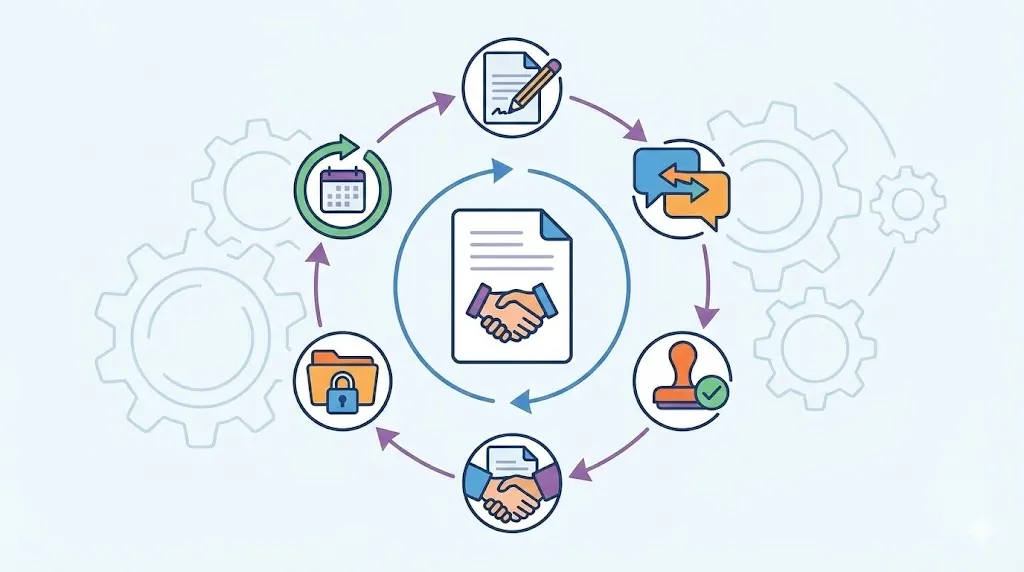
Volody AI CLM is an Agentic AI-powered Contract Lifecycle Management platform designed to eliminate manual contracting tasks, automate complex workflows, and deliver actionable insights. As a one-stop shop for all contract activities, it covers drafting, collaboration, negotiation, approvals, e-signature, compliance tracking, and renewals. Built with enterprise-grade security and no-code configuration, it meets the needs of the most complex global organizations. Volody AI CLM also includes AI-driven contract review and risk analysis, helping teams detect issues early and optimize terms. Trusted by Fortune 500 companies, high-growth startups, and government entities, it transforms contracts into strategic, data-driven business assets.





" height="216.72211px" id="FYO0bO80Y" transform="translate(3 6.105)" width="206.073px"/><path d="M 108.174 222 C 88.432 222 70.303 217.239 53.785 207.717 C 37.267 198.196 24.173 185.052 14.504 168.285 C 4.835 151.312 0 132.165 0 110.845 C 0 89.731 4.835 70.792 14.504 54.025 C 24.173 37.052 37.267 23.804 53.785 14.282 C 70.303 4.761 88.432 0 108.174 0 C 128.116 0 146.246 4.761 162.562 14.282 C 179.08 23.804 192.073 37.052 201.541 54.025 C 211.21 70.792 216.044 89.731 216.044 110.845 C 216.044 132.165 211.21 151.312 201.541 168.285 C 192.073 185.052 179.08 198.196 162.562 207.717 C 146.044 217.239 127.915 222 108.174 222 Z M 108.174 183.189 C 120.864 183.189 132.044 180.291 141.713 174.495 C 151.382 168.492 158.936 160.006 164.375 149.035 C 169.814 138.064 172.533 125.334 172.533 110.845 C 172.533 96.355 169.814 83.729 164.375 72.965 C 158.936 61.994 151.382 53.611 141.713 47.815 C 132.044 42.02 120.864 39.122 108.174 39.122 C 95.483 39.122 84.202 42.02 74.332 47.815 C 64.663 53.611 57.109 61.994 51.67 72.965 C 46.231 83.729 43.511 96.355 43.511 110.845 C 43.511 125.334 46.231 138.064 51.67 149.035 C 57.109 160.006 64.663 168.492 74.332 174.495 C 84.202 180.291 95.483 183.189 108.174 183.189 Z" fill="rgba(255, 255, 255, 0.12)" height="222px" id="aa1McFcE9" transform="translate(227.183 3)" width="216.04399999999998px"/><path d="M 42.302 182.257 L 111.799 182.257 L 111.799 216.722 L 0 216.722 L 0 0 L 42.302 0 Z" fill="rgba(255, 255, 255, 0.12)" height="216.72211px" id="yRq4AnrsX" transform="translate(477.721 6.105)" width="111.79899999999998px"/><path d="M 108.174 222 C 88.432 222 70.303 217.239 53.785 207.717 C 37.267 198.196 24.173 185.052 14.504 168.285 C 4.835 151.312 0 132.165 0 110.845 C 0 89.731 4.835 70.792 14.504 54.025 C 24.173 37.052 37.267 23.804 53.785 14.282 C 70.303 4.761 88.432 0 108.174 0 C 128.116 0 146.246 4.761 162.562 14.282 C 179.08 23.804 192.073 37.052 201.541 54.025 C 211.21 70.792 216.045 89.731 216.045 110.845 C 216.045 132.165 211.21 151.312 201.541 168.285 C 192.073 185.052 179.08 198.196 162.562 207.717 C 146.044 217.239 127.915 222 108.174 222 Z M 108.174 183.189 C 120.864 183.189 132.044 180.291 141.713 174.495 C 151.382 168.492 158.936 160.006 164.375 149.035 C 169.814 138.064 172.534 125.334 172.534 110.845 C 172.534 96.355 169.814 83.729 164.375 72.965 C 158.936 61.994 151.382 53.611 141.713 47.815 C 132.044 42.02 120.864 39.122 108.174 39.122 C 95.483 39.122 84.202 42.02 74.332 47.815 C 64.663 53.611 57.108 61.994 51.67 72.965 C 46.231 83.729 43.511 96.355 43.511 110.845 C 43.511 125.334 46.231 138.064 51.67 149.035 C 57.108 160.006 64.663 168.492 74.332 174.495 C 84.202 180.291 95.483 183.189 108.174 183.189 Z" fill="rgba(255, 255, 255, 0.12)" height="222px" id="mo8HQspQ0" transform="translate(609.155 3)" width="216.04500000000007px"/><path d="M 73.727 0 C 95.885 0 115.324 4.45 132.044 13.351 C 148.967 22.252 161.957 34.982 171.027 51.541 C 180.287 67.894 184.917 86.937 184.917 108.671 C 184.917 130.405 180.287 149.449 171.027 165.801 C 161.957 181.947 148.967 194.47 132.044 203.371 C 115.324 212.271 95.885 216.722 73.727 216.722 L 0 216.722 L 0 0 Z M 72.216 179.773 C 94.374 179.773 111.497 173.564 123.583 161.144 C 135.669 148.724 141.713 131.233 141.713 108.671 C 141.713 86.109 135.669 68.515 123.583 55.888 C 111.497 43.055 94.374 36.638 72.216 36.638 L 42.302 36.638 L 42.302 179.773 Z" fill="rgba(255, 255, 255, 0.12)" height="216.72211px" id="I3iXX5Hi_" transform="translate(859.693 6.105)" width="184.91699999999992px"/><path d="M 185.22 0 L 113.91 141.273 L 113.91 216.722 L 71.61 216.722 L 71.61 141.273 L 0 0 L 47.74 0 L 93.06 99.046 L 138.08 0 Z" fill="rgba(255, 255, 255, 0.12)" height="216.72211px" id="nzHyWC0_d" transform="translate(1061.78 6.105)" width="185.22000000000003px"/></svg>)