

Contracts form the backbone of every business deal, yet many organizations still struggle to keep them aligned with shifting market forces. The 2026 State of Contracting Report sheds light on how contracts will shape profitability, risk, and efficiency in the coming year. Imagine a company caught in tariff disputes, negotiating complex clauses while juggling automation tools. This report offers the data and insights legal and operations leaders need to adapt and thrive in this evolving environment.
TL;DR
Economic variability and evolving regulatory frameworks have introduced new layers of complexity to contracts, compelling the deployment of advanced management methodologies.
Additionally, integrating automation with AI technologies significantly accelerates contract review processes while enhancing the precision of risk identification.
Organizations that harness the actionable intelligence derived from contract data can boost profitability and ensure stricter compliance with regulatory requirements.
Implementing comprehensive contract lifecycle management solutions leads to notable gains in operational efficiency and mitigates delays in legal procedures.
Strategic contract intelligence supports better negotiation outcomes and risk mitigation.
Preparing for AI-powered contract workflows will be critical for 2026 and beyond.
Related Article: Understanding Contract Duration: Key Elements and Tips
How Are Macroeconomic Changes Impacting Contracting in 2026?
Economic conditions directly influence contract terms, negotiation strategies, and risk profiles. Additionally, businesses in 2026 contend with a complex combination of inflationary trends, evolving trade regulations, and heightened geopolitical instability. These factors create uncertainty that contracts must address clearly and flexibly.
Tariffs combined with ongoing supply chain disruptions increasingly compel companies to revisit and adjust pricing and delivery clauses on a more frequent basis. Contracts now often include detailed force majeure provisions and escalation paths to handle unexpected costs. Such developments increase complexity, compelling legal teams to maintain a high degree of responsiveness.
Inflation impacts contract durations and payment structures in significant ways. Fixed-price contracts risk eroding profitability if inflation spikes. More organizations opt for indexed pricing or shorter terms to reduce exposure. Moreover, legal teams must understand these economic drivers to draft contracts that protect margins without stalling deals.
Regulatory changes add another layer of complexity. New data privacy laws, environmental regulations, and compliance mandates require contracts to include updated clauses on confidentiality, liability, and reporting. Failure to adapt contracts quickly can lead to costly penalties or lost business.
According to a 2023 McKinsey report, companies that actively manage contract risks related to economic shifts reduce financial losses by up to 15%. This shows the value of integrating market intelligence into contract workflows.
In response to the shifting economic landscape of 2026, contracts must be crafted with an emphasis on adaptability, transparency, and leveraging data-driven insights to support strategic decision-making. Building strong partnerships between legal and operational teams is essential to effectively incorporate economic realities into contract strategies.
Explore in-depth perspectives on critical contract provisions in 2026 by reviewing 10 Key Contract Clauses Every Business Should Know in 2026.
What Are the Top Contracting Challenges in 2026?
Contracting teams face several critical challenges that slow down deal cycles and increase risk exposure. Additionally, recognizing these obstacles enables organizations to focus their efforts on the most impactful solutions.
Rising Contract Volume and Complexity
The number of contracts has grown steadily, driven by global expansion and digital partnerships. Contracts now include more clauses, cross-references, and compliance requirements. Managing this volume manually leads to errors and delays.
Fragmented Contract Data
Contract information often lives in multiple systems or formats, making it hard to get a complete view. This fragmentation hinders risk assessment and slows approvals.
Manual Review Bottlenecks
Legal teams spend excessive time on routine contract reviews and redlining. This slows deal closure and drains resources.
Inconsistent Risk Management
Without standardized processes, risk scoring and clause analysis vary widely. This inconsistency increases exposure to unfavorable terms.
Limited Use of Contract Analytics
Many organizations lack tools to extract actionable insights from contract data. This limits their ability to negotiate better terms or forecast liabilities.
Collaboration Gaps Between Teams
Contracting involves legal, procurement, finance, and business units. Poor communication causes rework and missed deadlines.
These challenges create operational inefficiencies and increase legal risks. Addressing them requires a mix of technology, process redesign, and cross-functional alignment.
Related articles: Top 5 Contract Management Solutions for Karnataka in 2026
How Will AI and Automation Shape Contracting in 2026?
Artificial intelligence and automation have fundamentally changed contract management, elevating it from a routine task to a critical strategic function. Additionally, looking ahead to 2026, these technologies will become indispensable for managing the increasing scale and intricacy of contract portfolios.
AI excels at processing contract language at scale, identifying high-risk clauses and proposing viable alternatives. AI-powered redlining tools detect deviations from established playbooks, thereby assisting legal teams in maintaining compliance with internal standards.
Automation enhances workflow efficiency by managing contract approvals, monitoring key deadlines, and automatically producing reports. This reduces the likelihood of errors and frees up personnel to focus on higher-value strategic initiatives.
Machine learning algorithms evolve by analyzing historical contracts in conjunction with their associated outcomes. This enables sophisticated predictive analytics, such as estimating negotiation durations and identifying clauses that commonly lead to disputes.
Moreover, according to Gartner, by 2026, 70% of organizations will implement AI-driven contract analytics to enhance compliance and accelerate processes. Early adopters report 30-50% faster contract turnaround times.
AI also supports full lifecycle contract intelligence. It connects drafting, negotiation, execution, and renewal phases, providing a continuous feedback loop. Such comprehensive insights enable the detection of process inefficiencies and the refinement of contract management approaches.
However, AI adoption requires careful change management. Teams must trust AI outputs and maintain human oversight for critical decisions. Transparency and explainability in AI models are vital.
In summary, AI and automation will shift contracting from reactive to proactive, enabling smarter risk management and faster deals.
Related Article: Contract Management Process Stages Guide for 2026
What Are the Key Data Points from the 2026 State of Contracting Report?
The 2026 State of Contracting Report offers over 30 data points revealing how contracts impact business outcomes. Here are some of the most relevant findings:
60% of contracts now include clauses addressing supply chain disruptions, reflecting ongoing volatility.
Companies using AI for contract review reduce cycle times by 40% on average.
Contracts with automated risk scoring show 25% fewer post-signature disputes.
Integrating contract data with ERP systems improves the accuracy of revenue recognition by about 15%.
Market volatility drives renegotiation in nearly half of all contracts within their initial year.
By adopting AI-powered tools, legal teams have cut down manual redlining efforts by 30%.
Centralized contract repositories contribute to a 20% boost in compliance rates across enterprises.
Contract analytics currently inform negotiation strategies in only 35% of organizations.
Accelerated contract approval processes correlate with a 10% increase in deal closure rates.
Automating contract renewals helps reduce revenue leakage by as much as 12%.
These data points highlight the growing role of technology and data in managing contracts effectively. They also demonstrate the tangible financial benefits derived from optimizing contract workflows.
Related articles: Best Contract Management Software in 2026: Top 20 CLM Tools
How Can Organizations Improve Contract Profitability and Risk Management?
Contracts have a direct impact on both financial outcomes and exposure to risk. Organizations that manage contracts strategically can protect margins and reduce liabilities.
To improve profitability:
Implement pricing strategies that dynamically reflect inflation trends and cost variability.
Automate the monitoring of contract renewals to safeguard against lost revenue and overlooked opportunities.
Standardize contract templates to streamline approvals and reduce delays during negotiations.
Provide targeted training to sales and procurement personnel on contract clauses that influence financial performance.
For risk management:
Integrate AI-driven contract analysis tools to identify potentially hazardous clauses at an early stage.
Develop quantitative models that evaluate risk exposure across contract portfolios, enabling prioritized mitigation efforts.
Centralize contract storage to improve audit processes and ensure adherence to regulatory standards.
Moreover, include clear dispute resolution and termination clauses to limit liabilities.
Monitor regulatory changes and update contracts proactively.
A practical example: A manufacturing firm facing frequent supply chain delays used AI to flag force majeure clauses and renegotiate terms. This reduced penalty costs by 20% and improved supplier relationships.
According to a Deloitte survey, companies with mature contract risk management practices see 30% fewer compliance violations. This leads to significant cost savings.
Enhancing contract-related financial performance and mitigating associated risks demands an integrated approach involving advanced technology, rigorous processes, and collaborative efforts across departments.
Related articles: How Does AI Limitations Impacting Contract Management?
What Does Full Lifecycle Contract Intelligence Mean for 2026?
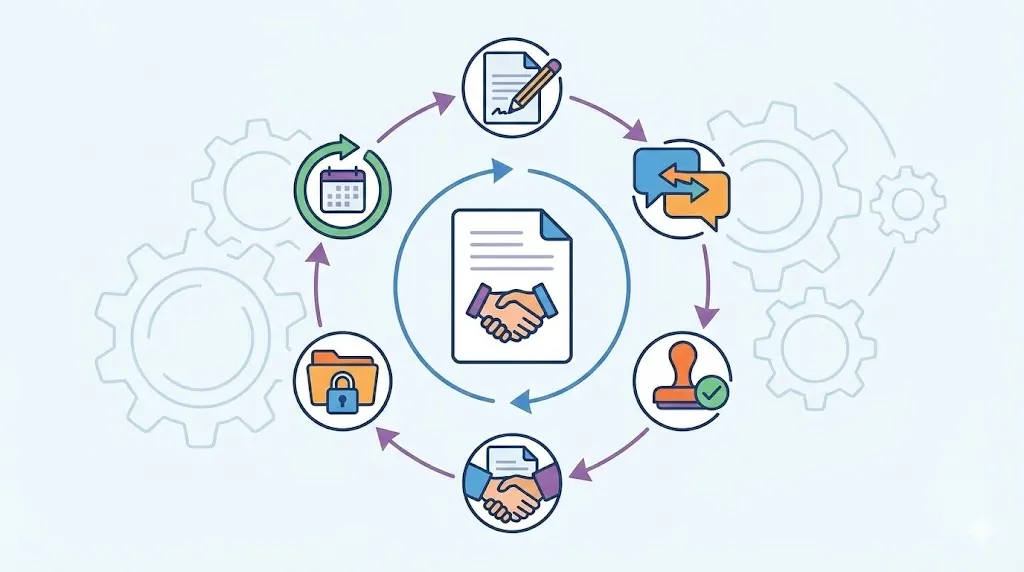
Full lifecycle contract intelligence means managing contracts from creation through renewal with continuous data insights. Additionally, this approach integrates contract phases to improve visibility and support strategic decision-making.
In 2026, mastering this framework will be critical to navigating the increasing complexity and accelerated pace of contract management.
It encompasses several key stages:
Drafting: AI technologies facilitate rapid generation of precise, compliant contract language tailored to specific requirements.
Negotiation: Advanced analytics enable organizations to delve deeply into counterparties’ risk profiles and negotiation tactics, yielding nuanced assessments beyond surface-level metrics.
Execution: Streamlining contract finalization involves automating approval workflows in tandem with electronic signature systems, effectively reducing bottlenecks and processing times.
Monitoring: Organizations implement real-time surveillance of contractual obligations, deadlines, and compliance mandates to proactively address potential issues before escalation.
Renewal/Amendment: Predictive modeling empowers companies to anticipate risks and identify strategic opportunities linked to impending contract renewals.
Archiving: Employing sophisticated indexing strategies ensures contracts remain accessible for prompt retrieval and thorough audit readiness.
This end-to-end view equips legal and business teams to identify emerging risks promptly, prevent deadline lapses, and refine contract provisions for optimal outcomes. It also supports continuous improvement by analyzing contract outcomes.
For example, a financial services firm integrated contract data with CRM and ERP systems. This gave them real-time insights into contract performance and revenue impact, enabling faster decisions.
The 2026 report highlights that organizations using full lifecycle intelligence reduce contract disputes by 25% and increase deal velocity by 35%.
Achieving this requires unified contract management platforms that combine AI, workflow automation, and data analytics.
Related articles: Contract Management Stages Guide For 2026
Why Is Cross-Functional Collaboration Critical in Contracting?
Contracts touch many parts of a business: legal, sales, procurement, finance, and operations. However, ineffective collaboration often causes delayed approvals, inconsistent contract provisions, and overlooked risks.
Additionally, cross-functional collaboration will prove essential for success in 2026.
This collaboration guarantees that:
Contract provisions support overarching business objectives and satisfy compliance requirements.
All relevant parties detect and address risks at an early stage.
Accountability mechanisms accelerate the approval process.
Exchanging expertise enhances the consistency and quality of contracts.
Analyzing contract data yields valuable insights across the organization.
For example, procurement teams can flag supplier risks while legal ensures contract language protects the company. Finance teams confirm that payment conditions correspond to budgetary constraints. Sales teams understand negotiation constraints.
Collaboration is enhanced by technology solutions that offer shared contract platforms, enabling role-based access, real-time editing, and comprehensive audit trails.
A PwC study reveals that organizations with robust legal-business collaboration achieve contract compliance rates 20% higher and close deals 15% faster.
Building effective collaboration relies on transparent workflows, well-defined roles, and integrated tools designed to support fluid teamwork.
Related articles: What Is CLM Software And Top 15 Best CLM Tools In 2026
How Legal AI Software Solves This
Advanced AI-driven legal platforms assist companies in managing intricate contract workflows by automating routine tasks and delivering insightful analyses. It accelerates contract drafting, review, and risk analysis while ensuring compliance.
Such software can extract key clauses, score risks, and suggest alternative language instantly. It also tracks deadlines and automates approvals, reducing bottlenecks.
One example is an AI platform that combines contract management, legal research, and workflow automation in a single workspace. This lets teams manage the entire contract lifecycle without switching tools.
Lawxy offers these capabilities, including AI contract drafting, risk scoring, clause comparison, and automated workflow routing. Its platform helps legal teams reduce manual work, improve contract quality, and close deals faster.
In addition, Interested in how artificial intelligence can streamline legal processes? Explore Lawxy Legal AI Software.
Related articles: What is Contract Risk & How to manage it?
FAQ
What is the 2026 State of Contracting Report?
It is a comprehensive analysis of contract trends, challenges, and technologies shaping contracting in 2026. The report provides data and insights to help legal and operations leaders improve contract profitability, risk management, and efficiency.
Why are contracts becoming more complex in 2026?
Moreover, contracts now include more clauses addressing economic volatility, regulatory changes, and supply chain risks. This complexity requires smarter management and technology to avoid errors and delays.
In what ways does AI enhance contract management?
AI streamlines contract review, risk detection, and redlining processes. It expedites approvals and delivers data-driven insights that improve negotiation strategies and compliance. Insight generation continues seamlessly throughout all contract phases.
What are the main challenges in contract workflows today?
Rising contract volume, fragmented data, manual review bottlenecks, inconsistent risk management, limited analytics, and poor cross-team collaboration are key challenges.
How can companies reduce contract risks?
Also, they can use AI-powered review tools, develop risk scoring models, centralize contracts, update clauses proactively, and improve collaboration between legal and business teams.
What is full lifecycle contract intelligence?
It is managing contracts from drafting to renewal with continuous data insights. Furthermore, this approach improves visibility, speeds workflows, and reduces risks throughout the contract lifespan.
Why is cross-functional collaboration important in contracting?
Contracts affect many departments. Collaboration ensures aligned terms, faster approvals, risk mitigation, and better contract outcomes.
Therefore, how does automation impact contract turnaround time?
Automation reduces manual tasks like routing and approvals, cutting turnaround times by up to 40%. This accelerates deal closure and improves operational efficiency.
What role does data analytics play in contracting?
Analytics pinpoint high-risk clauses, anticipate renewal opportunities, and inform negotiation tactics. Leveraging such data enhances both profitability and compliance.
Can AI replace legal teams in contract management?
No. AI functions as an aid by handling repetitive tasks and generating analytical insights. Critical decisions and sophisticated negotiations still require human expertise. AI solutions augment legal team efficiency without supplanting professional judgment.
About the Company
Volody AI CLM is an Agentic AI-powered Contract Lifecycle Management platform designed to eliminate manual contracting tasks, automate complex workflows, and deliver actionable insights. As a one-stop shop for all contract activities, it covers drafting, collaboration, negotiation, approvals, e-signature, compliance tracking, and renewals. Built with enterprise-grade security and no-code configuration, it meets the needs of the most complex global organizations. Volody AI CLM also includes AI-driven contract review and risk analysis, helping teams detect issues early and optimize terms. Trusted by Fortune 500 companies, high-growth startups, and government entities, it transforms contracts into strategic, data-driven business assets.




" height="216.72211px" id="FYO0bO80Y" transform="translate(3 6.105)" width="206.073px"/><path d="M 108.174 222 C 88.432 222 70.303 217.239 53.785 207.717 C 37.267 198.196 24.173 185.052 14.504 168.285 C 4.835 151.312 0 132.165 0 110.845 C 0 89.731 4.835 70.792 14.504 54.025 C 24.173 37.052 37.267 23.804 53.785 14.282 C 70.303 4.761 88.432 0 108.174 0 C 128.116 0 146.246 4.761 162.562 14.282 C 179.08 23.804 192.073 37.052 201.541 54.025 C 211.21 70.792 216.044 89.731 216.044 110.845 C 216.044 132.165 211.21 151.312 201.541 168.285 C 192.073 185.052 179.08 198.196 162.562 207.717 C 146.044 217.239 127.915 222 108.174 222 Z M 108.174 183.189 C 120.864 183.189 132.044 180.291 141.713 174.495 C 151.382 168.492 158.936 160.006 164.375 149.035 C 169.814 138.064 172.533 125.334 172.533 110.845 C 172.533 96.355 169.814 83.729 164.375 72.965 C 158.936 61.994 151.382 53.611 141.713 47.815 C 132.044 42.02 120.864 39.122 108.174 39.122 C 95.483 39.122 84.202 42.02 74.332 47.815 C 64.663 53.611 57.109 61.994 51.67 72.965 C 46.231 83.729 43.511 96.355 43.511 110.845 C 43.511 125.334 46.231 138.064 51.67 149.035 C 57.109 160.006 64.663 168.492 74.332 174.495 C 84.202 180.291 95.483 183.189 108.174 183.189 Z" fill="rgba(255, 255, 255, 0.12)" height="222px" id="aa1McFcE9" transform="translate(227.183 3)" width="216.04399999999998px"/><path d="M 42.302 182.257 L 111.799 182.257 L 111.799 216.722 L 0 216.722 L 0 0 L 42.302 0 Z" fill="rgba(255, 255, 255, 0.12)" height="216.72211px" id="yRq4AnrsX" transform="translate(477.721 6.105)" width="111.79899999999998px"/><path d="M 108.174 222 C 88.432 222 70.303 217.239 53.785 207.717 C 37.267 198.196 24.173 185.052 14.504 168.285 C 4.835 151.312 0 132.165 0 110.845 C 0 89.731 4.835 70.792 14.504 54.025 C 24.173 37.052 37.267 23.804 53.785 14.282 C 70.303 4.761 88.432 0 108.174 0 C 128.116 0 146.246 4.761 162.562 14.282 C 179.08 23.804 192.073 37.052 201.541 54.025 C 211.21 70.792 216.045 89.731 216.045 110.845 C 216.045 132.165 211.21 151.312 201.541 168.285 C 192.073 185.052 179.08 198.196 162.562 207.717 C 146.044 217.239 127.915 222 108.174 222 Z M 108.174 183.189 C 120.864 183.189 132.044 180.291 141.713 174.495 C 151.382 168.492 158.936 160.006 164.375 149.035 C 169.814 138.064 172.534 125.334 172.534 110.845 C 172.534 96.355 169.814 83.729 164.375 72.965 C 158.936 61.994 151.382 53.611 141.713 47.815 C 132.044 42.02 120.864 39.122 108.174 39.122 C 95.483 39.122 84.202 42.02 74.332 47.815 C 64.663 53.611 57.108 61.994 51.67 72.965 C 46.231 83.729 43.511 96.355 43.511 110.845 C 43.511 125.334 46.231 138.064 51.67 149.035 C 57.108 160.006 64.663 168.492 74.332 174.495 C 84.202 180.291 95.483 183.189 108.174 183.189 Z" fill="rgba(255, 255, 255, 0.12)" height="222px" id="mo8HQspQ0" transform="translate(609.155 3)" width="216.04500000000007px"/><path d="M 73.727 0 C 95.885 0 115.324 4.45 132.044 13.351 C 148.967 22.252 161.957 34.982 171.027 51.541 C 180.287 67.894 184.917 86.937 184.917 108.671 C 184.917 130.405 180.287 149.449 171.027 165.801 C 161.957 181.947 148.967 194.47 132.044 203.371 C 115.324 212.271 95.885 216.722 73.727 216.722 L 0 216.722 L 0 0 Z M 72.216 179.773 C 94.374 179.773 111.497 173.564 123.583 161.144 C 135.669 148.724 141.713 131.233 141.713 108.671 C 141.713 86.109 135.669 68.515 123.583 55.888 C 111.497 43.055 94.374 36.638 72.216 36.638 L 42.302 36.638 L 42.302 179.773 Z" fill="rgba(255, 255, 255, 0.12)" height="216.72211px" id="I3iXX5Hi_" transform="translate(859.693 6.105)" width="184.91699999999992px"/><path d="M 185.22 0 L 113.91 141.273 L 113.91 216.722 L 71.61 216.722 L 71.61 141.273 L 0 0 L 47.74 0 L 93.06 99.046 L 138.08 0 Z" fill="rgba(255, 255, 255, 0.12)" height="216.72211px" id="nzHyWC0_d" transform="translate(1061.78 6.105)" width="185.22000000000003px"/></svg>)