

Contracts govern business relationships, risks, and rewards. Yet, most professionals find contracts hard to read and understand. Imagine a sales rep, a procurement manager, or even a CEO quickly grasping the impact of contract terms without wading through dense legal text. Visual contracting makes this possible by turning complex contracts into clear, interactive visuals. This approach changes how teams negotiate, manage risk, and make decisions, making contract management more intuitive and effective.
TL;DR
Visual contracting uses AI to turn contract clauses into interactive visuals for easier understanding.
It enables users to analyze the interconnections among contract terms as well as their implications relative to external frameworks such as regulatory requirements.
Contract views are customized according to professional roles, emphasizing the elements of greatest relevance to each stakeholder.
By mapping out dependencies within and across contracts, these visualizations bring risks and opportunities into sharper focus.
The approach accelerates processes including contract review, negotiation, and ongoing compliance monitoring.
Incorporation of visual contracting features into contract management platforms aims to enhance overall business performance.
What Is Visual Contracting and Why Does It Matter?
Contracts are more than just legal documents. Additionally, they encompass business rules, risks, and obligations that influence multiple teams throughout an organization. However, contracts often look like walls of text filled with legal jargon. This makes it hard for non-lawyers to understand what they mean and how they impact the business.
Visual contracting changes this by breaking contracts into pieces and showing how those pieces connect. Instead of reading through paragraphs, users interact with diagrams, charts, and maps that explain contract terms and their effects.
Consider a contract containing a service level agreement (SLA) which imposes penalties when deadlines are missed. Through visual contracting, one can analyze the impact of modifying SLA conditions on penalties, pricing structures, or renewal clauses. It can also reveal the geographic scope of applicability and bring relevant local regulations into clear focus.
This approach helps teams spot risks, spot opportunities, and make informed decisions faster. It also reduces mistakes caused by misunderstandings or missed details.
Further reading: Elevate Technology Industry with CLM Software
How Does Visual Contracting Work?
Visual contracting relies on artificial intelligence (AI) and cloud technology to analyze contracts. Additionally, the software performs a detailed examination to identify clauses, obligations, deadlines, and other critical data points. Then, it creates visual models that show how these elements interact.
Here’s a step-by-step breakdown:
Clause Extraction: The contract text is parsed to extract individual clauses, terms, and obligations.
Relationship Mapping: Connections between related clauses are established, illustrating their dependencies and mutual influences.
Contextual Visualization: The presentation of contract elements adapts to the user’s specific role, employing timelines for monitoring deadlines, charts that quantify obligations, or maps delineating jurisdictional boundaries.
Interactive Exploration: The platform enables users to manipulate visual data directly, allowing them to simulate scenarios such as how adjustments in pricing terms might influence linked penalty clauses.
Portfolio Insights: Aggregating data across numerous contracts, the system identifies emerging patterns and highlights risks that could affect the overall contract portfolio.
This process turns static, hard-to-read contracts into dynamic, easy-to-understand visual stories.
Related articles: The Contract Visibility Crisis in Legal Teams
Why Visual Contracting Helps Different Teams
Contracts touch many parts of a business. Additionally, by adapting contract details to the specific concerns of each role, visual contracting enhances user engagement and relevance.
Sales Teams: Their priorities revolve around pricing models, renewal terms, and customer obligations. Visual tools bring these elements into sharp relief, demonstrating how changes to terms can directly affect revenue streams.
Legal Teams: It is essential for them to comprehend risk exposure, liability issues, jurisdictional complexities, and compliance requirements in depth. Visual contracting maps out these factors explicitly, drawing attention to clauses that could introduce potential liabilities.
Procurement: Oversight of supplier commitments, delivery schedules, and penalty clauses demands careful attention. Moreover, visual timelines paired with alert systems enable precise monitoring of contract performance over time.
Finance: Their analysis centers on payment schedules, penalty provisions, and evaluating financial risks. Visual summaries provide clarity on how these elements influence cash flow and compliance with budgetary limits.
Executives: They want a high-level view of contract risks, opportunities, and compliance across the company. Dashboards provide this overview.
By tailoring views, visual contracting makes contracts accessible and actionable for everyone.
Related articles: Atlanta Contract Management: Top AI CLM Solutions
What Can Visual Contracting Show You?
Visual contracting enables a multidimensional view of contract details, uncovering interrelations that traditional text often obscures.
Clause Dependencies: Identify how certain clauses influence others, for example, the impact of termination rights on penalty provisions.
Obligations and Deadlines: Interactive timelines provide granular oversight of deliverables, milestones, and renewal schedules.
Geographic Scope: The territorial reach of contracts is delineated alongside the relevant local statutes and regulatory frameworks.
Financial Impact: Pricing models are analyzed in conjunction with SLAs, penalties, and currency volatility to evaluate fiscal consequences.
Contract Relationships: Visual mappings illustrate linkages between contracts involving the same supplier or customer.
Risk Indicators: Clauses that pose compliance concerns or diverge from corporate policies are prominently flagged.
These insights empower teams to negotiate with greater sophistication, mitigate risks effectively, and oversee contracts with proactive management.
Related articles: CLM Integration with CRM, CPQ, and ERP: A Complete Guide
How Visual Contracting Changes Contract Review and Negotiation
Traditional contract review is slow and error-prone. Additionally, as reviewers navigate lengthy documents, they may overlook critical risks or obligations embedded within complex language. Negotiations often become protracted due to uncertainty about the implications of proposed modifications on the overall contract structure.
Visual contracting addresses these challenges by mapping contract terms directly to their consequential effects. AI-generated summaries emphasize key clauses, equipping reviewers with precise insights. At the same time, negotiators have the capability to track how alterations ripple through the contract. This increased clarity reduces back-and-forth discussions and accelerates the approval cycle.
For example, if a buyer wants to change delivery terms, visual contracting can show how this affects penalties, payment schedules, and supplier obligations. Both sides can quickly agree on terms with a shared understanding.
Related articles: Contract Management Software for Government Sector
What Challenges Does Visual Contracting Address?
Contracts are complex, and managing them manually creates risks:
Hidden Risks: Important clauses may be overlooked, exposing the business to penalties or compliance failures.
Slow Review: The process of manually analyzing contracts often extends timelines, causing delays in deal closures and escalating expenses.
Poor Collaboration: Teams frequently encounter difficulties when attempting to exchange contract insights in an efficient manner.
Data Silos: Contract data often lives in documents, spreadsheets, or disconnected systems.
Compliance Gaps: Manually monitoring obligations and deadlines increases the risk of overlooked renewals or contractual breaches.
Visual contracting tackles these by making contract data visible, interactive, and easy to share across teams.
Related articles: Mastering Digital Contract Management: A Strategic Guide
What Does Visual Contracting Look Like in Practice?
Imagine a procurement manager reviewing a supplier contract. Rather than sifting through a 50-page document, they access an integrated visual dashboard. The dashboard features a timeline outlining delivery milestones alongside penalties for delays. It also includes a map that delineates where the contract is enforceable and incorporates pertinent local regulations. A chart demonstrates how fluctuations in price impact overall costs. There are also links to related contracts with the same supplier, complete with their current status.
The manager identifies a penalty clause that contradicts company policy. They flag it for legal review. Meanwhile, the sales team sees how contract terms affect revenue forecasts in their own view. Everyone works from the same data but sees what matters to them.
Related articles: IT Teams Choosing a CLM Platform: An In-Depth Guide
How Contract Management Software Supports Visual Contracting
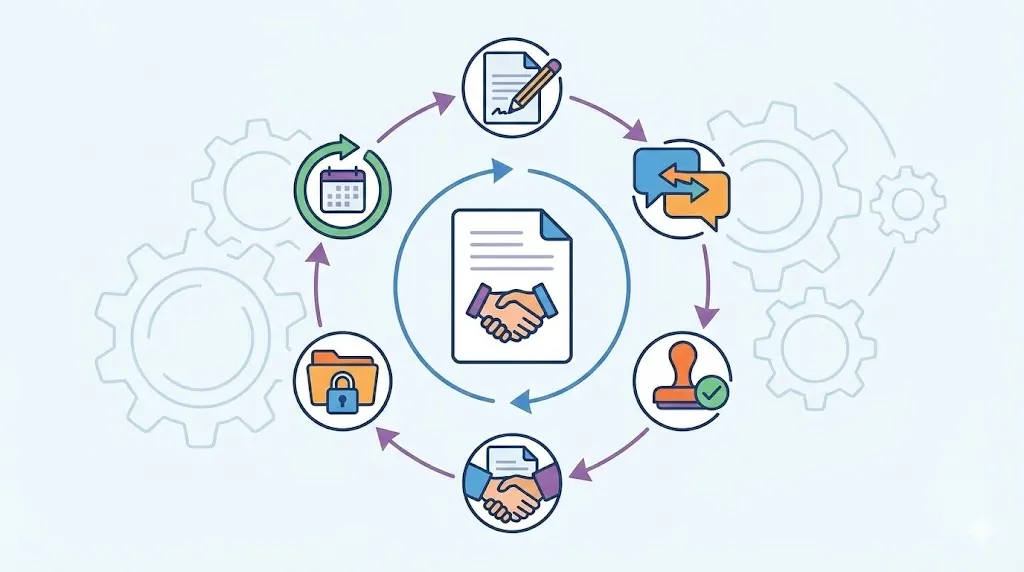
Contract lifecycle management (CLM) software organizes contracts from creation through renewal. Additionally, by combining advanced data extraction with sophisticated visualization techniques, visual contracting significantly extends the capabilities of CLM.
CLM software helps by:
Providing a secure, centralized repository that ensures all contract documents are readily accessible.
AI-driven detection and extraction target essential clauses, key dates, and contractual obligations without manual intervention.
Interactive dashboards and visualization tools facilitate in-depth analysis of contract data from multiple perspectives.
Automated alerts notify stakeholders about critical milestones such as renewals, deadlines, and compliance requirements.
Collaborative workflows are supported through comprehensive version control mechanisms and exhaustive audit trails.
This integration accelerates contract management processes, mitigates errors, and strengthens compliance adherence.
Why Contract Management Software Matters
Managing contracts in the absence of specialized software often leads to fragmented workflows and inefficiencies. Manual methods are not only time-intensive but also increase exposure to risks while diminishing overall contract transparency. Contract management software addresses these issues by delivering an organized and intelligent system designed to optimize contract processes.
Organizations benefit by:
Creating a unified repository that consolidates all contract documents and related data.
Automating routine workflows such as approvals and notification triggers to reduce manual intervention.
Employing AI-driven functionalities that improve precision through automated clause extraction and comprehensive risk assessments.
Enabling seamless collaboration across legal, sales, procurement, and finance departments to harmonize contract management.
Utilizing sophisticated analytics tools to generate actionable insights from contract data.
Visual contracting is the next step, making contract data not just accessible but easy to understand and act on.
How Visual Contracting Fits Into Enterprise Workflows
Visual contracting integrates with existing business systems and workflows. For example:
It connects to customer relationship management (CRM) tools to link contracts with sales deals.
Additionally, synchronization with enterprise resource planning (ERP) systems enables precise alignment of contracts with procurement and finance data.
Integration with electronic signature platforms accelerates contract execution timelines.
Compliance and risk management tools are incorporated to continuously monitor contractual obligations.
These integrations ensure contract visuals reflect current data and operate smoothly within established business processes.
Related articles: Contract Management Software for Sales Teams | CLM Guide
Real-World Benefits of Visual Contracting
Companies adopting visual contracting report accelerated timelines in contract reviews and approvals. Additionally, they also gain improved capabilities for pinpointing and mitigating potential risks. Negotiations benefit from enhanced insights and a higher degree of transparency. The use of automation bolsters both the integrity and efficiency of compliance workflows. Collaboration between legal and business teams becomes more seamless throughout various processes. Furthermore, decision-makers access more comprehensive and actionable intelligence to inform strategic directions.
These benefits translate into cost savings, reduced legal exposure, and stronger business relationships.
How to Start Using Visual Contracting
Identify the contracts that best support your strategic business objectives. Then:
Choose a contract management platform that integrates AI capabilities with advanced visualization tools.
Additionally, upload your contracts to establish a centralized, searchable repository.
Leverage AI-driven technologies to automatically extract clauses and obligations embedded within the contracts.
Visual dashboards facilitate a comprehensive understanding of contract terms and enable evaluation of potential risk exposures.
Conduct targeted training sessions to help teams navigate visual contracting views tailored to their specific roles.
Monitor contract performance and compliance with alerts and reports.
Start small with key contract types and expand as you gain confidence and insights.
How Contract Management Software Solves This
Contract management software simplifies handling complex contracts by automating data extraction and providing clear visuals. Additionally, by alleviating repetitive administrative tasks, it allows teams to concentrate on strategic decision-making. Modern platforms incorporate AI capabilities to conduct in-depth contract analysis, identify potential risks, and produce concise summaries.
One example includes a platform equipped with AI-driven contract drafting, comprehensive review functionalities, and intelligent clause recommendations. It precisely extracts metadata, including involved parties, critical dates, and contractual obligations. The system maintains ongoing surveillance of key deadlines and regulatory compliance requirements, issuing alerts as circumstances demand. Enhanced collaboration arises from sophisticated version control mechanisms paired with clearly defined approval workflows. Interactive dashboards offer transparent insights into contract interrelations, risk factors, and financial implications, making complex data readily interpretable.
This software accelerates the ability of legal, sales, procurement, and finance teams to interpret contracts thoroughly and proceed with assurance.
> Explore how Volody's CLM Software empowers your team to advance contracts efficiently and decisively.
FAQ
What is visual contracting?
Additionally, visual contracting employs AI techniques to dissect contracts into essential components and demonstrates the relationships between these elements through dynamic graphics.
This approach enables users to grasp complex contract provisions without wading through dense legal prose.
How does AI assist with visual contract analysis?
The technology processes contracts to extract clauses, obligations, and critical deadlines.
AI scans contracts to identify clauses, obligations, and deadlines. It links related terms and creates visual models that users can explore to see impacts and risks clearly.
Who gains the most from adopting visual contracting?
Moreover, legal teams, sales, procurement, finance, and executives all derive value. Each group receives a customized perspective emphasizing contract details pertinent to their responsibilities.
Can this approach accelerate contract reviews?
Yes. By highlighting key terms and risks visually, it reduces the time spent reading and interpreting contracts. This leads to faster negotiations and approvals.
Are existing contract management systems compatible with visual contracting?
Most modern contract management platforms support visual contracting features or integrate with tools that do. Furthermore, this allows seamless workflows and data sharing.
Which contract types see the greatest advantage from this technology?
All contract types can benefit, especially complex agreements with many clauses, obligations, or dependencies. Examples include supplier contracts, customer agreements, and service level agreements.
In what ways does visual contracting enhance risk management?
It facilitates the identification of risky clauses and compliance gaps by mapping contract terms against regulations, policies, and interconnected agreements.
User training is essential to enhance proficiency in interpreting visualizations and extracting actionable insights.
Also, well-designed software integrates intuitive interfaces, minimizing the learning curve.
Could these tools support contract renewals and obligations management?
Indeed, these tools provide visual timelines and alert mechanisms to monitor deadlines, renewal dates, and ongoing obligations, ensuring teams remain proactive and avoid lapses.
How does cloud technology contribute to visual contracting capabilities?
Cloud platforms provide the computing power and storage needed to analyze large contract portfolios and deliver interactive visuals accessible anywhere.
This article explains how visual contracting transforms contract management. By turning complex contracts into clear, interactive visuals, it helps teams understand, negotiate, and manage contracts more efficiently. Contract management software with AI and visualization features supports this approach, improving risk management and business outcomes.
About the Company

Volody AI CLM is an Agentic AI-powered Contract Lifecycle Management platform designed to eliminate manual contracting tasks, automate complex workflows, and deliver actionable insights. As a one-stop shop for all contract activities, it covers drafting, collaboration, negotiation, approvals, e-signature, compliance tracking, and renewals. Built with enterprise-grade security and no-code configuration, it meets the needs of the most complex global organizations. Volody AI CLM also includes AI-driven contract review and risk analysis, helping teams detect issues early and optimize terms. Trusted by Fortune 500 companies, high-growth startups, and government entities, it transforms contracts into strategic, data-driven business assets.





" height="216.72211px" id="FYO0bO80Y" transform="translate(3 6.105)" width="206.073px"/><path d="M 108.174 222 C 88.432 222 70.303 217.239 53.785 207.717 C 37.267 198.196 24.173 185.052 14.504 168.285 C 4.835 151.312 0 132.165 0 110.845 C 0 89.731 4.835 70.792 14.504 54.025 C 24.173 37.052 37.267 23.804 53.785 14.282 C 70.303 4.761 88.432 0 108.174 0 C 128.116 0 146.246 4.761 162.562 14.282 C 179.08 23.804 192.073 37.052 201.541 54.025 C 211.21 70.792 216.044 89.731 216.044 110.845 C 216.044 132.165 211.21 151.312 201.541 168.285 C 192.073 185.052 179.08 198.196 162.562 207.717 C 146.044 217.239 127.915 222 108.174 222 Z M 108.174 183.189 C 120.864 183.189 132.044 180.291 141.713 174.495 C 151.382 168.492 158.936 160.006 164.375 149.035 C 169.814 138.064 172.533 125.334 172.533 110.845 C 172.533 96.355 169.814 83.729 164.375 72.965 C 158.936 61.994 151.382 53.611 141.713 47.815 C 132.044 42.02 120.864 39.122 108.174 39.122 C 95.483 39.122 84.202 42.02 74.332 47.815 C 64.663 53.611 57.109 61.994 51.67 72.965 C 46.231 83.729 43.511 96.355 43.511 110.845 C 43.511 125.334 46.231 138.064 51.67 149.035 C 57.109 160.006 64.663 168.492 74.332 174.495 C 84.202 180.291 95.483 183.189 108.174 183.189 Z" fill="rgba(255, 255, 255, 0.12)" height="222px" id="aa1McFcE9" transform="translate(227.183 3)" width="216.04399999999998px"/><path d="M 42.302 182.257 L 111.799 182.257 L 111.799 216.722 L 0 216.722 L 0 0 L 42.302 0 Z" fill="rgba(255, 255, 255, 0.12)" height="216.72211px" id="yRq4AnrsX" transform="translate(477.721 6.105)" width="111.79899999999998px"/><path d="M 108.174 222 C 88.432 222 70.303 217.239 53.785 207.717 C 37.267 198.196 24.173 185.052 14.504 168.285 C 4.835 151.312 0 132.165 0 110.845 C 0 89.731 4.835 70.792 14.504 54.025 C 24.173 37.052 37.267 23.804 53.785 14.282 C 70.303 4.761 88.432 0 108.174 0 C 128.116 0 146.246 4.761 162.562 14.282 C 179.08 23.804 192.073 37.052 201.541 54.025 C 211.21 70.792 216.045 89.731 216.045 110.845 C 216.045 132.165 211.21 151.312 201.541 168.285 C 192.073 185.052 179.08 198.196 162.562 207.717 C 146.044 217.239 127.915 222 108.174 222 Z M 108.174 183.189 C 120.864 183.189 132.044 180.291 141.713 174.495 C 151.382 168.492 158.936 160.006 164.375 149.035 C 169.814 138.064 172.534 125.334 172.534 110.845 C 172.534 96.355 169.814 83.729 164.375 72.965 C 158.936 61.994 151.382 53.611 141.713 47.815 C 132.044 42.02 120.864 39.122 108.174 39.122 C 95.483 39.122 84.202 42.02 74.332 47.815 C 64.663 53.611 57.108 61.994 51.67 72.965 C 46.231 83.729 43.511 96.355 43.511 110.845 C 43.511 125.334 46.231 138.064 51.67 149.035 C 57.108 160.006 64.663 168.492 74.332 174.495 C 84.202 180.291 95.483 183.189 108.174 183.189 Z" fill="rgba(255, 255, 255, 0.12)" height="222px" id="mo8HQspQ0" transform="translate(609.155 3)" width="216.04500000000007px"/><path d="M 73.727 0 C 95.885 0 115.324 4.45 132.044 13.351 C 148.967 22.252 161.957 34.982 171.027 51.541 C 180.287 67.894 184.917 86.937 184.917 108.671 C 184.917 130.405 180.287 149.449 171.027 165.801 C 161.957 181.947 148.967 194.47 132.044 203.371 C 115.324 212.271 95.885 216.722 73.727 216.722 L 0 216.722 L 0 0 Z M 72.216 179.773 C 94.374 179.773 111.497 173.564 123.583 161.144 C 135.669 148.724 141.713 131.233 141.713 108.671 C 141.713 86.109 135.669 68.515 123.583 55.888 C 111.497 43.055 94.374 36.638 72.216 36.638 L 42.302 36.638 L 42.302 179.773 Z" fill="rgba(255, 255, 255, 0.12)" height="216.72211px" id="I3iXX5Hi_" transform="translate(859.693 6.105)" width="184.91699999999992px"/><path d="M 185.22 0 L 113.91 141.273 L 113.91 216.722 L 71.61 216.722 L 71.61 141.273 L 0 0 L 47.74 0 L 93.06 99.046 L 138.08 0 Z" fill="rgba(255, 255, 255, 0.12)" height="216.72211px" id="nzHyWC0_d" transform="translate(1061.78 6.105)" width="185.22000000000003px"/></svg>)