

Legal professionals increasingly turn to AI tools to speed up research, drafting, and review. However, the quality of AI output depends heavily on how you ask questions. Crafting impactful prompts for lawyers means giving clear, detailed instructions that guide AI to deliver relevant, accurate, and useful results. Think of it like briefing a junior associate: the better your instructions, the better their work product. This article breaks down how to write prompts that get the best from AI in legal workflows, with practical examples and expert advice.
TL;DR
Crafting precise and comprehensive prompts is essential for enhancing both the accuracy and relevance of AI outputs in the context of intricate legal workflows.
Specifying jurisdictional parameters, the nature of the document, and providing comprehensive instructions are fundamental to obtaining the most effective AI-generated results.
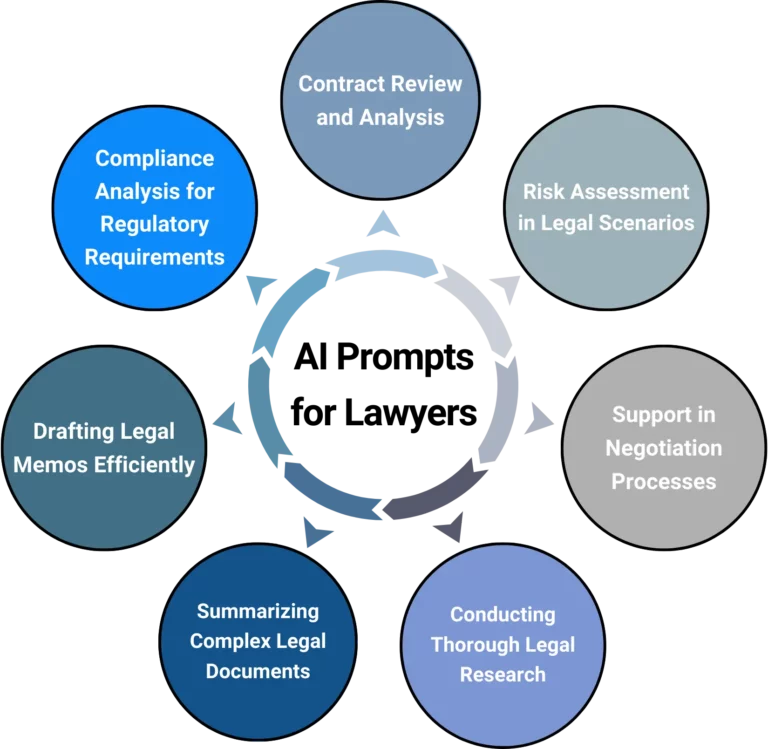
The spectrum of AI utilization encompasses tasks such as legal research, document drafting and review, litigation support, as well as enhancing client interaction processes.
Verifying that AI-generated content complies rigorously with established accuracy benchmarks, regulatory requirements, and confidentiality protocols remains a critical priority.
The use of iterative prompting strategies enables a nuanced evolution of AI-generated responses, particularly when navigating complex legal scenarios.
When AI functionalities are embedded within contract management platforms, organizations can achieve notable gains in operational workflow and risk mitigation.
Why Prompt Quality Matters in Legal AI Use
AI tools are only as good as the questions they receive. Additionally, a prompt lacking clarity or detail often results in generic or incorrect answers. For lawyers, this can mean wasted time or even legal risk if AI outputs are taken at face value. Precise prompts help AI understand the context, scope, and desired format of the response.
Imagine asking a junior lawyer to draft a contract clause without specifying the type of contract, jurisdiction, or key terms. The result might be a generic clause that misses critical points. The same applies to AI. The more context and direction you provide, the more tailored and useful the output will be.
Prompt quality directly impacts how AI supports your work. Clear, focused prompts can help AI:
Identify relevant case law or statutes
Summarize complex legal texts in plain language
Draft or review contract clauses with attention to risk
Generate discovery documents or deposition summaries
Explain legal concepts clearly for clients or colleagues
Poorly crafted prompts lead to irrelevant, incomplete, or inaccurate responses. This wastes time and requires more manual correction. Lawyers must treat AI as a tool that needs careful input and review.
Related articles: Mastering Legal AI Prompts: Top Tips with Clear Examples
How to Write Clear, Contextual Prompts for Legal Tasks
Writing effective prompts is a skill that improves with practice. Follow these principles to get better results:
Be Specific About Jurisdiction and Legal Area
Legal rules vary by jurisdiction and practice area. Always specify the relevant location and topic. For example, instead of asking:
> "What should be included in a non-disclosure agreement?"
Try:
> "List five key clauses for a technology startup’s confidentiality agreement governed by Delaware law."
This helps AI tailor its response to the right legal framework.
Define the Output Format and Style
Tell AI how you want the answer presented. Should it be a bullet list, a short summary, or a detailed explanation? Should it use plain English or legal jargon? For example:
> "Summarize the main obligations in this employment contract in plain English, using bullet points."
Clear formatting instructions save time on editing.
Include Relevant Background or Context
Provide any facts or background that affect the answer. For instance:
> "Draft a mutual indemnification clause for a SaaS agreement between two US companies."
This context helps AI generate clauses that fit the scenario.
Avoid Ambiguous or Broad Questions
Questions like "Explain contract law" are too broad. Narrow the scope to get actionable answers. For example:
> "Explain the difference between an indemnity and a warranty clause in US commercial contracts."
Use Iterative Prompting to Refine Results
If the first response is off, ask follow-up questions to clarify or expand. For example:
> "Expand on the risks associated with this clause." > "Rewrite the clause to be more favorable to the client."
This back-and-forth improves accuracy.
Related articles: What Legal Leaders Expect Law Students to Know About AI Use
Practical Examples of Prompts for Legal Research and Analysis
AI can help lawyers quickly find and summarize legal information. Here are examples that show how to frame prompts for research tasks:
"Summarize the key holdings of the Supreme Court’s ruling in Brown v. Board of Education in plain language."
"List potential legal issues in a breach of contract claim under New York law."
"Explain how the GDPR affects data processing agreements for European companies."
"Identify recent case law on force majeure clauses in commercial contracts in Texas."
"Compare the elements of negligence under California and Florida law."
When using AI for research, always verify the jurisdiction and date of cases or statutes. AI may not distinguish between binding precedent and outdated rulings. Use AI as a starting point, not a final authority.
Related articles: Can AI Replace Lawyers? Exploring the Future of Legal AI
Using AI for Contract Drafting and Review
Drafting and reviewing contracts are time-consuming tasks where AI can add value. To get useful outputs, your prompts must be precise.
Drafting Contract Clauses
Specify the contract type, parties, and key terms. For example:
"Draft a confidentiality provision applicable to a joint venture agreement between two manufacturing companies."
"Create terms addressing termination in a commercial lease for Illinois with a six-month notice requirement."
"Write data protection obligations aligned with CCPA for a SaaS agreement."
AI can generate first drafts or suggest alternative wording. Always review for legal accuracy and business fit.
Reviewing Contracts for Risks and Missing Terms
Ask AI to flag risky language or missing provisions. Examples:
"Identify red flags in this indemnity clause of a supplier contract."
"List missing standard warranties in this software license agreement."
"Summarize the obligations of the parties in this service-level agreement."
AI tools integrated with contract management software can automate these reviews and highlight deviations from approved templates.
Comparing Contract Versions
You can prompt AI to compare clauses or versions:
"Compare these two versions of the non-compete clause and highlight key differences."
"Explain how the revised payment terms affect the overall contract risk."
This helps lawyers quickly assess changes during negotiations.
How AI Supports Litigation and Case Preparation
Litigation involves large volumes of documents and complex arguments. AI can assist but not replace legal judgment.
Drafting Discovery Requests and Responses
Prompts for discovery might include:
"Draft interrogatories for a personal injury case involving a car accident."
"Generate document requests related to breach of fiduciary duty claims."
Summarizing Depositions and Evidence
Use AI to extract key points:
"Summarize this deposition transcript, highlighting admissions and contradictions."
"Identify potential weaknesses in the plaintiff’s testimony."
Outlining Legal Arguments
AI can help organize thoughts:
"List strategic arguments to challenge jurisdiction in a contract dispute."
"Summarize case law supporting a motion to dismiss for lack of standing."
Always review AI-generated legal arguments carefully for tone and accuracy.
Related articles: AI Contract Review: Enhancing Legal Workflow Efficiency
How to Use AI for Legal Strategy and Risk Assessment
AI can analyze contracts and scenarios to identify risks and suggest strategies.
Identifying Contractual Risks
Prompt examples:
"What are the risks of including a liquidated damages provision within a construction agreement?"
"Analyze this M&A term sheet for potential liabilities."
Suggesting Negotiation Strategies
Ask AI for options:
"Suggest arguments to negotiate a more favorable exclusivity term in a distribution agreement."
"What defenses could challenge a non-compete restriction under California law?"
AI can surface ideas lawyers might overlook but should not replace expert judgment.
Related articles: Can Generative AI be trusted by Lawyers? Expert Guide
Improving Client Communication with AI
Clear communication builds trust. Additionally, aI tools enable lawyers to elucidate complex issues with clarity and precision.
Writing Client Updates
Prompts:
"Write a client email explaining a delay in court proceedings in non-technical terms."
"Summarize recent changes to data privacy laws for a general audience."
Simplifying Legal Documents
Ask AI to translate legal jargon:
"Rewrite this privacy policy update in plain English for employees."
Drafting Routine Correspondence
Examples:
"Draft an email explaining the implications of a settlement offer."
AI can save time on routine writing while maintaining professionalism.
Related articles: Agentic AI in Legal: 5 Effective Ways Lawyers Use Agentic AI
Using AI for Compliance and Policy Drafting
Lawyers often draft or update policies to meet regulatory requirements.
Creating Internal Policies
Prompts:
"Generate a bring-your-own-device policy compliant with HIPAA."
"Draft a remote work policy addressing data security risks."
Summarizing Regulatory Requirements
Examples:
"Summarize GDPR requirements for processing customer data."
"List key compliance steps for anti-money laundering in fintech."
Developing Checklists and Procedures
Prompts:
"Create a checklist for conducting internal compliance audits."
AI helps maintain consistency and ensures policies reflect the latest standards but requires lawyer review.
Related articles: AI and Law: Comprehensive Guide to Stay Current
Best Practices to Protect Confidentiality When Using AI
Lawyers must safeguard client information when using AI tools. Follow these rules:
Never input identifiable client data, case numbers, or sensitive details into unsecured AI platforms.
Anonymize or generalize scenarios before submitting prompts.
Select AI solutions integrated into secure environments, like contract management systems, which incorporate rigorous privacy safeguards.
It is essential to examine both the terms of service and the data governance frameworks implemented by AI providers.
Equipping legal teams with comprehensive training focused on the secure application of AI technologies, while upholding confidentiality duties, remains paramount.
Maintaining client trust requires unwavering commitment to safeguarding sensitive information throughout every stage.
Related articles: Legal AI Prompting: Best Practices
How Contract Management Software Solves Prompting Challenges
Contract lifecycle management (CLM) software equipped with AI enhances lawyers' ability to craft precise prompts, yielding more consistent and accurate outcomes. These platforms offer:
AI-powered contract drafting that utilizes approved templates and comprehensive clause libraries to maintain consistent and precise language.
Automated contract review processes capable of identifying risky clauses and detecting missing terms by applying configurable legal rules.
Advanced clause recommendation engines designed to suggest fallback options and alternative phrasing optimized for specific negotiation scenarios.
Detailed contract summaries designed to extract and clarify critical obligations, key dates, and potential risks in accessible terminology.
Automated metadata extraction capabilities that identify parties, relevant dates, and payment conditions without requiring manual input.
Integration with Microsoft Word and other prevalent tools, allowing lawyers to draft and review contracts directly within environments they trust and rely upon.
By leveraging AI alongside structured workflows, CLM solutions minimize errors and accelerate the efficiency of legal processes. Volody’s contract management platform delivers these functionalities while prioritizing user experience and robust enterprise-grade security.
> Looking for a better way to manage contracts? Discover Volody's CLM Software.
FAQ
How detailed should my AI prompts be for legal tasks?
Additionally, your prompts need to specify jurisdiction, document type, and the desired output format to provide the AI with sufficient context for generating precise and relevant responses.
Can AI replace a lawyer in drafting contracts?
No. While AI can generate drafts or propose clauses, finalizing content to ensure legal accuracy and suitability requires careful customization by legal professionals.
Is it safe to input confidential client information into AI tools?
Avoid sharing identifiable client data in unsecured AI platforms. Use anonymized examples or secure, enterprise-grade AI tools integrated into contract management systems.
Moreover, how can I improve AI responses if the first output is not useful?
Use iterative prompting. Ask follow-up questions to clarify, expand, or adjust tone. This back-and-forth helps refine the AI’s answers.
What types of legal work benefit most from AI prompting?
Legal research, contract drafting and review, litigation support, client communication, and compliance policy drafting all benefit from well-crafted AI prompts.
Furthermore, how does contract management software help with AI prompting?
CLM software provides templates, clause libraries, and AI-powered review tools that guide prompt creation and improve the quality of AI outputs in legal workflows.
Are AI-generated legal summaries reliable?
They can be useful for quick understanding but always verify summaries against original documents and applicable law. AI may miss nuances or jurisdictional specifics.
Also, what should I avoid when writing prompts for AI in legal work?
Avoid vague, broad, or ambiguous questions. Also, don’t include confidential details. Avoid jargon or unclear instructions that can confuse the AI.
Can AI help with litigation document preparation?
AI supports drafting discovery requests, summarizing depositions, and outlining arguments; nevertheless, legal professionals must oversee these outputs to align with strategy and tone.
How do I ensure AI outputs comply with ethical standards?
It is essential to thoroughly assess AI-generated content for accuracy, jurisdictional adherence, and ethical implications. AI should augment, not replace, professional legal judgment.
About the Company

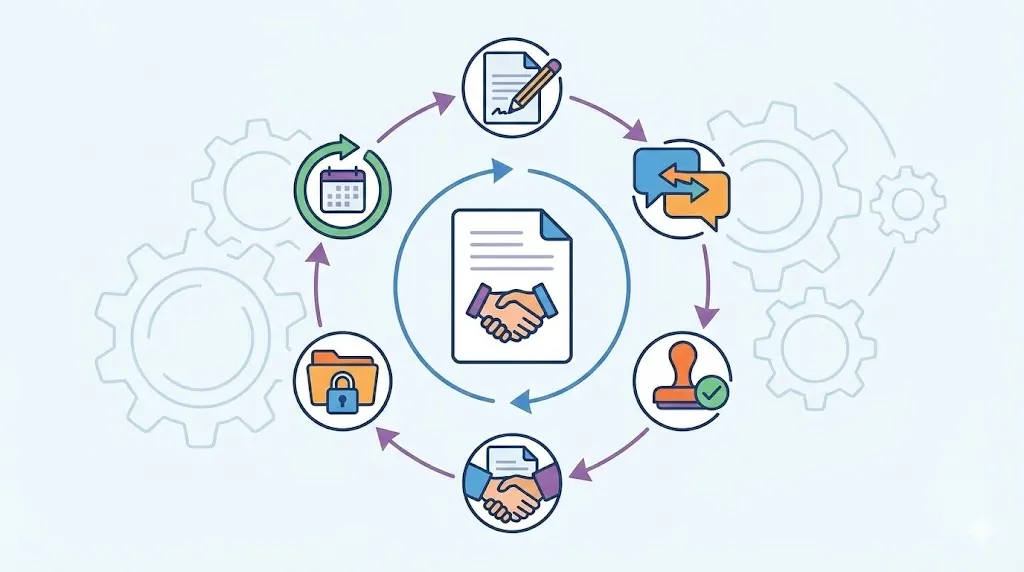
Volody AI CLM is an Agentic AI-powered Contract Lifecycle Management platform designed to eliminate manual contracting tasks, automate complex workflows, and deliver actionable insights. As a one-stop shop for all contract activities, it covers drafting, collaboration, negotiation, approvals, e-signature, compliance tracking, and renewals. Built with enterprise-grade security and no-code configuration, it meets the needs of the most complex global organizations. Volody AI CLM also includes AI-driven contract review and risk analysis, helping teams detect issues early and optimize terms. Trusted by Fortune 500 companies, high-growth startups, and government entities, it transforms contracts into strategic, data-driven business assets.





" height="216.72211px" id="FYO0bO80Y" transform="translate(3 6.105)" width="206.073px"/><path d="M 108.174 222 C 88.432 222 70.303 217.239 53.785 207.717 C 37.267 198.196 24.173 185.052 14.504 168.285 C 4.835 151.312 0 132.165 0 110.845 C 0 89.731 4.835 70.792 14.504 54.025 C 24.173 37.052 37.267 23.804 53.785 14.282 C 70.303 4.761 88.432 0 108.174 0 C 128.116 0 146.246 4.761 162.562 14.282 C 179.08 23.804 192.073 37.052 201.541 54.025 C 211.21 70.792 216.044 89.731 216.044 110.845 C 216.044 132.165 211.21 151.312 201.541 168.285 C 192.073 185.052 179.08 198.196 162.562 207.717 C 146.044 217.239 127.915 222 108.174 222 Z M 108.174 183.189 C 120.864 183.189 132.044 180.291 141.713 174.495 C 151.382 168.492 158.936 160.006 164.375 149.035 C 169.814 138.064 172.533 125.334 172.533 110.845 C 172.533 96.355 169.814 83.729 164.375 72.965 C 158.936 61.994 151.382 53.611 141.713 47.815 C 132.044 42.02 120.864 39.122 108.174 39.122 C 95.483 39.122 84.202 42.02 74.332 47.815 C 64.663 53.611 57.109 61.994 51.67 72.965 C 46.231 83.729 43.511 96.355 43.511 110.845 C 43.511 125.334 46.231 138.064 51.67 149.035 C 57.109 160.006 64.663 168.492 74.332 174.495 C 84.202 180.291 95.483 183.189 108.174 183.189 Z" fill="rgba(255, 255, 255, 0.12)" height="222px" id="aa1McFcE9" transform="translate(227.183 3)" width="216.04399999999998px"/><path d="M 42.302 182.257 L 111.799 182.257 L 111.799 216.722 L 0 216.722 L 0 0 L 42.302 0 Z" fill="rgba(255, 255, 255, 0.12)" height="216.72211px" id="yRq4AnrsX" transform="translate(477.721 6.105)" width="111.79899999999998px"/><path d="M 108.174 222 C 88.432 222 70.303 217.239 53.785 207.717 C 37.267 198.196 24.173 185.052 14.504 168.285 C 4.835 151.312 0 132.165 0 110.845 C 0 89.731 4.835 70.792 14.504 54.025 C 24.173 37.052 37.267 23.804 53.785 14.282 C 70.303 4.761 88.432 0 108.174 0 C 128.116 0 146.246 4.761 162.562 14.282 C 179.08 23.804 192.073 37.052 201.541 54.025 C 211.21 70.792 216.045 89.731 216.045 110.845 C 216.045 132.165 211.21 151.312 201.541 168.285 C 192.073 185.052 179.08 198.196 162.562 207.717 C 146.044 217.239 127.915 222 108.174 222 Z M 108.174 183.189 C 120.864 183.189 132.044 180.291 141.713 174.495 C 151.382 168.492 158.936 160.006 164.375 149.035 C 169.814 138.064 172.534 125.334 172.534 110.845 C 172.534 96.355 169.814 83.729 164.375 72.965 C 158.936 61.994 151.382 53.611 141.713 47.815 C 132.044 42.02 120.864 39.122 108.174 39.122 C 95.483 39.122 84.202 42.02 74.332 47.815 C 64.663 53.611 57.108 61.994 51.67 72.965 C 46.231 83.729 43.511 96.355 43.511 110.845 C 43.511 125.334 46.231 138.064 51.67 149.035 C 57.108 160.006 64.663 168.492 74.332 174.495 C 84.202 180.291 95.483 183.189 108.174 183.189 Z" fill="rgba(255, 255, 255, 0.12)" height="222px" id="mo8HQspQ0" transform="translate(609.155 3)" width="216.04500000000007px"/><path d="M 73.727 0 C 95.885 0 115.324 4.45 132.044 13.351 C 148.967 22.252 161.957 34.982 171.027 51.541 C 180.287 67.894 184.917 86.937 184.917 108.671 C 184.917 130.405 180.287 149.449 171.027 165.801 C 161.957 181.947 148.967 194.47 132.044 203.371 C 115.324 212.271 95.885 216.722 73.727 216.722 L 0 216.722 L 0 0 Z M 72.216 179.773 C 94.374 179.773 111.497 173.564 123.583 161.144 C 135.669 148.724 141.713 131.233 141.713 108.671 C 141.713 86.109 135.669 68.515 123.583 55.888 C 111.497 43.055 94.374 36.638 72.216 36.638 L 42.302 36.638 L 42.302 179.773 Z" fill="rgba(255, 255, 255, 0.12)" height="216.72211px" id="I3iXX5Hi_" transform="translate(859.693 6.105)" width="184.91699999999992px"/><path d="M 185.22 0 L 113.91 141.273 L 113.91 216.722 L 71.61 216.722 L 71.61 141.273 L 0 0 L 47.74 0 L 93.06 99.046 L 138.08 0 Z" fill="rgba(255, 255, 255, 0.12)" height="216.72211px" id="nzHyWC0_d" transform="translate(1061.78 6.105)" width="185.22000000000003px"/></svg>)