

Legal teams face growing pressure to handle contracts, compliance, and research faster and more accurately. Legal AI tools can help, but only if you know how to ask the right questions. Poor prompts lead to vague or off-target answers. Clear, precise prompts unlock AI’s full potential. This article shares the top legal AI prompts effectively, with practical examples you can apply today.
TL;DR
Define your exact goal before writing your prompt to get focused AI responses.
Additionally, add background and limits to guide the AI’s output for relevance and clarity.
Assign a role or tone to shape how the AI frames its answer.
Break complex tasks into smaller, clear steps for better results.
Use examples or templates to show the AI what you want.
Review and refine AI outputs by iterating your prompts.
What makes a good prompt for legal AI tools?
A prompt is the question or instruction you give an AI tool. For legal AI, a good prompt is clear, specific, and complete enough to guide the AI toward useful answers. Poor prompts are vague, too broad, or lack context. They cause the AI to guess what you want, often producing generic or irrelevant results.
Think of prompting like briefing a junior lawyer. If you say, “Review this contract,” without more details, the lawyer might miss key points. But if you say, “Review this contract for termination clauses and summarize risks related to early exit penalties,” the lawyer knows exactly what to focus on.
Good prompts have these qualities:
Specificity: They clearly state what you want.
Context: They include background information or constraints.
Role or tone: They tell the AI how to respond (e.g., as a legal analyst or a plain-English explainer).
Format: They specify how to present the answer (bullet points, summary, table).
This approach helps legal AI tools deliver precise, actionable insights that save time and reduce errors.
Related Article: How to Write Effective AI Prompts for Lawyers
How to clearly define your goal in prompts
Start every prompt by deciding what you want the AI to do. Defining your goal narrows the AI’s focus and improves relevance.
For example, instead of saying, “Summarize this contract,” say, “Summarize the key obligations and deadlines in this 15-page vendor agreement for our finance team.” This tells the AI the audience and what details matter.
Another example: “Identify all confidentiality clauses in this NDA and explain their implications for data sharing.” Here, you specify the clause type and the purpose of the analysis.
Defining your goal also means deciding the output format. Ask for a list, a short memo, or a table. For instance, “Create a table listing each party’s responsibilities with deadline dates.” This helps the AI organize information for easy review.
By setting clear goals, you reduce back-and-forth and get usable results faster.
Related articles: What Is Legal AI? A Beginner's Guide to AI in Law (2026)
Why adding context and constraints improves AI answers
Legal documents and questions often depend on background details. Including context helps the AI understand the situation and tailor its response.
For example, if you ask, “Draft a contract clause about delivery terms,” add context like, “The clause should cover penalties for late delivery and apply to international shipments.” This guides the AI to include relevant risks and scope.
Constraints limit the AI’s scope to avoid irrelevant or overly broad answers. You might say, “Limit the summary to five bullet points focusing on financial risks,” or “Use plain language suitable for non-lawyers.”
Context can also include the intended audience, jurisdiction, or company policies. For example, “Explain the termination clause for our compliance team in California.” This ensures the AI considers local laws and internal rules.
Without context, AI may produce generic or incomplete answers that require more editing.
Related articles: Top Legal AI Assistant for Legal Researchers' Accuracy 2026
How assigning tone or role shapes AI responses
You can tell the AI to respond as a specific role or with a particular tone. This helps the output match your needs and audience.
For example, say, “Explain this contract clause as a legal advisor to a non-legal executive.” The AI will simplify jargon and focus on business impact.
Or, “Act as a contract reviewer and highlight potential risks in this agreement.” This prompts the AI to analyze critically and flag issues.
Tone instructions might include “Be concise and formal,” or “Use friendly, clear language for training materials.”
Assigning roles and tones helps tailor AI outputs for different users, from legal teams to sales or finance.
Related articles: Your Enterprise Legal AI Assistant in 2026 | Lawxy
Breaking down complex requests into clear steps
Complex legal tasks often involve multiple parts. Additionally, splitting your prompt into smaller steps improves clarity and AI performance.
For example, instead of asking, “Review this contract, summarize risks, and draft a memo,” break it down:
Extract all indemnity clauses.
Summarize key risks in bullet points.
Draft a memo explaining these risks to the legal team.
You can run each step separately or chain them in one prompt with clear labels.
This method reduces confusion and helps the AI focus on one task at a time. It also makes reviewing outputs easier.
Related articles: Top Legal AI Assistant for Legal Researchers' Accuracy 2026
Why iterating and refining prompts is essential
Rarely will your first prompt get a perfect answer. Additionally, treat AI outputs as drafts that need refinement.
After you get a response, review it and ask for changes like:
“Make this summary more concise.”
“Add examples of similar cases.”
“Explain this clause in simpler terms.”
“Highlight missing risks related to liability.”
Iterating lets you guide the AI closer to your ideal answer. Each refinement improves accuracy and usefulness.
This process is similar to editing a junior lawyer’s memo. The difference is AI can quickly generate new versions based on your feedback.
Related articles: What Is Legal AI? A Beginner's Guide to AI in Law (2026)
Using examples and templates to guide AI
Showing the AI what you want through examples or templates improves results. Examples act as guardrails and reduce guesswork.
For instance, if you want a contract summary in bullet points, provide a sample summary. Then ask, “Summarize this contract like the example below.”
Or provide a template for a legal memo and ask the AI to fill it with relevant content.
Examples help the AI understand your style, format, and level of detail. This is especially useful for complex or unusual requests.
Related articles: Your Enterprise Legal AI Assistant in 2026 | Lawxy
How experimenting with prompt styles reveals what works best
Try different ways of asking your question to see what gets the best results. Some prompts work better as direct commands, others as open-ended questions.
For example:
Direct: “List all termination clauses in this contract.”
Open-ended: “What termination rights does this agreement provide?”
Comparative: “Compare the termination clauses in these two contracts and highlight differences.”
Changing prompt style can affect the depth, tone, and focus of AI responses.
Experimentation helps you find the best prompt style for your workflow and AI tool.
Related articles: Top Legal AI Assistant for Legal Researchers' Accuracy 2026
Common pitfalls to avoid when prompting legal AI
Avoid vague prompts like “Explain this contract.” The AI won’t know what to focus on and may give generic answers.
Additionally, don’t write overly long prompts with too many instructions. The AI might miss details or get confused.
Be clear and concise. Use simple language and avoid ambiguous terms.
Avoid asking multiple unrelated questions in one prompt. This can produce jumbled answers.
Check your prompt for clarity before submitting. If the AI’s answer is off, revise your prompt rather than blaming the tool.
Related articles: What Is Legal AI? A Beginner's Guide to AI in Law (2026)
Helpful frameworks for building effective prompts
Using a prompt framework can make your instructions more structured and complete.
One example is Role + Task + Context + Format + Tone:
Role: “Act as a contract analyst.”
Task: “Identify all payment terms.”
Context: “In this service agreement with a UK vendor.”
Format: “List findings in a bullet-point summary.”
Tone: “Use clear, professional language.”
Another is the C.R.I.S.P. method:
Context: Background information.
Role: Who the AI should act as.
Instructions: What to do.
Specifications: Format, length, tone.
Purpose: Why you need the output.
These frameworks help you cover all bases and avoid missing key details.
Related articles: Your Enterprise Legal AI Assistant in 2026 | Lawxy
Treating AI like a smart junior lawyer
Think of legal AI as a capable junior lawyer who needs clear instructions and supervision. Additionally, don’t expect it to guess your needs or read your mind.
Provide detailed prompts, check the answers carefully, and guide the AI with follow-up questions.
Use AI to handle routine or time-consuming tasks, but keep humans in control of final decisions.
This approach maximizes AI benefits while minimizing risks.
Related Article: How to Write Effective AI Prompts for Lawyers
Why AI-powered legal tools matter in modern workflows
AI tools help legal teams keep up with growing workloads and complexity. Additionally, they speed up contract review, due diligence, and research. They reduce errors and improve consistency.
According to a Gartner report, 48% of legal teams plan to increase AI use in contract management by 2025. AI tools free lawyers to focus on strategy and negotiation rather than repetitive tasks.
AI also supports better risk management by quickly flagging issues across large document sets. It helps legal teams scale without adding headcount.
Using AI effectively depends on knowing how to prompt it well. Clear prompts lead to better insights and faster turnaround.
Related articles: Top Legal AI Assistant for Legal Researchers' Accuracy 2026
How legal AI software solves these challenges
Legal AI software combines natural language processing and machine learning to read, analyze, and generate legal content. Additionally, it automates routine tasks like contract review, clause extraction, and legal research.
These tools integrate multiple workflows into one platform, improving collaboration and knowledge sharing.
For example, AI can scan thousands of contracts to identify risky clauses or missing approvals. It can draft contract language based on your input and company policies. It can answer legal questions from multiple documents instantly.
Lawxy is a legal AI platform that unifies contract management, research, due diligence, and workflow automation. It uses autonomous AI agents to execute legal tasks while keeping humans in control.
Lawxy’s features include AI contract drafting, clause analysis, legal research with citations, document intelligence, and multi-step workflow automation.
Ready to make legal work more efficient? Learn more about Lawxy Legal AI Tool.
FAQ
What is a legal AI prompt?
Additionally, a legal AI prompt is the instruction or question you give a legal AI tool. It guides the AI on what task to perform, such as summarizing a contract or identifying risks.
Why does prompt clarity matter?
Clear prompts reduce guesswork for the AI. They help the tool focus on relevant details and produce accurate, useful answers.
How do I add context to a prompt?
Provide background like the document type, audience, jurisdiction, or specific focus areas. For example, mention if the contract is for a sales deal or a licensing agreement.
Can I ask AI to draft legal documents?
Yes, many legal AI tools can draft clauses or full contracts when given clear instructions and relevant context.
Moreover, how do I handle AI mistakes?
Review AI outputs carefully. If something is off, refine your prompt with more details or ask the AI to correct or expand the answer.
What role does tone play in AI prompts?
Tone shapes how the AI writes. You can ask for formal, concise, or plain-English responses depending on your audience.
Are there prompt frameworks I can use?
Yes. Frameworks like Role + Task + Context + Format + Tone or C.R.I.S.P. help you structure prompts for better results.
Furthermore, how can I break down complex legal tasks for AI?
Split the task into smaller steps. For example, extract clauses first, then summarize risks, then draft a memo.
Is legal AI a replacement for lawyers?
No. AI assists lawyers by automating routine work. Lawyers still make final decisions and handle complex judgment calls.
What are common prompt mistakes to avoid?
Avoid vague, overly long, or multi-topic prompts. Be clear, concise, and focused on one task at a time.
This guide equips legal, operations, and tech leaders with practical advice to get the most from legal AI tools. Mastering prompt techniques unlocks faster, smarter, and more accurate legal workflows.
About the Company

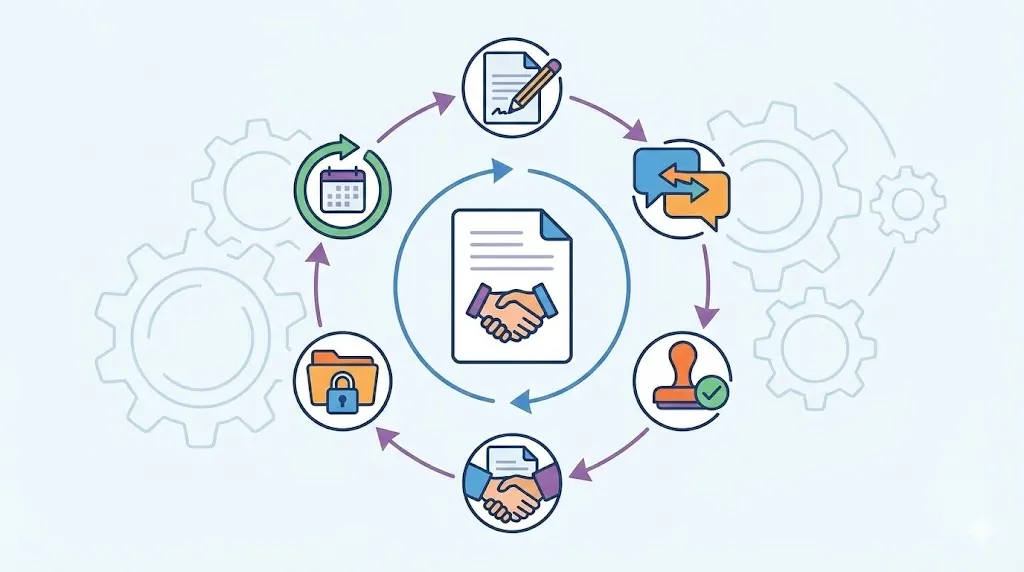
Volody AI CLM is an Agentic AI-powered Contract Lifecycle Management platform designed to eliminate manual contracting tasks, automate complex workflows, and deliver actionable insights. As a one-stop shop for all contract activities, it covers drafting, collaboration, negotiation, approvals, e-signature, compliance tracking, and renewals. Built with enterprise-grade security and no-code configuration, it meets the needs of the most complex global organizations. Volody AI CLM also includes AI-driven contract review and risk analysis, helping teams detect issues early and optimize terms. Trusted by Fortune 500 companies, high-growth startups, and government entities, it transforms contracts into strategic, data-driven business assets.





" height="216.72211px" id="FYO0bO80Y" transform="translate(3 6.105)" width="206.073px"/><path d="M 108.174 222 C 88.432 222 70.303 217.239 53.785 207.717 C 37.267 198.196 24.173 185.052 14.504 168.285 C 4.835 151.312 0 132.165 0 110.845 C 0 89.731 4.835 70.792 14.504 54.025 C 24.173 37.052 37.267 23.804 53.785 14.282 C 70.303 4.761 88.432 0 108.174 0 C 128.116 0 146.246 4.761 162.562 14.282 C 179.08 23.804 192.073 37.052 201.541 54.025 C 211.21 70.792 216.044 89.731 216.044 110.845 C 216.044 132.165 211.21 151.312 201.541 168.285 C 192.073 185.052 179.08 198.196 162.562 207.717 C 146.044 217.239 127.915 222 108.174 222 Z M 108.174 183.189 C 120.864 183.189 132.044 180.291 141.713 174.495 C 151.382 168.492 158.936 160.006 164.375 149.035 C 169.814 138.064 172.533 125.334 172.533 110.845 C 172.533 96.355 169.814 83.729 164.375 72.965 C 158.936 61.994 151.382 53.611 141.713 47.815 C 132.044 42.02 120.864 39.122 108.174 39.122 C 95.483 39.122 84.202 42.02 74.332 47.815 C 64.663 53.611 57.109 61.994 51.67 72.965 C 46.231 83.729 43.511 96.355 43.511 110.845 C 43.511 125.334 46.231 138.064 51.67 149.035 C 57.109 160.006 64.663 168.492 74.332 174.495 C 84.202 180.291 95.483 183.189 108.174 183.189 Z" fill="rgba(255, 255, 255, 0.12)" height="222px" id="aa1McFcE9" transform="translate(227.183 3)" width="216.04399999999998px"/><path d="M 42.302 182.257 L 111.799 182.257 L 111.799 216.722 L 0 216.722 L 0 0 L 42.302 0 Z" fill="rgba(255, 255, 255, 0.12)" height="216.72211px" id="yRq4AnrsX" transform="translate(477.721 6.105)" width="111.79899999999998px"/><path d="M 108.174 222 C 88.432 222 70.303 217.239 53.785 207.717 C 37.267 198.196 24.173 185.052 14.504 168.285 C 4.835 151.312 0 132.165 0 110.845 C 0 89.731 4.835 70.792 14.504 54.025 C 24.173 37.052 37.267 23.804 53.785 14.282 C 70.303 4.761 88.432 0 108.174 0 C 128.116 0 146.246 4.761 162.562 14.282 C 179.08 23.804 192.073 37.052 201.541 54.025 C 211.21 70.792 216.045 89.731 216.045 110.845 C 216.045 132.165 211.21 151.312 201.541 168.285 C 192.073 185.052 179.08 198.196 162.562 207.717 C 146.044 217.239 127.915 222 108.174 222 Z M 108.174 183.189 C 120.864 183.189 132.044 180.291 141.713 174.495 C 151.382 168.492 158.936 160.006 164.375 149.035 C 169.814 138.064 172.534 125.334 172.534 110.845 C 172.534 96.355 169.814 83.729 164.375 72.965 C 158.936 61.994 151.382 53.611 141.713 47.815 C 132.044 42.02 120.864 39.122 108.174 39.122 C 95.483 39.122 84.202 42.02 74.332 47.815 C 64.663 53.611 57.108 61.994 51.67 72.965 C 46.231 83.729 43.511 96.355 43.511 110.845 C 43.511 125.334 46.231 138.064 51.67 149.035 C 57.108 160.006 64.663 168.492 74.332 174.495 C 84.202 180.291 95.483 183.189 108.174 183.189 Z" fill="rgba(255, 255, 255, 0.12)" height="222px" id="mo8HQspQ0" transform="translate(609.155 3)" width="216.04500000000007px"/><path d="M 73.727 0 C 95.885 0 115.324 4.45 132.044 13.351 C 148.967 22.252 161.957 34.982 171.027 51.541 C 180.287 67.894 184.917 86.937 184.917 108.671 C 184.917 130.405 180.287 149.449 171.027 165.801 C 161.957 181.947 148.967 194.47 132.044 203.371 C 115.324 212.271 95.885 216.722 73.727 216.722 L 0 216.722 L 0 0 Z M 72.216 179.773 C 94.374 179.773 111.497 173.564 123.583 161.144 C 135.669 148.724 141.713 131.233 141.713 108.671 C 141.713 86.109 135.669 68.515 123.583 55.888 C 111.497 43.055 94.374 36.638 72.216 36.638 L 42.302 36.638 L 42.302 179.773 Z" fill="rgba(255, 255, 255, 0.12)" height="216.72211px" id="I3iXX5Hi_" transform="translate(859.693 6.105)" width="184.91699999999992px"/><path d="M 185.22 0 L 113.91 141.273 L 113.91 216.722 L 71.61 216.722 L 71.61 141.273 L 0 0 L 47.74 0 L 93.06 99.046 L 138.08 0 Z" fill="rgba(255, 255, 255, 0.12)" height="216.72211px" id="nzHyWC0_d" transform="translate(1061.78 6.105)" width="185.22000000000003px"/></svg>)